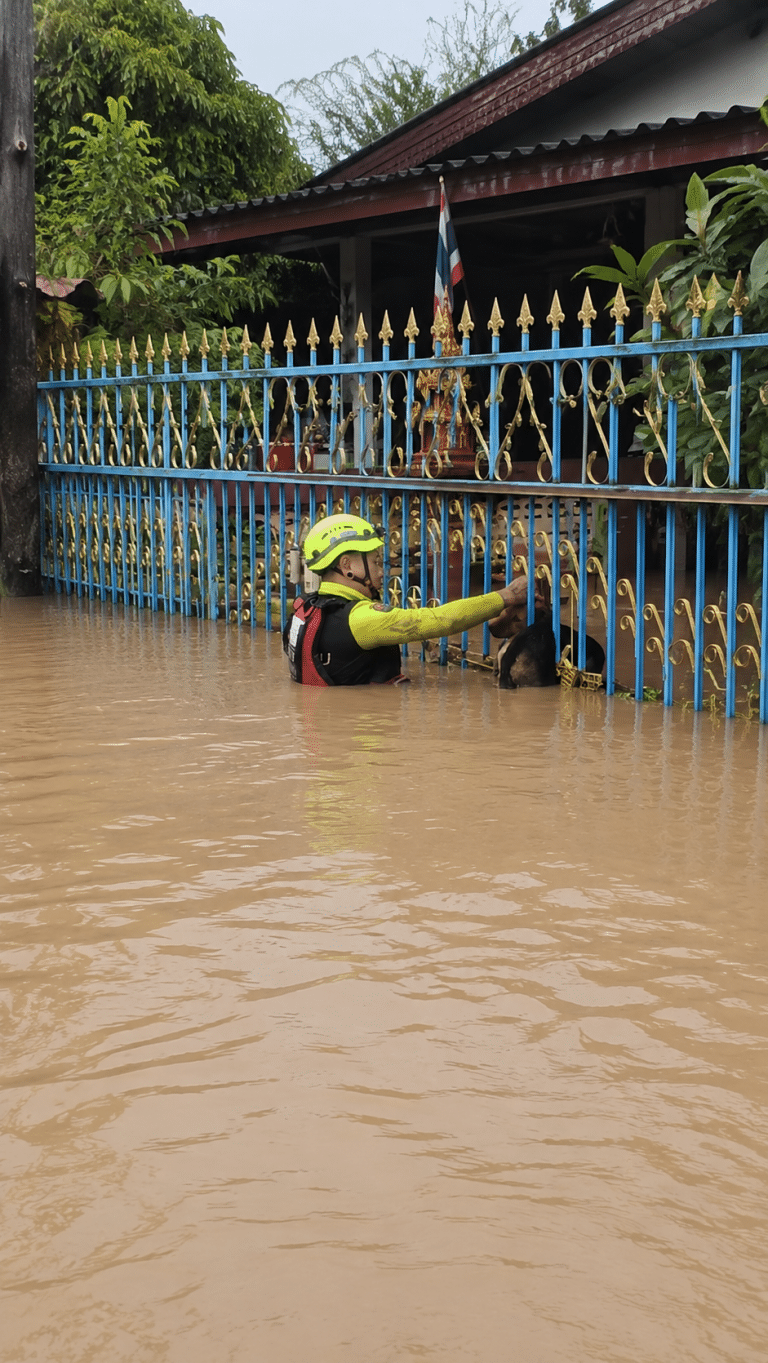
The flood had swallowed almost everything.
Brown water surged through the streets, rising high enough to reach the chests of adults trying to move against the current. Fences had disappeared beneath the surface, homes stood partially submerged, and every careful step carried an unseen risk.
Then rescuers noticed a small movement behind a metal barrier.
A dog was trapped there.
Nearly his entire body was underwater. Only his head remained visible as the current pushed continuously against the narrow space surrounding him.
He could not climb through the metal bars.
He could not find higher ground.
And by the time a rescue worker began moving toward him, the exhausted dog appeared to have very little strength left.
Trapped Behind Metal as the Water Kept Moving
The dog had become confined inside a section bordered by metal fencing.
Under ordinary conditions, the barrier may have marked the edge of a yard or walkway. Now it had become a trap.
Floodwater rushed through and around the bars, but the openings were too narrow for the dog to escape safely. Debris and the force of the current made every possible route more dangerous.
His body remained almost entirely submerged.
Whenever the water surged, he lifted his face higher, trying to keep his nose and mouth above the surface. His movements were small and increasingly limited, suggesting that he had already spent a long time struggling against the flood.
There was nowhere for him to rest.
Lowering his body would place his face underwater.
Trying to force his way through the barrier could leave him injured or caught between the bars.
The dog could only remain in place and continue holding his head up while the water moved relentlessly around him.
Video: Rescuer Reaches a Dog Trapped Behind Metal Bars in Chest-Deep Floodwater
One Rescuer Entered the Dangerous Current
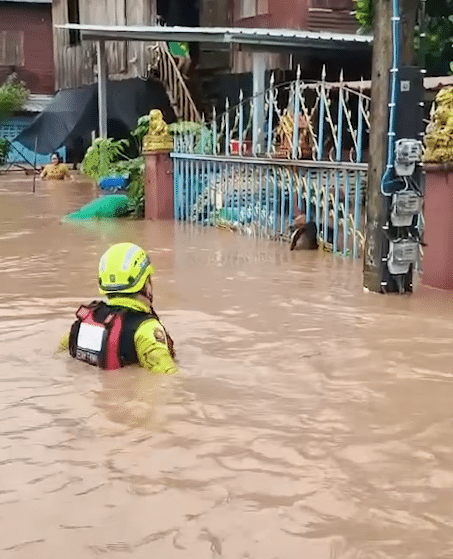
A rescue worker wearing a helmet and life vest stepped into the flooded street.
The protective equipment reduced some of the risk, but it did not make the journey simple. The water was deep enough to hide broken objects, uneven ground, and holes beneath the surface.
Each step had to be tested before the rescuer shifted his full weight forward.
The current pushed against his legs and body as he moved toward the barrier. Water that looked manageable from a distance became far more powerful once he entered it.
The dog watched him approach.
His head moved anxiously, and his body appeared to tremble beneath the water. With the metal fence blocking his escape, he had no way to create distance from the unfamiliar person moving closer.
The rescuer did not rush the final approach.
A frightened animal can struggle suddenly, even when exhausted. In such deep water, panic could place both the dog and the person helping him in greater danger.
So the man stopped within reach.
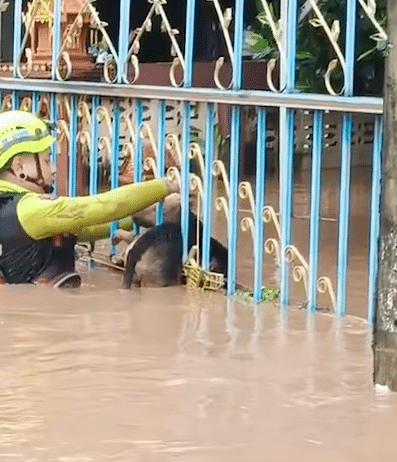
Before attempting to lift the dog, he extended one hand slowly.
A Gentle Touch Came Before the Rescue
The rescuer placed his hand carefully on the dog’s head.
It was a small action in the middle of a dangerous situation.
He did not immediately grab the animal around the neck or pull him toward the bars. He allowed the dog to feel his presence first.
The dog remained frightened, but his frantic movement began to lessen.
It is impossible to know exactly what he understood. He may simply have been too exhausted to continue resisting the current. But the calm contact appeared to help him remain still while the rescuer assessed the narrow opening.
That pause mattered.
Sharp metal surrounded the dog.
The current was still moving.
And lifting him incorrectly could cause his body to strike the barrier or slip from the rescuer’s arms.
The man continued speaking and touching the dog gently while positioning himself between the animal and the strongest movement of the water.
For a moment, he became a physical shield.
The dog no longer faced the current alone.
The Narrow Opening Made Every Movement Dangerous
Reaching the dog was only the first challenge.
The rescuer still had to move him through the metal barrier without causing injury.
The bars left little room for adjustment. The dog’s body needed to be lifted high enough to clear the obstruction while remaining securely supported.
One sudden struggle could cause him to become wedged between the metal sections.
A loose grip could return him to the flood.
The rescuer lowered his arms around the dog and began lifting slowly.
The animal did not lunge or attempt to escape.
Instead, his body appeared heavy with exhaustion as the man took over the effort of keeping him above the water.
The rescuer adjusted his grip carefully.
He raised the dog’s chest.
Then he guided the rest of the body through the available opening, protecting it from the sharp edges as much as possible.
The process lasted only moments in the footage, but every movement had to be deliberate.
The water continued pushing against them.
The bars remained close.
And the rescuer could not afford to lose his balance while holding the dog.
He Pressed Against the Man Carrying Him
Once the dog cleared the barrier, the rescuer held him firmly against his chest.
The animal no longer had to use his remaining strength to keep his face above the flood.
He did not struggle in the man’s arms.
He stayed close as the rescuer turned and began moving back through the water.
His wet body rested against the life vest, supported above the surface that had nearly covered him only moments earlier.
The image was striking.
One person stood chest-deep in brown floodwater.
A tired dog was held securely against him.
Behind them was the metal space where the animal had been trapped. Ahead was the difficult journey toward safer ground.
The rescue was not complete until both of them reached a stable area.
The man continued testing each step, balancing the weight in his arms while the current pressed against his body.
The dog remained still.
For the first time in the video, he no longer had to fight the water himself.
Disasters Leave Animals With Few Ways to Ask for Help
During severe floods, attention naturally turns toward people, homes, roads, and essential services.
Animals can be much harder to notice.
Some climb onto rooftops or pieces of debris.
Others hide inside damaged buildings.
Some become trapped behind fences, inside yards, or beneath structures that once seemed safe.
They cannot explain where they are.
They cannot call an emergency number.
And frightened animals may remain silent or hidden even when rescuers pass nearby.
This dog was visible only because someone noticed movement behind the metal barrier.
From a distance, his head could easily have blended into the muddy surroundings. The flood covered nearly his entire body, leaving little evidence that a living animal remained inside.
The rescue team looked closely enough to see him.
Then one worker entered the water rather than assuming the barrier was impossible to reach.
That decision became the difference between continued isolation and a path toward safety.
The Flood Did Not Become the End of His Story
By the final moments of the footage, the dog was no longer behind the fence.
He was still soaked and exhausted.
He would need warmth, clean water, rest, food, and an examination after prolonged exposure to the flood.
But he had been lifted away from the immediate danger.
The current no longer pushed directly against his body.
The metal bars no longer restricted every possible escape.
And he no longer had to keep his own head above the water.
The rescue did not rely on a dramatic machine or an elaborate operation.
It depended on someone noticing.
Someone entering dangerous conditions with the right protective equipment.
And someone remaining calm enough to reassure a frightened animal before attempting the most difficult part.
The moment many viewers remembered was not only the lift through the barrier.
It was the hand resting briefly on the dog’s head.
In the middle of moving water, sharp metal, and urgency, the rescuer still made time for gentleness.
That touch did not stop the flood.
It did not remove the danger surrounding them.
But it helped create the calm needed for the next step.
Only minutes earlier, the dog’s face was the sole part of him visible above the water.
Then the rescuer reached him.
He lifted the exhausted animal into his arms and carried him away from the place where the flood had left him with nowhere else to go.
The water had taken away nearly every option.
Compassion gave him one more.


