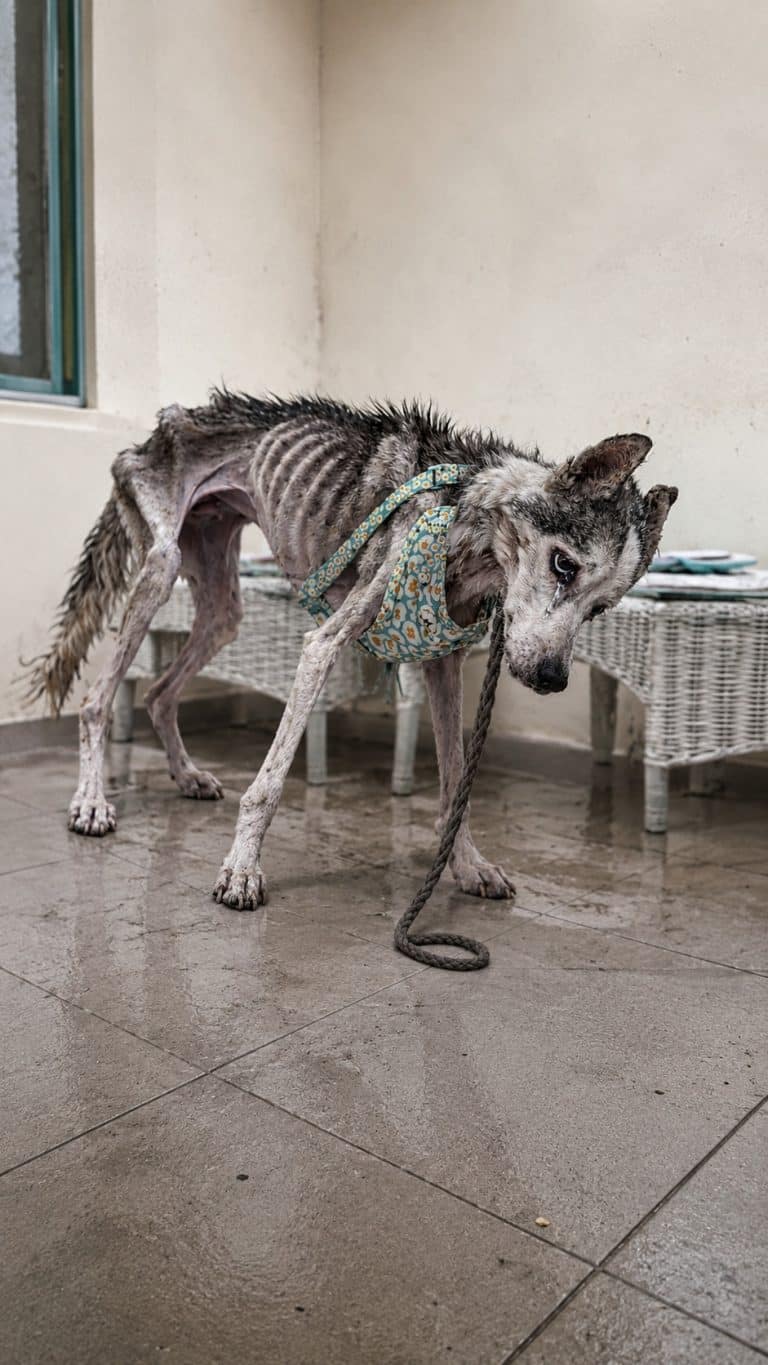
When rescuers first saw Wolf, it was difficult to recognize the powerful Husky beneath his weakened body.
His ribs and hips were sharply visible. His legs trembled whenever he attempted to stand, and even lifting his head appeared to require effort.
Wolf weighed less than nine kilograms—far below what would be expected for a healthy adult Husky.
He had reportedly been left without reliable food or water during extreme heat. Desperate for something to eat, he consumed spoiled scraps he found outside.
By the time help reached him, that attempt to survive had created another dangerous emergency inside his already fragile body.
His Body Had Almost No Strength Left
Wolf barely reacted when rescuers approached.
He did not attempt to run.
He showed little interest in the unfamiliar voices around him and struggled to support his own weight for more than a short time.
His body was severely undernourished and dehydrated. Every visible part of him suggested that the decline had not happened overnight.
The rescuers offered assistance carefully and transported him to a veterinary clinic.
There, examinations revealed that Wolf’s condition involved more than starvation.
A serious abdominal infection had developed, reportedly after he consumed spoiled food while trying to survive. The infection had progressed far enough that medication alone would not be sufficient.
Wolf needed emergency surgery.
The problem was that his body appeared almost too weak to endure it.
Anesthesia can place significant strain on any critically ill animal. For a dog with severe dehydration, malnutrition, and active infection, the risks were even greater.
Still, without intervention, his condition was unlikely to improve.
The medical team prepared him for the operation.
Video: Wolf Was So Starved He Could Barely Stand—Then Emergency Surgery Became His Only Chance
The First Surgery Was Only the Beginning
Wolf survived the procedure.
For the rescuers waiting nearby, that news brought enormous relief. But the operation did not mean the danger had completely passed.
His body still had to recover from the infection, anesthesia, prolonged hunger, and the stress of surgery.
During the first days, Wolf remained extremely weak.
He spent long periods resting and required close monitoring. His meals had to be introduced gradually rather than allowing him to eat large amounts immediately.
After prolonged starvation, feeding too much too quickly can place additional strain on a weakened body. The veterinary team provided carefully controlled portions while monitoring how Wolf responded.
Hydration also had to be restored under supervision.
Medication was given on schedule.
The surgical area was checked regularly.
And for the first time in an unknown period, Wolf could sleep somewhere protected from heat, hunger, and the dangers of surviving outdoors.
There was no dramatic transformation during those first nights.
Wolf simply rested.
At that stage, resting safely was already progress.
Trust Returned Through Repeated, Quiet Care
As Wolf’s condition stabilized, caregivers began noticing how cautious he remained around people.
Unexpected movement made him tense.
Gentle touch sometimes caused him to pull away or watch the approaching hand closely. He did not immediately understand that the people surrounding him would continue providing care.
The rescuers did not force affection.
They sat nearby.
They spoke in calm voices.
When Wolf lacked the energy or confidence to approach a bowl, they offered food by hand in small amounts.
The same people returned again and again.
Meals arrived consistently.
Medication was administered without punishment.
No one took away his bed or expected him to become affectionate in exchange for treatment.
Gradually, Wolf started eating with greater interest.
He became more alert when familiar caregivers entered.
Then one day, as someone approached, his tail moved slightly.
It was not a large or energetic wag.
The movement lasted only a moment.
But to the team monitoring every small change, it showed that Wolf was beginning to respond to more than food and medical treatment.
He was beginning to recognize the people beside him.
Then Wolf Suddenly Collapsed Again
Over the following weeks, Wolf appeared to be moving in the right direction.
His posture became steadier.
He showed more interest in his surroundings.
His eyes appeared brighter, and he could remain standing for longer periods without immediately lowering himself to rest.
Then the progress stopped without warning.
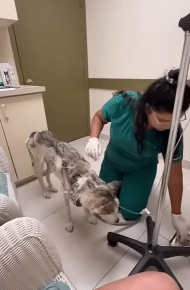
Wolf collapsed.
The rescue team rushed him back for emergency evaluation. Veterinarians determined that another exploratory surgery was necessary to identify and address the new crisis.
This time, his condition was described as even more dangerous.
According to the rescue account, doctors believed Wolf had only a very small chance of surviving the second operation—estimated at around ten percent.
The team had already watched him endure one major surgery while dangerously underweight.
Now they faced the possibility of losing him just as his strength and personality had begun to return.
There was little time to consider alternatives.
Wolf was prepared for surgery again.
The rescuers could only wait.
Against the Odds, He Woke Up Again
Wolf survived the second operation.
The outcome offered hope, but his body had now endured two major medical procedures within a relatively short period.
Recovery would be slow.
In the beginning, even simple movement required support. Wolf’s muscles remained weak after prolonged starvation and extended periods of rest.
Caregivers helped him change positions and encouraged gentle movement when the medical team believed he was ready.
The rehabilitation process unfolded through small milestones.
Standing with assistance.
Remaining upright for a few seconds longer.
Taking several careful steps.
Eating a complete controlled meal.
Resting comfortably afterward.
Some days brought visible progress.
Other days required Wolf to do little more than sleep while his body recovered.
The rescuers did not treat slower days as failure.
They continued following his medical plan and allowed him to rebuild strength at the pace his condition permitted.
Little by little, his legs became steadier.
The dog who had once struggled to raise his head began walking through the recovery area.
The Husky Beneath the Exhaustion Began to Appear
As Wolf gained weight, his appearance started changing.
His ribs became less prominent.
His body developed greater strength and stability.
A healthier coat began to replace the thin, neglected appearance seen when he first arrived.
But the most noticeable changes were often behavioral.
Wolf began greeting familiar caregivers with more energy.
His tail wagged more frequently.
Instead of remaining still when people entered, he sometimes moved toward them.
Then he began showing interest in play.
A toy that once would have received no reaction now caught his attention. Other dogs became possible companions rather than part of an overwhelming environment.
Wolf’s confidence did not return in a single dramatic moment.
It developed through repeated experiences that ended safely.
A person approached and brought food.
A hand touched him gently and then stopped.
A door opened for a walk rather than exposing him to another danger.
Each ordinary interaction gave Wolf more reason to participate in the life unfolding around him.
The exhausted dog found outside was slowly revealing the energetic Husky hidden beneath the illness.
His Days Were No Longer Focused Only on Survival
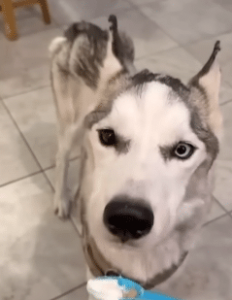
By the later stages of his recovery, Wolf looked almost unrecognizable beside his earliest footage.
The dog who had weighed less than nine kilograms now carried healthy weight across a stronger frame.
He could walk comfortably.
He played with other dogs.
And he approached the people around him with enthusiasm rather than remaining motionless at a distance.
His body language had changed.
His posture was more relaxed.
His eyes followed activity with curiosity.
His tail moved when familiar people arrived.
These changes did not erase what had happened to him.
Wolf’s recovery required two emergency surgeries, careful feeding, medication, rehabilitation, and continuous monitoring. His survival was not the result of one procedure or one emotional moment.
It was built through people repeatedly choosing to continue.
The first surgery addressed the immediate abdominal emergency.
The second gave him another chance when his condition suddenly deteriorated.
Everything afterward helped turn those chances into a life Wolf could actually enjoy.
Twice, People Chose Not to Give Up on Him
Wolf’s story shows that rescue rarely ends when an animal is removed from the street.
Finding him was only the first step.
He still needed doctors willing to operate on a dangerously weakened body.
He needed caregivers prepared to feed him slowly instead of expecting immediate weight gain.
He needed help standing after surgery and patience when his behavior remained cautious.
Then, just as improvement became visible, everyone had to begin again.
Another collapse.
Another emergency.
Another operation with no guaranteed outcome.
Wolf survived both crises, but he did not do so alone.
Veterinary treatment kept his body alive.
Daily care gave that body time to rebuild.
And consistent kindness allowed the dog inside it to become curious, playful, and affectionate again.
When Wolf was first discovered, he could barely stand.
His body had been reduced to the effort of finding food, water, and enough strength to continue through another day.
Now he wakes somewhere protected.
He has regular meals.
He moves without the same painful weakness.
And when people approach, he no longer simply lies still and waits for them to leave.
He greets them.
He plays.
He joins the other dogs around him.
Wolf’s transformation is powerful not because recovery happened easily.
It is powerful because it did not.
Twice, his condition became critical.
Twice, the people caring for him faced the possibility that treatment might not be enough.
And twice, Wolf opened his eyes again.
Once, he was so underweight that every step seemed uncertain.
Today, those same legs carry him toward people, companionship, and a future no longer measured by how much suffering his body can endure.


