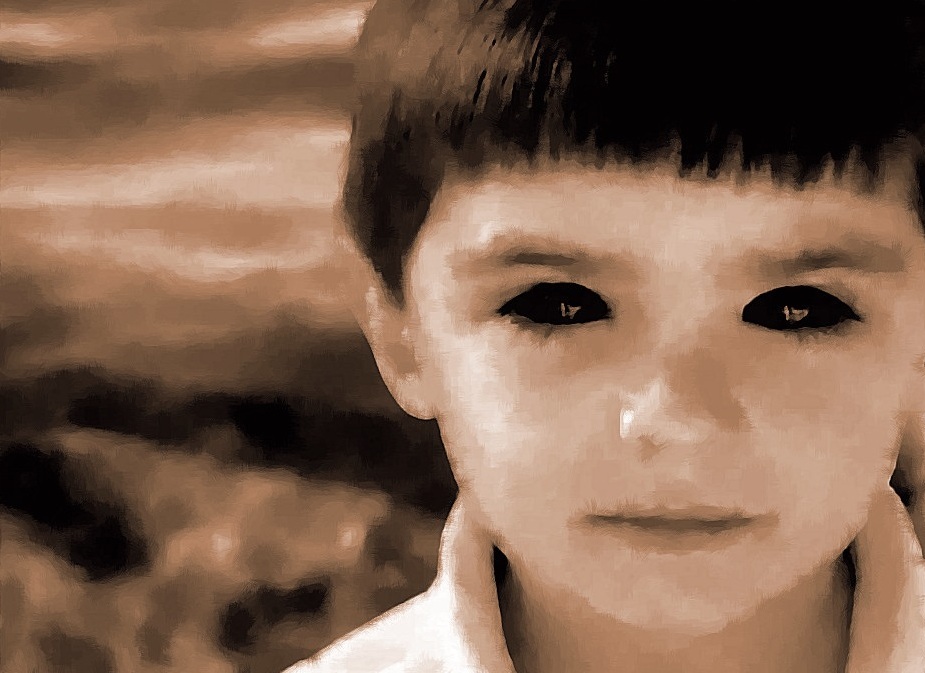
The parking lot was quiet. A Texas journalist sat in his car late at night, finishing a task before heading home. Two children approached. Politely, calmly, they asked for a ride. Something felt wrong—not wrong in a way he could immediately name, but wrong in the way a body registers danger before the mind catches up.
Then he looked at their eyes.
That scene—a parked car, two children, a request that required permission to enter—became the seed of one of the most widely circulated supernatural legends of the Internet age. Within a few years, versions of that encounter had been reported from driveways, doorsteps and front porches across multiple countries. The children were always polite. The request was always the same. The eyes were always completely black.
The Earliest Known Version
The trail leads back to 1996 and a man named Brian Bethel, a journalist based in Abilene, Texas. According to Bethel’s own account—first posted to a ghost-related mailing list in January 1998—the encounter took place in 1996 outside a movie theater. He was sitting in his car when two boys approached and asked for a ride to their mother’s house. Bethel later described feeling a powerful and irrational fear he could not explain in the moment. He wrote that he hesitated, nearly unlocked the door and then stopped. When he finally looked directly at the children, he saw that their eyes were entirely black—no iris, no white, no visible pupil boundary. He drove away.
The account was posted to a mailing list called Ghost Watchers and quickly circulated to other paranormal and folklore communities online. Bethel, who was a real journalist at the Abilene Reporter-News, gave the story a layer of credibility that purely anonymous posts lacked. He was a named individual with a verifiable professional identity, and he attached his name to the account. Folklorists who have studied the legend’s origin consistently cite this 1998 posting as the earliest known circulating version.
What makes the Bethel account significant as a document is not whether the encounter happened as described—that cannot be independently verified—but that it established the defining elements of the legend in one concentrated narrative. The elements were: nighttime setting, two children traveling alone, a request requiring the witness to grant entry or access, an overwhelming feeling of dread without a clear cause, and eyes that were entirely black. Every major element that appears in thousands of later accounts was present in this first circulating version.
Bethel later confirmed and reaffirmed the account in subsequent interviews, including a piece published by the Abilene Reporter-News and later coverage by outlets tracking the legend’s spread. He maintained the account was genuine. Whether it was an unusual real experience misinterpreted, a conscious piece of creative writing, a vivid dream later remembered as real or something else entirely is not something the existing record can settle. What the record does settle is that his 1998 post is the origin point of the modern Black-Eyed Children legend as it circulated publicly.
No earlier account matching the full pattern—black eyes, request for entry, overwhelming dread, children traveling alone at night—has been authenticated in folklore collections or newspaper archives.
YOUTUBE EMBED 1 — PRIMARY SEARCH QUERY: “Black Eyed Children urban legend origin folklore documentary”
The Details That Repeat
One of the most useful things about the Black-Eyed Children legend from a folklore research perspective is how consistent the repeating details are. Across hundreds of later self-reported encounters—posted to paranormal forums, Reddit threads, personal blogs and eventually television shows—the same specific elements recur with a frequency that would be striking if the events were independent. Folklorists recognize this pattern immediately, because it is exactly what happens when a legend spreads through a community and shapes the way subsequent tellers frame and remember their own experiences.
The threshold element is perhaps the most persistent. In nearly every version, the children are on the outside of a boundary—a car door, a front door, a screen door, a porch step—and they make a request that requires the witness to actively open that boundary. They do not force entry. They ask for it, often with unusual politeness and a formal phrasing that witnesses frequently describe as slightly off, as if the children had rehearsed the words rather than spoken naturally. The door or car door is never opened in the stories that become widely circulated, because the witness flees or refuses. The few versions in which the witness opens the door tend to end abruptly and without detail.
The eye detail itself is fixed. Accounts do not describe partially darkened eyes, strange pupils or reflective surfaces. They describe fully black eyes—sclera, iris and pupil all one seamless dark surface. The description is specific enough to suggest either that tellers were drawing directly from earlier accounts they had read or that the detail functioned as what folklorists call a legend marker: a single striking image that signals membership in a known story tradition.
Other recurring details include: children who appear to be between roughly eight and sixteen years old; a feeling of wrongness or supernatural dread that precedes the witness noticing the eyes; children who know the witness’s name or personal details in some versions; and a pressure or compulsion that some witnesses describe as feeling commanded to open the door despite not wanting to. The ages, the compulsion, the threshold and the eyes repeat across accounts separated by years and geography in ways that are consistent with legend transmission, not independent confirmation.
The Real Events Behind the Legend—Older Threshold Stories
The Black-Eyed Children legend did not emerge from nothing. The threshold motif—the dangerous visitor who cannot enter without permission—has roots in folk traditions that predate the Internet by centuries. Vampire folklore across Eastern European traditions consistently included the rule that the creature could not enter a home uninvited; the homeowner’s act of granting access was both the protective failure and the dramatic pivot of the story. Accounts of demonic beings, fae creatures and malevolent spirits in various folk traditions frequently included similar constraints, as if the danger carried with it a ritual limitation that human action could either enforce or surrender.
The stranger-child motif also has a long history. Changelings in European folklore were children left by supernatural beings in place of human infants—children who looked almost right but were subtly wrong in ways that gradually revealed themselves. The uncanny child, the child who asks too-formal questions, the child found alone in places where children should not be: these figures appear in cautionary tales across many cultures, functioning as warnings about the vulnerability of households and the danger of misplaced trust.
The Black-Eyed Children story drew on both of these traditions, whether consciously or not. The threshold request enforces the older rule. The children’s calm politeness maps onto the uncanny-child tradition. What the 1996 legend added was the specific eye detail and the contemporary setting—a parking lot, a car, a movie theater—that placed the ancient pattern inside a modern American context recognizable to anyone scrolling through a late-night forum.
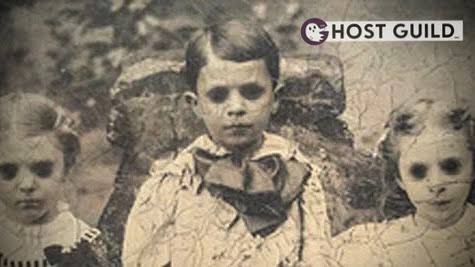
Researchers in Internet folklore studies have noted that this kind of grafting is common in modern legend formation. An older cultural anxiety—about threshold safety, about children who are wrong in some fundamental way, about the danger of letting strangers in—gets attached to a new vehicle that fits the contemporary sensory landscape. The result feels both fresh and somehow familiar, which is part of what makes it stick.
How the Story Spread
The 1998 mailing list post was the ignition point, but the amplification machinery of the early Internet is what turned a regional account into a global legend. Ghost Watchers, the mailing list where Bethel’s account first appeared, served a community already primed to receive and forward unusual encounter stories. From there, the account migrated to early paranormal websites, then to Usenet groups, then to dedicated forums in the early 2000s.
The acceleration picked up significantly in the mid-2000s when paranormal blogging communities expanded, and then again in the early 2010s when the legend reached mainstream entertainment media. A dedicated website, BEKsOnline.com, compiled submitted accounts and maintained what it presented as a growing database of encounters. The site’s architecture—a submission form, a searchable archive, a community of self-identified witnesses—created the infrastructure of a phenomenon. Each new submission was presented alongside hundreds of others, lending any individual account the weight of a pattern.
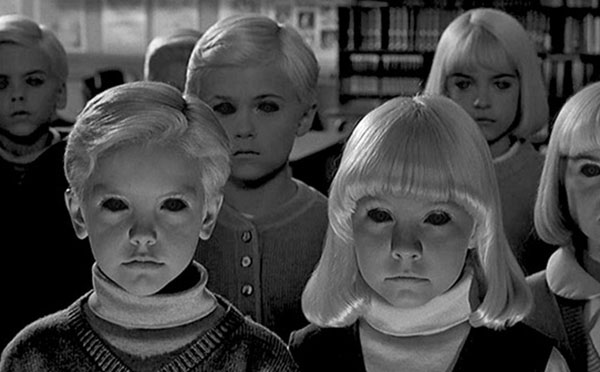
Television played a significant amplifying role. The Travel Channel series Monsters and Mysteries in America featured Black-Eyed Children accounts. Later, Destination America ran a dedicated program. These broadcasts introduced the legend to audiences who had never visited a paranormal forum, adding the visual dimension of reenactments that further fixed the imagery. After television coverage, the eye description in self-reported accounts became even more consistent—a reliable indicator that later tellers had been influenced by dramatized versions.
Academic and journalistic observers documented this spread. Journalists at outlets including Vice and Mental Floss traced the legend’s trajectory, interviewed Bethel and consulted folklore researchers. The consensus from those who study legend formation was consistent: the Black-Eyed Children story followed the well-documented pattern of Internet-accelerated legend transmission, in which an initial account provides a template that subsequent tellers adapt to fit their own circumstances, each new version reinforcing the pattern and lending it an apparent breadth that reads as independent corroboration.
YOUTUBE EMBED 2 — SECONDARY SEARCH QUERY: “PBS Black Eyed Children urban legend”
The Folklore Explanation
Folklore scholars who have examined the Black-Eyed Children legend frame it within a well-established category: the contemporary legend, sometimes called the urban legend, in which a story circulates as a first- or second-hand personal account and is widely believed despite lacking documentary verification. The scholar Jan Harold Brunvand, whose work on American urban legends set much of the framework for later research, identified recurring features that the Black-Eyed Children story matches closely: a specific setting, a personal-narrative framing, a dramatic climax, an outcome that confirms a cultural fear and a chain of transmission in which the story is always told as something that happened to a friend, a family member or the teller directly.
The dread-before-the-eyes detail is particularly interesting from a psychological folklore perspective. Witnesses in Bethel’s account and in many later versions describe feeling overwhelmed by fear before they consciously registered what was wrong with the children’s appearance. This sequencing—emotion precedes perception—maps well onto what psychologists describe as the “uncanny valley” effect, in which subtle wrongness in a humanoid figure triggers instinctive discomfort before rational identification of the cause. The story format leverages this real perceptual phenomenon to make the encounter feel bodily and real to the reader, even when the account is read rather than lived.
The permission-request structure serves an additional narrative function. It externalizes the victim’s agency. The danger cannot proceed without the witness actively opening the door. This creates both suspense—will they open it?—and a moral dimension: the witness who refuses has, in some sense, protected themselves through a correct choice. The story is simultaneously a warning and a reassurance. It tells you what to refuse and implies that refusal is possible. This structure is deeply common in protective folklore across cultures.
Folklorist David Emery, who wrote about the legend in multiple essays, noted that the Black-Eyed Children story satisfied the core requirements of an effective contemporary legend: it was specific enough to feel like a real account, ambiguous enough to resist easy disproof, emotionally resonant enough to be worth retelling and formally complete enough to survive transmission without losing its essential shape.
The Details Added Later
As any legend ages and spreads, details accumulate that were not present in the original account. The Black-Eyed Children legend is no exception, and tracking what was added when helps separate the original template from the mythology that grew around it.
The earliest accounts focused on the encounter itself—the request, the dread, the eyes. Later versions began to include aftermath claims: technology failures after the encounter, illnesses that followed, deaths in households where the door had allegedly been opened. These consequence details appear more frequently in accounts from the 2010s than in accounts from the early 2000s, suggesting they were additions rather than original features.
Claims of an older history also appeared. Some later accounts asserted that Black-Eyed Children had been reported for decades before Bethel’s posting, citing alleged newspaper clippings from the 1950s and police reports from earlier eras. Folklore researchers examining these claims have not located authenticated source documents. No archived newspaper from the pre-Internet era matching the described reports has been verified. The claim of historical depth appears to be a retroactive addition—a common feature of maturing legends, which often acquire fabricated precedents to lend the story a longer and therefore more credible history.
The geographic spread also brought localization. Accounts from the United Kingdom, Australia and parts of Europe adapted the car-and-parking-lot setting to front doors and neighborhood streets, replacing the American suburban context with local equivalents. The eye detail and the permission request remained constant; the setting changed to match the teller’s environment. This kind of localization is precisely what folklorists expect to see in a legend that is genuinely spreading through word of mouth and Internet transmission rather than one being independently experienced by unconnected witnesses.
What the Evidence Does Not Show
Given the volume of accounts—hundreds of self-reported encounters spread across two decades—it is worth being precise about what those accounts do and do not establish.
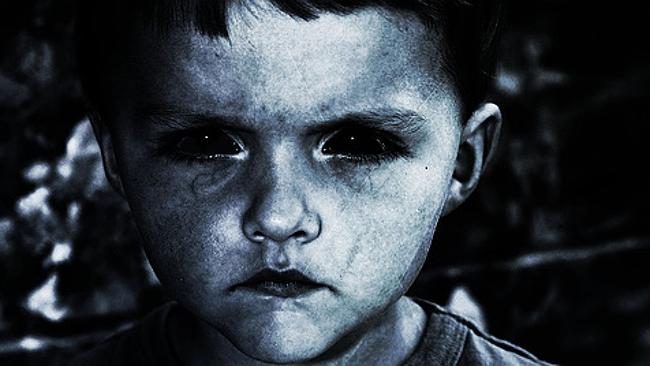
They do not establish the existence of a nonhuman species. No confirmed photograph of a black-eyed child has been authenticated; images circulated online have been traced to film productions, digital manipulations or contact lens demonstrations. No police report in any verifiable public database documents an encounter with children matching the description. No medical or scientific examination of a black-eyed child has been recorded. The claims of government investigation or official agency involvement that appear in some forum posts have produced no documentary evidence.
The accounts do establish that many people have had experiences they interpreted through the lens of this legend—and that the legend, once read, is capable of shaping the interpretation of subsequent ambiguous experiences. Memory research consistently shows that people incorporate narrative frameworks into their recollection of events, particularly unusual or frightening ones. A witness who read Bethel’s account, then later had a strange encounter with children at night, might genuinely and sincerely describe their experience in terms shaped by the legend without being aware of the contamination.
The popular theories attached to the legend—that the children are demons who require invitation as a matter of supernatural law, extraterrestrial hybrids, government-created experiments, or vampiric entities—share a common evidential problem: none of them have produced testable or authenticated evidence. They are explanations in search of a phenomenon that has not been documented outside of self-reported accounts. The leading explanation, supported by folklore research, media history and the traceable transmission record, is that the Black-Eyed Children are a modern legend: a story that began with one account, spread through a community primed to receive it and replicate it, and grew through the mechanisms that all effective legends use—emotional resonance, formal consistency, cultural fear and the human appetite for a story that feels just real enough to be possible.
Why the Legend Survives After Midnight
The file has a traceable origin—a January 1998 mailing list post attributing an encounter from 1996 to a named Texas journalist. It has a recognizable mechanism—the Internet’s capacity to amplify, replicate and gradually authenticate stories through sheer repetition. It has a folkloric skeleton—the threshold motif, the uncanny child, the protective refusal—that connects it to storytelling traditions far older than any website. And it has a sustained cultural presence that no amount of debunking has meaningfully diminished.
That last point is worth understanding on its own terms. The failure of a legend to disappear after its origin is traced is not evidence of supernatural validity. It is evidence of the legend’s emotional function. The Black-Eyed Children story works because it channels a real anxiety—the vulnerability of the threshold, the danger of letting strangers in, the wrongness we sometimes sense before we can name it—into a form that is vivid, specific and transferable. The parking lot, the polite request, the dread before the eyes: these details create a scene that readers can inhabit, and scenes people can inhabit get retold.
The fact that the children’s eyes are entirely black is almost secondary to the structure of the encounter. What the story is really about is the moment of hesitation at the door—the choice to open or not open, the instinct that something is wrong, the question of whether the rules of hospitality apply when something has gone deeply wrong with the person requesting entry. That question is not a new one. It appears in folklore across centuries and cultures. Brian Bethel’s 1998 post simply gave it a contemporary image and an Internet upload.
The file remains open in the narrow sense that no one can prove a negative: the non-existence of black-eyed children cannot be certified any more than the non-existence of any other category of being. But what the record does show—clearly, with traceable sources—is that the legend’s origin is human, its spread is cultural and its evidence, after more than two decades of reported encounters, remains entirely self-reported. The room may feel dark when the knock comes at the door after midnight. The record, examined in daylight, is considerably quieter than the legend suggests.

