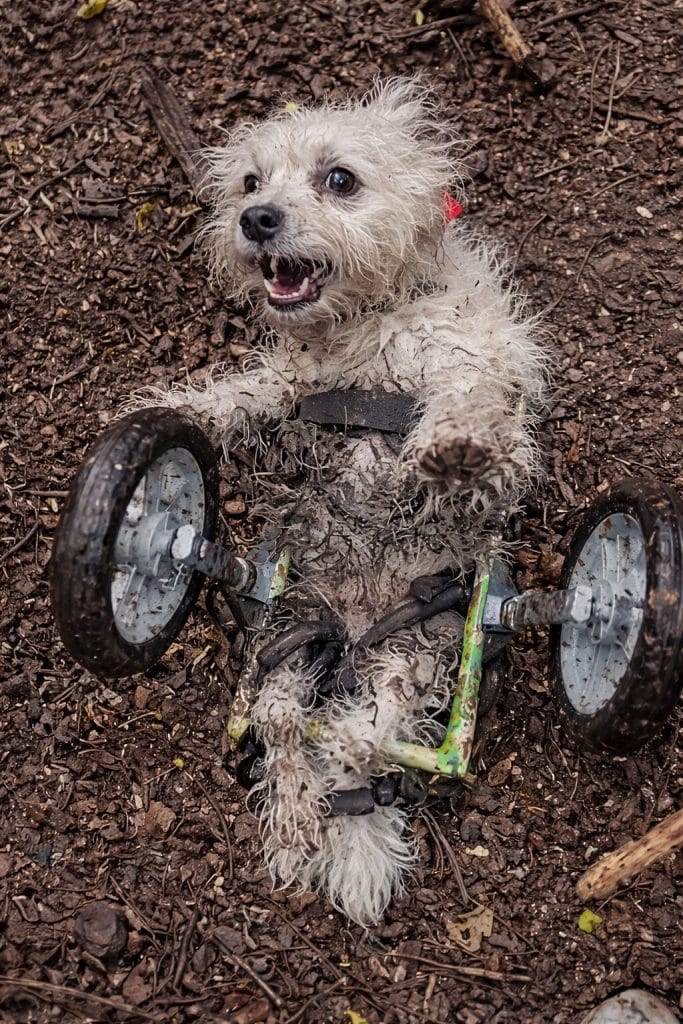
Jack’s bark does not always mean danger.
It does not necessarily mean that he is frightened, hurt, or ready to leave the trail.
Sometimes, it means something much simpler.
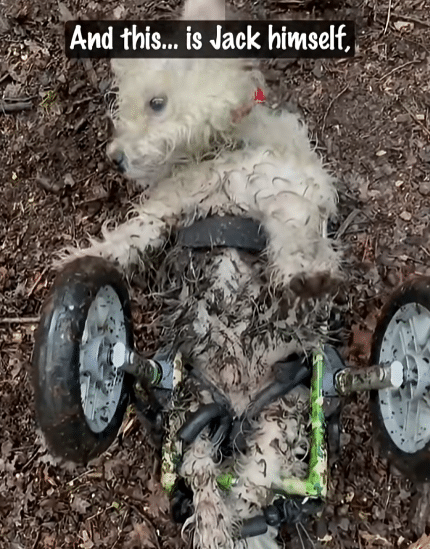
His wheelchair has tipped over, his little paws are facing the sky, and he needs someone to place him upright again.
Fortunately, Jack knows exactly what to do.
He barks.
Someone comes running.
And within seconds, the determined little dog is racing through the woods again as though nothing happened.
A Little Dog Who Refused to Stay Behind
Jack is a small West Highland White Terrier with bright white fur, an energetic personality, and a deep love for outdoor adventures.
At first glance, he looks like the kind of dog many people might expect to see walking calmly beside his family on a smooth neighborhood sidewalk.
Jack, however, is not interested in living quite so carefully.
He cannot use his back legs, so he moves with the help of a small wheelchair designed to support the rear of his body. Two wheels replace the movement his hind legs can no longer provide, while his front paws pull him forward.
The device may look unusual to someone seeing it for the first time.
To Jack, it simply means freedom.
It allows him to travel across open ground, explore unfamiliar places, follow interesting scents, and remain close to the person he trusts.
His wheelchair is not something that keeps him apart from the world.
It is what helps him enter it.
Once Jack is properly positioned in the frame, his front legs begin moving almost immediately. There is little hesitation and no sign that he wants to be treated as fragile.
He simply looks ahead and goes.
That desire to move becomes even more obvious when he reaches the woods.
Smooth floors and easy paths may be convenient, but Jack appears happiest when the ground becomes unpredictable and there is something new waiting around every turn.
Video: Jack’s Wheelchair Tips Over—Then His Special Bark Brings Help Running
The Forest Became His Favorite Kind of Freedom
A forest trail presents challenges for any small dog.
The ground is rarely level.
Roots rise unexpectedly from the soil. Fallen leaves hide stones and holes. Narrow paths twist between trees, while branches and uneven patches make every few feet different from the last.
For a dog moving with two wheels behind him, the terrain could easily seem overwhelming.
Jack does not appear to see it that way.
The moment he is released onto the trail, he moves forward with enthusiasm. His front paws work quickly against the earth, pulling the wheelchair behind him as he follows the path.
His ears remain alert.
His nose points toward every new scent.
His attention shifts from one part of the woods to another, as though there is far too much to investigate and never enough time to see it all.
He does not remain on the easiest section of ground merely because it is safer.
Jack follows the trail wherever it leads.
Sometimes he moves across dry leaves that rustle beneath his wheels. At other moments, he navigates exposed roots or turns quickly around trees.
The wheelchair bounces slightly over the uneven ground, but Jack continues pulling himself forward.
There is a sense of urgency in the way he explores—not because he is afraid, but because he seems genuinely excited to discover what lies ahead.
To Jack, the wheelchair is not a reason to remain at home.
It is his way of joining the adventure.
The forest gives him space to move as quickly as he can. It gives him new smells, changing terrain, and the stimulation that dogs naturally seek outdoors.
Most importantly, it gives him the opportunity to make his own choices.
He decides which direction to follow.
He decides which scent deserves further investigation.
He decides when to speed up and when to pause.
His person remains nearby, but she does not control every movement or keep him confined to a perfectly smooth path.
She allows Jack to explore.
That freedom matters because independence does not always mean doing everything without assistance.
Sometimes it means being given the chance to lead your own life, while knowing help is close when you genuinely need it.
One Hidden Root Could Change Everything
Jack moves with confidence, but the forest is still unpredictable.
His front paws can adjust quickly when the ground changes. The wheels behind him cannot always do the same.
A wheel may catch against a branch.
One side of the wheelchair may rise when it passes over a root.
A quick turn can shift Jack’s weight before he has time to correct himself.
Then, in an instant, the adventure comes to a temporary stop.
The small terrier tips sideways.
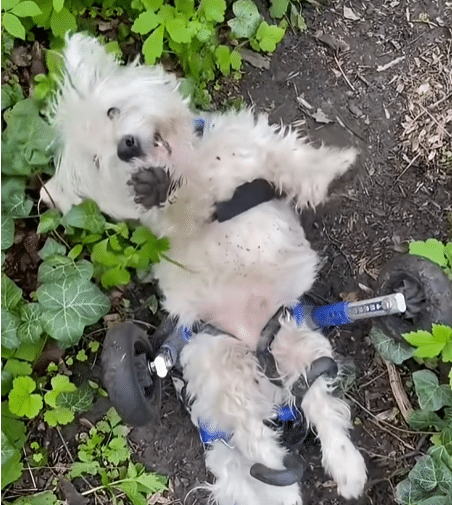
Sometimes he rolls completely onto his back, leaving all four paws and both wheels pointing upward.
For a moment, the sight can be alarming.
Jack is unable to place himself upright with his front legs alone. The same wheelchair that gives him freedom now holds him in a position from which he cannot easily escape.
His wheels may continue spinning.
His front paws move through the air.
The trail that seemed full of possibilities only seconds earlier suddenly sits beyond his reach.
But Jack does not appear to interpret the fall as the end of the outing.
He does not remain silent and wait helplessly.
He has developed his own way of handling the situation.
He calls for assistance.
The bark is clear and persistent enough to reach the person following nearby.
It is not difficult for her to understand.
Jack has tipped over again.
He needs help getting back onto his wheels.
A Bark His Family Immediately Understands
Dogs communicate through far more than words.
They use movement, posture, eye contact, facial expression, and different kinds of vocalization. Over time, the people who live closely with them often begin recognizing what certain sounds mean.
Jack and his mom have developed that kind of understanding.
When his wheelchair overturns in the woods, Jack barks loudly.
The sound immediately gets her attention.
It does not appear to be the bark of a dog who believes the adventure is over. Jack does not seem to be asking to be carried home or removed from the trail.
He needs one specific thing.
He needs to be placed upright.
His mom hears the call and begins walking toward him. There is no confusion about what has happened because this is a situation they have faced before.
Jack waits, still positioned awkwardly on the ground.
As she approaches, she speaks to him in the familiar, reassuring tone of someone who already understands the problem.
Then she bends down and reaches for the wheelchair.
The entire interaction lasts only a few moments.
There is no panic.
There is no frustration directed at Jack for moving too quickly or choosing a difficult route.
She does not scold him for falling.
She simply helps.
That calm response may be one of the reasons Jack sounds so confident when he calls.
His bark is effective because experience has taught him that someone is listening.
He knows he has not been abandoned upside down on the trail.
His person is nearby.
She will come.
Video: Jack Calls for Help—Then Races Away the Moment His Wheels Touch the Ground
Help Arrives, Then Jack Is Gone Again
Jack’s mom gently grips the frame and turns him back over.
His paws return to the earth.
The wheels settle onto the trail.
For many dogs, a tumble might create hesitation. They might remain still for a moment, look around cautiously, or decide that the unfamiliar terrain is no longer worth exploring.
Jack reacts differently.
Almost as soon as his wheelchair is upright, his front paws begin moving again.
There is no long pause.
He does not look back at the root that stopped him.
He does not wait for someone to carry him over the next difficult section.
He simply continues down the trail.
Within seconds, Jack is once again pulling his wheelchair through the leaves, following scents and searching for the next interesting place.
The fall becomes part of the adventure rather than the conclusion.
That immediate return to movement is what makes the moment so memorable.
Jack needed assistance, but he did not need to be rescued from the life he was enjoying.
He only needed a brief adjustment.
Once that was provided, he was ready to continue on his own.
His response challenges the assumption that a disabled animal must always live cautiously or avoid situations that contain difficulty.
Jack’s outings are not completely free from risk.
His wheelchair may tip again.
The trail may become rougher.
He may bark for help several more times before the walk is over.
None of those possibilities appear strong enough to take away his excitement.
The woods are still worth exploring.
Every tumble is temporary.
Every upright moment means he can move forward again.
The Trust Behind Every Adventure
Jack’s confidence is supported by something that cannot be seen in the wheelchair itself.
Trust.
He explores boldly because his person stays close enough to hear him.
She allows him to move independently because she recognizes when he truly needs assistance.
Their relationship exists somewhere between freedom and protection.
Jack is not carried through the entire forest.
He is not prevented from approaching every root or turn that might cause the wheelchair to shift.
Doing so might reduce the number of falls, but it would also reduce his ability to experience the trail in his own way.
Instead, his mom gives him room to make choices.
She watches.
She listens.
And when his familiar bark rises between the trees, she responds.
This arrangement requires both of them to understand their roles.
Jack keeps moving for as long as he is able.
His mom does not interfere unnecessarily.
When the terrain temporarily defeats him, he communicates.
She arrives, restores his balance, and lets him continue.
The process may repeat more than once during the same outing.
Yet there is something peaceful about the routine.
Neither of them treats the situation as a disaster.
Jack does not appear ashamed that he cannot turn the wheelchair over by himself.
His mom does not view helping him as an interruption to be avoided.
It is simply one part of the life they share.
This is what thoughtful support can look like.
It does not remove every challenge before it appears.
It does not take control away from the one receiving help.
It creates enough safety for independence to remain possible.
Jack is free to be adventurous because someone has chosen to stay within hearing distance.
He Does Not Think of Himself as Fragile
People often respond to physical disability by focusing first on what is missing.
They notice the legs that cannot move.
They notice the wheelchair.
They notice the moments when Jack tips over and cannot stand without assistance.
Jack’s behavior draws attention somewhere else.
He shows what remains.
His front legs are strong enough to carry him quickly across the trail.
His curiosity remains active.
His desire to explore has not disappeared.
His voice clearly communicates when he needs help.
Most importantly, his enthusiasm for life is visible every time he begins moving again.
Jack does not approach the world as though it has become too large for him.
A rough trail is still a trail.
A forest is still a place filled with scents.
A fallen wheelchair is still something that can be corrected.
His body moves differently, but many of the things that make him a dog remain unchanged.
He still wants to investigate.
He still wants to be included.
He still wants to move quickly enough that his person must follow behind.
There may be times when he needs more support than another dog would.
That does not mean every part of his life must revolve around his limitations.
His wheelchair helps provide mobility.
His mom provides assistance when the device overturns.
Jack provides everything else—the determination, curiosity, energy, and unmistakable desire to keep going.
A Life Measured by Joy, Not Limitations
Jack’s story is not powerful because he never falls.
He falls often enough to have developed a special bark for it.
His story matters because falling does not stop him from returning to the life he enjoys.
Each time the wheelchair tips, Jack calls for help.
Each time his mom comes, she places him upright.
And each time his wheels touch the ground, he moves forward again.
There is no need to pretend that he never struggles.
The difficult moments are real.
He cannot always overcome them alone.
But independence has never required complete isolation.
Every living being depends on others in some way. The form of that support may differ, but receiving help does not erase courage or strength.
For Jack, asking for help is what allows the adventure to continue.
His bark is not a surrender.
It is a solution.
It says that he knows what he needs and trusts someone enough to ask for it.
Then, once that need has been met, he does not remain focused on the fall.
He returns his attention to the trail.
There are more trees ahead.
More leaves to cross.
More scents waiting beyond the next turn.
Jack’s life may not look exactly like the life people once imagined for him.
It may involve wheels, occasional tumbles, and a person ready to come whenever a certain bark echoes through the woods.
But none of those things make his days incomplete.
Jack is active.
He is curious.
He is loved.
And whenever the forest gives him more than he can manage alone, he knows help is never far away.
A bark brings his mom running.
A gentle hand places him upright.
Then the little white dog disappears down the trail once more—moving fast, exploring freely, and showing everyone watching that a joyful life is not defined by how rarely we fall.
It is defined by how eagerly we begin moving again.


