At first, the emergency appeared painfully simple.
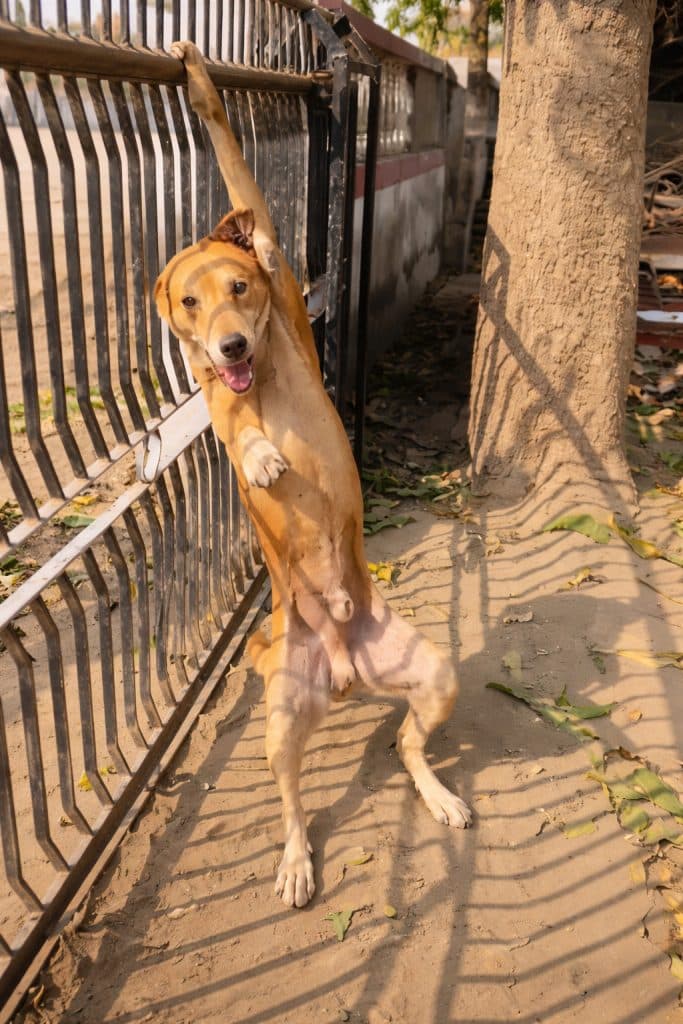
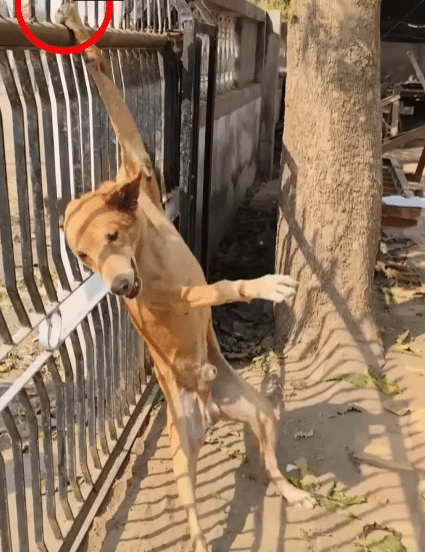
A stray dog had stepped too close to a metal fence, and one of his paws had slipped into the narrow space between the iron bars.
He could not move forward.
He could not pull himself free.
Every frightened attempt to escape placed more pressure on the trapped leg.
But when rescuers from RRSA India finally released him and examined his body more closely, they discovered that the fence was not the only reason he needed help.
Near his ear was another serious wound—one that appeared to have been present long before that day’s accident.
One Wrong Step Left Him Completely Trapped
There was no warning before the dog’s situation changed.
He had been moving near a metal fence when his paw entered a narrow opening between two iron bars. The gap was wide enough for the paw to slip through, but not wide enough for him to pull it back easily.
His first reaction was instinctive.
He pulled away.
When that failed, he shifted his weight and tried again.
His body twisted from one side to the other as he searched for an angle that might release the trapped limb. But the more he struggled, the more firmly the bars appeared to hold him.
The dog could not understand the mechanics of what had happened.
He only knew that something had caught his leg and prevented him from leaving.
Fear turned each movement into another risk.
Pulling harder could injure the paw.
Twisting suddenly could place pressure on the joints above it.
Remaining still, however, meant staying exposed beside the fence with no way to find food, water, or shelter.
Eventually, exhaustion began replacing panic.
The dog remained close to the metal structure, unable to move more than the limited distance allowed by his trapped leg.
By the time help arrived, he had already spent valuable strength trying to save himself.
The RRSA India rescuers quickly evaluated the problem.
They could see that simply pulling the dog backward would not be safe. Even if enough force released the paw, the movement could worsen an injury that was not yet visible beneath the fur.
The team would need to change the fence—not force the dog’s body through a space that was too narrow.
That decision required time, proper tools, and complete control of every movement.
Video: Stray Dog’s Paw Is Trapped Between Iron Bars—Rescuers Work Carefully to Free Him
The Team Chose Patience Instead of Force
A frightened dog cannot be expected to remain perfectly still during a rescue.
He does not know why unfamiliar people are surrounding him.
He cannot understand the purpose of the tools in their hands.
The sound of metal shifting or equipment touching the fence may only add to his fear.
For that reason, the rescuers needed to manage two problems at once.
They had to widen the space between the bars while keeping the dog as calm and steady as possible.
One sudden movement from either side could cause further pain.
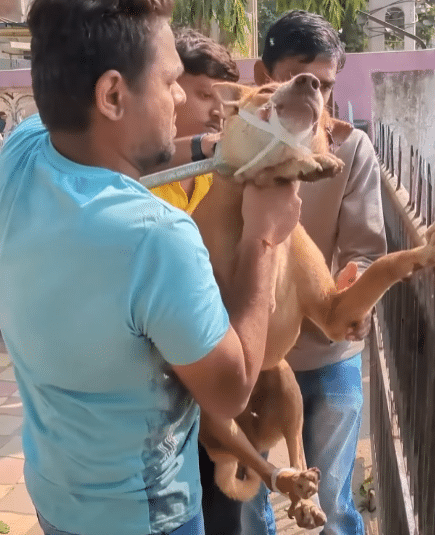
The team positioned themselves carefully around him. Rather than pulling on the trapped leg, they focused their attention on the iron bars.
Specialized tools were placed against the fence.
Pressure was applied gradually.
The gap began to widen.
Only a little at first.
The rescuers repeatedly checked the position of the dog’s paw before continuing. They needed enough space to release the limb, but every adjustment had to remain controlled.
There was no benefit in working faster if speed increased the risk of injury.
The dog remained frightened, but calm hands stayed close to support him.
Little by little, the metal moved.
The opening became wider.
Then came the moment everyone had been waiting for.
The paw slipped out.
The dog was no longer physically attached to the fence.
What had seemed impossible during his own desperate attempts had been accomplished without anyone forcefully yanking his leg through the bars.
The immediate danger was over.
But the rescuers did not simply release him and walk away.
A trapped paw still required examination. There could be swelling, abrasions, or damage caused by the pressure of the bars and the dog’s repeated efforts to escape.
As the team moved closer to assess him, their attention was drawn to another part of his body.
Near his ear was a wound that had nothing to do with the fence.
The Injury Near His Ear Changed the Rescue
The wound was serious enough to require attention.
It appeared irritated and untreated, and its condition suggested that it was not caused by the brief accident at the fence.
The rescue team could not determine the entire history of the injury simply by looking at it.
They did not know exactly how it had happened.
They could not know how long the dog had been living with it.
But they could see that it needed proper cleaning, medication, and continued care.
The discovery changed their understanding of the dog’s situation.
Until then, the trapped paw had been the most visible emergency.
Anyone passing the fence could immediately see that he was stuck.
The wound near his ear was different.
It may have gone unnoticed by people who saw him only from a distance. Fur, movement, and the dog’s fear could have made it difficult to recognize the extent of the problem.
Only after the team came close enough to help did the second injury become clear.
That is often one of the challenges in rescuing stray animals.
The first problem seen is not always the only one.
A dog may be found limping but also be dehydrated.
An animal rescued from a drain may have skin disease hidden beneath dirt.
A frightened stray may appear physically stable until a closer examination reveals wounds, parasites, or infection.
In this case, the metal fence created the emergency that brought people to the dog.
It also placed him close enough to rescuers for them to notice another source of suffering.
Freeing the paw had prevented immediate harm.
Treating the wound near his ear would require a longer process.
The dog could not be left beside the fence after what the team had found.
He needed to be transported to the rescue facility, where his injuries could be examined and treated in a cleaner, controlled environment.
Treatment Began as Soon as He Reached Safety
Once the dog arrived at the facility, the rescue shifted from extraction to medical care.
The wound near his ear needed to be cleaned carefully.
Areas of damaged or contaminated tissue can be extremely sensitive, especially when an animal has been living outdoors without regular treatment.
The team worked slowly.
The skin around the wound was examined.
The affected area was cleaned to remove dirt and reduce the risk of infection progressing.
Medication was provided according to his condition.
Throughout the process, the dog remained cautious.
This was understandable.
Only a short time earlier, he had been trapped against a fence while strangers approached with unfamiliar equipment. Now he was in a new environment, surrounded by different sounds, smells, and hands.
Even care intended to help can feel frightening to an animal who does not understand it.
The rescuers therefore avoided unnecessary force.
They supported his body and completed each step as gently as possible.
Their work was not finished when the wound looked cleaner.
Recovery would depend on continued treatment.
Medication needed time to work.
The area would need to be monitored for changes.
The dog would also require rest, nourishment, and protection from the conditions he had been facing outside.
The first day of care was about more than treating a visible injury.
It was also the first opportunity for the team to observe how he responded once the immediate fear and exhaustion began to settle.
A stray animal may arrive guarded, tense, or unable to rest.
The body remains prepared for danger even after danger has passed.
Creating a quiet and predictable environment can be as important as the first medical procedure.
The dog was given a safe place to recover.
No metal bars held his paw.
No need remained for him to pull, twist, or struggle.
For the first time since the accident, he could lie down without being trapped.
Video: After His Paw Is Freed, Rescuers Begin Treating the Hidden Wound Near His Ear
His First Signs of Relief Were Quiet
The changes during the early recovery period were not dramatic.
The dog did not immediately begin playing.
He did not rush toward the people caring for him.
There was no single moment when every sign of fear disappeared.
Instead, the rescuers noticed smaller shifts.
His breathing became calmer.
The tension in his body began to ease.
He could rest without remaining completely overwhelmed by the activity around him.
The wound was receiving treatment, and the constant discomfort associated with it could finally begin to decrease.
These improvements mattered because the dog had arrived carrying more than one source of stress.
His paw had been caught.
He had exhausted himself trying to escape.
He had been handled by unfamiliar people.
And he was already living with a wound that needed medical care.
Recovery from all of that could not reasonably happen in a few hours.
The team allowed him time.
They continued cleaning and monitoring the affected area.
Medication was provided as required.
Food and water were kept within reach.
Movements around him remained calm and predictable.
At first, he was still cautious when people came close.
His eyes followed them carefully.
His posture showed that trust had not yet formed.
But caution did not prevent the caregivers from helping him.
Nor did it make him less deserving of care.
A frightened dog does not need to understand kindness immediately for kindness to matter.
He may need to experience the same safe routine many times before his response changes.
A person approaches.
The wound is treated.
Nothing worse follows.
Food is offered.
The person steps away.
Later, they return and behave gently again.
Through repetition, an animal begins collecting new information about the people around him.
The dog had not reached the end of that process.
But he no longer appeared as overwhelmed as he had beside the fence.
The reduction in visible panic was itself an important victory.
His body was beginning to discover that it did not need to struggle every second.
The Most Important Rescues Are Not Always Dramatic
There were no crowds surrounding this rescue.
No major disaster had drawn public attention to the area.
The dog was not trapped on the roof of a flooded building or stranded in the center of a busy highway.
He was simply one stray animal with a paw caught in a fence.
From a distance, the situation may have looked small.
Yet for the dog, it was everything.
He could not free himself.
He could not continue searching for food or shelter.
He could not explain that another untreated wound was already causing him pain.
His entire future depended on someone noticing that he was there.
The RRSA India team did more than remove his paw from between the bars.
They stayed long enough to look at the rest of him.
That choice revealed the wound near his ear.
Had they focused only on the fence and released him immediately, the second injury might have remained untreated.
The rescue therefore became an example of why careful observation matters.
Helping an animal is not always about completing the most obvious task as quickly as possible.
Sometimes, the crucial moment comes afterward.
It comes when someone checks the paw.
Looks beneath the fur.
Notices an unusual posture.
Recognizes that an animal’s silence may be exhaustion rather than calmness.
The dog did not need an audience.
He needed people willing to treat his life as important even when no one else was watching.
That is what the rescuers provided.
Their actions were practical.
They widened the fence.
They transported him.
They cleaned the wound.
They gave medication.
But behind every practical step was a simple decision.
The dog’s suffering was worth interrupting.
Kindness Began When Someone Looked Beyond the Fence
The image of the trapped paw was what first demanded attention.
It was immediate, visible, and impossible for the dog to solve alone.
But the deeper meaning of the rescue appeared only after the bars were opened.
Near his ear was evidence that he had needed help before the accident ever happened.
The fence did not create all of his suffering.
It made that suffering harder to overlook.
Once the dog was safely inside the rescue facility, his healing could begin.
The trapped leg could be observed for injury.
The wound near his ear could be cleaned and treated.
His fear could be met with calm rather than punishment.
He could rest in a place where every movement did not require another fight for survival.
The available information does not tell us exactly what caused the wound.
It does not reveal how long the dog had been living alone or what his life had been like before he reached the fence.
It also does not provide a final adoption outcome.
What it does show is enough.
A dog became trapped.
People arrived with the correct tools.
They chose patience over force.
They freed him without pulling carelessly on his leg.
Then they looked closer and recognized that he needed more than a brief rescue.
That sequence of choices changed the direction of his life.
Pain is not always visible from the road.
Some injuries remain beneath fur.
Some animals remain silent even while they are suffering.
And some rescue stories begin not with a dramatic cry, but with a dog standing quietly beside a fence because he has no other option.
He could not ask for medical treatment.
He could not explain the wound near his ear.
He could only remain where he was and hope that someone would stop.
Someone did.
The bars were widened.
His paw was released.
The hidden wound was treated.
And although his recovery still required time, he was no longer facing it alone.
That is why quiet rescues matter.
They remind us that compassion does not need a crowd to be meaningful.
It only needs someone willing to notice, move closer, and care about what becomes visible after the first emergency is over.


