The terminal is quieter at this hour. The last connecting flights have pushed through the gates, the souvenir shops have rolled down their shutters, and the only movement is the slow drift of janitorial carts across the polished floor. Somewhere beneath your feet, a network of tunnels runs under the tarmac—automated carts carrying bags through underground corridors that most passengers will never see.
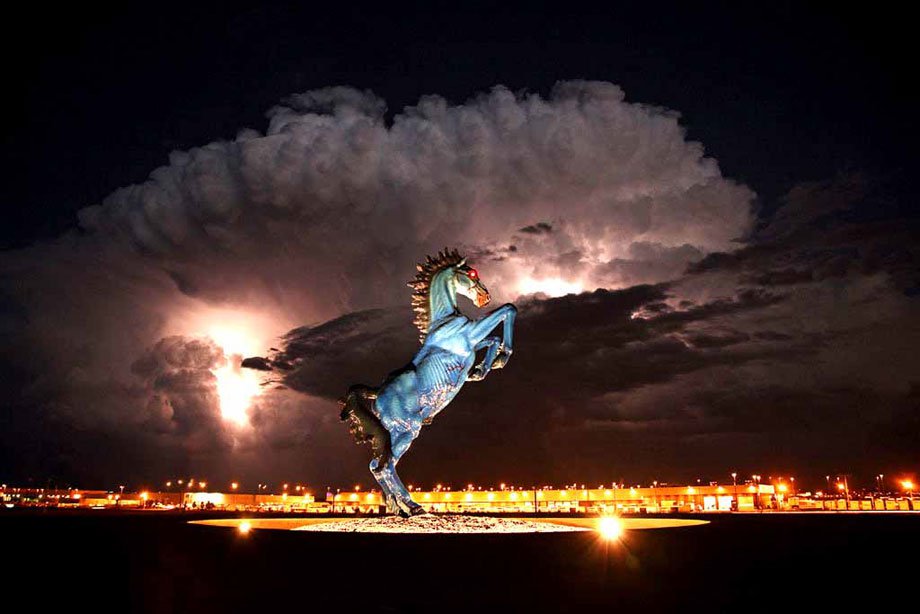
Above the tunnel system, the concourses hold something else: murals painted in vivid, unsettling color, bronze gargoyle figures perched in luggage carts, a dedication capstone inscribed with a symbol that caught the attention of the internet and never let it go. Out near the approach road, a thirty-two-foot blue stallion with glowing red eyes stares into the dark.
Every one of those details is real. The tunnels exist, the murals were commissioned from a named artist, the gargoyles were placed by the airport authority, and the horse has a documented history that includes a tragic accident during its construction. None of that is in dispute.
The Real Details That Started the Theory
Denver International Airport opened on February 28, 1995—sixteen months behind its original schedule and roughly $2 billion over its initial budget. The final construction cost reached approximately $4.8 billion, making it one of the most expensive airport projects in American history at the time. Those facts, reported extensively by outlets including The Denver Post and The New York Times, became the foundation for a question that conspiracy communities would ask for the next three decades: where did the money go?
The physical details that greet arriving passengers did not quiet that question. The roof of the main terminal—Jeppesen Terminal—is constructed from white tensile fabric peaks intended to evoke the Rocky Mountains or Arapaho teepees, depending on the source. From certain angles and in certain light, the white spires look like something else entirely, and that flexibility of interpretation became a recurring feature of the Denver airport experience.
The underground baggage handling system was one of the central sources of delay and cost overrun. Originally designed to be a fully automated, airport-wide system that would route bags without human intervention, the technology failed repeatedly during testing. The system was partially scaled back before opening, and the tunnels that run beneath the airfield—some stretching for miles—became a documented and acknowledged part of the airport’s infrastructure. Airport officials have confirmed their existence in public statements and media interviews. The tunnels were built for baggage logistics, and portions of the system were later repurposed for a train connection between concourses.
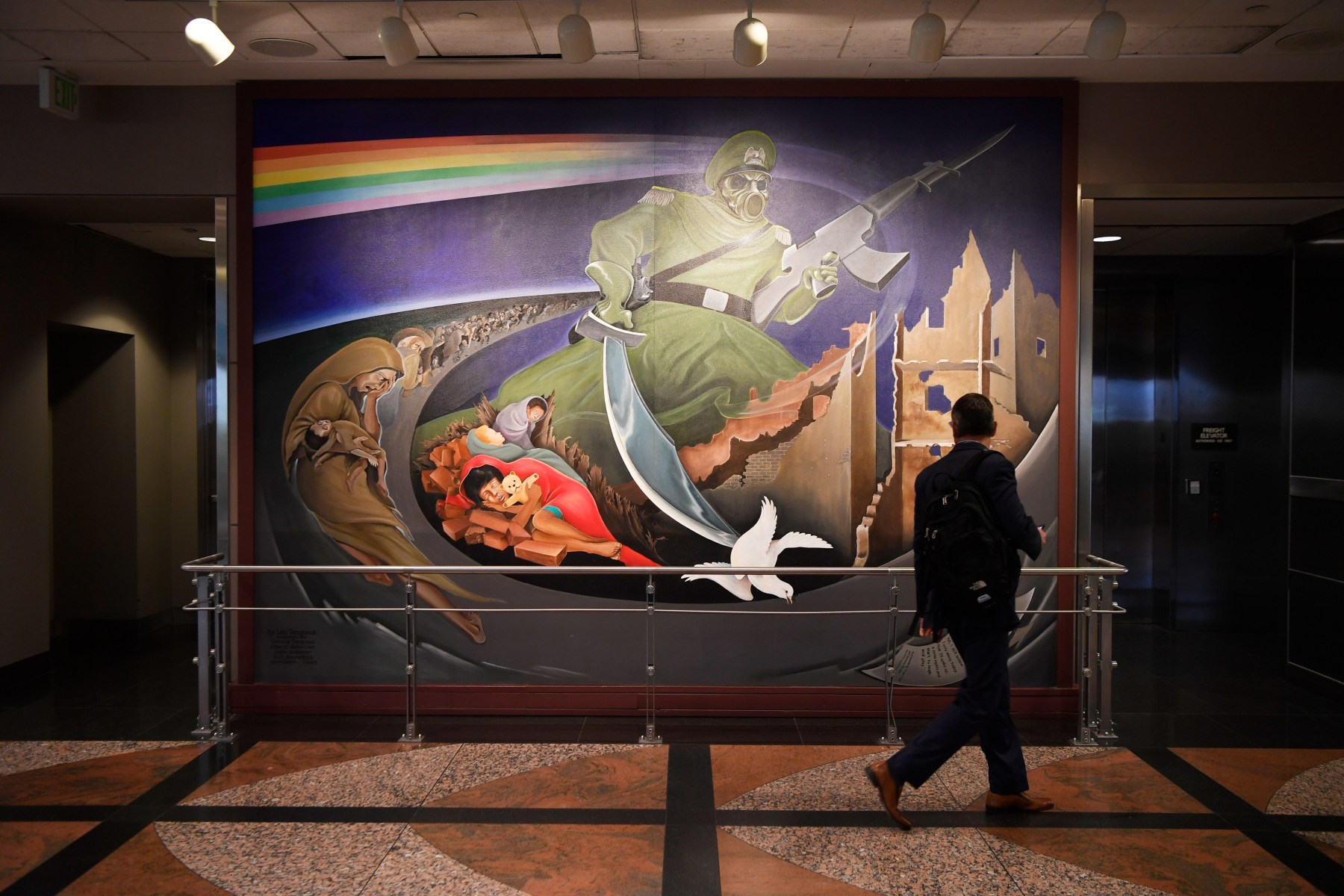
The art program compounded the atmosphere. The airport commissioned murals by Denver-based artist Leo Tanguma for the Great Hall. The two large works—In Peace and Harmony with Nature and Children of the World Dream of Peace—depict scenes of environmental destruction, a figure in a gas mask and military coat wielding a sword, children in coffins, and a dove emerging from flames. Tanguma has stated in documented interviews that the murals illustrate the destruction of the environment and the triumph of peace over war, functioning as cautionary allegory. That explanation exists on the record. It did not prevent visitors from reading the images as something else.
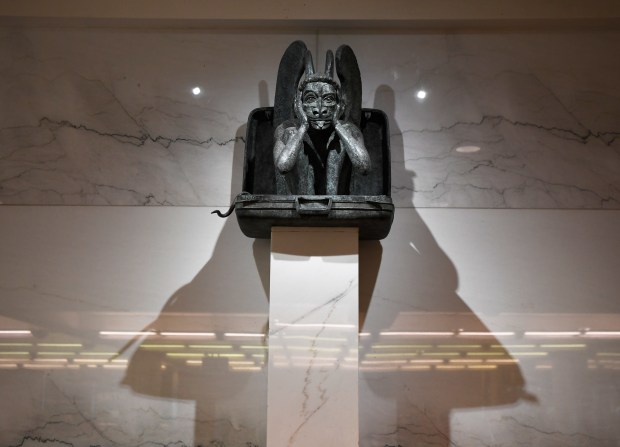
The gargoyles—two bronze figures seated in vintage suitcases near baggage claim—were placed by the airport authority with a small sign noting they are watching over the luggage. Paired with the murals, the capstone inscribed with Masonic symbols near the terminal entrance, and the presence of construction-era time capsule ceremonies, the cumulative effect was an aesthetic that felt, to some visitors, deliberately coded.
The horse near Peña Boulevard was installed in 2008. The sculpture, titled Blue Mustang and created by artist Luis Jiménez, is thirty-two feet tall, painted cobalt blue, and fitted with internally lit red eyes that glow at night. During its fabrication, a portion of the sculpture fell on Jiménez in his studio in 2006, causing injuries from which he died. The airport and Jiménez’s family completed the installation posthumously. That history is documented in news reporting and the airport’s own public records.
Runway patterns, land area—Denver International covers 53 square miles, making it one of the largest airports by area in the world—and the sheer physical scale of the site all contributed to an environment where unusual details accumulated faster than routine explanations could neutralize them.
YOUTUBE EMBED 1 — PRIMARY SEARCH QUERY: “Denver airport conspiracy theories official explanation”
The Official Explanation for the Underground System
Airport officials have been unusually direct about addressing the theories, in part because the volume of questions made silence impractical. The airport’s own website, at various points in its public history, has featured a page titled “DEN Conspiracy Theories” that lists common claims and responds to them plainly. That page—a rare example of an institution actively engaging with its own mythology—acknowledged the tunnels, explained their baggage function, and noted that no underground city or bunker has been found because none was built.
The Masonic cornerstone near the terminal entrance is real. It was placed as part of a dedication ceremony common in American civic architecture, and the inscription includes the phrase “New World Airport Commission,” which became a significant item in online discussions. The New World Airport Commission was a local business and civic booster organization formed specifically to support the airport’s opening. It does not appear in records connected to any secret society, and no document has established a connection between the organization’s name and any larger coordinating body. Airport spokespersons have confirmed the commission’s local and temporary nature.
The cost overrun and construction delay had documented causes: the automated baggage system’s failures, mid-project design changes, disputes with contractors, and the complexity of building an airport on a scale that had not been attempted in the continental United States for decades. Federal Aviation Administration records, municipal bond disclosures, and contemporaneous news coverage documented the overruns in substantial detail. The money trail—while unpleasant for the project’s financial backers—was a matter of public record, not a hidden mystery.
The airport’s train system connects the terminal to the three concourses underground. Passengers use it daily. The corridors are visible through train windows, and the system has been photographed, filmed, and described in official architectural documentation. There is no section of the public train route that passes through concealed infrastructure that would support a bunker or hidden city of the scale described in conspiracy literature.
As for the murals, Leo Tanguma spoke publicly and repeatedly about the work’s meaning. In interviews documented by regional and national outlets, he described the progression of the images—from catastrophe and violence toward unity and peace—as intentional allegory rooted in his experience as a Chicano artist and his interest in humanist themes. The airport purchased the works with that context attached. Whether viewers accept that explanation or replace it with another is a matter of interpretation, not evidence.
How the Larger Theory Began to Take Shape
The construction delays opened in February 1995 to heavy media coverage, much of it focused on the cost overruns and the failed baggage system. Early internet communities—the airport predates mainstream social media but not early bulletin boards and email discussion groups—began collecting the unusual details almost immediately after opening.
The theory gained significant structure in the late 1990s and early 2000s as dedicated conspiracy websites began compiling lists of features and attaching interpretations. The runway layout, viewed from above, was described as resembling a Nazi swastika—an interpretation that requires a specific aerial angle and a willingness to exclude runway sections that break the shape. Airport officials noted the layout was designed for noise reduction and wind efficiency, matching the standard explanation for parallel runway configurations at large hub airports.
Alex Jones and other prominent figures in the American conspiracy media ecosystem discussed Denver International Airport extensively in the 2000s and 2010s, reaching large audiences and helping to elevate specific details—the capstone, the murals, the underground tunnels—to a national conversation. The framing in those discussions typically presented the documented details as evidence rather than as starting points requiring further verification.
Books, documentary films, and YouTube channels built entire narratives around the airport. Some of those productions cited one another rather than primary sources, creating a closed circuit in which claims appeared to be multiply documented when the original sources were often the same speculation recycled through different formats. The capstone’s “New World Airport Commission” text, for example, appeared in dozens of productions as a reference to the “New World Order” without documentation linking the two. The airport’s explanation of the commission’s local nature was rarely included.
By the mid-2010s, the Denver airport conspiracy had become one of the most widely recognized examples of its genre in the United States, with polling suggesting a significant minority of Americans believed the airport contained some form of secret underground facility. The belief persisted alongside—and in some ways was amplified by—the airport’s own acknowledgment of the theories.
Where the Theory Makes Its Biggest Leap
The conspiracy framework built around Denver International Airport has a specific structural problem: it requires the existence of facilities that have not been found, confirmed, or photographed despite thirty years of public attention, extensive media access, thousands of airport employees, and multiple independent investigations.
The underground city claim requires hidden construction on a scale that could not plausibly be concealed from the workforce that built the visible infrastructure. Airport construction employed thousands of workers across multiple years. No verified firsthand account from a construction worker has established the existence of concealed deep-bunker construction distinct from the documented tunnel and train systems. Reports circulated online claiming former workers had confirmed secret levels—but these accounts are anonymous, unverified, and not reproduced in any archive or news record with named sources.
The Illuminati claim requires an organization whose existence and structure are themselves unverified to have selected and constructed a specific site for a specific purpose. The capstone inscription and the Masonic ceremony—both real—are connected to the broader theory through association rather than through documentation. Masonic ceremonies have accompanied the laying of civic cornerstones in American public architecture since at least the late eighteenth century, including the United States Capitol and numerous state buildings. Their presence at Denver International Airport does not distinguish the site from hundreds of other public buildings.
The doomsday bunker claim is specifically addressed in federal emergency management literature, which identifies several facilities designed for continuity of government. Denver International Airport does not appear in that literature as a designated continuity site. The actual designated sites are themselves a matter of substantial public record and historical documentation, and the Denver airport is not among them.
The reptilian occupation claim—that non-human entities use the underground tunnels as habitat or headquarters—rests on no physical evidence, no verifiable witness account, and no document. It belongs to a tradition of belief that predates the Denver airport and attaches itself to different locations across different communities and time periods.
The leap the theory makes is consistent and identifiable: it treats real objects as coded messages, then constructs a hidden system to explain the code, then treats the absence of proof as further evidence of concealment. That logical structure is self-sealing. An evidence-based investigation cannot penetrate a framework in which disconfirmation is itself reframed as confirmation.
YOUTUBE EMBED 2 — SECONDARY SEARCH QUERY: “Denver airport murals Leo Tanguma explanation”
The Evidence Believers Point To—and What It Actually Establishes
It is worth examining the strongest items in the conspiracy evidence list on their own terms, because the weakness of the conclusion does not always mean the individual pieces are fabricated. Most of them are not.
The tunnels are real. They were built, they carry baggage and trains, and their approximate dimensions and routing are known from engineering documentation and press coverage. What the tunnels do not establish is any additional hidden level, any concealed access point to a deeper facility, or any function beyond what officials have described. No engineering drawing, no construction record, and no independent investigation has produced a blueprint for a deeper system.
The murals are real and genuinely unusual for an airport context. Art depicting weapons, dying children, and burning cities is not standard terminal decor. Tanguma’s explanation—that the work is allegory about environmental destruction and the hope for peace—is also real and documented. The fact that the explanation exists does not obligate every viewer to accept it, but the explanation does appear in the record and was part of the commissioned artwork’s publicly stated intent. A viewer who finds the images disturbing is responding to something genuine; a viewer who concludes the images are secret communications from a hidden power structure is making an additional inferential step that the images themselves do not require.
The capstone and Masonic elements are real. The claim that they connect Denver International Airport to a secret global governing body is not supported by any document linking the airport, its funders, its designers, or its operators to such an organization. The New World Airport Commission’s records, to the extent they exist in civic archives, describe a booster organization, not a covert authority.
The horse is real and documented, including the accident that killed its creator. The red eyes glow because of internal lighting installed as part of the sculpture’s design. The color is blue because Jiménez worked in a style that used vivid colors as a signature element—his prior works, documented in gallery and museum collections, show the same palette. The horse is unsettling by design, in the tradition of public sculpture that challenges rather than comforts. That is not the same as evidence of supernatural occupation or hidden programming.
What Independent Sources Have Been Able to Verify
Journalists from regional and national outlets have investigated the Denver airport theories at multiple points over three decades. The Denver Post, in particular, has covered the airport’s construction history, its art program, and the conspiracy culture surrounding it in extensive detail. None of those investigations produced documentation for the underground city, the bunker, or the Illuminati headquarters.
Architectural and engineering records for the airport are available through municipal filings, bond disclosures, and FAA documentation. Researchers who have examined those records have found documentation for the baggage tunnel system, the train corridor, the terminal structure, and the runway layout. They have not found permits, engineering drawings, or construction records for a concealed deep facility distinct from the acknowledged underground systems.
The airport’s workforce—which at peak construction numbered in the thousands and currently employs several thousand people in ongoing operations—represents a large potential pool of witnesses. The conspiracy framework requires that a significant number of those employees either participated in concealing the hidden facility or were themselves kept unaware of it. Neither scenario has been documented through named, verifiable accounts.
Independent researchers who have examined the runway aerial photographs note that the swastika interpretation requires excluding several runway sections and applying a specific rotational reading. The same aerial photographs, viewed without a prior interpretive commitment, show a parallel runway layout consistent with large hub airports designed for noise abatement and operational efficiency.
The airport’s own embrace of the conspiracy lore—selling merchandise, hosting a conspiracy-themed pop-up installation in 2018, and featuring gargoyle figures with signs that read “Agents of the Illuminati”—has been interpreted by some theorists as either a winking admission or a deliberate misdirection. Independent observers have noted a simpler explanation: the airport recognized that the conspiracy lore was generating attention and decided to monetize it rather than fight it.
How Popular Culture Expanded the Story Beyond Its Original Claims
By the early 2010s, Denver International Airport had become a cultural shorthand—a symbol invoked in television, fiction, and online discussion to represent institutional secrecy and hidden power. The specific claims about tunnels and bunkers had migrated beyond their original community and become a shared reference point that did not require belief in order to be cited.
Television programs covering conspiracy theories featured the airport in dedicated segments, typically presenting the documented details and the unsupported theories in parallel without clearly distinguishing their evidentiary status. The visual contrast between the airport’s unusual art and the underground tunnel footage created a compelling television package regardless of what the evidence actually supported.
Internet communities developed elaborate secondary theories around the primary claims: that the airport’s opening was timed to specific dates with occult significance, that the underground system connected to other sites across Colorado, that specific employees were placed at the airport by hidden organizations. These secondary claims proliferated rapidly because the original framework was already established and any new detail could be integrated into it.
The comedy and satire community also engaged with the airport’s mythology, producing material that treated the conspiracy as a known quantity and played with its familiar elements. Saturday Night Live, late-night hosts, and regional comedy outlets all referenced the airport in sketches and monologues. This cultural saturation did not diminish the sincere belief community—in some cases, satirical acknowledgment was itself incorporated into the theory as evidence that the establishment was using humor to normalize awareness of the secret.
By the 2020s, the Denver airport conspiracy had accumulated enough cultural mass to be largely self-sustaining. New visitors to the airport encountered the murals and the horse already primed by prior cultural exposure, meaning the unusual details confirmed expectations rather than generating fresh questions. The feedback loop between the physical site and its cultural representation was essentially complete.
Why the Theory Refuses to Disappear
The most honest answer to why the Denver airport conspiracy has persisted for three decades without resolution lies not in hidden evidence but in the structure of the theory itself and the genuine strangeness of the site it describes.
The airport is, by any reasonable standard, unusual. Its scale is enormous. Its art is genuinely challenging. Its construction history involved real failures and real financial pain for the people of Denver. Its underground infrastructure is real and largely invisible to the average traveler. These details are not fabrications—they are the foundation on which the theory was built, and they remain present and visible to anyone who visits.
The theory also serves a psychological function that a straight infrastructure explanation does not. A bunker beneath a public building implies preparation for catastrophe by people who know something the public does not. That implication is frightening, but it is also organizing: it suggests that someone, somewhere, has a plan. In an environment of genuine institutional distrust—itself partly warranted by actual documented government programs that were concealed from the public—the Denver airport theory offers a familiar template applied to a new location.
The airport’s own decision to lean into the mythology deserves examination as part of the story’s survival. When the airport installed conspiracy-themed signs, sold Illuminati merchandise, and hosted conspiracy-themed pop-up events, it was treating the theory as a marketing asset. That decision was commercially rational. It also had the effect of keeping the theory in circulation. You cannot simultaneously market your building as a mystery and expect people to stop treating it as one.
The deliberate humor in the airport’s self-presentation—gargoyles with “Agents of the Illuminati” signs, a website page that lists conspiracy claims with straight-faced rebuttals—created a tone that is neither pure denial nor pure confirmation. That ambiguity is sustainable as entertainment. It is less useful as a resolution.
What the file actually supports is this: Denver International Airport contains real tunnels built for baggage and transit, real art commissioned with documented intent, real construction delays explained by documented failures, and real unusual aesthetics that emerged from a large and ambitious civic project. The infrastructure beneath the airport serves the airport. The art above it reflects its creators’ stated vision. The capstone connects to civic tradition, not to a secret world order.
The hidden command center, the underground city, the alien and reptilian occupation, the Illuminati headquarters—none of these appear in engineering drawings, construction records, federal emergency management plans, or verified firsthand accounts. They appear in a theory that found the real details of an unusual airport and built a much larger structure around them.
The room stays dark because the airport is genuinely strange. The record stays clear because strange is not the same as secret. And the file—after thirty years of airport employees, journalists, independent researchers, and the airport’s own transparency campaigns—remains open only on the question of whether a convincing rebuttal can close a theory that was never really built on evidence to begin with.

