Rico was hungry.
Not the ordinary hunger that disappears after a full meal, but a constant and dangerous hunger that remained no matter how eagerly he tried to eat.
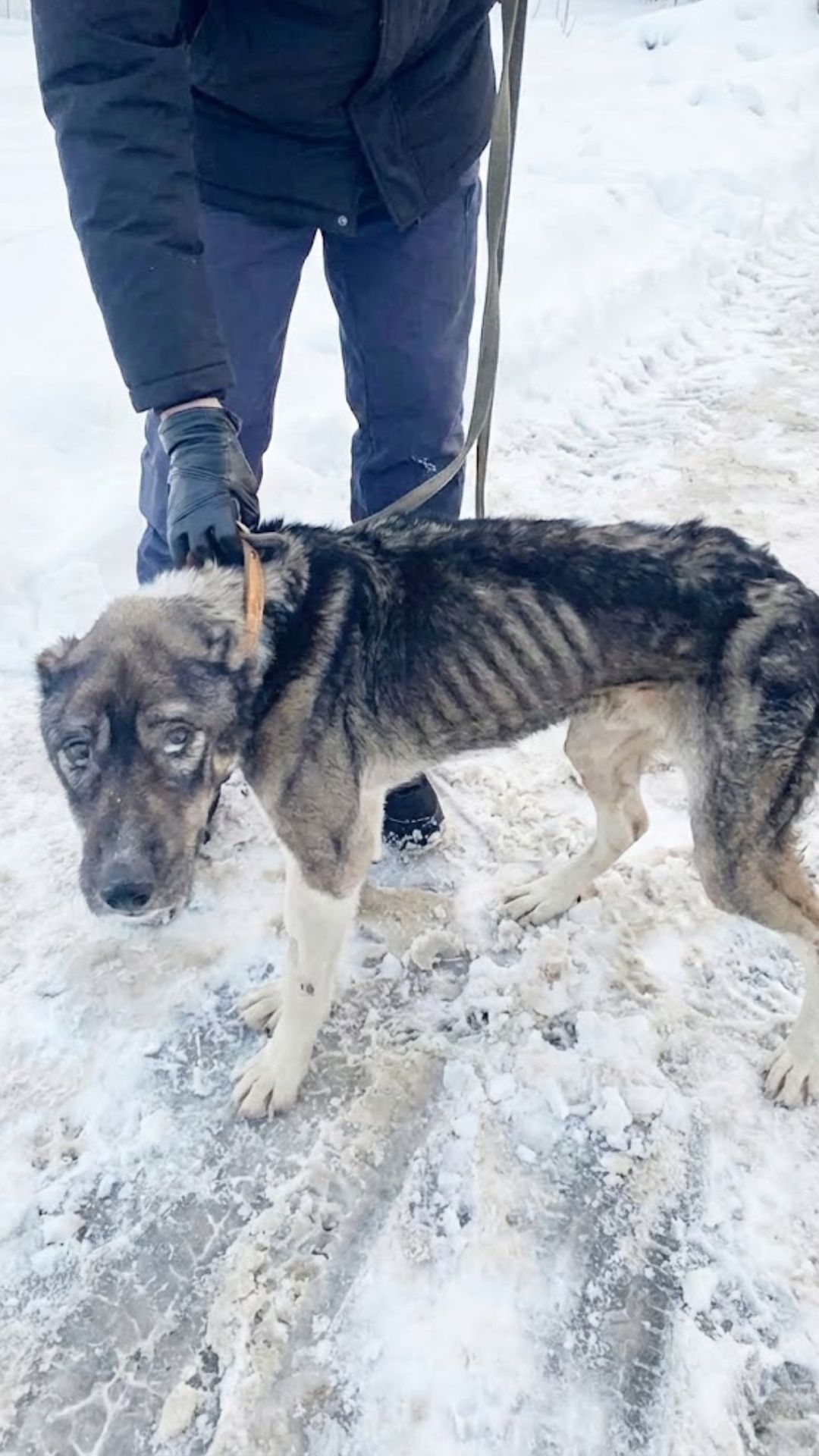
When rescuers found him wandering near a shelter on Pozharsky Street, his body had already been reduced to a frighteningly thin frame.
Every rib could be seen.
His spine rose sharply beneath his skin.
The bones around his hips appeared far too prominent for a dog his size.
Rico moved slowly, conserving what little strength he had left while continuing to search for food.
At first, the explanation seemed obvious.
He must have been without regular meals for a long time.
But when rescuers finally placed food in front of him, they discovered that hunger was only part of the problem.
Rico could eat.
His body simply could not keep the meal down long enough to receive the nourishment it contained.
He Looked Like a Dog Who Had Not Eaten in Weeks
The rescue team could barely understand how Rico was still moving.
His body showed almost none of the healthy weight or muscle expected in an adult dog. His coat rested against a frame so thin that the outline of nearly every major bone remained visible.
He appeared cold.
He was weak on his feet.
Even standing required effort.
Yet when food appeared, Rico still showed interest.
That response gave rescuers hope at first.
A dog willing to eat may have a better chance of regaining strength once regular meals and medical care begin. The team believed that careful feeding, warmth, and rest might allow his body to recover from severe starvation.
They could not give him a large meal immediately.
A dangerously underweight animal often needs food introduced gradually, allowing the body to adjust without being overwhelmed.
Rico was offered a controlled portion.
He ate.
For a brief moment, it seemed that the most urgent problem had a straightforward solution.
Then the food came back up.
The rescuers tried again with an even more cautious approach.
The same thing happened.
Food would not remain inside him.
Water was also difficult for his body to keep down.
The team realized that Rico had not become skeletal simply because he could not find something to eat.
Even when a bowl was placed directly in front of him, his body was preventing the meal from reaching the place where it could be properly used.
The dog was surrounded by people willing to feed him.
He was still starving.
That discovery turned an already serious rescue into a medical emergency.
Video: Rico Eats From a Full Bowl—Then Rescuers See Why He Is Still Starving
The Problem Was Hidden Inside His Esophagus
Rico was taken to a veterinary clinic for immediate evaluation.
The team needed to understand why food and water returned so quickly after he swallowed.
According to the veterinary findings described in his rescue account, the muscles inside Rico’s esophagus were no longer moving food downward as they should.
In a healthy dog, swallowed food travels through the esophagus and enters the stomach. Muscular movement helps guide each mouthful along that path.
Rico’s esophagus was not performing that function properly.
Instead of continuing into his stomach, food remained trapped higher in the digestive tract.
Eventually, it came back up.
The result was devastating.
Rico still experienced hunger.
He could see food and attempt to eat it.
But if the meal failed to reach his stomach, his body could not absorb enough of the calories and nutrients needed to rebuild itself.
Every feeding became a struggle against the same internal problem.
His rescuers now understood why ordinary meals had not saved him.
Rico had reportedly lost more than 10 kilograms, or approximately 22 pounds.
For a dog already weakened by prolonged nutritional loss, that amount was extremely dangerous.
His body had begun using whatever reserves remained simply to continue basic functions.
There was very little fat available to protect him from the cold.
His muscles had weakened.
His ability to stand and move had declined.
Without a different feeding strategy, placing more food in his bowl would not be enough.
The veterinary team needed to find a way to help the meal travel downward despite the poor function of his esophagus.
Their first solution relied on something simple but powerful.
Gravity.
Every Meal Had to Be Followed by 30 Minutes Upright
Rico could no longer be allowed to eat and immediately lower his body toward the floor.
After each meal, volunteers carefully raised him into a vertical position.
They supported him almost like a child being held upright after feeding, keeping his chest elevated and his body as straight as possible.
Then they waited.
Rico remained upright for approximately 20 to 30 minutes at a time.
The hope was that gravity would help guide the food past the poorly functioning esophagus and into his stomach before it could return.
This turned every meal into a lengthy procedure.
Someone needed to prepare the appropriate food.
Someone needed to watch how Rico swallowed.
Then one or more caregivers had to support his fragile body in the correct position for nearly half an hour.
They could not simply place the bowl down and walk away.
If Rico lowered himself too soon, the meal might never reach his stomach.
The routine had to be repeated several times, day after day.
Rico was still extremely weak, so holding himself upright without help was not realistic.
The volunteers supported his weight carefully, making sure the position did not place unnecessary pressure on his thin frame.
During those long minutes, Rico remained calm.
He allowed the caregivers to hold him.
He did not understand the medical reason for the unusual position, but he seemed to tolerate the routine that had become essential to his survival.
Some feedings went better than others.
On difficult days, food still came back up.
Even water could fail to remain inside him.
Every unsuccessful attempt meant lost nutrition and another risk of dehydration.
The caregivers could not know immediately how much each meal had provided.
They could only continue the routine, observe his response, and adjust his treatment with veterinary guidance.
For most dogs, eating requires only a few minutes.
For Rico, every bowl marked the beginning of a careful process involving time, physical support, and constant attention.
Warmth and Hydration Became a Second Battle
Food was not Rico’s only urgent need.
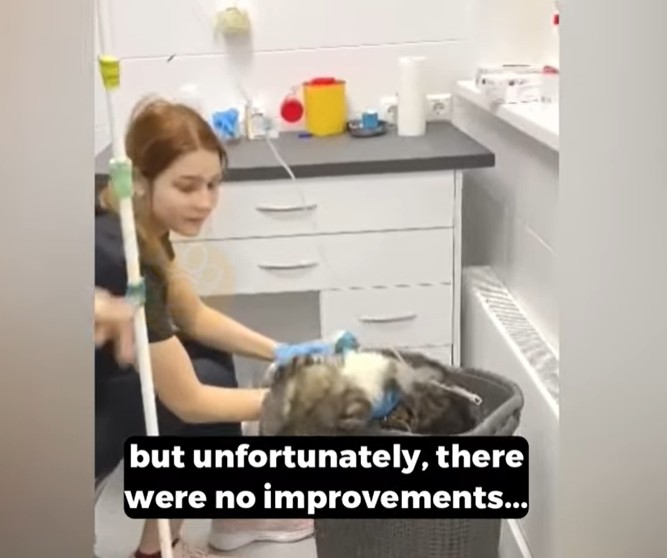
Because he struggled to keep water down, maintaining adequate hydration became difficult.
The veterinary team used intravenous fluids to help support him while his body remained unable to receive everything it needed through ordinary drinking and eating.
The IV treatment allowed fluids to enter his system without traveling through the damaged pathway causing so many problems.
Rico remained patient during the procedures.
His body was fragile, and repeated treatment could be tiring, but the fluids helped address a danger that could not wait for his feeding routine to improve.
At the same time, the rescue staff were fighting to keep him warm.
A healthy layer of body fat helps insulate an animal against cold temperatures.
Rico had almost none left.
He shivered frequently.
Blankets were wrapped around him, and caregivers monitored his condition closely. Warm bedding gave him a place to rest between feedings and veterinary procedures.
These ordinary comforts had become medically important.
His body was already spending enormous energy trying to function with insufficient nutrition.
It could not afford to lose more energy simply trying to remain warm.
The team therefore had to think about every part of his condition at once.
They needed to provide calories.
They needed to help those calories reach his stomach.
They needed to replace lost fluids.
They needed to protect him from the cold.
And they needed to watch for signs that his weakened body was no longer able to continue.
Rico’s care was exhausting because no single treatment solved the entire problem.
A successful meal did not remove the need for the next one.
IV fluids did not repair the esophagus.
Blankets kept him comfortable but could not restore the weight he had lost.
Recovery would depend on many small efforts repeated consistently.
Video: Volunteers Hold Rico Upright After Every Meal in a Race to Help Him Gain Weight
Veterinarians Had to Consider a Feeding Tube
Despite the dedication of the rescue team, Rico’s condition remained critical.
The upright feeding method offered a way to help some food travel downward, but it did not guarantee that every meal would stay inside him.
If he continued losing weight or failed to gain enough strength, veterinarians knew they might need to consider a more advanced intervention.
The rescue account described the possibility of a gastrostomy.
This procedure would place a feeding tube directly into Rico’s stomach, allowing nutrition to bypass the poorly functioning esophagus.
Instead of depending on muscular movement and gravity to carry food downward, caregivers could deliver specially prepared nutrition through the tube.
Such a procedure would not be a small decision.
Rico was already dangerously underweight.
His body had limited reserves for treatment and recovery.
A feeding tube would also require careful management afterward, including keeping the area clean, providing measured feedings, and monitoring him closely for complications.
But the procedure could become necessary if ordinary feeding remained unsuccessful.
The veterinary team faced a difficult balance.
They needed to give Rico every opportunity to respond to the less invasive method.
At the same time, waiting too long while he continued to lose weight could make him even weaker.
The decision would depend on his progress.
Could the upright routine deliver enough nutrition?
Would he begin retaining meals more consistently?
Could his weight stabilize?
Or would direct feeding into the stomach become his only realistic chance?
There was no simple answer.
For the rescuers, each successful feeding brought cautious hope.
Each time food returned, the seriousness of his situation became impossible to ignore.
Rico’s journey was not following a predictable path from rescue to recovery.
His future depended on how his body responded one meal at a time.
Through Every Treatment, Rico Remained Gentle
Rico’s physical appearance made his suffering visible.
His ribs, spine, and hips showed how much weight he had lost.
His trembling revealed how difficult it was for him to stay warm.
His repeated inability to retain food demonstrated the seriousness of his internal condition.
Yet the rescue team also noticed something else.
Rico remained remarkably gentle.
He allowed volunteers to support him after meals.
He stayed calm while receiving IV fluids.
He accepted blankets, examinations, and repeated handling from people he had only recently met.
None of this meant the treatments were easy for him.
Holding a weak body upright for 30 minutes can be tiring.
Needles, clinic sounds, and unfamiliar surroundings can create stress.
Rico still had to endure all of those things while feeling hungry and physically depleted.
But he continued cooperating with the people trying to save him.
The caregivers did not interpret his stillness as a reason to become careless.
They handled him gently, aware that his body had little protection around the bones beneath his skin.
They supported his weight rather than expecting him to balance alone.
They remained beside him through every meal instead of treating the feeding routine as a burden he had created.
That relationship became one of the most hopeful parts of his story.
For an unknown length of time, Rico had faced hunger without anyone able to solve it.
Now each failed meal was witnessed.
Each shiver was noticed.
Each small change in his condition mattered to someone.
He was no longer a skeletal dog wandering near a shelter while his body slowly weakened.
He had a team.
The treatment remained difficult, but the struggle was no longer his alone.
His Second Chance Still Depends on What Happens Next
Rico’s story does not yet have a simple ending.
He has not been declared fully recovered.
He still requires carefully managed meals, veterinary monitoring, and support after eating.
He needs to regain a significant amount of weight.
Additional tests or a feeding procedure may still become necessary if gravity-assisted meals do not provide enough nutrition.
That uncertainty is an important part of his journey.
Rescue saved Rico from facing the condition alone, but it did not instantly repair the problem inside his body.
His caregivers can offer food.
They can hold him upright.
They can provide fluids and warmth.
They can seek further treatment.
Ultimately, his progress will depend on how well his weakened system responds.
Still, something fundamental has already changed.
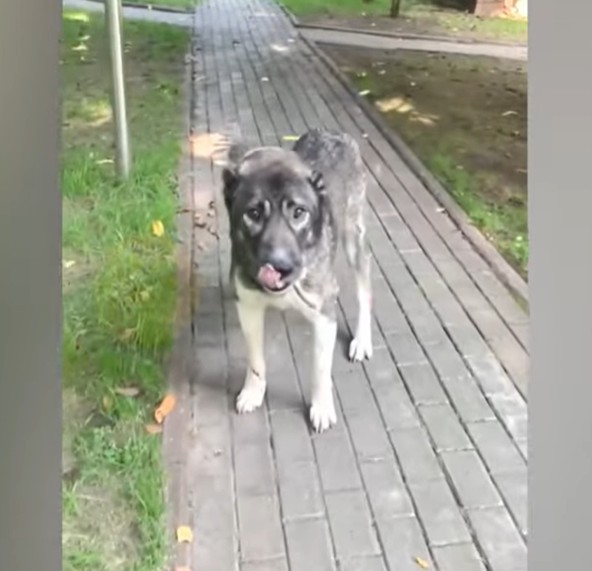
Rico survived long enough to be seen.
Someone noticed the impossibly thin dog wandering near the shelter and understood that he needed more than another bowl left outside.
The team looked beyond the obvious signs of starvation.
They watched what happened after he ate.
They recognized that the food itself was not reaching its destination.
That attention gave Rico access to treatment he could never have found on his own.
The full bowl in front of him was not the solution.
It was the clue.
It revealed that his hunger came from something deeper than an empty stomach or a lack of available food.
Once rescuers understood that, they could begin building a different approach around his needs.
Today, every meal carries both risk and possibility.
A volunteer prepares the food.
Rico eats.
Then gentle arms lift him upright.
For the next 20 to 30 minutes, everyone waits and hopes gravity will succeed where his esophagus cannot.
The process may look unusual.
For Rico, it is a lifeline.
He Is Finally Fighting With People Beside Him
Rico’s future remains uncertain, but uncertainty is not the same as hopelessness.
Before his rescue, he was losing weight without anyone understanding why.
He could search for food, eat what he found, and still receive almost no benefit from the meal.
His body continued shrinking while hunger remained.
Now his condition is known.
His feeding is supervised.
His hydration is supported.
His temperature is monitored.
Veterinarians are considering the next steps instead of allowing the problem to continue unseen.
Rico is still thin.
He is still medically fragile.
He has not yet reached the point where anyone can say the danger has passed.
But he is alive.
He continues eating when food is offered.
He remains patient while volunteers hold him upright.
He accepts treatment from the people gathered around him.
Those actions do not guarantee a particular outcome, but they show that the effort to save him is continuing from both sides.
Rico is trying to eat.
The team is trying to help his body use what he swallows.
Together, they are working against a condition that once left him starving beside a full bowl.
His story is a reminder that suffering is not always explained by what appears to be missing.
Sometimes, food is present.
Care is offered.
An animal is willing to eat.
And still, something hidden inside the body prevents recovery.
That is why looking closer matters.
Rico did not need someone merely to fill another bowl.
He needed people who would remain long enough to notice that the meal came back up.
People who would take him to a clinic.
People willing to spend half an hour holding him upright after every feeding.
People prepared to consider more difficult treatment if the first plan failed.
He has those people now.
The road ahead may include more unsuccessful meals, more IV treatments, and possibly a procedure to bypass his esophagus.
It may take a long time before his ribs become less visible and his body feels strong again.
But for the first time, Rico’s hunger is being met with more than food.
It is being met with understanding.
And after wandering alone with a body that rejected nearly everything he tried to eat, Rico finally has what he needed most:
A real chance to survive—and people who refuse to let him face the next meal alone.


