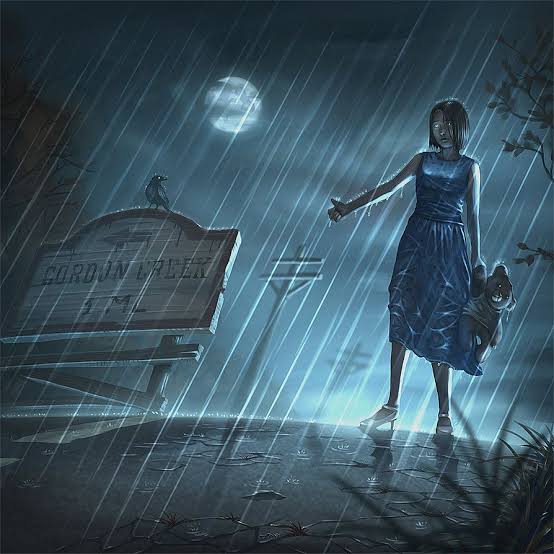
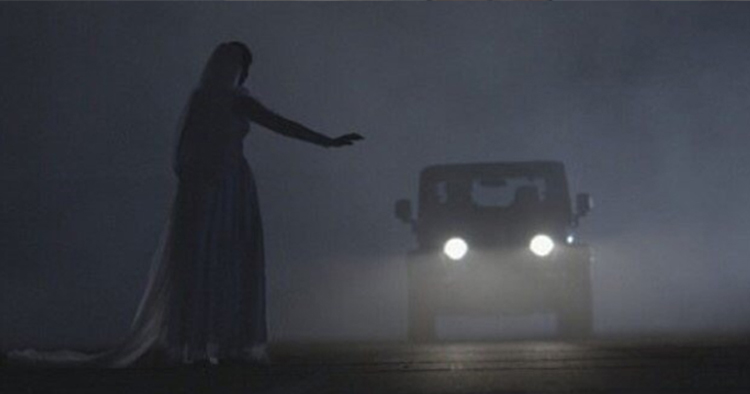
The road is empty in both directions. It has been raining, or it is about to rain, and the headlights catch something on the shoulder—a figure standing still, facing the oncoming car. The driver slows. The passenger gets in without much conversation, gives a destination and stares out the window for most of the ride.
The driver glances over. The seat is empty. The door has not opened. The car is still moving.
That is the shape of a story that has appeared on rural highways, suburban backroads and mountain passes across dozens of countries and more than a century of recorded folklore. The setting changes. The passenger’s name changes. The road changes. The shape of the story does not.
The Earliest Known Version
The story is routinely called a product of the automobile age, but folklorists who examined the evidence early found versions that predate the car entirely. In a landmark 1942 paper published in California Folklore Quarterly, researchers Richard Beardsley and Rosalie Hankey collected and classified dozens of variants of what they called the “vanishing hitchhiker” motif. Their work remains one of the foundational documents in urban legend scholarship. What they found pushed the story’s recorded history back considerably further than most people assumed.
Among the pre-automobile versions Beardsley and Hankey traced were accounts involving horse-drawn carriages and wagons. A traveler offers a ride to a lone figure on the road. The figure accepts, rides in silence or near-silence and then disappears before the destination is reached. The driver later learns that the figure matches the description of someone who died—often near that same road. The structure of the story is identical to the automobile versions that would follow decades later. Only the vehicle changed.
Even older motifs exist in ghost-lore traditions from multiple cultures. Stories of the dead returning briefly to complete unfinished journeys, deliver messages to the living or simply be seen one final time on a familiar road appear in European, Asian and American folk traditions. Scholars of comparative folklore have noted that the vanishing hitchhiker belongs to a broader family of “return from the dead” narratives, adapted in each era to whatever form of transportation was common. The horse and wagon gave way to the automobile. The traveler on foot became the figure on the roadside. The core transaction—a stranger accepted, a destination offered, a disappearance—remained constant.
The pre-automobile versions are documented in folklore collections, but they received limited public attention until the automobile made the story feel contemporary and immediate. By the early twentieth century, as cars became widespread in America and Europe, the vanishing hitchhiker began appearing in the form most people recognize today. Beardsley and Hankey’s 1942 classification organized these modern variants into sub-types based on the specific detail that completed the reveal: the coat left behind, the address given to an unsuspecting family, the cemetery discovered nearby. That structure—the driver, the ride, the disappearance, the verification—was already well established by the time they began collecting.
The 1942 paper did not claim to have found the original story. It documented a pattern already in circulation, already carrying local names and local roads. That distinction matters, because it means the vanishing hitchhiker had no single point of origin that can be pinned down. It emerged, or re-emerged, whenever the conditions were right: a road, a culture familiar with sudden death on that road, and a community that shared stories face to face.
YOUTUBE EMBED 1 — PRIMARY SEARCH QUERY: “Vanishing Hitchhiker urban legend folklore documentary”
The Details That Repeat
What makes the vanishing hitchhiker unusual among folklore types is the consistency of its recurring details across unrelated versions. Beardsley and Hankey identified these repeating elements in their original classification, and later researchers found them holding across decades and continents. Understanding what stays constant—and what varies—is central to understanding how the story works.
The coat motif appears in a significant number of versions. The driver, finding the passenger cold or distressed, offers a jacket or coat. When the passenger vanishes, the coat remains on the seat. The driver traces the address given by the passenger, finds a home and learns that the person described died some time ago—often on the anniversary of that night. The coat is later found draped over a gravestone in the nearby cemetery. This detail is specific enough to feel like a physical clue, which is part of why it has such staying power. A coat on a grave is the kind of evidence a person could theoretically verify. That verifiability, even when it remains purely imagined, makes the story feel closer to a report than a legend.
The cemetery reveal is itself a recurring element across many variants. The driver, following up after the disappearance, visits the address the passenger provided. A family member—often elderly, often clearly grieving—confirms that someone matching the description died years earlier, usually in a road accident near the place where the driver first saw the figure. The grave, when found, is often said to be nearby and freshly disturbed, or marked with the object the driver left behind.
The friend-of-a-friend structure is equally consistent. The story is almost never told in the first person by the driver involved. It is told by someone who knows someone who knows the driver. This structure, which folklorist Jan Harold Brunvand analyzed extensively in his 1981 book The Vanishing Hitchhiker: American Urban Legends and Their Meanings, is one of the defining features of urban legend as a form. The distance of one or two relationships from the original event makes the story both credible and unverifiable. The source is real enough to trust; the event is far enough away to resist direct questioning.
Local naming is another reliable feature. In nearly every community where the story circulates, the passenger is given a specific name, tied to a specific road and a specific date. In some American versions, she is a young woman who died on her way home from a school dance. In some Philippine versions, the figure is a woman in white associated with a particular highway. In Irish tradition, similar figures appear on roads between towns after dark. The local specificity functions as a form of credibility—the story is not about somewhere else, it is about here, this road, this family, this accident that the oldest residents remember.
What the recurring details collectively accomplish is a simulation of eyewitness testimony. The coat can be checked. The grave can be found. The family can be visited. The address can be confirmed. In practice, none of these verifications appear in documented records. But the story is structured so that they feel one step away from being checkable, and that feeling is what carries it from one teller to the next.
The Real Events Behind the Legend
Researchers examining the vanishing hitchhiker have consistently asked whether local versions trace back to real accidents or real deaths. The answer is complicated. In some cases, there is a real accident somewhere near the road named in the legend—a young person did die, a crash did happen, a family did grieve. The legend attaches itself to that real event and gives it a supernatural extension. In other cases, no corresponding accident record can be found, and the story appears to have generated its own local history rather than growing from one.
The grief function of the legend has been examined by several folklore researchers. Road deaths are sudden, often inexplicable and particularly difficult to process because they happen in transit—between home and destination, between one life and the next. A story in which the dead appear briefly on the road and make one final journey home addresses that rupture directly. The vanishing hitchhiker does not haunt a house or a specific place. She appears on the road itself, in motion, going somewhere. The story’s emotional logic maps onto the experience of loss in travel.
Brunvand’s 1981 analysis identified the legend as belonging to what he called “car lore”—a body of folklore generated by American road culture and its anxieties. Picking up strangers carries risk. Roads after dark carry risk. The story takes both of those anxieties and adds a third layer: the stranger you helped was not alive to begin with, and your act of kindness was witnessed by something beyond the living world. The emotional residue of that encounter—the empty seat, the coat on the grave—is what people carry with them when they tell the story again.
Contemporaneous newspaper archives from the early twentieth century occasionally recorded stories that resemble the vanishing hitchhiker, often in regional papers that collected local strange reports. These newspaper versions function as early documentation of the story’s circulation, though they do not constitute evidence of a supernatural event. They show that the legend was already being treated as a credible local report—something a specific person experienced, on a specific road, recently enough to be newsworthy—before scholars began collecting it systematically.
How the Story Spread
The vanishing hitchhiker is one of the stories that helped define the academic study of urban legends as a field. Brunvand’s 1981 book used it as the title piece precisely because it demonstrated how a story could be simultaneously local and universal, eyewitness-structured and impossible to trace to a single eyewitness. The book brought the concept of the urban legend to a general audience and established a vocabulary—FOAF (friend of a friend), legend tripping, motif transfer—that researchers still use.
Before Brunvand, the story had already crossed national borders through the ordinary mechanisms of travel and cultural contact. Soldiers, immigrants, travelers and missionaries carried story-structures with them across continents. When a new version of the vanishing hitchhiker appeared in a community, it was rarely imported wholesale. Instead, the motif arrived and found local material to attach to—a real road, a recent accident, a family name that carried weight in the community. The story was rebuilt in each location with local timber.
The post-World War II expansion of automobile culture in the United States accelerated the spread significantly. As more Americans drove more roads, the roadside pickup scenario became a common part of daily life. Hitchhiking was widespread, especially among young people, and the figure on the shoulder of the road was a familiar sight. The vanishing hitchhiker story fit that era so precisely that it seemed to grow from it—though Beardsley and Hankey had already shown the story was older.
Radio programs, pulp fiction magazines and later television anthology series carried versions of the vanishing hitchhiker to large audiences during the mid-twentieth century. Each retelling introduced the story to people who had not heard it before and reinforced it for people who had. By the time the Internet arrived, the story had already completed its global distribution through older channels. Online forums and social media accelerated the local-naming process, as users shared regional versions and debated which road and which name represented the “real” story.
The spread of the legend was also aided by its structural simplicity. The story requires no special setting beyond a road at night, no special props beyond a car, and no special knowledge beyond the basic human experience of picking someone up and having them not be there anymore. That simplicity made it easily transmissible and easily adapted. Every culture with roads and cars had the raw material to generate a local version.
YOUTUBE EMBED 2 — SECONDARY SEARCH QUERY: “phantom hitchhiker folklore history”
The Folklore Explanation
Scholars who study why certain stories persist across generations and cultures point to a cluster of factors that the vanishing hitchhiker satisfies almost perfectly. The story is what researchers call a “memorate”—a personal-experience narrative structured around a supernatural event—even when the person telling it was not the one who experienced it. The friend-of-a-friend construction provides just enough personal connection to make the story feel like testimony while keeping it far enough away to prevent direct verification.
The story also belongs to what comparative folklorists classify as the “revenant” tradition—stories of the dead returning to interact with the living before moving on. Revenants appear in folklore from ancient Greece, medieval Europe, pre-colonial Asia and the Indigenous traditions of the Americas. The returning dead are typically benign or neutral in their intentions: they want to complete something, deliver something, say goodbye or simply be seen. The vanishing hitchhiker fits squarely in this tradition, updated for modern roads.
Psychologists who have examined why urban legends feel like true reports point to a phenomenon sometimes called “source monitoring error”—the tendency to misattribute where information came from. When a story is told with specific details (a named road, a date, a physical object like the coat), listeners encode those details as memories rather than as narrative elements. Retelling the story later, they may genuinely believe they heard it from a reliable source, even if the original telling was clearly presented as something that happened to a friend of a friend. The specificity of the vanishing hitchhiker—the coat, the grave, the family’s grief-worn face—makes it particularly susceptible to this kind of memory consolidation.
The story also addresses what sociologists of risk call “road danger narratives”—the informal cultural processing of the known hazards of driving. Car accidents are among the most common causes of sudden death in modern industrialized societies. The vanishing hitchhiker turns that danger into story form: the road is where the dead linger, the road is where boundaries between living and gone are thin, the road at night is where something ordinary can become something that cannot be explained. Telling and retelling this kind of story is a way of giving shape to formless anxiety about a risk that is real and statistically significant.
The Details Added Later
Tracking how the vanishing hitchhiker changed across different eras reveals how folklore evolves to stay current. Early automobile-era versions were relatively spare. The hitchhiker appeared, rode in silence, disappeared. The verification through the family at the address was present but not always elaborated. Later versions added layers of detail that made the story feel more like a first-person account: the driver’s exact words, the passenger’s physical description, the specific year of the accident, the name carved on the grave.
Television anthology programs from the 1950s through the 1980s dramatized versions of the vanishing hitchhiker repeatedly, and these dramatizations fed back into oral tradition. Viewers who saw a televised version would later tell the story as something that had happened to someone they knew, incorporating visual details from the show—the dress the figure wore, the color of the coat, the design of the gate at the cemetery—without necessarily remembering where those details originated. This feedback loop between mass media and oral tradition is well documented in folklore scholarship and helped give the story new visual texture that oral telling alone might not have generated.
The Internet era introduced another layer of local adaptation. Forum threads and social media posts allowed users in specific regions to collaborate on building out the local history of their version. Users would add details—a named stretch of highway, a year, a school—and these details would be picked up and repeated by other users until they achieved a kind of collective authority. None of this collaborative world-building produced documentary evidence of a supernatural event, but it produced locally credible narratives that felt to participants like the recovery of a true local history.
Some later versions introduced variants that older collectors had not documented. A male hitchhiker rather than female. A figure who does not vanish but whose face, when glimpsed in the rearview mirror, is wrong in some way. A passenger who gives accurate information about an accident ahead on the road, which is then confirmed. These additions suggest that the story’s core structure is robust enough to accommodate new details without losing its essential shape, which is itself evidence of a highly successful folklore type.
What the Evidence Does Not Show
Despite the hundreds of versions collected by folklorists across more than a century, no single case of the vanishing hitchhiker has produced documentary evidence of a supernatural event. No police report records a disappearing passenger. No hospital or morgue record links a reported ghost to a verifiable death on a specific road on a specific date. No family has produced a coat found on a grave with authenticated chain of custody connecting it to a stranger who gave their address to a driver who then visited their door.
This is not an absence of evidence created by institutional suppression or official indifference. It is the expected result of examining a folklore type rather than a documented event. The vanishing hitchhiker is a story, and the evidence for it is the evidence of storytelling: the collected variants, the scholarly classifications, the way the same motifs appear independently across cultures, the mechanisms by which the story travels and adapts. That body of evidence is substantial and well-documented. It simply does not constitute evidence that a passenger ever vanished from a moving car.
Some researchers have tested specific named local versions by searching contemporary newspaper archives for the accidents they reference. Results are mixed. Occasionally a real accident can be found on or near the road named in the legend, in roughly the right era, with roughly the right demographics. More often, the accident is not in the record, or the accident found does not match the legend’s details closely enough to establish a connection. When a real accident does exist near a named road, it is more likely that the legend attached to the accident than that the accident generated the legend from scratch—the story-structure existed before the local naming.
The friend-of-a-friend chain that characterizes every told version of the vanishing hitchhiker means that the original driver—the one who actually picked up the vanishing passenger—is always one or two steps away from the person currently telling the story. Folklorists who have tried to follow these chains find that each link in the chain points to another link, and the original witness is never reachable. This is not evidence of a cover-up. It is the structural signature of an urban legend, where the credibility of the story depends on its being just close enough to be plausible and just far enough to be unverifiable.
Why the Legend Survives After Midnight
A story survives when it is useful. The vanishing hitchhiker has proven useful to a remarkable number of communities across a remarkable span of time, which is why it persists long after the conditions that supposedly generated it have changed. Hitchhiking is far less common than it was in the mid-twentieth century. Roads are better lit. Emergency services are more accessible. None of that has diminished the story’s circulation, because the story was never really about the practical risks of the roadside pickup. It was about something older and less fixable.
It was about the people who do not come home. It was about the strange feeling that the road between departure and arrival is a different kind of space—governed by different rules, populated by the possibility of encounters that would not happen elsewhere. It was about grief looking for a shape, and the human need to believe that the dead do not simply stop at the moment of death but continue, at least briefly, on a road they were already traveling.
The story’s genius, if a legend can be said to have genius, is in its ending. The driver does not see a ghost that frightens and threatens. The driver gives a ride to someone who needed one and finds, afterward, that the kindness was received by someone already gone. That is a different kind of haunting—not malevolent, not even particularly dramatic, but quietly unresolved. The coat on the grave. The family’s face when the coat is described. The driver sitting in the car outside the cemetery, not sure what to do with what they now know.
That image is portable because it maps onto something real. Loss on the road is real. The wish to have helped someone who could not be helped is real. The feeling that a drive through a certain stretch of road at a certain hour puts you briefly in contact with something you cannot name is real, even if what you are in contact with is only the accumulated weight of every story ever told about that road.
The folklorists who collected and classified this story were not trying to prove or disprove a supernatural claim. They were documenting a pattern in human storytelling that is older than the automobile, older than the paved road and probably older than any single version anyone will ever trace to its source. What they found was not evidence of a ghost. It was evidence of a story that knows, with remarkable precision, where people are most likely to believe it.
The road after midnight is exactly that place. It always has been.

