At first, the sound was so faint that it could easily have been mistaken for the wind moving through the bamboo.
A soft whimper.
Then another.
The cries came from somewhere beyond the tangled branches, hidden beneath thick leaves and overgrown plants.
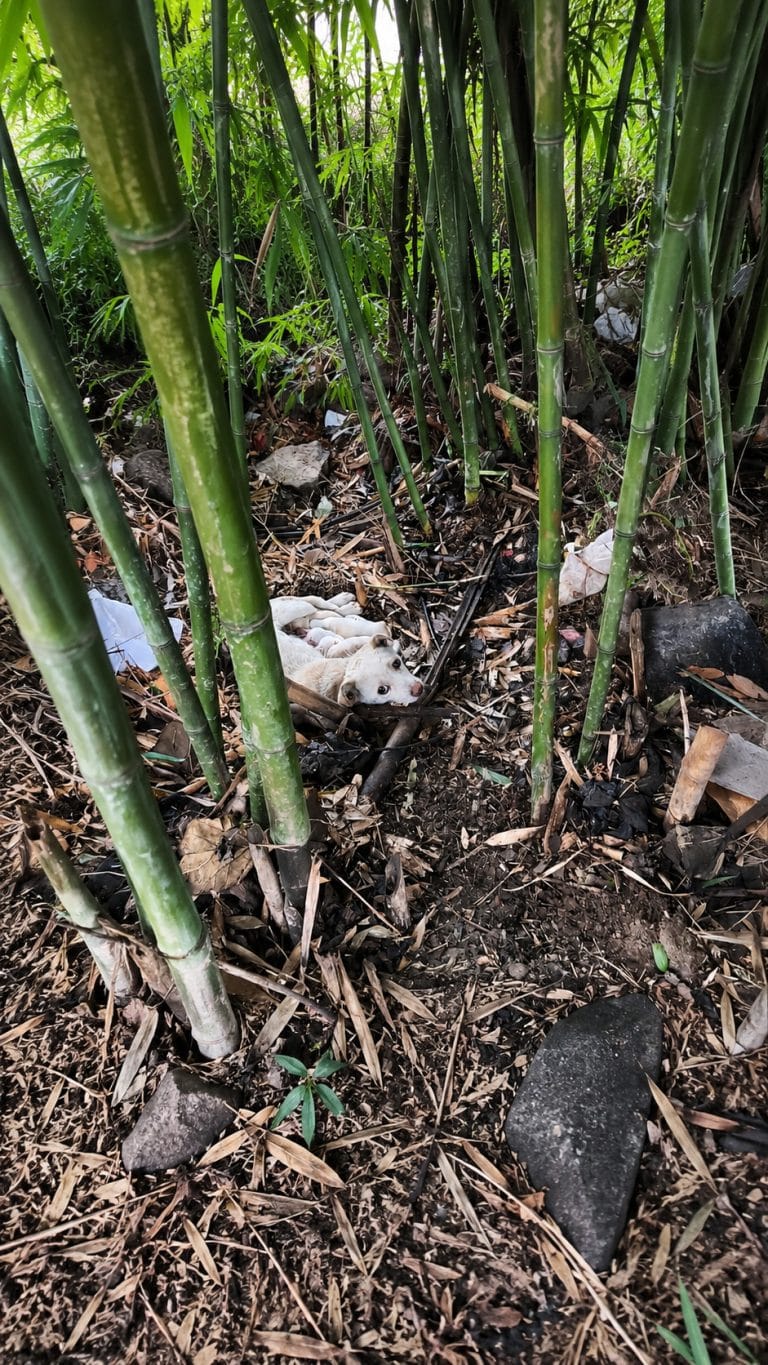
Concerned, a rescuer carefully pushed through the bamboo to see what was there.
Inside the thicket, curled tightly against the ground, was a frightened mother dog.
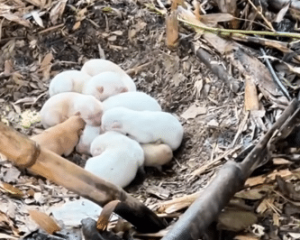
Pressed against her body were eight newborn puppies.
They were tiny, vulnerable, and exposed to the changing weather. Some moved weakly beside their mother while others cried for warmth and milk.
The mother immediately noticed the stranger.
Her body stiffened.
She lowered herself protectively over the puppies and began to growl.
The rescuer understood the warning.
This mother did not know whether the person approaching her family had come to help or cause more harm.
So the rescue could not begin by taking the puppies away.
It had to begin by proving that the stranger would return with kindness.
Eight Newborn Puppies Were Hidden Beneath the Bamboo
The bamboo thicket gave the family some protection from view, but it was not a safe place for newborn puppies.
The ground was uneven and covered with leaves and debris.
There was no proper shelter from rain.
Cold air could move easily through the branches, and the puppies were still too young to regulate their body temperature well without their mother.
They depended on her for nearly everything.
Warmth.
Milk.
Protection.
And because the mother dog was also living outdoors, her ability to provide those things depended on whether she could find enough food for herself.
The rescuer did not know how long the family had been there.
The mother’s guarded behavior suggested that she was accustomed to protecting the puppies without assistance.
Whenever the rescuer shifted closer, she watched carefully.
Her eyes followed every movement.
A quiet growl warned against coming too near.
The reaction was understandable.
She had eight fragile puppies pressed beneath her body and nowhere else to take them.
Trying to grab the newborns or force the mother from the thicket would only increase her fear.
Instead, the rescuer began with the most urgent need.
The puppies required a warmer and drier place to rest.
Old clothing was gathered and placed beneath them to create a softer layer between their bodies and the ground.
The mother remained cautious, but the rescuer did not push beyond the distance she could tolerate.
For the moment, making the bamboo shelter slightly safer was the most that could be done.
Video: Tiny Cries Lead a Rescuer to a Mother Dog Protecting Eight Newborn Puppies
A Sudden Downpour Put the Entire Family at Risk
Not long after the puppies were discovered, the weather changed.
Rain began falling over the bamboo thicket.
What had already been an unstable shelter quickly became dangerous for eight newborn animals.
Leaves could offer only limited protection.
The ground began absorbing water.
The clothing beneath the puppies risked becoming wet, and once their bodies became cold, their condition could deteriorate quickly.
The rescuer hurried back with cardboard boxes, dry blankets, and anything else that could help shield the family from the weather.
Working around a frightened mother dog required caution.
Every movement had to be slow enough that she did not feel forced to defend the puppies.
The rescuer arranged the materials around the family, creating a barrier against some of the rain while preserving enough space for the mother to move in and out.
It was not a permanent home.
But it gave the puppies a better chance of remaining dry through the sudden downpour.
That day also made something else clear.
Helping the family could not be a single visit.
The puppies would continue needing protection.
Their mother would need reliable food and clean water if she was going to produce enough milk.
And because she was still afraid of people, trust would have to be built before the family could be handled more safely.
So the rescuer returned the following day.
Then returned again.
Fresh food and clean water were placed near the bamboo shelter every day.
At first, the mother refused to approach while the rescuer remained close.
She waited.
She watched.
And she continued protecting the puppies with her body.
The Mother Dog Would Not Lower Her Guard
The mother’s reaction was not unusual for a dog caring for newborn puppies in an unfamiliar environment.
She had no way to understand the rescuer’s intentions.
Food appeared beside the shelter, but accepting it required her to move closer to someone she did not yet trust.
When the rescuer approached too quickly, the mother growled.
When a hand moved toward the puppies, she immediately became more alert.
The rescuer respected those boundaries.
No attempt was made to punish her for being defensive.
She was not being difficult.
She was communicating that the distance felt unsafe.
Each day followed a similar pattern.
Food was brought.
Water was replaced.
The shelter was checked.
Then the rescuer stepped back.
Hunger eventually encouraged the mother to move toward the food, but she continued watching the person nearby.
She ate quickly and returned to her puppies.
The next day, the food appeared again.
Nothing was demanded from her.
No one tried to take the puppies while she ate.
No one chased her when she retreated into the bamboo.
That consistency began changing the way she reacted.
Her growls became less frequent.
She allowed the rescuer to remain a little closer.
She still guarded the puppies, but she no longer responded to every movement with the same immediate tension.
Then, on the fourth day, the relationship reached an important turning point.
The rescuer held out food.
The mother hesitated.
She watched the hand carefully, unsure whether moving closer was safe.
Then she stepped forward and accepted the food directly.
It was only one small interaction.
But it showed that the mother had begun associating the rescuer with nourishment rather than danger.
Trust had not appeared all at once.
It had been built through four days of returning without causing harm.
When Their Mother Left, the Puppies Began Crying
Although food was now being delivered regularly, the mother sometimes disappeared from the bamboo shelter.
She may have been searching for additional food or responding to needs outside the thicket.
Whatever the reason, her absence created an immediate problem for the newborn puppies.
Without their mother beside them, they lost their main source of warmth.
They also lost access to milk.
The longer she remained away, the louder the puppies cried.
Their tiny bodies shifted against one another beneath the blankets, searching for the warmth and nourishment that were no longer there.
The rescuer could not know exactly when the mother would return.
Waiting too long could leave the puppies weak and dehydrated.
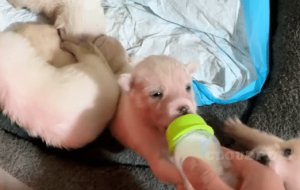
So goat milk was purchased as an emergency source of nourishment.
Each puppy had to be fed individually.
Because they were too young to drink from a bowl, the rescuer used a syringe and offered the milk slowly.
One puppy at a time was lifted carefully.
A small amount of milk was placed near the mouth.
The rescuer waited for the puppy to swallow before offering more.
The process required patience.
Feeding too quickly could be dangerous for such young animals, while stopping too early might leave them without enough nourishment.
Eight puppies meant repeating the routine again and again.
Pick one up.
Support the tiny body.
Offer the milk.
Wait.
Then begin with the next puppy.
Their desperate movements gradually slowed as they fed.
Afterward, they settled together beneath the dry material placed inside the shelter.
The rescuer could not replace everything their mother provided.
But during the hours when she was absent, the supplemental feeding helped the puppies continue through another difficult day.
The Weak Newborns Slowly Began Growing Stronger
Newborn puppies change quickly when they receive regular nourishment and remain protected from the weather.
At first, the eight puppies did little beyond sleeping, feeding, and crying when hungry.
Their legs were too weak to support them.
Their movements consisted mainly of crawling toward warmth or pressing closer to their mother.
As the days passed, however, those movements became stronger.
The puppies began lifting their heads more often.
They reacted more clearly to sounds.
Their small bodies gained weight, and the constant vulnerability of the first days slowly began to ease.
The rescuer continued bringing food for the mother and checking the shelter.
When additional feeding was needed, goat milk was provided carefully.
The puppies’ progress could be seen in ordinary moments.
A puppy that had once crawled unsteadily began pushing itself higher on its legs.
Another started exploring beyond the blanket.
Their eyes opened more fully, revealing growing curiosity about the bamboo, the other puppies, and the person who arrived with food.
Eventually, their legs became strong enough for short, awkward steps.
They stumbled over one another.
They lost their balance.
Then they stood and tried again.
The bamboo shelter that had once held eight nearly motionless newborns began filling with movement.
Each day brought a little more strength.
Each meal brought them closer to the stage when they would no longer depend entirely on milk.
Another Dog Became Their Gentle Babysitter
As the puppies became more active, they began exploring everything around them.
They followed scents.
They investigated the blankets.
They climbed over one another and wandered short distances before returning to the group.
During this stage, another dog from the rescuer’s home began spending time near them.
The friendly dog appeared calm and accepting around the puppies.
While their mother remained nearby, the second dog interacted gently with the growing litter.
The puppies followed the dog with interest.
They gathered around, watched every movement, and treated the older animal almost like an additional caretaker.
The interaction also gave the puppies an opportunity to experience safe contact beyond their mother and the rescuer.
They were no longer simply surviving beneath the bamboo.
They were beginning to socialize.
Before long, their unsteady steps became confident enough for play.
They chased one another.
They explored beyond the place where they had once remained huddled together.
They approached the rescuer instead of hiding.
As they transitioned toward solid food, mealtime became increasingly energetic.
Eight small bodies hurried toward the food.
Eight tails moved with excitement.
And when the rescuer walked away, the puppies often followed closely behind like a group of tiny shadows.
Their mother observed the activity without the same defensive behavior she had shown during the first days.
She no longer growled whenever the rescuer approached.
She remained close to the puppies, but her posture had softened.
The stranger who once represented a possible threat had become part of the family’s daily routine.
The Frightened Mother Finally Began to Relax
The mother dog’s transformation was quieter than the puppies’ growth, but it was just as meaningful.
At the beginning, she had shielded the litter with her entire body.
Every movement near the thicket caused her to tense.
She watched the rescuer constantly and growled when the distance became uncomfortable.
Weeks of consistent care changed that response.
Food arrived every day.
The puppies were handled gently.
When rain threatened them, the rescuer brought dry shelter.
When the mother left, the puppies were fed rather than harmed.
Nothing was taken from her.
No one forced affection.
Gradually, she stopped expecting each visit to become a confrontation.
She allowed the rescuer to feed the puppies.
She remained nearby while they explored.
She no longer needed to place herself between the person and her babies every moment.
The change did not mean she had stopped being protective.
She was still their mother.
She still watched them and responded when they needed her.
But she could now share the work of caring for them.
For an exhausted dog raising eight puppies outdoors, that support mattered.
She could eat without immediately rushing away.
She could rest while the puppies played near the other dog.
And she could observe human hands reaching toward them without reacting as though danger had returned.
Her trust had been earned through actions repeated over time.
Returning Every Day Changed Nine Lives
The rescue began with a sound that was almost lost among the bamboo.
A few faint whimpers beneath the leaves.
Had no one stopped to investigate, the mother and her eight puppies would have remained exposed to rain, hunger, and the uncertainty of surviving outdoors.
But one person listened.
Then that person returned.
The family received old clothing when they needed a softer place to rest.
They received cardboard and dry blankets when rain moved through the thicket.
The mother received food and clean water while she was nursing eight puppies.
And when she disappeared to search elsewhere, the newborns received goat milk one syringe at a time.
None of those actions transformed the family immediately.
On the first day, the mother still growled.
The puppies remained weak.
The bamboo was still their only shelter.
But care continued.
By the fourth day, the mother accepted food from the rescuer’s hand.
As the weeks passed, the puppies opened their eyes, strengthened their legs, and began exploring.
They learned to eat solid food.
They played with one another.
They followed the rescuer through their surroundings and accepted the presence of another gentle dog.
By the end of their early journey, the fragile newborns discovered beneath the leaves had become healthy, active puppies.
The mother who once shielded them from every movement could finally remain nearby without constant fear.
Their story was not changed by one grand gesture.
It was changed by consistency.
By noticing the faint sound.
By bringing food the next day.
By returning with blankets when the rain came.
By feeding eight tiny mouths when their mother was gone.
Sometimes saving animals does not begin with having every answer or resource available.
Sometimes it begins with listening closely enough to realize that something vulnerable is calling from a place most people would walk past.
And sometimes the most important part of rescue is simply keeping a quiet promise:
I will come back tomorrow.


