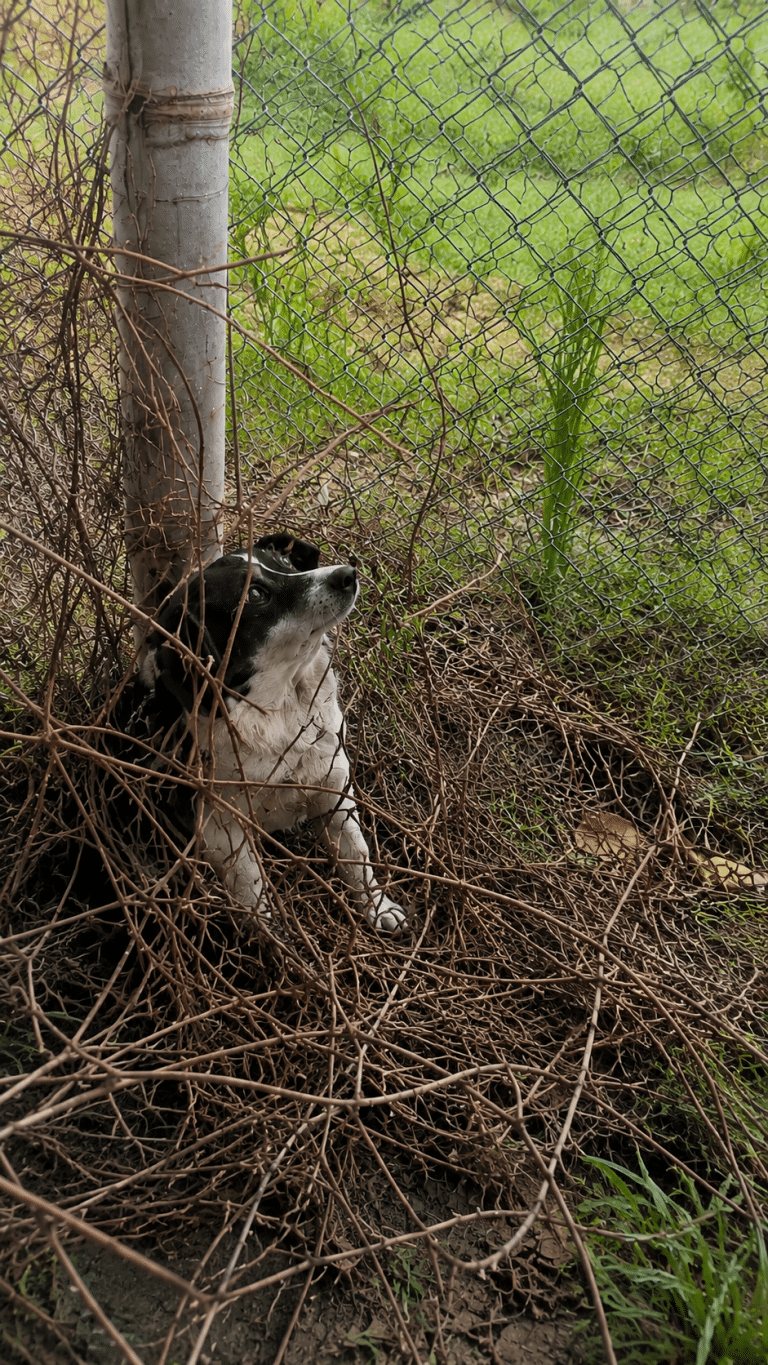
Jerri was so small that he could easily have been lifted into someone’s arms.
But when rescuers first found him curled behind a wire fence, getting anywhere near him seemed almost impossible.
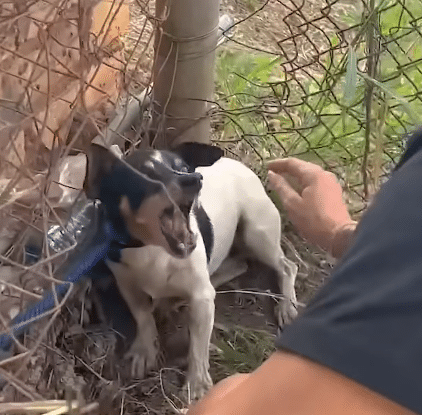
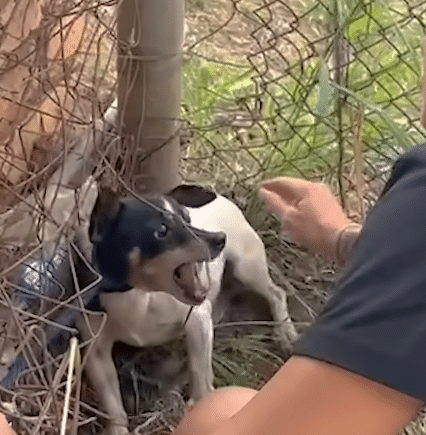
The black-and-white dog shook violently whenever a person approached.
He barked without stopping.
His lips pulled back to reveal his teeth, and if someone stepped too close, he lunged forward before immediately retreating again.
To anyone passing by, Jerri might have looked dangerous.
The rescue team saw something different.
His body was not moving with confidence.
It was trembling.
He did not chase people away and stand proudly in the open. He pressed himself against the fence, trying to create as much distance as the confined space allowed.
Whatever had happened before that moment was unknown.
But Jerri’s behavior made one thing clear:
Being close to people did not feel safe to him.
The Tiny Dog Who Tried to Look Dangerous
Jerri remained tucked behind the wire barrier as the rescuers assessed how to reach him safely.
Every movement caught his attention.
A hand lifting slightly made his body stiffen.
A footstep in his direction triggered another burst of barking.
When someone leaned closer, Jerri exposed his teeth and lunged.
Then he pulled back again.
His behavior was defensive, but it did not appear calm or controlled.
His ears remained tense.
His eyes moved quickly between the people around him.
His entire body shook even while he attempted to warn everyone away.
The team could not know whether Jerri had previously been harmed, chased, abandoned, or simply left without enough positive contact with people.
There was no confirmed history explaining his reaction.
They could only respond to the dog standing in front of them.
Punishing the barking would not make him feel safer.
Forcing a hand through the fence could lead to a bite and reinforce his belief that people ignored his warnings.
So the rescuers slowed everything down.
They softened their voices.
They stopped reaching directly toward him.
And they gave Jerri enough space to observe without feeling cornered.
Video: Terrified Jerri Growls Behind a Fence Until Patient Care Slowly Changes His Behavior
The Fear Followed Him Into the Rescue Center
Leaving the fence did not immediately transform Jerri into a relaxed dog.
Once he arrived at the rescue center, the unfamiliar environment gave him even more to process.
There were new smells.
Doors opening and closing.
Footsteps in nearby rooms.
Dogs barking from other areas.
People entering with food, blankets, and cleaning supplies.
Jerri reacted to many of those sounds as though they might signal danger.
He startled easily.
When someone moved suddenly, he retreated.
If an unfamiliar person entered his space, he kept his distance and watched closely.
At times, he continued growling when the interaction became more than he could tolerate.
The rescuers did not treat this as disobedience.
Jerri was communicating the only way he knew how.
He was showing them when the distance had become too small.
The team respected those signals.
They did not surround him.
They did not insist that he accept petting.
And they did not pick him up simply because his small size made it physically possible.
A frightened dog may become quieter when forced into someone’s arms, but silence does not always mean comfort.
Sometimes it means the animal has stopped believing escape is possible.
The rescuers wanted something different for Jerri.
They wanted him to choose interaction.
That would require time.
Kindness Came Without Pressure
Jerri’s caregivers began creating a routine around him.
Meals arrived at similar times each day.
The same calm voices greeted him.
People moved slowly when entering his resting area.
Instead of reaching over his head, they lowered themselves nearby and allowed him to watch.
Food was placed within reach.
Then the person stepped back.
No affection was demanded in return.
Jerri did not have to wag his tail before receiving care.
He did not have to stop growling immediately.
He did not have to approach anyone before he was ready.
The predictability mattered.
A frightening experience often feels even more overwhelming when an animal cannot anticipate what will happen next.
At the rescue center, the pattern remained steady.
A caregiver arrived.
Food appeared.
Water was refreshed.
The space was cleaned.
Then the person left without hurting or chasing him.
The next day, the same thing happened again.
At first, Jerri continued keeping as much distance as possible.
Then he began remaining nearby for slightly longer periods.
His body still appeared tense, but he did not retreat after every movement.
Sometimes he watched from a short distance instead of hiding completely.
Those changes were easy to miss.
There was no dramatic moment when the barking suddenly ended.
Trust began through seconds.
One calm entrance.
One meal eaten while a person remained in the room.
One interaction that stopped before Jerri became overwhelmed.
Then the routine began again.
Other Dogs Showed Him a Different Way to Respond
One of the most important parts of Jerri’s recovery came from the other dogs at the rescue center.
They were calmer around people.
They approached caregivers for attention.
They accepted gentle touch.
Some rested comfortably while humans moved nearby.
Others played, received treats, and returned willingly when called.
Jerri watched them.
At first, he remained at a distance.
He observed as another dog walked toward a caregiver and was stroked without being restrained or punished.
He saw dogs become excited when familiar people arrived.
He watched them relax in the same environment that still made him cautious.
The other dogs could not explain to Jerri that the rescue center was safe.
But their behavior provided information that human reassurance alone could not.
They approached.
Nothing bad happened.
They played.
No one chased them.
They rested beside people and were allowed to move away when they wanted.
Gradually, Jerri began participating from the edges.
He stayed in the same area instead of immediately hiding.
He followed the other dogs’ movement.
He showed interest when they gathered around a familiar caregiver.
The source describes the peaceful rescue dogs as helping Jerri learn to trust.
That process cannot be measured exactly, but his behavior changed as he spent more time around them.
His trembling became less constant.
The barking decreased.
And the distance he required from familiar people slowly became smaller.
One Gentle Touch Became a Turning Point
The first time Jerri accepted human touch was not a dramatic scene.
He did not run into someone’s arms.
He did not suddenly begin wagging his tail and asking for affection.
A familiar caregiver approached slowly while Jerri remained still.
The hand stopped before entering his space.
Jerri watched.
His body was tense, but he did not lunge.
The caregiver moved slightly closer.
Then, carefully, a hand touched him.
For a moment, everyone waited for the familiar response.
The growl.
The exposed teeth.
The sudden retreat.
But Jerri remained where he was.
He allowed the contact to continue.
The touch itself was brief, yet it represented a major change.
Previously, Jerri had treated an approaching hand as a threat requiring immediate defense.
Now he had experienced contact that did not involve pain, restraint, or the loss of control.
The caregiver did not use the moment as permission to overwhelm him.
The touch ended while Jerri was still tolerating it comfortably.
That mattered.
Trust could grow because his boundaries continued to be respected even after progress appeared.
Over the following days, similar interactions were repeated.
A hand approached slowly.
Jerri was allowed to sniff.
A gentle stroke followed.
Then the caregiver stopped.
Each successful interaction gave him another experience to place beside the fear that had shaped his earlier behavior.
Eventually, Jerri no longer showed his teeth every time someone reached toward him.
He began allowing longer contact.
Then came another milestone.
The little dog who once lunged from behind the fence allowed himself to be held.
The Dog Beneath the Defensive Behavior Began to Appear
As Jerri became more comfortable, the difference in his daily behavior grew increasingly visible.
He no longer spent every interaction trying to create distance.
The growling became less frequent.
His body remained looser around familiar caregivers.
He played more confidently with the other dogs and began moving through shared spaces without immediately searching for somewhere to hide.
Then Jerri started approaching people on his own.
At first, he came only a little closer before stopping.
Later, he remained nearby.
Eventually, he moved toward familiar caregivers instead of waiting for them to close the distance.
This choice was more meaningful than simply allowing someone to touch him.
Jerri was beginning to control the interaction himself.
He could decide when to approach.
He could remain for affection.
And he could move away without being followed or forced back.
The rescue team described him as becoming a completely different dog.
His appearance had not changed dramatically.
He was still the same small black-and-white pup.
What changed was the behavior that had once hidden everything else about him.
Jerri could be playful.
He could enjoy companionship.
He could accept being held when the contact came from someone he knew.
He could join the other dogs without remaining constantly focused on possible threats.
The source says his fear was gone and replaced by love.
That is an emotional interpretation rather than something that can be proven directly.
Jerri could still experience uncertainty in unfamiliar situations.
But the observable transformation was powerful enough.
He was no longer trembling behind a barrier and lunging at every approaching person.
He was participating in a world that had once overwhelmed him.
Jerri Needed Understanding, Not Punishment
Jerri’s first behavior could easily have led someone to label him as aggressive.
He barked.
He snarled.
He showed his teeth.
He lunged when people came too close.
But those actions did not happen in isolation.
His body shook throughout them.
He hid behind a fence.
He retreated whenever distance became available.
Those details helped the rescuers understand that his warnings were rooted in fear.
Had they punished him for growling, Jerri might have learned that communicating discomfort brought another frightening response.
Had they forced affection, he might have become even more defensive.
Instead, they listened.
They recognized that a growl can be valuable information.
It tells a person that the dog is uncomfortable before the situation escalates further.
By respecting that warning, the rescuers showed Jerri that he did not need to defend himself more intensely to be heard.
They gave him predictable routines.
They surrounded him with calm dogs.
They allowed him to observe.
They waited for tiny signs of readiness.
Then they responded without asking for too much at once.
Jerri’s transformation did not come from one special technique or a single emotional moment.
It came from consistency.
The same gentle voices.
The same unhurried movements.
The same willingness to stop when he became uncomfortable.
Day after day, the people around him proved that patience would not disappear simply because he was difficult to approach.
The dog behind the fence had not needed someone stronger than him.
He needed someone willing to understand why he was trying so hard to look frightening.
Today, Jerri can play with other dogs, remain calmly near people, and accept affection that once sent him into panic.
The source does not confirm whether he later entered a permanent home, so that part of his future remains unknown.
But the documented change already carries an important message.
Fearful dogs should not be judged only by the loudest moment of their fear.
Behind the barking may be an animal asking for more distance.
Behind the bared teeth may be a dog who has not yet learned another way to feel protected.
And behind a wire fence may be a gentle companion who cannot appear until someone proves that his warnings will be respected.
Jerri did not change because people ignored his fear.
He changed because they noticed it.
They made room for it.
And they stayed patient long enough for him to discover that an approaching hand did not always mean he had to fight.


