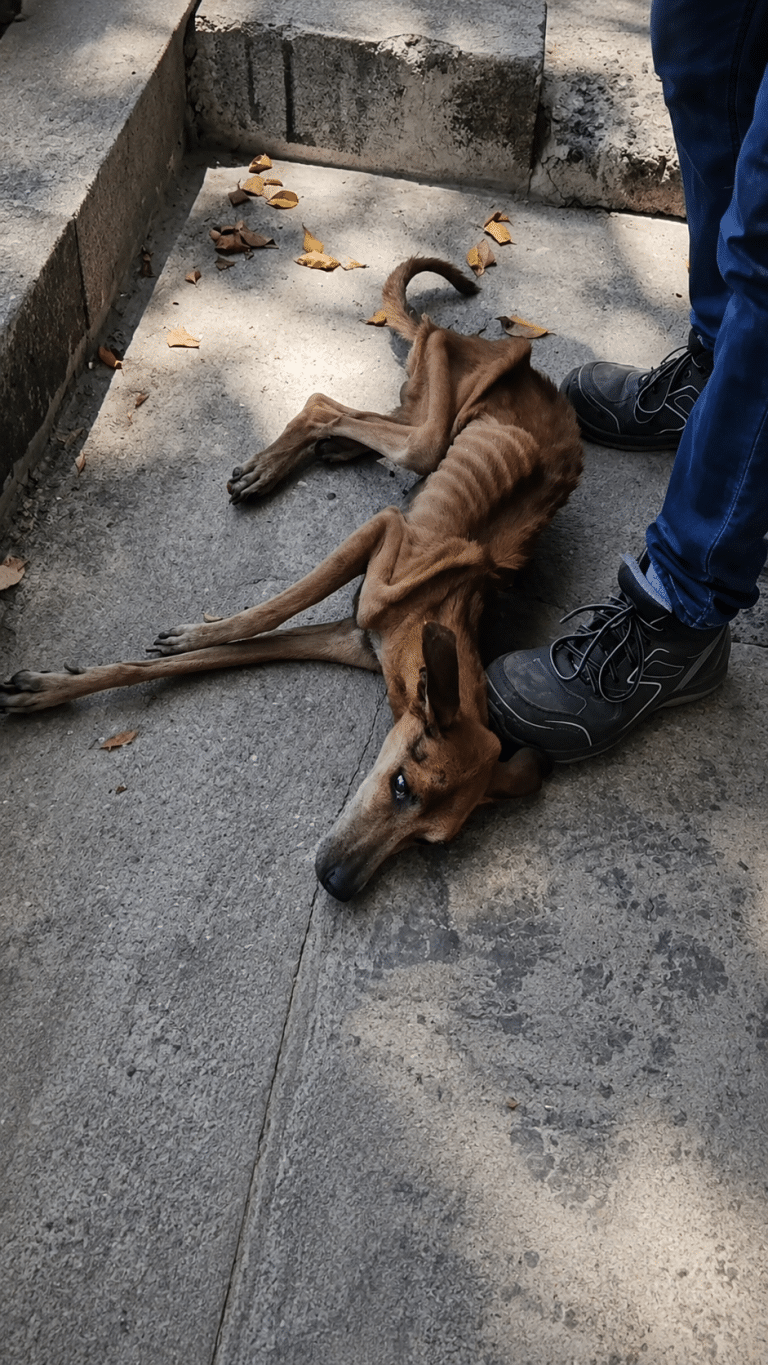
The man riding past on his motorbike almost failed to notice the dog standing beside the road.
Ripped garbage bags and discarded objects covered the ground around him. Against that clutter, the small brown body could easily have disappeared from view.
Then the man noticed the trembling.
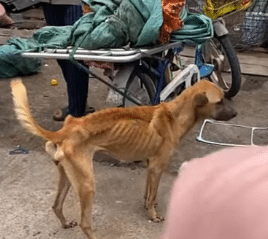
The dog’s legs shook so violently that it seemed impossible for him to remain upright. Every rib pressed through his thin coat, while the sharp outlines of his hips and spine revealed how little strength remained inside him.
Still, he stood.
He did not bark at the stranger.
He did not attempt to run.
He simply watched as the man moved closer, too weak to do anything except remain beside the trash and wait.
The dog would later be named Còi.
By then, however, rescuers would learn that the illness consuming his body had already progressed frighteningly far.
The Dog Beside the Trash Pile Was Barely Holding Himself Up
Còi stood near a roadside area where a local woman reportedly collected scrap materials.
According to people familiar with the situation, the dog belonged to her. But despite technically having an owner, his physical condition showed that he had not received the medical attention he urgently needed.
His entire body appeared wasted.
There was almost no healthy weight covering his ribs.
His legs shook continuously beneath him, and his head remained low as though even holding it upright required effort.
Rescuers could not determine from appearance alone how long Còi had been sick or when his decline began.
What they could see was an animal approaching the limits of what his body could endure.
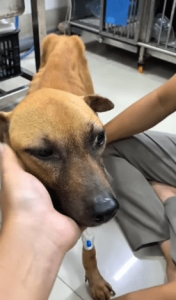
When someone reached toward him, Còi did not growl.
He did not pull away.
A gentle hand touched his head, and he remained still.
It might be tempting to say that he understood help had finally arrived. The footage cannot reveal exactly what he thought.
His lack of resistance may have reflected trust.
It may also have reflected profound exhaustion.
Either way, the rescuers now had an opportunity to remove him from the roadside.
After speaking with the woman identified as his owner and receiving permission to take him, they carefully placed Còi inside a carrier.
The dog who had been trembling beside scattered garbage was finally leaving.
But no one yet understood how little time he might have left.
Video: Còi Was Found Trembling Beside Roadside Trash—Too Weak to Keep Standing Alone
His Nearly White Gums Revealed a Medical Emergency
At the veterinary clinic, the team began examining Còi immediately.
Ticks and other parasites were visible across his weakened body.
His temperature had fallen dangerously low, meaning he could no longer maintain normal warmth without assistance.
Then veterinarians examined his ears and gums.
They appeared almost white.
Healthy gums normally contain visible color because blood is circulating through the tissue. Còi’s extreme paleness was a serious warning that his red blood cell levels might be critically low.
Blood tests confirmed the severity of the problem.
According to the rescue account, Còi was suffering from a serious blood parasite infection accompanied by severe anemia.
The parasites had affected his blood so extensively that his body could no longer carry oxygen efficiently.
That helped explain the trembling.
The weakness.
The dangerously low temperature.
And the way his legs seemed unable to support him.
Còi was not simply hungry.
He was critically ill.
His thin body had almost no reserves available to help him withstand the infection. Without immediate intervention, veterinarians believed he had little chance of surviving.
The team prepared an emergency blood transfusion.
A Blood Transfusion Became His Only Immediate Chance
Còi’s anemia had reached a point where medication alone could not restore what his body needed quickly enough.
He required healthy donor blood.
The transfusion was intended to provide functioning red blood cells while veterinarians treated the underlying parasite infection and supported his weakened system.
Everything had to be monitored carefully.
Còi was already hypothermic.
His circulation was fragile.
His body had endured both prolonged malnutrition and serious disease.
Veterinary staff kept him warm while administering fluids, medication, and the transfusion.
Rescuers stayed nearby.
They watched for changes in his breathing.
They checked whether his temperature was beginning to rise.
They looked for any sign that the donated blood was helping his body respond.
Food was also offered in tiny amounts.
One caregiver held small pieces of beef close to Còi’s mouth, hoping the smell might encourage him to eat.
At times, he showed interest.
He accepted a little food.
Those moments gave the people around him reason to hope that strength might return once treatment had time to work.
But Còi remained extremely fragile.
The transfusion could support him.
It could not immediately reverse everything the infection, parasites, anemia, and lack of nutrition had already done.
Every Small Response Made the Team Hope Again
During the first stage of treatment, Còi produced brief signs that appeared encouraging.
He lifted his head.
He looked toward the food being offered.
At times, he attempted to adjust his position or rise.
For a healthy dog, those actions would have seemed ordinary.
For Còi, each one required precious energy.
The rescuers celebrated them quietly.
They knew the prognosis remained uncertain, but they also knew that Còi was still responding to the people and treatment around him.
Medication continued.
Fluids supported his circulation.
Warm blankets helped raise his body temperature.
The team remained attentive throughout the day and night, responding whenever his condition changed.
Còi did not need dramatic encouragement.
He needed careful medical work repeated hour after hour.
Another temperature check.
Another small amount of food.
Another adjustment to keep him comfortable.
Another moment with someone sitting close enough to notice if his breathing changed.
For a while, those small responses made recovery feel possible.
Then Còi’s strength began fading again.
His body had been severely compromised before he ever reached the clinic.
Despite the transfusion and intensive care, the damage proved greater than he could overcome.
After Two Days, His Body Could No Longer Continue
Còi remained under treatment for two days.
The veterinary staff and rescuers continued doing what they could to stabilize him.
But his condition worsened.
The temporary signs of strength became less frequent.
His body responded less.
Eventually, Còi passed away.
There was no miraculous recovery.
No scene of him running from the clinic.
No permanent home waiting at the end of the documented rescue.
His story concluded quietly inside the place where people had fought to save him.
That outcome was devastating for everyone involved.
Rescuers often enter these situations knowing that treatment may arrive too late. Even so, knowing the risk does not make losing an animal easier.
They had seen Còi standing alone beside the trash.
They had carried him to the clinic.
They had watched him accept small pieces of food.
They had hoped the transfusion would give his body enough strength to recover.
When it did not, they remained with him.
Còi’s final hours were no longer spent beside a noisy road while his legs shook beneath him.
He was warm.
He was resting on soft material.
And people were close enough to respond until he no longer needed their help.
His Final Resting Place Was Prepared With Care
After Còi died, the rescue team prepared a peaceful place for him to rest.
Soft blankets were placed around his body.
Flowers were arranged nearby.
The gestures could not change what had happened to him or replace the care he should have received earlier.
But they acknowledged that his life mattered.
Còi was not treated as something to be discarded.
The same dog who had stood beside torn garbage bags was now handled gently by people who knew his name.
That difference does not turn the ending into a happy one.
It does, however, change the way his final chapter was experienced.
Còi did not die unseen on the roadside.
He did not collapse among the trash without anyone noticing that his body was failing.
Someone stopped.
Someone spoke with the person responsible for him.
Someone carried him into a vehicle.
Veterinarians attempted the emergency transfusion his condition required.
Caregivers offered food by hand and stayed while his strength disappeared.
The treatment could not save him.
Their presence still mattered.
Rescue Does Not Always End With a Miracle
Stories of animal rescue are often remembered through dramatic transformations.
A starving dog gains weight.
A paralyzed animal walks again.
A frightened puppy finds a home.
Còi’s story offers a more difficult truth.
Sometimes help arrives after illness has progressed too far.
Sometimes every reasonable treatment is attempted, but the body can no longer recover.
That does not mean the rescue was pointless.
Before the man on the motorbike stopped, Còi was trembling beside roadside garbage with almost no strength left.
His severe anemia had gone untreated.
Parasites covered his body.
His temperature had dropped dangerously low.
Without intervention, he likely would have died in the same place where he had been found.
Instead, he was carried away.
His condition was diagnosed.
He received donor blood, medication, warmth, fluids, food, and continuous attention.
Those efforts did not produce the ending everyone wanted.
They gave Còi dignity during the time he had left.
His story also raises a painful reminder about animals who technically belong to someone but remain without adequate care.
Having an owner does not automatically mean an animal is protected.
A dog still needs food, parasite prevention, medical treatment, and attention when his behavior or body begins changing.
Pale gums, severe weakness, continuous trembling, visible parasites, and rapid weight loss are not problems that can safely be ignored.
By the time Còi reached the clinic, his illness had already pushed him to the edge.
Earlier treatment might have created a different possibility, though the source does not provide enough medical information to know what the outcome would have been.
What is known is that someone eventually noticed.
And once Còi entered their care, the rescuers refused to treat him as invisible.
Còi Was Seen Before It Was Too Late to Show Him Kindness
Còi’s life cannot be measured only by the two days he spent at the clinic.
Much of his history remains unknown.
The source does not explain where he was born, what his earlier life looked like, or how long the blood parasite infection had been damaging his body.
The documented story begins when he was already gravely ill.
Standing beside trash.
Trembling.
Barely able to support himself.
That is the image most people first saw.
But it was not the final image.
At the end, Còi was surrounded by blankets and flowers.
People mourned him.
They remembered the small moments when he tried to eat and lift his weakened body.
They cared that he had died.
For an animal who had spent so much time overlooked, being seen at the end could not undo the neglect that came before it.
But it meant he did not disappear without anyone knowing he had existed.
Rescue is about fighting for recovery whenever recovery remains possible.
It is also about refusing to abandon an animal when the outcome becomes uncertain.
Sometimes the greatest kindness is medicine.
Sometimes it is a permanent home.
And sometimes, when the body has already suffered too much, kindness means staying close enough that the final moments are warm, quiet, and free from loneliness.
Còi did not receive the miracle everyone hoped for.
He received a name.
He received treatment.
He received gentle hands instead of indifference.
And when his body could no longer continue, he was not lying beside garbage.
He was surrounded by people who had chosen to care.


