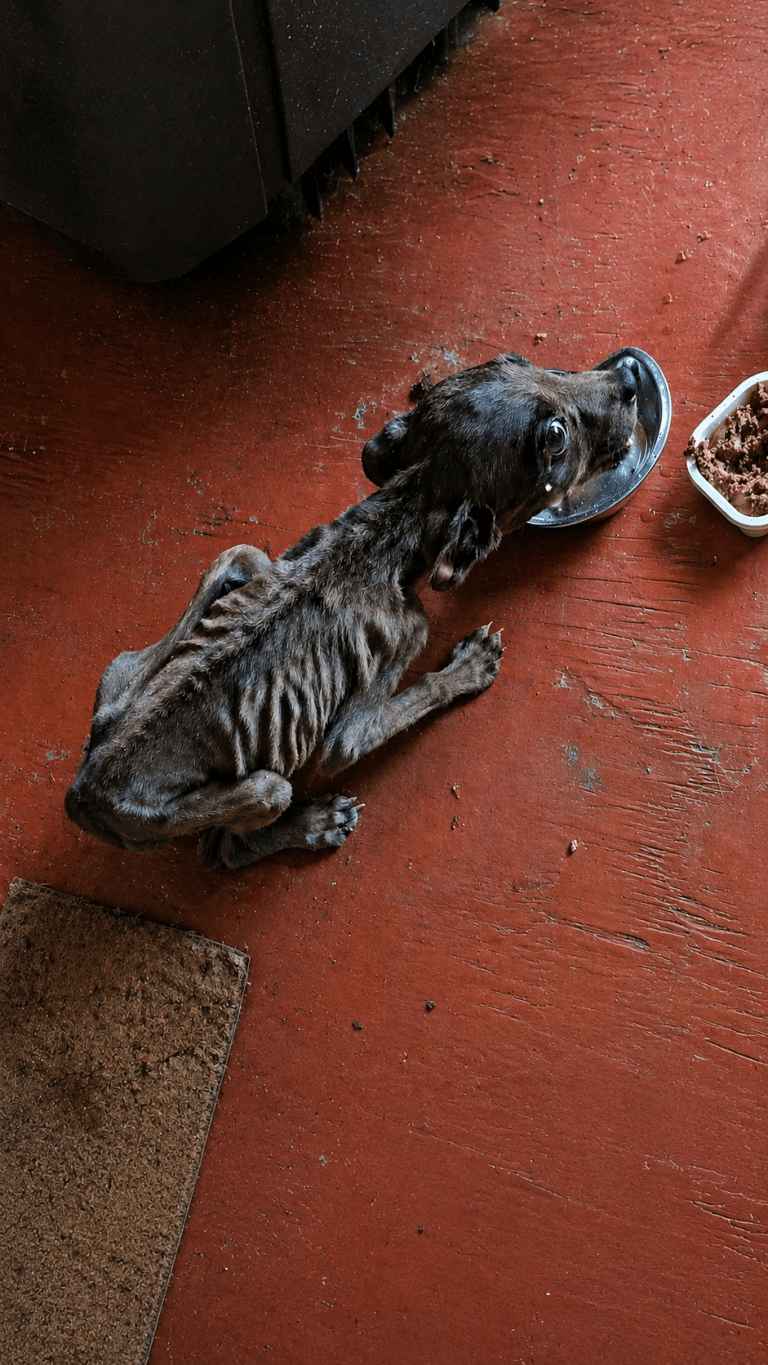
The puppy lay completely still beside the dusty road.
Under the intense heat, his tiny body showed almost no visible movement. His ribs pressed beneath thin skin, his legs rested weakly against the ground, and his head remained lowered as though he no longer had the strength to lift it.
From a passing vehicle, he might have looked as though help had already arrived too late.
Then someone stepped closer.
The puppy did not raise his head.
He did not make a sound.
But his tail moved.
Only once.
The movement was so small it could easily have been missed. Yet it was enough to reveal that the fragile animal was still alive.
That single response changed everything.
The puppy would later be named Ember.
At that moment, however, he was simply a three-pound life lying beside the road—and the people who noticed his tail wag were about to discover how close he was to disappearing.
One Tiny Tail Wag Was the Only Sign He Still Had Strength
The rescuers approached carefully, unsure whether Ember could respond to touch.
His body was severely underweight.
He appeared dangerously dehydrated.
The heat around him only increased the risk to a puppy already unable to regulate his condition normally.
When a hand moved near him, Ember showed almost no reaction beyond that faint movement of his tail.
He could not stand.
He could not walk toward water.
He could not move himself into shade.
Whatever strength had carried him to the roadside appeared nearly exhausted.
The original rescue account does not establish how long Ember had been lying there or exactly how he came to be alone.
What it does show is a puppy whose condition required immediate medical attention.
Rescuers later shared a simple warning based on what they had seen:
Animals lying motionless near a road should always be checked, even when they appear to be gone.
Had no one moved closer, Ember’s faint tail wag might never have been seen.
The team gently lifted him, supporting his entire body as they carried him away from the heat.
There was no time to begin treatment at the roadside.
Ember needed blood tests, fluids, warmth, and veterinary monitoring.
He was rushed into emergency care while rescuers waited to learn whether his tiny body still had enough strength to respond.
Video: Tiny Puppy Found Motionless Beside the Road Surprises Rescuers With One Weak Tail Wag
His Red Blood Cell Level Had Fallen to Only Nine Percent
At the clinic, veterinarians began examining Ember immediately.
His extreme weakness could not be explained by hunger alone.
Blood tests revealed that his packed cell volume, commonly called PCV, had fallen to approximately nine percent.
According to the rescue account, a healthy dog would normally have a PCV of roughly 35 to 55 percent.
Ember’s level was critically low.
PCV measures the proportion of red blood cells circulating through the body. Those cells carry oxygen to organs and tissues.
With so few healthy red blood cells remaining, Ember’s body could not deliver enough oxygen efficiently.
That helped explain why he could barely move.
His muscles lacked the support needed for normal activity.
His gums and other tissues may also have appeared unusually pale, although the original story focuses primarily on the blood test results.
Veterinarians diagnosed life-threatening anemia.
Without an urgent blood transfusion, the rescue team was told that Ember was unlikely to survive.
Then additional tests revealed why his body had become so depleted.
The puppy was suffering from hookworms, roundworms, and coccidia.
The three parasitic infections had placed enormous strain on an animal who weighed barely three pounds.
Hookworms can contribute to blood loss.
Other intestinal parasites interfere with digestion and the body’s ability to absorb the nutrition needed for growth.
For Ember, the infections were not minor problems that could be solved with one routine dose of medication.
His body had already reached a critical state.
The veterinary team needed to treat the parasites while also keeping him alive long enough for the medication to work.
Two Blood Transfusions Gave His Body a Chance to Respond
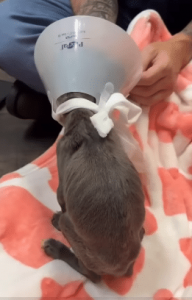
Ember received the first of two blood transfusions while veterinary staff monitored him closely.
Donated blood could replace some of the red blood cells his body had lost, but the procedure was only one part of the emergency care he required.
He also needed fluids to address dehydration.
Medication was started for the parasitic infections.
Because Ember could not maintain a safe body temperature on his own, caregivers kept him continuously warm.
A puppy weighing only three pounds can lose heat quickly, especially when illness and malnutrition have already weakened the body.
Blankets, controlled warmth, and regular temperature checks became part of Ember’s daily care.
The first transfusion did not produce an instant transformation.
He remained fragile.
His movements were limited.
Veterinary staff continued checking his blood values and watching for any sign that the anemia was improving or returning.
When his condition required further support, Ember underwent a second transfusion.
The following days remained uncertain.
No one knew whether his small body would tolerate everything happening at once.
He was fighting anemia.
He was receiving treatment for multiple parasites.
His digestive system had to begin accepting nutrition.
His temperature needed constant support.
Every hour without a serious complication mattered.
Progress first appeared in details that might have seemed insignificant in another animal.
Ember opened his eyes more fully.
He noticed movement around him.
He lifted his head.
Then he began showing more interest in food and the people providing it.
The changes were small, but they suggested that oxygen, warmth, medication, and nourishment were beginning to reach a body that had nearly stopped responding.
On Day Six, an Unlikely Friendship Began
By the sixth day, Ember was stable enough to meet a larger dog named Bear.
According to the original account, Bear was not normally interested in spending time with puppies.
Ember somehow became an exception.
The two dogs began staying close to one another.
Bear’s larger body contrasted sharply with the recovering puppy beside him. Ember was still small, thin, and rebuilding his strength after the transfusions.
Yet he appeared comfortable in Bear’s presence.
He followed the older dog.
He rested nearby.
And as his energy increased, Bear became one of his first companions.
The source describes their bond as forming almost immediately.
No one can know exactly why Bear responded differently to Ember than to other puppies.
What could be seen was that the larger dog accepted him and continued remaining nearby.
For Ember, the interaction represented another change in his recovery.
Until then, most of his days had revolved around medical care.
Blood tests.
Medication.
Temperature checks.
Meals.
Rest.
Now he had another dog to observe and follow.
On Day 7, Ember began showing interest in toys.
At first, his movements were cautious.
He approached unfamiliar objects slowly and appeared to be learning what to do with them.
Then curiosity took over.
He nudged the toys.
He followed them.
He began moving around the room with growing enthusiasm.
Only a week earlier, Ember had been unable to lift himself from the roadside.
Now he was beginning to play.
The Puppy Who Could Not Stand Began Exploring Everything
Once Ember’s strength started returning, his personality became increasingly visible.
He no longer spent every hour lying beneath blankets.
He moved from one part of the room to another.
He investigated corners.
He followed caregivers.
And when toys appeared, he approached with the energetic curiosity expected from a young puppy.
His movements were still uncoordinated at first.
He stumbled.
He occasionally moved faster than his recovering body could balance.
But each day brought greater control.
The parasite treatment continued while caregivers made sure he received enough nutrition to gain weight safely.
His meals helped rebuild the muscles that had nearly disappeared beneath his skin.
As his red blood cell level improved, he had more energy available for activity.
By Day 36, Ember had become comfortable meeting unfamiliar people and interacting with other dogs.
The original account describes the fear disappearing and trust taking its place.
Those internal emotions cannot be measured directly, but his behavior clearly changed.
He no longer remained motionless when someone approached.
He greeted people.
He sought contact.
He played near dogs much larger than himself.
He also continued staying close to Bear, whose companionship had become part of his new routine.
The skeletal puppy from the roadside was still recognizable in earlier images, but his daily behavior no longer resembled the animal found beneath the heat.
Ember was not simply surviving treatment.
He was participating in life around him.
On Day 45, Ember Finally Went Home
Forty-five days after his rescue, Ember was officially adopted by a local family.
The puppy who had been found without anyone beside him now had people prepared to continue his care.
He also remained close to Bear, according to the original story.
The adoption marked a major transition.
At the clinic and rescue center, Ember’s life had been structured around recovery.
In a home, he could begin experiencing the ordinary routines that had previously been missing.
Soft beds.
Toys that belonged to him.
Regular meals.
People returning each day.
Time to play without a medical procedure immediately following.
As the weeks passed, Ember continued growing.
The three-pound puppy began gaining the healthy weight his body had been unable to maintain while overwhelmed by parasites and anemia.
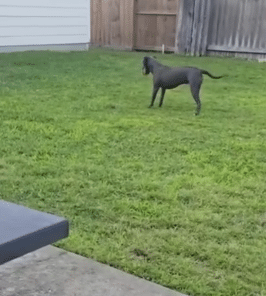
By approximately six months of age, Ember weighed more than 38 pounds.
The physical contrast was remarkable.
The puppy once small enough to be carried easily in two hands had become a strong, energetic young dog.
His coat looked healthier.
His legs carried him confidently.
Instead of a faint tail movement against the road, his entire body now responded excitedly to the people and animals around him.
His family introduced him to experiences that would have been impossible during his critical first days.
He saw snow for the first time.
He tasted his first ice cream treat.
He received new toys and slept on soft beds.
Those moments were ordinary parts of family life.
For Ember, each one existed only because someone had checked whether the motionless puppy beside the road was still breathing.
By Day 250, Almost Nothing Looked the Same
Around Day 250, Ember looked dramatically different from the puppy in the first rescue footage.
His body had filled out.
He could run and play without the weakness that had once prevented him from standing.
The severe anemia had been treated.
The hookworms, roundworms, and coccidia were no longer consuming the resources his body needed to grow.
He had a family.
He had Bear.
And he had enough energy to fill his days with activity rather than medical survival.
The source describes Ember as joyful and deeply loved.
Rather than attempting to prove those feelings, the visible evidence tells the story clearly enough.
He greeted people willingly.
He played with other dogs.
He explored new environments.
He sought affection and remained close to the family caring for him.
The puppy who once appeared almost lifeless now behaved like a healthy young companion.
His transformation was not created by one treatment.
It required two blood transfusions.
Medication for several parasitic infections.
Continuous warmth.
Fluids.
Nutrition.
Veterinary monitoring.
Then weeks of patient care after the immediate crisis had passed.
Each part connected to the next.
Without the tail wag, rescuers might not have realized Ember was alive.
Without emergency blood tests, the severity of his anemia might not have been identified in time.
Without transfusions, his body may not have survived long enough for the parasite treatment to work.
Without continued nutrition and a stable home, the tiny puppy could not have grown into the dog shown months later.
Ember’s story became powerful because the first sign of life was so small.
He did not stand and walk toward his rescuers.
He did not bark loudly enough to call them from a distance.
He moved his tail once.
That was all he could offer.
The people beside him decided it was enough.
They did not assume that stillness meant death.
They moved closer.
They checked.
And when Ember’s tail revealed that he had not stopped responding, they treated his fragile life as something worth fighting for.
By Day 250, the result of that decision could be seen in every energetic step.
Ember no longer lay alone beside a dusty road.
He ran.
He played.
He followed Bear.
He returned to a family that knew how close he had come to never reaching them.
His recovery is not proof that every critically ill puppy will have the same outcome.
It is a reminder that an animal should not be declared beyond help from a distance.
Sometimes the difference between being overlooked and being rescued is one person willing to step closer.
For Ember, everything that followed began with a movement almost too small to see.
One weak tail wag.
One sign that life remained.
And one group of people who refused to ignore it.


