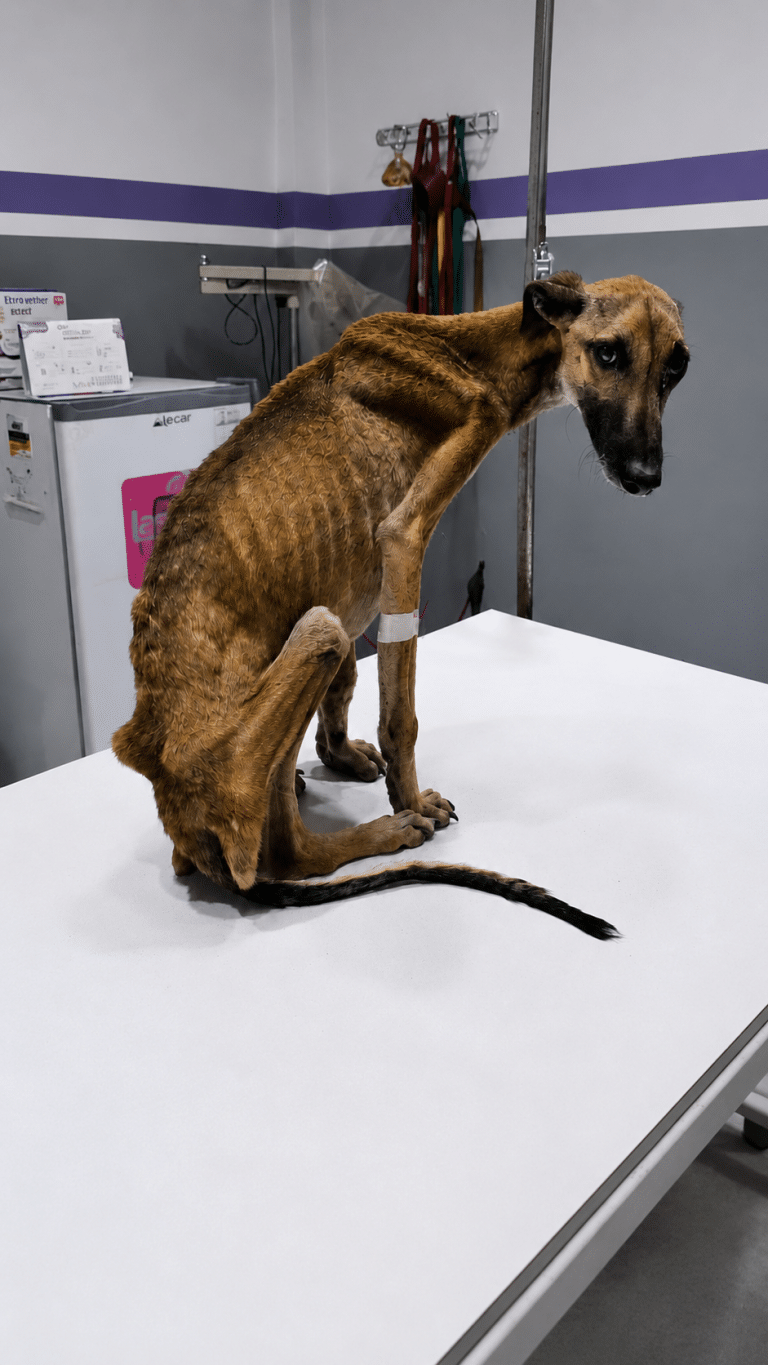
The photograph showed a greyhound so thin that every rib could be counted beneath his coat.
His waist had narrowed almost impossibly.
His legs looked fragile beneath the weight of his own body, and his head hung low as he stood alone on the street.
The rescuers who saw the image online could not determine everything Grisin had endured simply by looking at one photograph.
But they could see that waiting was dangerous.
He appeared severely malnourished.
His body was exhausted.
And if no one reached him soon, there was no guarantee he would remain strong enough to survive outside.
So the team began searching.
They expected a frightened stray who might run the moment strangers approached.
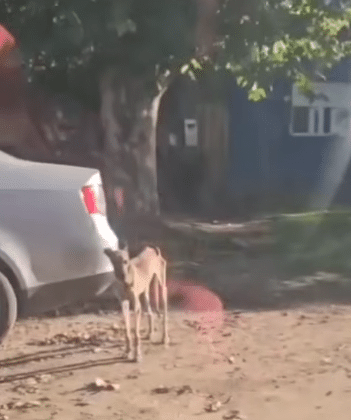
Instead, Grisin slowly walked toward the rescuer.
Then he lowered his head and placed it gently into her open hand.
A Photograph Made It Clear Grisin Could Not Wait Much Longer
Grisin had reportedly been wandering through the area for several weeks before rescuers became aware of him.
People had seen the greyhound moving through the streets, but no one had yet removed him from the conditions steadily weakening his body.
He was easy to overlook from a distance.
Greyhounds naturally have lean frames, but Grisin’s condition went far beyond the normal shape of the breed.
His ribs projected sharply beneath his skin.
The bones around his hips and spine were clearly visible.
His legs appeared thin and unsteady, while his posture suggested that even remaining upright required effort.
The online photograph captured enough detail to alarm the rescue team.
They did not know whether Grisin had once belonged to someone.
They did not know how long he had been without dependable food.
They also could not tell whether illness was contributing to his weight loss.
Those questions would require a veterinary examination.
First, they had to find him.
The rescuers traveled to the area shown in the post and began asking where the dog had last been seen.
They searched nearby streets, open lots, and the places where a hungry animal might look for discarded food or water.
Every hour mattered.
A dog with so little body weight has limited reserves to rely on when illness, cold, or further hunger places additional stress on the body.
Eventually, the rescuers spotted the thin greyhound.
Grisin was still alive.
But the next challenge was getting close enough to help him.
Video: Starving Greyhound Walks Toward a Rescuer and Places His Head in Her Hand
He Did Not Run When the Rescuer Came Closer
The team prepared for Grisin to retreat.
Stray dogs often keep their distance from unfamiliar people, especially when previous interactions have been frightening or unpredictable.
A frightened greyhound can also move quickly, even when underweight.
Chasing him would have increased the danger of driving him toward traffic or causing him to disappear before help could reach him.
The rescuer therefore approached slowly.
She kept her movements calm and avoided surrounding him.
Grisin watched her.
Then, rather than stepping away, he began moving forward.
His pace was slow.
His weakened legs did not carry him with the speed normally associated with a greyhound.
But he continued closing the distance himself.
When he reached the rescuer, Grisin lowered his head.
She extended a hand.
The dog rested his face against it.
The moment was quiet.
There was no dramatic leap into waiting arms.
No excited barking.
Only an exhausted dog allowing a stranger to support the weight of his head.
The original narration interprets the gesture as proof that Grisin still believed in human kindness.
No one can know exactly what he understood in that moment.
His behavior did show that he was willing to approach and accept gentle contact despite his condition.
That cooperation allowed the rescuers to secure him without a frightening chase.
They placed him into transport and headed toward a veterinary clinic.
Grisin had taken the first step toward help on his own.
Now the medical team needed to discover why his body had become so dangerously thin.
A Blood Test Revealed More Than Starvation
At the clinic, veterinarians began assessing Grisin’s weight, hydration, circulation, and overall physical condition.
Severe malnutrition was immediately apparent.
His body needed nourishment, but feeding had to be introduced carefully.
An animal weakened by prolonged hunger may not tolerate large meals safely, especially when an underlying infection is also present.
Veterinarians performed blood testing to look for additional causes of his exhaustion.
According to the rescue account, Grisin tested positive for Ehrlichia.
Ehrlichiosis is a tick-borne disease that can affect blood cells and place significant strain on a dog’s body.
Untreated illness may contribute to weakness, reduced appetite, weight loss, anemia, or other complications, depending on how the infection progresses.
For Grisin, the disease was occurring alongside severe malnutrition.
His body was therefore fighting on more than one front.
Medication was started to treat the infection.
The veterinary team also monitored him closely while introducing fluids and appropriate nutrition.
Grisin remained calm during examinations and handling.
He did not resist the people checking his body or administering the care he needed.
But his gentle behavior did not mean his condition was mild.
He was physically fragile.
His immune system had been under pressure.
And rebuilding the weight he had lost would require much more than one large meal and a night of rest.
The team prepared for a gradual recovery.
His Strength Returned One Meal at a Time
Grisin’s transformation began quietly.
Small, nutritious meals were offered according to a controlled routine.
Water and medication remained available.
He was given a clean, peaceful place where his body could rest without the uncertainty of street life.
At first, much of his time was spent sleeping.
His muscles had little strength.
Even short periods of standing or walking could leave him tired.
The rescuers did not expect immediate playfulness or affection.
They focused first on consistency.
Food arrived every day.
Medication was given as directed.
Caregivers checked his condition and watched for signs that his body was responding.
Slowly, Grisin began gaining weight.
The sharp outline of his ribs became less severe.
His legs supported him more confidently.
He lifted his head more often when people entered the room.
Then his tail began to move.
The changes did not happen all at once.
A small amount of weight appeared around his shoulders.
His coat looked healthier.
He became more interested in unfamiliar sounds and movement.
Instead of spending every moment conserving energy, Grisin began exploring his surroundings.
As the Ehrlichia treatment continued and proper nutrition reached his body, his behavior became increasingly active.
The greyhound who had barely managed to approach a rescuer on the street began walking with greater ease.
Then he started to play.
The Quiet Greyhound Revealed a Playful Personality
During the early rescue, Grisin’s condition had hidden much of his natural behavior.
Hunger and illness shaped nearly every movement.
He walked slowly because his body lacked energy.
He rested frequently because his muscles could not support long periods of activity.
Once those urgent needs began easing, another side of him appeared.
Grisin became curious.
He investigated toys and followed caregivers through the rescue area.
His movements grew more energetic.
He began responding enthusiastically when familiar people arrived.
The source describes him as playing like a puppy discovering happiness for the first time.
That emotional interpretation cannot be confirmed directly, but the visible contrast was remarkable.
The dog in the online photograph had stood with his head low and his ribs exposed.
The recovering Grisin moved freely, engaged with people, and showed interest in play.
His caregivers also described him as affectionate and gentle.
Those qualities could be seen in the way he approached people and accepted attention.
The contact he had initiated during the rescue was not an isolated moment.
As his health improved, Grisin continued seeking human companionship.
Once treatment was completed, he received vaccinations and was neutered.
Medically, he was moving beyond the crisis that had brought him into care.
He was gaining weight.
His energy had returned.
And he was ready for the next stage of his life.
Everyone expected a family to notice him quickly.
Instead, Grisin continued waiting.
Other Dogs Went Home While Grisin Received No Inquiries
Grisin appeared to have everything many adopters claimed to want.
He was gentle.
Affectionate.
Social with the people caring for him.
His medical treatment had been completed, and his body no longer resembled the dangerously thin greyhound seen on the street.
Still, the adoption inquiries did not come.
Week after week passed.
Other dogs entered the rescue center and later left with families.
Grisin remained behind.
The source does not explain why potential adopters overlooked him.
Perhaps they preferred a different size, age, or breed.
Perhaps his story had not yet reached the right audience.
Whatever the reason, his recovery had created a new kind of waiting.
On the street, Grisin had waited without reliable food or treatment.
At the rescue center, his needs were being met.
He had meals, shelter, companionship, and people who cared for him.
But he still lacked a permanent home.
The rescue team continued sharing photographs and updates online.
They wanted people to see more than the image of a starving dog.
Grisin was no longer only a medical case.
He was a companion who enjoyed attention, play, and being near people.
His caregivers knew how naturally he had approached the rescuer and rested his head in her hand.
They had watched him remain calm through treatment.
They had seen the first tail wags, the growing curiosity, and the playful behavior that followed.
They believed someone else would see those qualities too.
They simply did not know when.
One Family Finally Looked Closely Enough
Eventually, a family discovered Grisin’s story.
They contacted the rescue team and arranged to meet him.
The source describes the connection as immediate.
While that feeling is subjective, the meeting led to the outcome rescuers had been working toward.
Grisin was adopted.
The greyhound who had once wandered without dependable care now had a permanent home.
He no longer needed to wait inside the rescue center while visitors chose other dogs.
His new life included the ordinary comforts that had once been uncertain.
A safe place to sleep.
Regular meals.
Space to move.
People who expected him to be there each morning.
The source describes Grisin running freely and resting peacefully with his family.
Those moments represented more than physical recovery.
They showed that the rescue had continued beyond treating Ehrlichia and restoring his weight.
Grisin had moved from survival to belonging.
The scars of his earlier condition could not explain who he was in the home.
He was not simply the greyhound from a heartbreaking photograph.
He was affectionate.
Playful.
Gentle.
And capable of becoming part of a family’s daily life.
His Future Changed Because Someone Refused to Scroll Past
Grisin’s rescue began with an image on a screen.
A dangerously thin greyhound stood somewhere in the streets while strangers shared his photograph online.
It would have been easy for the rescuers to feel sorry for him and continue scrolling.
Instead, they acted.
They searched for the place where he had last been seen.
They approached without frightening him.
They carried him to a clinic, where testing revealed that starvation was not his only problem.
They treated the Ehrlichia infection.
They introduced meals gradually.
They waited while his body rebuilt itself.
Then, when adoption inquiries failed to appear, they continued sharing his story.
Grisin’s transformation was created through several decisions, not one.
The decision to search.
The decision to examine rather than assume hunger was the only issue.
The decision to continue treatment until he was medically ready.
And the decision to keep advocating for him after the dramatic recovery images were no longer new.
The first person who reached Grisin gave him a hand to rest his head upon.
The veterinary team gave his body a chance to heal.
The rescue center gave him time.
Finally, a family gave him the permanence he had been missing.
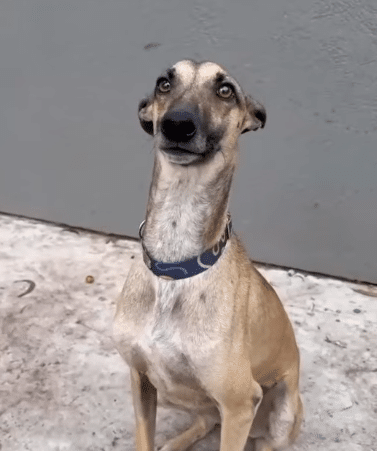
Today, Grisin no longer looks like the dog in the photograph that first alarmed rescuers.
His ribs are no longer sharply exposed.
His legs carry him with confidence.
He can run, play, and rest without needing to search for his next meal.
But one detail from the beginning remains important.
When help approached, Grisin moved toward it.
He did not know what the stranger would do next.
He simply stepped closer and placed his head in an open hand.
That gesture alone did not save him.
What saved him was the person attached to that hand choosing to take responsibility for what happened afterward.
Grisin’s story reminds us that suffering animals are often noticed before they are helped.
A photograph may be shared.
A passerby may stop briefly.
Someone may comment that the dog looks unwell.
The future changes only when concern becomes action.
For Grisin, one rescuer looked at a photograph and decided that watching from a distance was not enough.
She went searching.
And when the exhausted greyhound finally reached her, she was ready to carry him toward the life he had been waiting to find.


