The house is quiet. The lights have been off for an hour. Somewhere down the hall, a faucet drips—or something does—but the sound is distant enough to ignore.
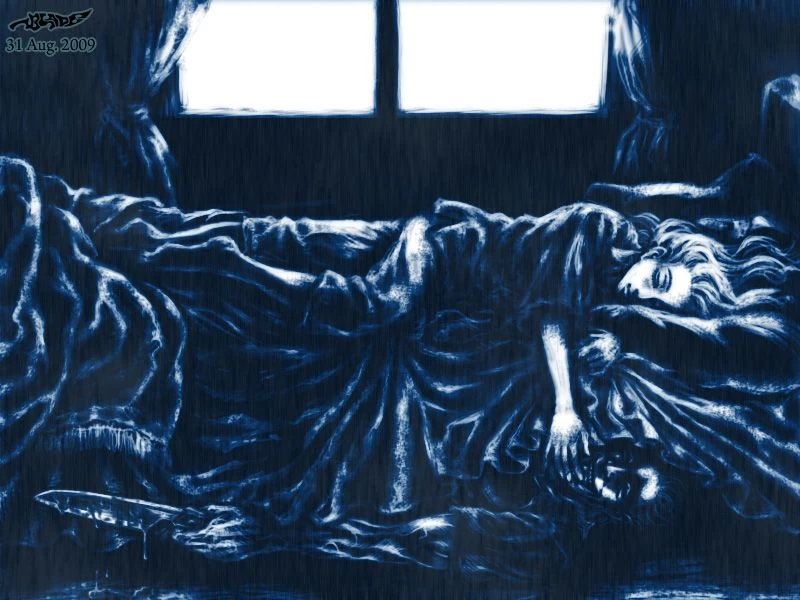
A hand drops from the edge of the mattress, fingers trailing toward the floor. A moment later, something warm and wet presses against them. The dog. Right where he always sleeps. Everything is fine.
By morning, the bathroom mirror has a message written on it. The dog is dead. Whatever licked her hand in the dark was not the dog.
Most people who have heard this story encountered it at a sleepover, in a school hallway or through a late-night retelling at summer camp. It feels like something that happened nearby, recently, to someone just one or two degrees removed. That feeling is part of what the story does. It is not what the evidence supports.
The Earliest Known Version
Folklorists who study urban legends rarely find a clean moment of invention. Stories tend to surface gradually across multiple sources before one version stabilizes and spreads. The Licked Hand follows that pattern, but researchers have identified a meaningful early anchor.
An 1871 diary entry—discussed by folklore researchers as one of the earliest printed appearances of the deceptive-lick motif—describes a young woman alone in a house who extends her hand in the night and receives a lick she interprets as her pet’s affectionate response. The comfort the touch provides is the point of the story. The reassurance is false. The source of the lick is not what she believed. The structural logic of the tale—extend a hand, receive a signal, interpret it as safe, discover it was not—is fully present in that early version.
This matters because it moves the story out of the category of “something that started on the internet” or “something teenagers invented at sleepovers in the 1980s.” The false-comfort mechanism is old. What changed across the following century was the setting, the specific animal, the killer’s identity and the method of discovery.
Folklore scholar Jan Harold Brunvand, whose collections of American urban legends remain standard reference points in the field, documented versions of the story in his work during the 1980s. Brunvand’s research into what he called “belief legends”—stories told as true by people who did not witness them—established that The Licked Hand circulated widely across North America in the mid-to-late twentieth century and showed the structural consistency that characterizes a stable legend rather than a one-off rumor. His documentation noted that the story traveled particularly efficiently among young people at overnight gatherings, where the late hour, the unfamiliar setting and the social pressure to be frightened created ideal transmission conditions.
The version Brunvand and other collectors recorded shared a recognizable skeleton: a person alone or nearly alone in a home or bedroom, a companion animal present as a source of security, a strange ambient sound (often dripping), a hand extended in the night, a lick received and taken as reassurance, and a morning discovery revealing that the animal was dead and the real source of the lick had been a human intruder. The message—sometimes written in blood, sometimes in lipstick, sometimes simply scratched into a surface—varies in wording across versions but carries the same function: it tells the victim, and the audience, what the touch actually was.
The 1871 antecedent does not contain a murderer or a dog. But it contains the mechanism. And in folklore studies, mechanism is often more telling than surface detail.
YOUTUBE EMBED 1 — PRIMARY SEARCH QUERY: “Licked Hand urban legend origin”
The Details That Repeat
When a story circulates across decades and continents in dozens of independent retellings, certain details stabilize while others drift. The details that stabilize tend to be load-bearing—they are doing structural work that the story cannot function without. The details that drift are incidental, local color that adapts to the teller’s context.
In The Licked Hand, five elements appear in virtually every collected variant.
The first is isolation. The central character is alone, or effectively alone. Parents are away for the night. A roommate has left. The usual protective presence is absent. This detail is not incidental—it removes the possibility of immediate help and forces the character to interpret ambiguous signals without a second opinion.
The second is the companion animal. In the dominant modern version, it is a dog. In older and some regional variants, it may be a cat or left unspecified. The animal’s role is to be a known, trusted, familiar presence whose signals the character can read without thinking. The lick is not alarming precisely because it comes from a creature whose affection is expected and routine.
The third is the ambient sound. The dripping. Its source is ambiguous throughout the story—it could be a faucet, rain, a pipe. The character notices it but does not investigate, partly because the lick has already provided reassurance. In many versions, the dripping is later explained as blood from the dead animal. This retroactive explanation transforms a mundane detail into evidence that the danger was present the entire time.
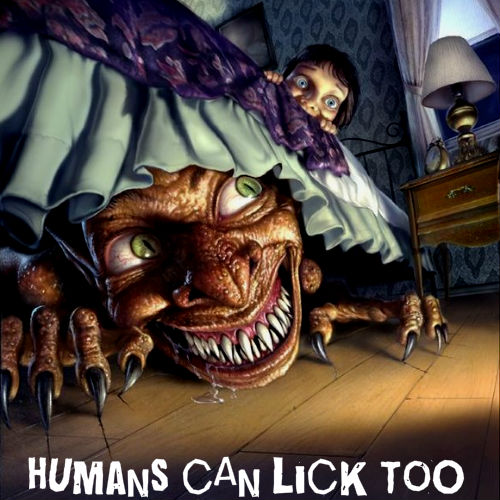
The fourth is the message. Found in the morning, written somewhere prominent—a mirror is common, a wall is common. The message’s content varies. “Humans can lick too” is one well-documented phrasing. Other versions use something similar in structure but different in wording. What the message must accomplish is to simultaneously confirm what happened, deny the comfort that was provided and force the character—and the listener—to replay the previous night with new understanding.
The fifth is the reversal. The moment of reassurance is the moment of deepest danger. The character felt safest at the exact moment the threat was closest. This is the structural engine of the story, and it is the element that the 1871 version already contained. Everything else is updatable. The reversal is not.
The consistency of these five elements across collections documented by Brunvand, by Lynda Lee Burris and other American folklorists, and by researchers working in the United Kingdom and Canada, suggests the story achieved narrative stability relatively early in its modern circulation and has maintained that stability across different transmission environments—campfire, sleepover, school hallway, and eventually online message board and social media.
The Real-World Fear Behind the Story
Urban legends do not survive for generations on structure alone. They survive because they compress a real anxiety into a form that can be shared quickly and felt immediately. The Licked Hand is built on a fear that is neither irrational nor exotic: the fear that an intruder is already inside the home.
This fear has a specific psychological texture that the story exploits with precision. It is not the fear of something unknown approaching from outside. It is the fear of something known to be threatening that is already within the space considered safe—already past every boundary that was supposed to provide protection. The locks, the walls, the familiar layout of the rooms: none of it helped, because the intruder was already there when the character went to bed.
The companion animal amplifies this by providing false reassurance through a channel that should be reliable. People who live with pets develop automatic interpretations of animal behavior. A dog licking a hand is not a signal that requires analysis. It is a known quantity. The story weaponizes that automaticity. The character does not think about the lick because she has been conditioned not to think about it. The intruder exploits a routine so embedded it bypasses conscious evaluation.
Psychologists who study fear and threat detection have noted that among the most destabilizing threat scenarios are those in which familiar safety signals are corrupted. A dark street is frightening. A familiar home where something is wrong is more frightening, because the familiar home was the mental location where fear was supposed to be set aside. The Licked Hand places the threat not just in the home but in the comfort ritual itself.
This connects the story to a broader category of what folklorists call “safe-space violation” legends—stories in which the threat originates within a protected boundary rather than crossing one. The babysitter-and-upstairs-caller legend works on the same logic. So do several college-campus variants in which the danger is already inside a dormitory room. The Licked Hand is perhaps the cleanest expression of this structure because the violation occurs through a signal so intimate and routine that it cannot be suspicious: the touch of a known animal in the dark.
The dripping sound adds a second layer. It is audible throughout the night but not investigated. Most listeners, replaying the story after the revelation, recognize that the dripping was the clue—but also recognize that they, in the same situation, would probably have made the same decision. The lick was reassurance. The dripping was explainable. Sleep was possible. The story does not ask its audience to judge the character for her choices. It asks them to recognize themselves in those choices.
How the Legend Spread
The Licked Hand’s movement through American culture in the second half of the twentieth century follows a pattern well-documented in folklore research. Stories of this type travel along social networks of proximity and trust: they are told by people who know the audience, in settings where the audience is already primed for mild fear, and they are attributed to someone just close enough to be credible but just far enough away to be unverifiable.
The sleepover was its primary vector. Adolescent overnight gatherings—at homes, at camps, at school events—provided the story with nearly ideal transmission conditions. The audience was separated from their normal environment. It was late. The lights were low or off. The social dynamic rewarded the teller who could produce a genuine reaction and punished obvious skepticism with the label of being no fun. The story was already set in a bedroom, at night, with a person trying to sleep—exactly where the audience was. The overlap between the story’s setting and the listener’s current situation is not a coincidence of content. It is one of the reasons the story traveled so effectively through that particular environment.
By the 1980s, when Brunvand was collecting and publishing his surveys of American urban legends, The Licked Hand was already well established enough to have multiple regional variants. Different versions circulated in different parts of the country with local details adjusted—the breed of dog, the type of message, the layout of the house. The core remained stable. These regional adjustments are a standard sign of a legend that has been in active oral circulation long enough to adapt to local contexts without losing its essential shape.
The story crossed into print in horror anthologies and young adult collections during the same period. Appearing in published form gave it a secondary kind of authority. Readers who encountered it in a book were less likely to treat it as something someone had made up, even if the book itself identified its contents as folklore or legend. Print also expanded the story’s reach beyond the social networks through which oral transmission travels, seeding it into communities where it might not have arrived by word of mouth for additional years.
Online circulation, beginning in the 1990s and accelerating through the 2000s, repeated the pattern of oral and print transmission at much greater speed. The story appeared on early horror-focused message boards, in chain emails and later in social media posts that attributed it, as always, to someone known but not present—a friend of a friend, a cousin’s neighbor, someone whose name was not quite provided. The attribution pattern of urban legends did not change when the transmission medium changed. It simply moved faster.
YOUTUBE EMBED 2 — SECONDARY SEARCH QUERY: “1871 licked hand legend diary”
The Folklore Explanation
Folklorists approach a story like The Licked Hand not by asking whether it happened but by asking what work the story does. A legend that survives for over a century in active circulation is surviving because it continues to do something useful or meaningful for the people who tell and hear it. The question is what that something is.
One answer, supported by the story’s consistent structural features, is that it functions as a rehearsal. Telling and hearing the story is a low-stakes way of processing a high-stakes fear: the fear that the protective boundaries of domestic space have been breached, that the signals we use to evaluate safety have been corrupted and that the moment of greatest confidence in our own security might coincide with actual danger. The story allows an audience to feel those fears, experience the cognitive reset of the revelation and return to ordinary life with the anxiety temporarily discharged rather than suppressed.
This explanation, associated with what folklorists call the “safety valve” function of horror legend, does not require the audience to consciously think about any of this. The psychological work happens through the experience of being frightened and then returning to ordinary reality. The explanation matters for understanding why the story is told, not for predicting that any individual teller is consciously seeking anxiety management.
A second and complementary explanation focuses on social instruction. The story teaches—without explicitly stating—a particular lesson about domestic vulnerability and the unreliability of routine signals. It suggests, obliquely, that checking sounds rather than ignoring them is worthwhile. That assumed safety is not guaranteed safety. That familiarity can be exploited. These are not useless lessons, and stories that embed a practical warning in a frightening narrative have a long recorded history across many cultures. The specificity of the lesson varies with the version: some tellings emphasize the unlocked door or window, others say nothing about how the intruder entered, leaving that detail to the imagination.
A third explanation focuses on the social function of the telling itself. Horror legends circulate in part because they create a shared emotional experience that reinforces group bonds. The collective reaction—the shared intake of breath, the nervous laughter, the comparing of who was most frightened—is not incidental to the story’s function. It is part of it. The Licked Hand travels efficiently through groups of young people partly because its effect is most powerful when it is experienced together, in the dark, in a setting that mirrors the story’s own.
The Details Added Later
As The Licked Hand moved through different transmission environments, certain details were added that were not present in early versions. Tracking these additions helps distinguish the story’s stable core from the elaborations that different eras and media layered onto it.
The specific message “Humans can lick too” appears to be a relatively late stabilization. Earlier collected versions used different phrasings, or described only a note whose content was summarized rather than quoted. The current phrasing is clean, short and rhetorically effective—it mirrors the story’s structure by referencing the act of licking directly, transforming it from an ambiguous comfort into an explicit threat. Its spread may have been accelerated by its ease of quotation: it fits in a caption, a text message, a social media post. It is, in a sense, the version of the message optimized for digital transmission.
The dripping sound became more consistently identified as the source of blood from the dead animal in later versions. Earlier tellings sometimes left the dripping unexplained or attributed it to a faucet. The later consolidation of “dripping equals blood” tightens the story’s internal logic but also makes it slightly more graphic. This is a pattern common in urban legend evolution: later versions tend to be more explicit about the details that earlier versions implied or left open, reflecting both audience expectation and the influence of horror media conventions.
Film and television adaptations introduced visual elements that had no counterpart in oral versions—specific breeds of dog, the appearance of the bathroom mirror, the physical form of the intruder. These images fed back into oral circulation, influencing how people described the story even when they had never seen the specific adaptation. This cross-contamination between media and oral tradition is well-documented in folklore research and makes it progressively harder to isolate “original” details the further a legend has traveled from its earliest forms.
Several widely circulated online versions added a detail about the intruder having been inside the house for multiple nights before the final night of the story. This addition intensifies the violation—the safe space was not breached once but repeatedly—but it is not present in the versions collected by Brunvand and other researchers working from oral sources. It appears to be an internet-era amplification.
What the Evidence Does Not Show
Given the story’s long circulation and its repeated attribution to real events, it is worth being precise about what the available evidence does not establish.
No verified police report, court record or contemporaneous news account has been identified that corresponds to the central event of The Licked Hand. Folklore researchers who have investigated this class of legend—including Brunvand, who explicitly addressed reader attempts to verify urban legend events—note that investigation consistently fails to produce authenticated primary sources. The friend of a friend who was there, or whose cousin was affected, or whose neighbor’s house was the scene, does not resolve into an identifiable person with a verifiable account when the chain is actually followed.
This does not mean nothing frightening has ever happened in a home where a dog was present and an intruder entered. Home intrusions are real. The story, however, is not a report of a specific real event that has been preserved in legend form. It is a legend whose content describes a type of fear, not a type of documented occurrence.
The 1871 diary entry is significant as a demonstration of the motif’s age, but it does not document a crime. It documents a story—a narrative using the false-lick mechanism. The age of the motif confirms the story’s lineage, not its factual content. An old false-comfort story is still a false-comfort story.
The message “Humans can lick too”—despite being widely attributed to crime scenes, mirrors, walls and other surfaces in retellings—has not been documented in any authenticated police evidence record. It exists in the story. It does not exist in any verified physical record outside the story.
Some versions of the legend add a claim that the specific phrasing can be traced to a specific case in a specific year in a specific city. These claims, when investigated, consistently fail to produce a source beyond another retelling. Precision of claimed detail in an urban legend is not a marker of authenticity. It is frequently the opposite: a rhetorical technique by which a fictional story borrows the surface appearance of a verifiable report.
Why the Story Survives After Midnight
A story that cannot be verified and has been circulating for over a century in essentially the same shape is not surviving because people are confused about whether it happened. Most people who tell The Licked Hand are not making a factual claim about a specific event. They are transmitting a particular feeling: the feeling of reaching out in the dark and receiving comfort, not knowing until morning what they actually touched.
The story survives because that feeling is not reducible to information. Knowing that the legend is folklore does not eliminate the experience of lying in a dark room, hearing an unexplained sound and choosing, as we almost always do, to interpret the available signal as safe rather than dangerous. The story does not warn against that choice so much as it reveals how universal it is. We extend our hands. We receive a signal. We go back to sleep. That is not foolishness. It is how people function in environments they believe to be safe. The story’s power lies in the fact that the belief was almost certainly correct—almost every night, for every person who has ever slept beside an animal in a dark room. Almost.
The 1871 motif and the twentieth-century dog-and-intruder versions are connected by more than a shared narrative trick. They are connected by a shared understanding of what darkness does to interpretation. In the absence of sight, other signals carry more weight. Touch, sound and smell fill the gap. The story understands this and plants its threat precisely there—in the sensory channel that was supposed to be trustworthy.
Scholars of folklore have noted that The Licked Hand belongs to a tradition of legends that locate danger in the most intimate spaces: the bedroom, the home, the relationship between a person and the animal companion she trusts. These are not neutral settings. They are the places where alertness is lowest, where the mental cost of sustained vigilance is highest and where the psychological benefit of assuming safety is greatest. The story does not suggest that anyone was wrong to feel safe. It suggests that the feeling of safety and the condition of safety are not the same thing—and that the gap between them is exactly large enough to contain a story.
The false reassurance is not a plot device. It is the story. And as long as people reach out in the dark and feel something warm press back, the story will have a place to live.

