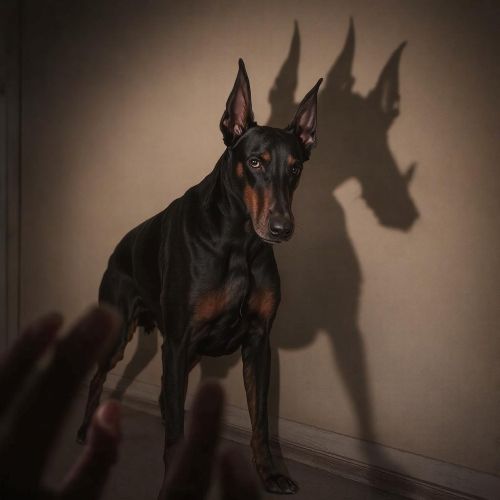
The dog was on the kitchen floor when the owner came home, heaving, unable to breathe. Something was lodged deep in its throat. There was no time to look around the house, no time to ask what had happened in the hours the rooms had been empty. The animal needed a veterinarian immediately.
So the owner drove. Left the front door unlocked. Left whatever was inside, inside.
The call came before the car had made it back. The veterinarian had found something in the dog’s throat—not food, not a toy—and the message was simple: don’t go home. Call the police first.
That is the legend. It has been told across the United States and beyond, passed from neighbor to neighbor, sometimes set in a specific suburb, sometimes assigned to a specific breed, always framed as something that happened to someone the teller almost knew.
The Earliest Traceable Version
The legend was already circulating across several regions of the United States by the early 1980s. Folklorists began noting it in that period, passed through the channels that urban legends favor: workplace conversations, neighborhood telephone trees and the friend-of-a-friend attribution that researchers sometimes call FOAF framing. The teller never experienced it directly. It happened to someone they know, or to someone that person knows.
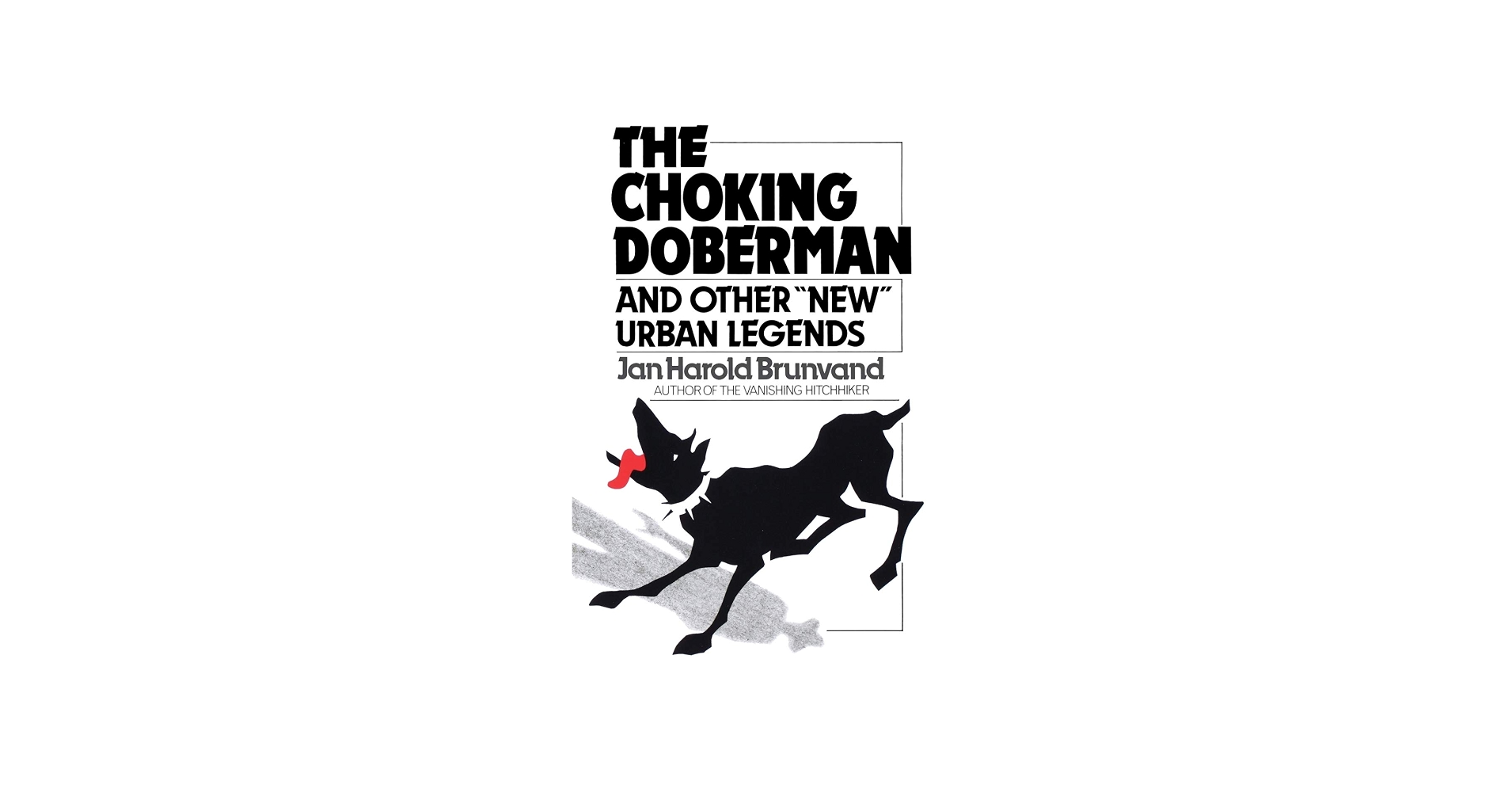
Jan Harold Brunvand, the University of Utah folklorist who spent decades documenting contemporary legends, collected versions of the story and made it the title case of his 1984 book The Choking Doberman and Other “New” Urban Legends. Brunvand’s work established it as one of the clearest examples of what scholars call a modern urban legend—a narrative with a contemporary setting, a believable cast of ordinary people and institutions, and an emotional payload that explains why it keeps being told. His collection drew on variants submitted by readers, heard at secondhand from journalists and forwarded through the informal networks that move folklore faster than any archive.
The core plot in the earliest collected versions was consistent: a homeowner returns to find a large dog—most often a Doberman pinscher, though the breed varied—choking or in respiratory distress. The owner rushes the animal to a veterinarian. While the owner is away or shortly after arriving at the clinic, the veterinarian discovers human fingers lodged in the dog’s throat. Police are called to the home and find an intruder hiding in a closet or bedroom, injured and bleeding from a hand injury consistent with the fingers removed.
The specific city changed. The number of fingers sometimes changed. In some tellings there were two fingers; in others, three. The breed occasionally shifted to a German shepherd or a rottweiler, particularly in versions told in communities where the Doberman was not the dominant symbol of guard-dog power. But the structure—loyal animal, confused owner, medical emergency that conceals a crime, telephone warning, hidden intruder—remained essentially fixed across the variants Brunvand and other folklorists collected.
No contemporaneous newspaper account matching the complete legend has been authenticated. Local-news stories from the early 1980s occasionally referenced the tale as something that had reportedly happened nearby, but these reports themselves traced back to secondhand accounts rather than police records or hospital documentation. The legend was already aware of itself as a story—it had begun to generate its own paper trail of near-citations.
YOUTUBE EMBED 1 — PRIMARY SEARCH QUERY: “The Choking Doberman urban legend history”
The Details That Repeat
What makes The Choking Doberman unusual among modern legends is the precision of its recurring elements. Most oral narratives drift significantly as they travel. This one held its shape with remarkable fidelity across regions and decades, which is itself a clue about how it functions.
The dog is always large. It is never a small breed. The size matters because the legend’s emotional logic requires that the animal was capable of inflicting real damage on an adult intruder—and capable of defending the home. A toy poodle choking on a human finger would generate dark comedy, not dread. The Doberman, the German shepherd and the rottweiler all carry cultural weight as working guard dogs. The choice is not incidental.
The veterinarian is always a professional. The legend uses institutional authority to certify the strange discovery. It is not a neighbor who finds the fingers, not the owner. It is someone whose formal role makes the claim feel documented even when no documentation exists. The telephone call from the veterinarian—warning the owner not to return home before police arrive—is the hinge on which the entire story turns. It converts a medical emergency into a crime scene and reframes everything the owner thought had happened that evening.
The fingers themselves are the detail that lodges in memory. They are proof that the animal fought, that the intruder was real and that the dog’s distress was caused by loyalty rather than accident. They also carry a specific kind of horror that requires no elaboration: the image is complete and visceral without any additional description.
The friend-of-a-friend framing is the final recurring element. The story is almost never told as something that happened to the teller. It is always one degree removed—close enough to feel credible, far enough to make verification impossible. Brunvand identified this as a structural feature of modern urban legends rather than evidence of deception on the teller’s part. People who pass the story along typically believe it. The FOAF distance is part of how the legend travels, not how it is invented.
The Real-World Fear Behind the Story
Urban legends do not survive by accident. They attach themselves to anxieties that are already present in the communities where they circulate, and The Choking Doberman arrived in a period when home security was a live concern in American suburban life.
The early 1980s saw significant media attention on residential burglary and home invasion in the United States. Neighborhood watch programs expanded. Home security systems moved from luxury items toward mass-market products. The fear of the hidden intruder—not the burglar who breaks in while the family is away, but the one who is still present when the family returns—had become a recognizable category of domestic anxiety. It appeared in film, in advice columns and in the same local-news segments that occasionally referenced the Choking Doberman story as a recent local event.
The legend speaks directly to this fear by placing it inside the home the owner believed was safe. The dog’s distress is the only warning. If the owner had not noticed, had been tired enough to go straight to bed, had not registered that something was wrong with an animal that could not speak—the intruder might have remained concealed. The veterinarian’s call is not just a plot device. It is a reassurance that the dog’s sacrifice will not go unread, that the clue will be decoded in time.
The legend also addresses a secondary anxiety: the fear of misreading loyalty. The owner who grabs a choking dog and rushes to a clinic has no idea what they are doing. They are treating the animal as the problem. The story’s reversal—the animal is not the problem; it is the only witness who fought back—vindicates the dog and, by extension, vindicates the decision to have one. The Doberman is not malfunctioning. It performed exactly as the relationship promised. The owner simply could not read the evidence until the veterinarian decoded it.
How the Legend Spread
By the mid-1980s, The Choking Doberman had moved beyond purely oral transmission. Newspaper advice columnists and human-interest writers began citing it as something readers had written in about, often presenting it with careful hedges—”a story circulating in our area,” “readers have been writing to ask”—that acknowledged its legendary status without fully classifying it. These published appearances gave the story a new kind of authority. A legend that has been printed looks more documented than one that has only been spoken.
Brunvand’s 1984 book accelerated scholarly attention to the story and simultaneously introduced it to readers who had never heard the oral version. This is a dynamic that folklorists have noted with several modern legends: academic or journalistic documentation can extend a legend’s reach even while analyzing it skeptically. Readers who encountered Brunvand’s account would often retell the story at one remove from the book, restoring the FOAF framing and stripping the scholarly context, so that the legend continued circulating as if freshly reported.
The story also spread through the emerging architecture of early digital communication. As email chains and bulletin board systems created new channels for forwarding extraordinary claims in the late 1980s and 1990s, The Choking Doberman appeared in text form alongside other circulating legends of its type. These digital versions preserved the core structure while sometimes adding local place names to increase credibility. The legend was adapting to each new transmission technology it encountered, which is precisely what durable folklore does.
Regional newspapers occasionally ran the story as fact during this period before corrections appeared. The corrections themselves were rarely as widely shared as the original reports, which meant that some communities had both a legendary version and a “confirmed” newspaper version circulating simultaneously, each lending credibility to the other.
YOUTUBE EMBED 2 — SECONDARY SEARCH QUERY: “Choking Doberman older guardian myth”
The Folklore Mechanism That Makes It Work
Brunvand’s most significant contribution to understanding this legend was not simply collecting its variants but tracing its structural relationship to much older stories in which a guardian animal is misread by its owner. The most cited analogue is the medieval Welsh legend of Gelert, in which Prince Llywelyn returns to find his hound covered in blood. He assumes the dog has killed his infant son, draws his sword and kills the animal—only to discover the child alive beneath the overturned cradle and a dead wolf nearby. The dog had saved the child and was punished for it.
The Gelert story, recorded in later medieval Welsh sources and associated with the village of Beddgelert in Gwynedd, shares the Choking Doberman’s emotional architecture almost exactly: a loyal animal behaves in a way the owner cannot initially interpret; the owner responds to surface appearances; the true meaning of the animal’s actions is revealed too late—or, in the modern version, just in time. The difference in outcome is itself instructive. The medieval story ends in irreversible tragedy. The modern legend ends with the intruder caught and the dog vindicated in time. This shift from tragedy to near-miss reflects a broader modern preference for the narrow escape over the cautionary ending.
Brunvand was careful to present this relationship as motif continuity rather than direct literary descent. The Choking Doberman was not adapted from the Gelert legend by any identifiable author. Instead, the two stories share a deep narrative template—what folklorists call a migratory legend type—in which the protective animal is misunderstood. The template is old enough and widespread enough that it appears across multiple cultures and periods independently. What The Choking Doberman did was update the template’s surface details for a late-twentieth-century American context: the dog is a breed associated with security rather than hunting; the danger is a domestic intruder rather than a wolf; the revelation arrives by telephone rather than by sight.
The veterinarian’s role in the modern version is particularly telling. Medieval guardian-animal stories typically revealed the truth visually—the owner saw the wolf, found the child, understood the evidence with their own eyes. In The Choking Doberman, the revelation is mediated by an institution and transmitted by technology. The veterinarian interprets what the dog cannot explain. The telephone delivers the warning. The story is thoroughly modern in its machinery while being ancient in its moral shape.
The Details Added Later
As the legend aged, later tellings began to add details that were not present in the earliest collected versions. Some of these additions attempted to increase specificity in ways that would make the story feel more authenticated. Street names or neighborhood descriptions were sometimes included. The intruder was occasionally given a motive—a recently released convict, a known burglar working the neighborhood—that connected the story to current local news in a way that made it harder to dismiss.
Other additions reflected the cultural moment of the retelling. In some later versions, the veterinarian’s warning came not by phone but by pager, then by cell phone, tracking the story’s adoption of whatever communication technology was most current. The emotional hinge remained the same—the urgent message that the owner must not return home—but the device that carried it updated with each decade.
A small number of later versions altered the story’s ending. In the most dramatic variants, the owner does not wait for police and returns home to confront the situation directly. These versions expanded the legend toward the home-invasion thriller genre, adding confrontation scenes that the original plot carefully avoided. Folklorists who tracked these variants noted that they tended to spread through specific channels—particularly entertainment media—rather than through the oral FOAF networks that carried the original. The expanded versions were less stable and more likely to be recognized as fictional elaboration rather than believed as recent events.
The detail of the dog’s breed also continued to shift, reflecting regional differences in which breeds carried the strongest symbolic association with protection. In communities where the rottweiler had replaced the Doberman as the culturally dominant guard dog, the story shifted accordingly. The choice of dog was never incidental—it always had to be a breed the listener would immediately associate with the ability to do serious damage to an adult human intruder, because the legend’s credibility rested on that assumption.
What the Evidence Does Not Show
The clearest limit of the surviving record is also the most important one: no authenticated case matching the full plot of The Choking Doberman has been verified by folklorists or journalists who investigated the story.
This does not mean nothing unusual ever happened to someone with a large dog during this period. Domestic intrusions occurred. Dogs have been known to bite intruders. Veterinarians have found objects in animals’ throats. None of these isolated facts, however, assembles into the complete legend. The specific sequence—choking dog, removed fingers, telephoned warning, hiding intruder discovered with a hand injury—has not been matched to a police report, a hospital record or a veterinary case file that researchers have been able to examine independently.
Attempts to trace the story back to an original incident consistently terminate in the FOAF structure. Each teller has a source, and that source has a source, and the chain leads back to a point of origin that cannot be found because it was never a single event. This is the standard finding for legends of this type. Brunvand documented the same result across most of the narratives in his collected volumes: the search for the first event produces only more retellings.
The newspaper versions that appeared to confirm the legend during the 1980s and 1990s were themselves drawing on secondhand accounts. Where researchers followed these citations, they found that the newspapers had published accounts provided by readers who were reporting what they had heard—not what they had witnessed or documented. Some papers issued corrections; many did not. The printed versions had already done their work by the time corrections appeared, embedding the legend more firmly in the local record it had never actually entered.
The claim that the story traces directly from the Gelert legend or any other specific older text is also not supported by documented evidence. Motif continuity is real; direct literary ancestry has not been demonstrated. The emotional structure is inherited; the inheritance was not deliberate. These are related but meaningfully different claims, and the distinction matters for understanding how folklore actually travels across time.
Why the Story Survives After Midnight
The Choking Doberman has outlasted the decade that produced it because its emotional mechanism is not dependent on any of its surface details being true. The legend works on a level that sits beneath the Doberman, beneath the veterinarian’s telephone call, beneath the fingers and the hiding intruder. It works because it tells people something they already believe but cannot easily articulate: that protection can look like a problem, that loyalty can be misread as failure and that the animal who cannot speak may be the only one who understood what was happening.
The story is also a parable about information arriving in the wrong order. The owner acts on incomplete evidence and, by luck and the intervention of a professional institution, avoids a worse outcome. The dog acted on complete information the entire time. The reversal—realizing who actually knew what—is the legend’s real payload, and it arrives with the veterinarian’s call rather than at the end of an investigation.
That is why the telephone is not just a plot device. It is the moment when the story catches up to the dog. The animal had already fought the intruder, already paid a physical cost, already done everything the owner hoped the dog would do in exactly this situation. The call simply delivers the translation. The owner rushed to save a choking dog. The dog had been saving the house.
The legend survives, in the end, as a record not of what happened to any particular family but of what people fear and what they want the animals they live with to mean. That is old enough to last. The Doberman is still choking. The call is still coming. And the person hidden in the back room has not been found yet.

