Some rescues begin with an emergency call and a team rushing toward an animal in immediate danger.
Jang-soon’s rescue began differently.
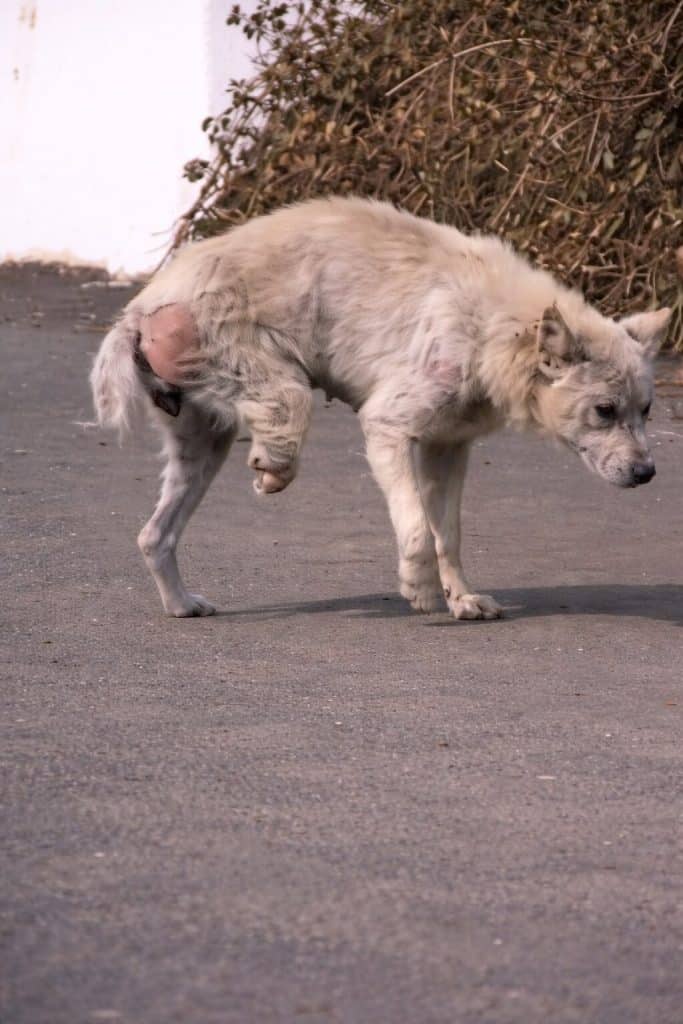
It started with one elderly woman noticing a frightened stray dog moving through a dusty construction yard on a badly injured leg.
She could not touch him.
She could not bring him home.
And she could not give him the medical treatment he clearly needed.
But she could return the next day.
So she did.
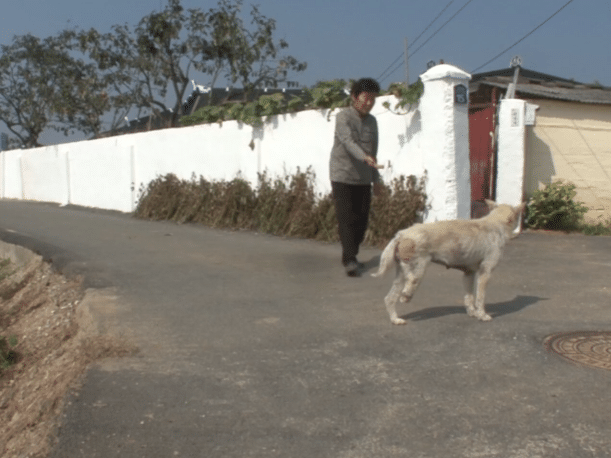
For four years, the woman brought food, spoke to him gently, and watched over him from the distance he required. Her care did not immediately take Jang-soon away from the dangerous place where he lived.
It did something just as important.
It kept him alive until more help could finally reach him.
The Injured Dog Living Among Scrap and Broken Wood
The construction site was filled with hazards.
Pieces of broken timber covered the ground. Rusted materials, scrap metal, and discarded equipment created narrow paths that were difficult even for a healthy animal to cross safely.
For Jang-soon, every journey through the yard was harder.
One of his hind legs was badly swollen and appeared to have been injured for a long time. He placed little weight on it, adjusting his body with every step to avoid the worst of the pain.
His coat looked rough.
His skin appeared irritated.
And his cautious behavior suggested that life around people had taught him to keep his distance.
No one knew exactly how the original injury had happened.
Perhaps he had been struck by something.
Perhaps his leg had become trapped.
Or perhaps a smaller wound had simply gone untreated until it became much worse.
Whatever the cause, Jang-soon had adapted because he had no other choice.
He continued moving through the site.
Searching for food.
Finding places to rest among the debris.
And avoiding anyone who came too close.
Many people passed through the area without forming any lasting connection with him.
Then an elderly woman who lived nearby began paying attention.
She noticed the limp.
She noticed how carefully he stepped around the sharp debris.
And she noticed that beneath his fear was a dog trying to survive with an injury he could not escape.
She began leaving food for him.
At first, Jang-soon would not approach while she was nearby.
So she stepped back.
She allowed him to eat without feeling trapped.
Then she returned the next day.
Video: The Injured Stray an Elderly Woman Fed Every Day for Four Years Is Finally Seen Up Close
She Could Not Touch Him, but She Never Stopped Returning
Jang-soon remained deeply cautious around people.
Even after he became familiar with the woman’s presence, he would not allow her to handle his injured leg or bring him indoors.
She understood that forcing him could destroy the limited trust they had built.
Instead, she cared for him in the only way he would accept.
She brought meals consistently.
She spoke to him in a calm voice.
She stayed near enough for him to recognize her, but far enough that he did not feel cornered.
Over time, she gave him a name.
Jang-soon.
The name carried personal meaning for her. It had belonged to a dog she once loved and lost, and using it again reflected the bond she had formed with the frightened stray.
To others, he may have looked like another dog wandering around a worksite.
To the woman, he had become someone whose absence would be noticed.
She worried when he did not appear at the usual time.
She watched his injured leg grow worse.
And when she obtained medicine intended to help him, she found a way to give it without touching him.
She hid it inside pieces of grilled pork belly, one of the foods Jang-soon was most willing to eat.
It was an imperfect solution.
Medicine hidden in food could not repair a serious old injury or remove damaged tissue. But it was one of the few ways she could offer him any relief while respecting the fear that kept him beyond her reach.
Days became months.
Months became years.
Through changing weather and continued construction activity, the woman kept returning.
She did not know when proper help would arrive.
She only knew that abandoning him would leave Jang-soon with no dependable food and no one watching his condition.
Her care became the most stable part of his life.
Four Years of Kindness Bought Him the Time He Needed
From the outside, the woman’s routine may have appeared simple.
A meal placed on the ground.
A few gentle words.
Medicine concealed in a piece of meat.
Then another visit the following day.
But for Jang-soon, those repeated actions meant survival.
A dog living with a painful leg cannot compete for food as effectively as a healthy stray. He cannot run as quickly from danger or travel long distances to find better shelter.
The construction yard offered little comfort, but leaving it may have felt even more dangerous.
The elderly woman’s meals reduced the distance he needed to walk.
Her presence gave someone the opportunity to notice when his condition declined.
Most importantly, she refused to let him disappear unnoticed.
She could not solve every problem alone.
She lacked the equipment needed to safely capture a terrified dog.
She could not diagnose the damage inside his leg.
And she could not perform the surgery he would eventually require.
But she continued doing what was within her power.
That persistence gave Jang-soon four more years.
Four years in which someone could learn about him.
Four years in which rescuers could eventually be contacted.
Four years in which the possibility of a life beyond the construction yard remained open.
Her compassion was not dramatic.
There were no cameras during most of those ordinary days.
No crowd gathered each time she placed food near him.
Yet without those quiet visits, Jang-soon might not have survived long enough for the next part of his story.
Eventually, the animal rescue group Kritter Klub learned about the injured dog and the woman who had been caring for him.
A team traveled to the site.
For the first time, Jang-soon had access to people equipped to do what the elderly woman had hoped someone could eventually accomplish.
They could bring him to a hospital.
First, however, they had to reach him.
Rescuing Him Without Making His Injuries Worse
The rescue team quickly understood that Jang-soon could not simply be approached and lifted into a vehicle.
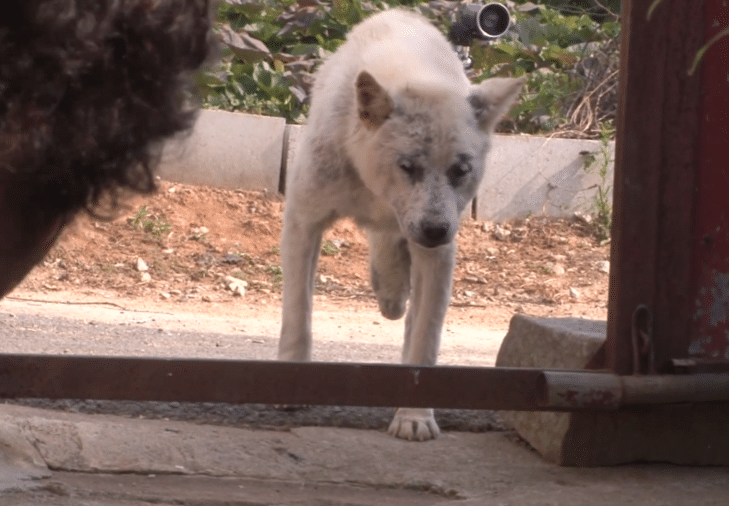
Years of surviving outdoors had made him highly suspicious of people.
Even the woman who fed him every day had never been able to touch him safely.
When unfamiliar rescuers entered the construction yard, Jang-soon kept his distance.
The team did not immediately chase him.
A frightened dog with a severely injured leg could easily panic, run across dangerous debris, and cause further damage.
Instead, the rescuers observed him.
They watched the routes he used through the site.
They identified the places where he rested.
They studied his reactions to movement and determined how much distance he needed before attempting to flee.
The woman remained nearby, offering the familiar presence Jang-soon had known for years.
Eventually, the rescuers decided that a humane net would be the safest method.
The goal was not to punish or frighten him.
It was to briefly prevent him from escaping so he could be moved without forcing him into a dangerous chase.
When the moment came, the rescue unfolded quickly.
Jang-soon struggled in confusion as the net surrounded him. He could not understand that the people restraining him were trying to end the pain he had carried for years.
The team worked carefully to secure him and protect the injured leg.
Nearby, the elderly woman became emotional.
She had waited a long time for Jang-soon to receive real medical care.
Yet watching him leave the construction site was difficult.
For four years, caring for him had been part of her daily life.
She knew where he rested.
What foods he preferred.
How close she could stand without frightening him.
Now, she had to trust strangers to take him somewhere she could not.
Her tears did not mean she wanted the rescue to stop.
They reflected the weight of finally seeing the moment she had hoped for—and the uncertainty of saying goodbye to a dog she had quietly protected for so long.
X-Rays Revealed Why Every Step Had Hurt
At the veterinary hospital, doctors were finally able to examine Jang-soon’s leg properly.
The results confirmed that the injury was old and severe.
It had never healed correctly.
Over time, infection and tissue damage had developed around the affected area. The leg was no longer simply weak or swollen.
It had become a constant source of pain and a continuing threat to his health.
The veterinary team could now see what the elderly woman had only been able to observe from a distance.
Jang-soon had been walking on a profoundly damaged limb through sharp debris and rough ground for years.
Every trip toward his food.
Every attempt to find shelter.
Every movement away from unfamiliar people.
All of it had required him to compensate for an injury that should have received treatment long before.
The doctors determined that the leg could not recover through medication and rest alone.
The damage had progressed too far.
Surgery was necessary.
To remove the infection and prevent further suffering, part of the injured limb would have to be amputated.
Losing part of a leg sounds devastating.
For Jang-soon, however, the damaged limb had already stopped functioning as a healthy leg. It was causing pain, carrying infection, and making ordinary movement increasingly difficult.
Surgery would change the shape of his body.
But it could also remove the source of suffering that had shaped nearly every day of his life.
The operation was completed successfully.
When Jang-soon woke, he faced a period of adjustment and recovery.
The painful part of his leg was gone.
So was the untreated infection that had continued worsening while he lived outdoors.
For the first time in years, his body had the chance to heal instead of merely endure.
Healing Required More Than a Successful Operation
Jang-soon’s surgery addressed his most urgent physical problem.
It did not erase four years of fear.
Inside the hospital, everything was unfamiliar.
The rooms.
The smells.
The people approaching him.
The medical handling required to clean and monitor the surgical area.
At first, Jang-soon remained guarded.
He had survived by keeping humans at a distance, and one operation could not immediately convince him that close contact was safe.
The caregivers adjusted their approach.
They moved slowly.
They avoided surrounding him.
They allowed him time to observe each person before treatment began.
Meals arrived consistently.
His resting place remained warm and clean.
Medication was no longer hidden in grilled meat because staff could now provide it directly and monitor his response.
With each passing day, Jang-soon received the same message through actions rather than promises.
No one was going to hurt him.
No one was going to chase him back into the construction yard.
And no one expected him to become trusting immediately.
At first, the changes were subtle.
His body appeared less tense when familiar caregivers entered.
He stopped reacting as strongly to necessary treatment.
He accepted food while people remained nearby.
Later, he tolerated gentle touch.
Trust did not arrive through one dramatic breakthrough.
It formed through ordinary experiences repeated without harm.
A bandage changed carefully.
A hand withdrawing when he became uncomfortable.
A meal offered without forcing contact.
A calm voice returning the following morning.
Jang-soon also had to adjust physically.
Dogs can often adapt remarkably well after losing part of a limb, but the process requires time. His remaining legs needed to become stronger, and his balance had to change after years of compensating for the injured leg.
The difference was that movement no longer included the same constant source of pain.
He was not dragging an infected limb across rough concrete.
He was learning how to move forward without it.
The Woman Who Saved Him Long Before the Rescue Team Arrived
Jang-soon’s story could easily be told as the moment a rescue team captured him and veterinarians performed surgery.
Those moments were essential.
But his rescue had begun years earlier.
It began when an elderly woman looked at a frightened stray in a dangerous construction yard and decided he was worth returning for.
She did not wait until she had the perfect solution.
She gave him what she had.
Food.
Medicine concealed in something he trusted enough to eat.
A name.
And the reassurance of seeing the same kind person appear again and again.
Her care did not immediately change Jang-soon’s location.
For years, he still slept near debris and walked on an injured leg.
But her actions prevented his suffering from remaining completely invisible.
She became the connection between a fearful stray and the people who could eventually provide medical help.
Without her, rescuers might never have learned where he lived.
Without the food she supplied, his weakened body might not have survived the years before surgery.
Without her persistence, Jang-soon could have disappeared into the construction site as quietly as he had lived there.
The woman often worried that what she was doing was not enough.
She could not touch him.
She could not carry him away.
She could not stop the swelling in his leg.
But compassion is not meaningless simply because it cannot solve everything at once.
Sometimes it keeps an animal alive until the next person can help.
Sometimes it creates the trust that allows a frightened dog to remain near one safe location.
And sometimes it becomes the reason rescuers hear about a life everyone else has overlooked.
The elderly woman did not complete Jang-soon’s rescue alone.
She made it possible.
His Future Is No Longer Defined by the Construction Yard
For four years, Jang-soon’s world consisted of dust, scrap material, broken boards, and a badly damaged leg.
He survived because he adapted to pain.
He kept people at a distance because caution had protected him.
And he continued returning to the elderly woman because her meals were one of the few dependable things in his life.
Now, that construction yard is behind him.
His body has received the treatment it needed.
The source of the chronic pain and infection has been removed.
He has a clean place to rest, regular meals, and people who monitor his recovery.
Jang-soon still carries the effects of his past.
Trust may continue developing slowly.
New people may require patience.
His body must adapt to moving differently after surgery.
But he is no longer facing those challenges alone.
The woman who cared for him gave him time.
The rescue team gave him access to safety.
The veterinary staff gave his body a chance to heal.
Together, they transformed a life that had been built entirely around endurance.
Jang-soon’s story is not only about a dog surviving a terrible injury.
It is about the value of showing up even when progress cannot be seen.
For four years, the woman placed food before a dog she could not touch.
She may not have known whether he would ever leave the construction yard.
She may not have known whether someone with the right equipment would come.
Still, she returned.
That steady kindness carried Jang-soon through thousands of painful days until the help he needed finally arrived.
Once, every step he took across the construction site hurt.
Today, he can begin moving toward a life shaped by something different.
Relief.
Safety.
And the knowledge that, even during the years when most people passed him by, one person never stopped seeing him.


