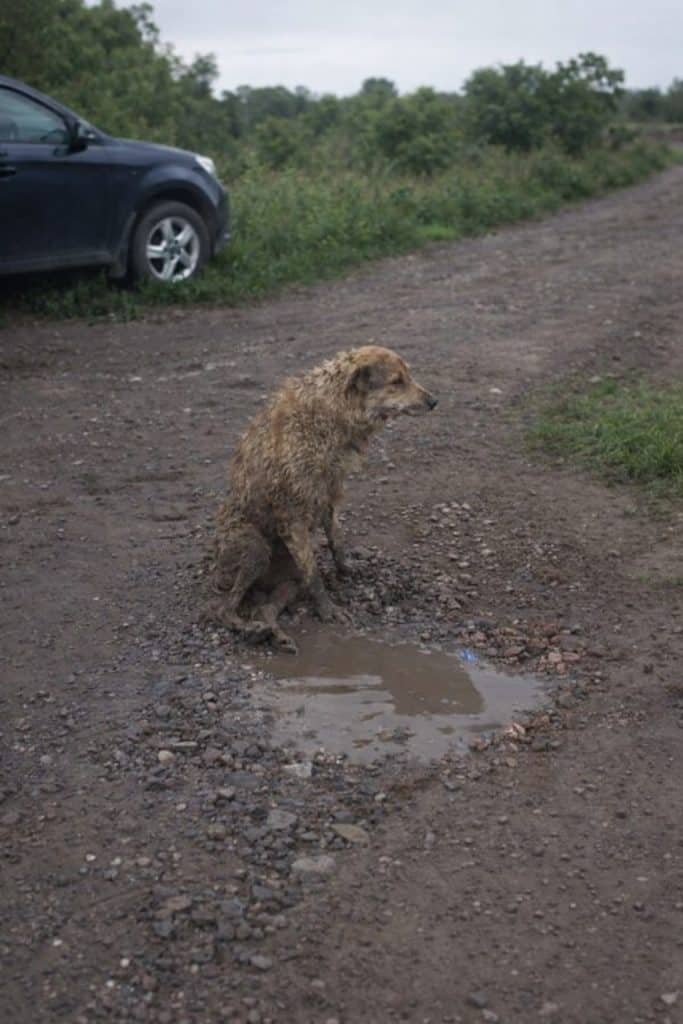
For years, Korablik moved quietly through the streets of a small village.
Residents recognized the elderly stray by his slow steps and gentle nature. He rarely caused trouble, avoided conflict, and seemed content to rest wherever he could find a peaceful corner.
He belonged to no one.
Yet in a way, he had become part of the village.
Children knew him.
Neighbors saw him passing through familiar streets.
No one considered him dangerous.
Then one frightening incident involving another dog set off a chain of events that changed Korablik’s life overnight.
According to accounts shared with rescuers, a child had been bitten somewhere in the area. Emotions rose quickly, and Korablik—an old, harmless dog who happened to be nearby—was wrongly targeted.
By the time help reached him, he was lying on the ground, unable to stand properly.
His body had been badly injured.
But the deeper challenge would be convincing this frightened old dog that human hands could still bring kindness.
The Gentle Stray Villagers Had Known for Years
Korablik had spent much of his life surviving outdoors.
He moved slowly through the village, searching for food and choosing quiet places where he could rest without being disturbed. Age had already begun affecting his body, and years without dependable veterinary care had left him thin and physically vulnerable.
Fleas had irritated his skin.
His coat showed the effects of street life.
His movements lacked the ease of a younger dog.
Still, people who knew him described him as calm.
He did not chase residents or rush aggressively toward strangers. Most of the time, he simply tried to remain unnoticed.
That familiar behavior made what happened next even more difficult for villagers to understand.
One day, a child was reportedly bitten by a different dog.
The incident created fear and anger throughout the area. Witnesses later told rescuers that the child’s father became highly emotional and began searching for an animal to blame.
Reports also alleged that he had been drinking, though rescuers could not independently establish every detail of what occurred.
What they did know was that Korablik was not believed to be the dog involved in the original incident.
He was simply nearby.
An elderly stray.
Slow-moving.
Unable to escape quickly.
That night, residents found him badly hurt.
The peaceful dog they had watched wandering through the village for years could no longer move normally.
People began contacting animal rescuers.
For Korablik, help could not arrive quickly enough.
Video: Elderly Korablik Is Found Unable to Stand After Being Wrongly Blamed for Another Dog’s Actions
Rescuers Found an Old Dog Too Frightened to Move
When the rescue team reached Korablik, he was lying helplessly on the ground.
His physical condition was immediately concerning.
The elderly dog was thin, exhausted, and covered with signs of prolonged life outdoors. But the injuries around his lower body were far more serious than the ordinary hardships of being a stray.
Korablik could not rise normally.
His hips appeared unstable, and even small changes in position caused visible discomfort. The trauma had also begun interfering with basic bodily functions, indicating that the damage extended beyond bruising or temporary soreness.
Despite his condition, Korablik did not lash out.
He did not growl or attempt to bite the rescuers approaching him.
Instead, he remained almost completely still.
His head stayed low.
His body appeared tense.
And his eyes followed every movement with uncertainty.
The rescuers could not know exactly what he understood about the previous night. They could only see that sudden human contact now frightened him.
They approached slowly.
Every hand movement was deliberate.
Because of the suspected pelvic injury, lifting Korablik incorrectly could increase his pain or cause further damage.
The team supported his body carefully and placed him onto a safe surface for transport.
He did not resist.
He seemed to have too little strength left to do anything except allow the rescuers to carry him away.
For years, Korablik had survived without belonging to anyone.
Now, for the first time since the incident, people were treating his life as something worth protecting.
Scans Revealed Multiple Fractures in His Pelvis
At the veterinary clinic, the medical team began examining Korablik immediately.
Imaging confirmed that he had suffered multiple fractures in the pelvic region.
The damage was complex.
The pelvis supports much of the lower body and protects important organs. When several parts are fractured, an animal may lose the ability to stand, walk, or perform basic functions without severe difficulty.
Korablik’s age added another concern.
An elderly stray often enters treatment with fewer physical reserves than a young, well-nourished dog. Years of inconsistent meals, parasites, and exposure to weather can make recovery from major trauma more difficult.
The veterinary team had to consider all of those factors.
But leaving the fractures untreated was not a reasonable option.
Korablik was already in pain.
The instability in his lower body was affecting his ability to move and function normally.
Without intervention, his suffering could continue or worsen.
The doctors began stabilizing him and preparing for emergency surgery.
For the rescuers, the diagnosis brought both clarity and fear.
They now understood why Korablik could not stand.
They also understood that the procedure ahead would be complicated.
The surgery would not erase his age or guarantee a perfect recovery. Its purpose was to repair as much damage as possible, restore stability, and give the old dog a realistic chance to move without constant pain.
Korablik had spent years quietly adapting to the challenges of street life.
This injury was something his body could not overcome alone.
Surgery Gave Him a Chance, but Trust Had Been Broken
The operation required careful work around the damaged pelvic area.
Veterinary surgeons focused on stabilizing the fractures and reducing the pressure that was interfering with Korablik’s movement and normal bodily functions.
Because of his weakened condition, every stage needed to be closely monitored.
The procedure was long and delicate.
Outside the treatment room, rescuers waited for news.
Korablik had already survived the night that injured him.
Now he had to survive the operation intended to give him relief.
Eventually, the veterinary team completed the surgery.
It was an important success, but no one described it as an instant miracle.
Korablik still faced a long recovery.
His body needed time to heal around the repaired fractures. His muscles had weakened while he was unable to stand, and his age meant progress might arrive more slowly than people hoped.
There was another injury that no scan could fully measure.
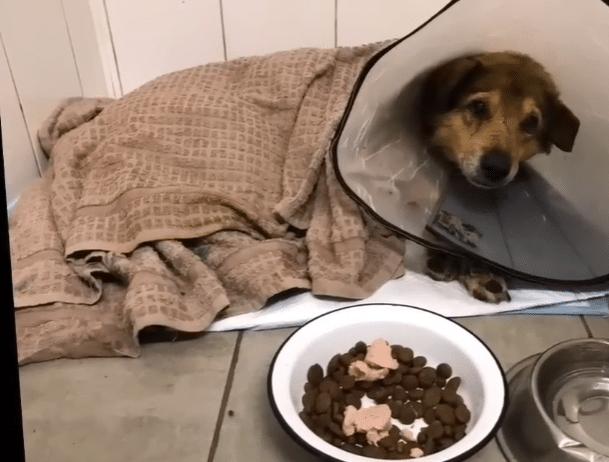
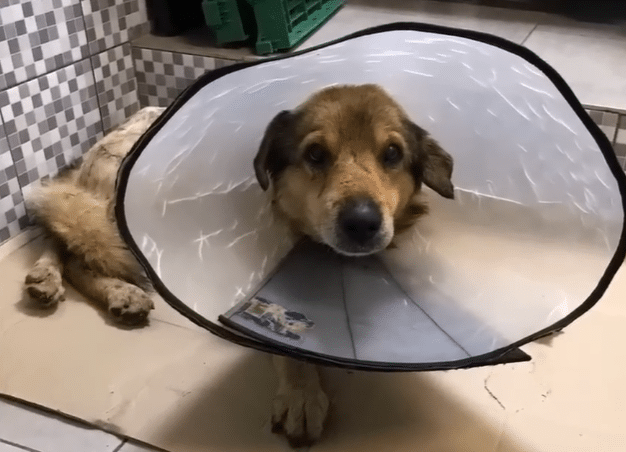
After surgery, Korablik often lowered his head or turned his face away when people approached.
He tried to make himself small in the recovery space.
His body became tense during treatment, even when caregivers moved gently.
The team understood that the old dog’s fear would not disappear simply because the operation was over.
His recent experience had taught him that a person coming closer could bring pain without warning.
Now, the caregivers had to show him something different.
They could not explain with words that he was safe.
They had to prove it through every interaction that followed.
Kindness Returned in Small, Predictable Moments
Korablik’s caregivers built his recovery around patience.
They kept his resting area clean and quiet.
They approached slowly enough that he could see them coming.
Before touching him, they spoke in calm voices and gave him time to recognize who was nearby.
His food was mixed with prescribed medicine so treatment could continue with as little stress as possible.
At first, Korablik remained withdrawn.
He avoided eye contact.
He stayed near the back of his resting area and showed little interest in interacting.
When someone reached toward him, his body stiffened as though he expected something frightening to happen.
No one forced affection on him.
The caregivers did not pull his face upward or insist that he accept petting.
They completed the necessary medical care and then allowed him to rest.
The same pattern repeated every day.
Food arrived.
Medicine arrived.
Bandages and injuries were checked carefully.
No one shouted.
No one punished him for being afraid.
And no one disappeared simply because his recovery was slow.
Gradually, Korablik began eating more comfortably.
At first, he waited until people stepped back.
Later, he accepted food while a caregiver remained nearby.
Eventually, he took small pieces directly from a familiar hand.
For another dog, eating from someone’s fingers might seem ordinary.
For Korablik, it represented a major shift.
He was allowing a human hand close to his face and discovering that nothing painful followed.
His posture slowly became less guarded.
He lifted his head more often.
He rested without constantly trying to hide.
The fear did not vanish all at once.
Trust returned through small, predictable moments—each one placing a safer experience beside the memory of what had happened.
His First Steps Led Him Into a Peaceful Garden
As Korablik’s fractures began healing, the medical team focused on helping him regain strength.
Standing was difficult.
The muscles supporting his lower body had weakened, and the repaired pelvis needed to bear weight carefully. Caregivers supported him so he could attempt movement without falling or placing excessive pressure on the healing area.
Korablik tried to rise.
At first, his legs trembled beneath him.
He managed only brief moments before needing to rest again.
No one treated those attempts as failures.
For an elderly dog recovering from multiple pelvic fractures, lifting his body at all was meaningful progress.
The team continued patiently.
Proper meals helped restore weight.
Medication reduced discomfort.
Rest allowed the repaired areas to strengthen.
Then came the moment everyone had been waiting for.
With gentle support, Korablik stood.
He remained uncertain, adjusting his balance before moving one paw forward.
Then he took another careful step.
The old dog who had once been found unable to move was walking again.
His pace was slow.
His body was not completely strong.
But the steps showed that surgery and rehabilitation were giving him back a degree of independence.
As his condition improved, caregivers began taking him into a quiet garden.
The environment was very different from the place where he had been injured.
Soft grass replaced hard ground.
Fresh air moved gently around him.
There were no crowds or frightening sounds.
Korablik could stand in the sunlight while someone remained nearby to support him if needed.
These peaceful outings became part of his recovery.
He sniffed the grass.
Observed the surroundings.
And gradually spent more time outside without appearing overwhelmed.
Then one day, a nurse approached him in the garden.
Korablik looked toward her.
His tail moved.
It was only a small wag, but everyone noticed.
This was the dog who had once lowered his face whenever someone came near.
Now he was responding to a familiar caregiver with a gesture of recognition.
The fractures were healing.
So was something less visible.
A Cat Named Bela Became His Quiet Companion
As the weeks passed, Korablik’s strength continued returning.
He regained healthy weight.
His steps became steadier.
And he began moving through the garden with less assistance.
His personality remained calm.
He did not suddenly behave like a playful puppy, nor did anyone expect him to. Korablik was an old dog whose idea of happiness seemed to be peaceful surroundings, regular meals, and the presence of someone he trusted.
During this period, he formed an unexpected friendship with a cat named Bela.
The two animals began spending quiet time together.
They rested near one another in the garden and appeared comfortable sharing the same safe space.
Their companionship was not loud or dramatic.
There were no wild games or constant chasing.
Instead, Bela’s calm presence seemed well suited to Korablik.
They could sit in the sunlight.
Observe the world.
And enjoy the kind of silence that no longer carried danger.
For an elderly dog who had spent years wandering alone, this quiet friendship added something meaningful to his new life.
Korablik was no longer isolated.
He had caregivers who watched over his health.
A nurse whose approach could make his tail move.
And a feline companion who seemed content simply to remain nearby.
His expression gradually changed.
The constant tension around his eyes softened.
He rested more deeply.
He no longer tried to disappear each time someone entered his space.
Korablik’s happiness did not appear as endless excitement.
It appeared through comfort.
A relaxed body.
A peaceful afternoon.
A dog choosing to remain beside others because he no longer believed solitude was the only safe option.
The Final Chapter of His Life Is Being Written With Kindness
What happened to Korablik cannot be undone.
He was an elderly stray who had survived quietly for years without threatening anyone. Then, according to those who reported the incident, he was wrongly blamed during a moment of anger and left with devastating injuries.
The fractures were real.
The surgery was necessary.
The fear in his behavior showed how deeply the experience affected him.
But that night is no longer the only part of his story.
Korablik’s life now includes the rescuers who lifted him carefully from the ground.
The veterinary team who repaired his damaged pelvis.
The caregivers who returned every day without demanding trust.
The garden where he learned to stand in the sunlight.
The nurse who received one of his first tail wags.
And Bela, the cat who quietly shared his peaceful afternoons.
Korablik did not recover because one dramatic act solved everything.
His healing was created through many smaller acts connected together.
A careful surgery.
Medicine hidden in food.
A hand that moved slowly.
A clean place to sleep.
Support beneath his body when he tried to stand.
Patience when he hid his face.
Companionship when he was ready to accept it.
Some rescued animals arrive with injuries that can be treated through medicine and time.
Others also arrive believing that closeness is dangerous.
For them, safety must be demonstrated repeatedly.
Korablik needed both kinds of care.
His bones needed skilled treatment.
His trust needed consistency.
Today, he is no longer lying helplessly where rescuers first found him.
He can move through the garden.
He can eat without fear.
He can rest beside another animal and accept the presence of people who care about him.
His body still carries the marks of age and injury.
But his days are no longer shaped entirely by pain.
For most of his life, Korablik survived at the edge of the village without ever truly belonging anywhere.
Now, during the years when he needs comfort most, he is surrounded by people who see him.
They know his name.
They notice when he needs assistance.
And they understand that an elderly stray does not need to be young, perfect, or easy to deserve protection.
One cruel night nearly ended Korablik’s quiet life.
Compassion gave that life a different ending.
Not one defined by fear.
But by sunlight, friendship, gentle hands, and the peace of finally knowing he is safe.


