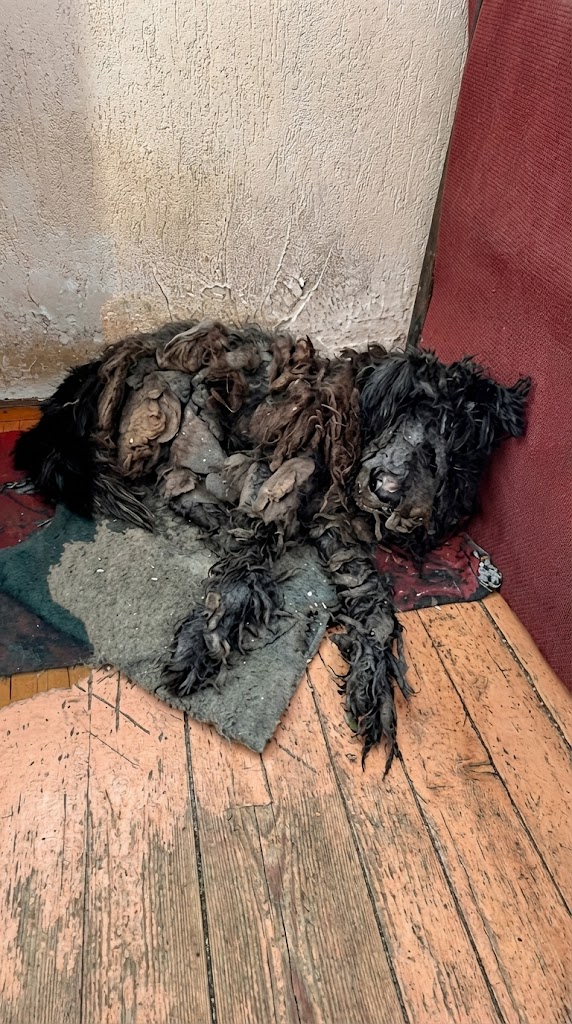
At first, it was difficult to understand what rescuers were looking at.
Near the entrance of an aging building sat a dog whose coat had hardened into a thick, rigid shell.
His name would later be Chekia.
According to those who rescued him, he had once belonged to someone before being abandoned near the building. He remained in the area for a long time, surviving outside while people came and went around him.
Then his situation became far worse.
A glue-like industrial substance had reportedly been poured across his body.
It mixed with his already tangled fur and hardened.
By the time help arrived, Chekia could barely move normally beneath it.
But somewhere underneath that heavy covering, a dog was still waiting to be reached.
His Fur Had Hardened Into Something Like Armor
The substance covering Chekia was not sitting loosely on top of his coat.
It had fused into the fur.
Large sections had become stiff and heavy, restricting his movement and pulling against the skin underneath.
Rescuers could see that simply shaving him quickly would not be possible.
The hardened material had created a barrier around much of his body, and beneath it, the skin was irritated and damaged.
One side of his face was especially concerning.
The material had gathered around an eye, making it difficult to see its condition beneath the hardened coat.
Chekia also appeared physically exhausted.
His movements were limited.
His body looked weak.
Even shifting position seemed uncomfortable.
The rescuers did not know how long he had been living this way.
They only knew that leaving him there was no longer an option.
Chekia needed medical attention.
But before veterinarians could properly examine much of him, they first had to reach the dog beneath the shell.
VIDEO: Chekia Could Barely Move Beneath the Hardened Coat—Then Rescuers Began Cutting Him Free
Removing It Required More Than an Ordinary Grooming
Freeing Chekia became slow, careful work.
Every section had to be handled cautiously because pulling too hard could damage the already-sensitive skin beneath it.
There was no dramatic moment when the entire covering simply fell away.
Instead, rescuers worked little by little.
Cut.
Separate.
Check the skin.
Then continue.
Some areas were easier than others.
Around his face, the process required even more patience.
The hardened material had become tangled close to delicate tissue, and no one wanted an attempt to help him to cause another injury.
As more of it was removed, the shape of the dog underneath began to appear.
His body was thinner than the shell had made it seem.
His coat was in poor condition.
His skin needed treatment.
And eventually, rescuers were able to uncover the eye that had been hidden.
It opened.
For the first time since they began working on him, they could properly see his face.
The process was far from finished.
But Chekia was no longer completely trapped inside what had formed around him.
Once the Shell Was Gone, the Medical Problems Became Clear
Removing the hardened fur solved only one part of Chekia’s condition.
His body had been under enormous strain.
The skin beneath the coat needed continued treatment, and the rescuers reported concerns about infection, fever, and his overall health.
Blood tests also suggested that his system had been affected.
His liver was reportedly under stress.
During the first days, Chekia had little appetite.
He spent much of his time resting while the veterinary team treated his wounds and monitored his condition.
This was the stage when recovery was least certain.
A dog can look dramatically different after a badly damaged coat is removed, but appearance alone does not mean the body has recovered.
Chekia still needed medication.
Nutrition.
Clean bedding.
Regular wound care.
And time.
His caregivers also stayed near him without demanding interaction.
They spoke softly.
They offered food.
They allowed him to rest when that was all he wanted to do.
After so much discomfort, the goal was not to make him immediately behave like a happy dog.
It was to give his body a chance to stabilize.
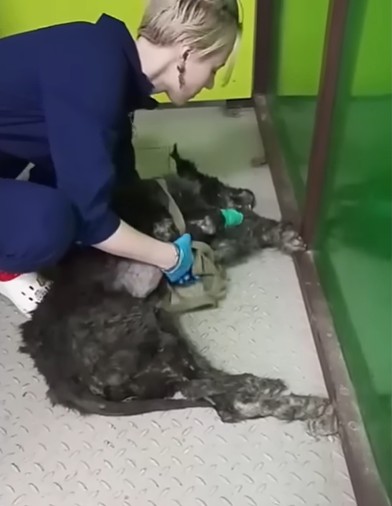
By Day Ten, His Bloodwork Told a Different Story
The first encouraging changes appeared gradually.
Around the seventh day, caregivers noticed that areas of damaged skin were beginning to heal.
Chekia’s condition was becoming more stable.
Then came another important update.
By approximately day ten, rescuers reported that his blood test results had returned to normal ranges.
For the team caring for him, the improvement meant more than a number on a medical report.
Only days earlier, Chekia had arrived physically depleted beneath a hardened coat that restricted nearly every movement.
Now his body was beginning to respond to treatment.
His appetite improved.
His wounds continued closing.
His strength slowly returned.
The dog beneath all that damaged fur was becoming easier to see.
Not only physically.
His behavior was changing too.
Chekia began paying more attention to the people around him.
He rested more comfortably when someone sat nearby.
And as his body felt better, he became increasingly willing to move.
Learning to Move Without the Weight Around Him
Chekia’s legs had spent a long time working beneath a body restricted by hardened fur and poor health.
They needed time to become strong again.
At first, his steps were slow and uncertain.
Caregivers allowed him to move at his own pace.
A few steps were enough.
Then a few more.
Day after day, his balance improved.
His body became stronger as regular meals and medical care replaced the conditions he had been surviving through before rescue.
One eye had suffered lasting damage, according to his rescuers, leaving Chekia with vision primarily through the other.
But that did not stop him from exploring his surroundings.
He began walking farther.
His pace increased.
Eventually, the weak dog who had struggled simply to move beneath the hardened shell could run.
For those who remembered his first days, seeing that change was difficult to reconcile with the animal they had originally found.
The same legs that once moved cautiously beneath a heavy, rigid coat were now carrying him freely.
A New Home Asked Him to Trust Again
Physical recovery was not the only change waiting for Chekia.
Eventually, he found someone willing to make him part of a family.
For a dog who had reportedly experienced both abandonment and deliberate mistreatment, entering another human home could not be treated as though the past had never happened.
Trust had to develop through repetition.
Food arriving every day.
A safe place to sleep.
Hands that touched gently.
A familiar voice.
Someone returning again tomorrow.
Chekia did not need grand gestures.
He needed ordinary kindness to remain ordinary.
Over time, the home became familiar.
The people around him became his people.
Instead of waiting outside an old building, Chekia could rest somewhere protected.
Instead of carrying a hardened coat that made movement difficult, he could walk where he wanted.
And instead of being repeatedly passed by, he now had someone paying attention to the details of his day.
For a rescued dog, sometimes that is what belonging looks like.
Not one emotional moment.
But thousands of quiet ones that keep happening.
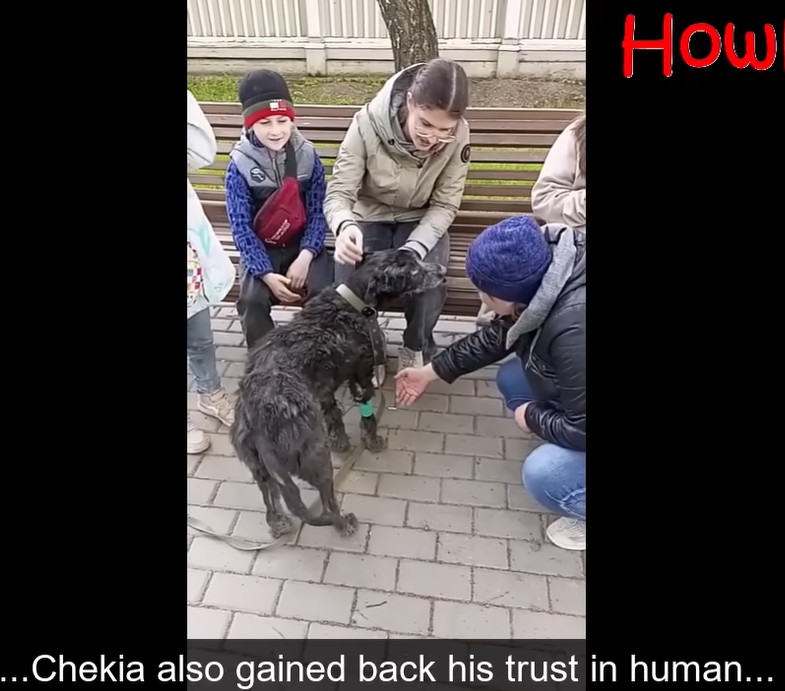
The Most Remarkable Part Was the Dog Still Underneath
Chekia’s condition when rescuers found him was visually shocking.
It is easy for that image to become the entire story.
The hardened coat.
The damaged skin.
The hidden eye.
The body struggling underneath it all.
But those things describe what happened to Chekia.
They do not completely describe Chekia himself.
Once the material was removed and his health improved, another dog emerged.
A dog who could respond to gentle attention.
A dog who could become stronger.
A dog who could learn a new environment and eventually run through it.
That distinction matters.
Animals who arrive in extreme conditions are often described only through their injuries.
Yet beneath every wound, infection, neglected coat, or frightened posture is still an individual animal responding to what happens next.
Chekia responded to care.
First with survival.
Then with strength.
Eventually, with trust.
He No Longer Has to Wait for Someone Who Isn’t Coming Back
There was a time when Chekia reportedly stayed near the building where he had been left.
Perhaps it was simply the only familiar place he knew.
Perhaps he had nowhere else to go.
Whatever kept him there, his life became smaller and more difficult until rescuers finally intervened.
They could not undo what had already happened.
They could not give him back the months he had spent outside.
And they could not completely reverse every physical consequence.
What they could do was begin changing what happened next.
They removed the hardened material one careful section at a time.
Veterinarians treated the body underneath.
Caregivers remained through the uncertain first days.
They watched his bloodwork improve.
They watched him stand more steadily.
Then walk.
Then run.
And eventually, Chekia left rescue care for a home.
His story does not need to turn suffering into something beautiful.
What happened to him should never have happened.
The beautiful part came afterward.
Someone finally stopped.
Someone carefully reached the dog beneath the shell.
And when they did, they discovered that Chekia had never disappeared.
He had simply been waiting for the chance to live differently.


