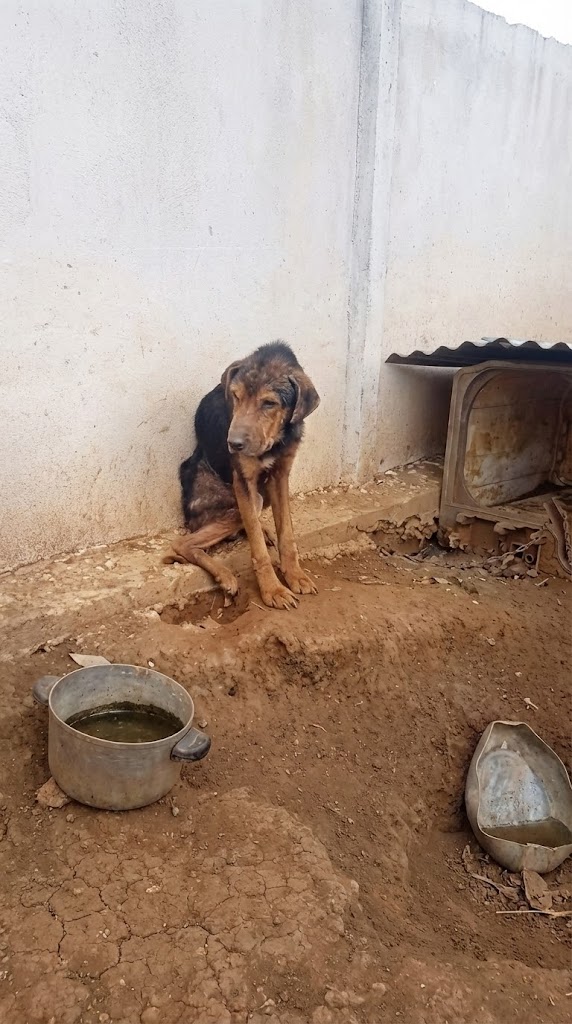
The first thing rescuers noticed was how carefully Max moved.
He was painfully thin, his steps stiff and uncertain, and his coat showed the effects of prolonged neglect.
But whenever someone came near, Max seemed to make himself smaller.
He watched without approaching.
Moved without drawing attention.
And carried himself like a dog who had learned that staying unnoticed might be safer than asking for anything.
By the time rescuers became involved, his body was already dangerously weak.
Getting him away from that life would require help from both rescue workers and local authorities.
Keeping him alive afterward would be another challenge entirely.
Max Had Learned to Move Through Life Without Being Noticed
The signs of neglect were visible almost immediately.
Max was severely underweight.
His body had lost much of the strength a healthy dog should carry, and even ordinary movement seemed to require concentration.
Yet the way he responded to people concerned his rescuers just as much.
He did not rush toward them.
He did not appear to expect comfort.
Instead, Max watched cautiously and kept his distance whenever possible.
No one could know exactly what experiences had taught him to behave that way.
They could only work with the dog standing in front of them.
And that dog needed help quickly.
Rescuers coordinated with authorities until Max could finally be removed from the environment where his condition had deteriorated.
Then he was taken directly for veterinary care.
Leaving was only the first step.
His body was far more fragile than anyone wanted it to be.
VIDEO: Max Was Removed From a Life of Neglect—But Doctors Soon Realized How Little Strength He Had Left
At the Clinic, His Body Needed Immediate Support
The veterinary team found Max dangerously underweight and physically depleted.
He needed more than a few good meals.
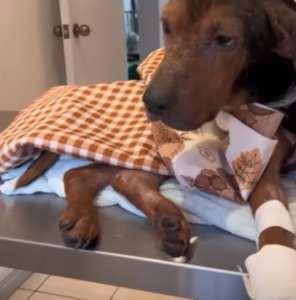
According to his rescuers, his treatment included IV fluids, blood transfusions, and close monitoring as doctors tried to stabilize him.
Those first days were uncertain.
A body weakened over a long period cannot always recover quickly simply because care has finally arrived.
Max needed time to respond.
His nutrition had to be rebuilt carefully.
His hydration had to be supported.
Veterinary staff watched for complications while allowing him as much rest as possible.
Some days brought encouraging signs.
Others reminded everyone how fragile he still was.
There was no guarantee that the dog who had arrived with so little physical reserve would recover smoothly.
So the team focused on what they could control.
Another meal.
Another treatment.
Another quiet night in a clean place.
And slowly, Max began holding on.
Then They Gave Him a Bed—and Max Didn’t Know What to Do
One moment during his early recovery stayed with the people caring for him.
Max was placed on a soft bed.
For most dogs, the response would hardly be worth mentioning.
They might circle once.
Lie down.
Fall asleep.
Max simply became still.
He rested on the soft surface without immediately settling into it, appearing uncertain about this unfamiliar kind of comfort.
The caregivers did not force him to relax.
They let him remain there.
Warm.
Supported.
Safe.
Eventually, the bed became just another part of his environment.
Something that would still be there the next time he needed to rest.
That consistency mattered.
Max did not need to understand everything at once.
He only needed enough ordinary experiences to learn that comfort did not always disappear.
A Month of Recovery Was Built From Very Small Changes
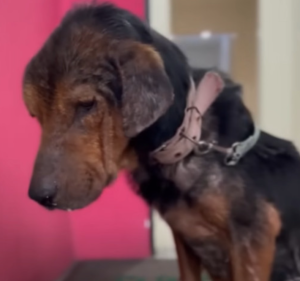
Max’s improvement happened gradually.
His appetite began to return.
Meals became something he could finish more consistently.
As nutrition and veterinary support began helping his body, he gained strength.
His movements became less difficult.
He looked more alert when people entered the room.
Then came one of those tiny moments rescue workers tend to remember.
Max’s tail moved.
Just a little.
There was no sudden burst of excitement.
No dramatic transformation.
But the dog who had once remained guarded around everyone was beginning to respond differently to familiar caregivers.
Over the following days, that change became easier to see.
Max appeared more comfortable with gentle attention.
He became increasingly willing to interact.
His physical recovery and emotional adjustment seemed to be moving alongside each other.
One meal restored a little strength.
One peaceful interaction added another safe experience.
Neither process could be rushed.
Once His Body Was Stronger, His World Became Bigger
After roughly a month of intensive treatment, Max had improved enough to leave the most critical stage of veterinary care.
He was transferred to a safer environment where recovery could continue.
For the first time, his days were no longer centered entirely on medical procedures.
There were new spaces to investigate.
People to observe.
Ordinary routines to learn.
Max began exploring.
He showed more curiosity about what surrounded him.
Play gradually became part of his life.
Touch no longer seemed to carry the same level of uncertainty it once had.
The changes did not mean every fear had disappeared.
A dog does not simply forget a difficult past because the scenery changes.
But Max was collecting experiences that gave him something different to expect.
A hand approaching and offering affection.
A meal arriving when it should.
A soft place remaining available overnight.
People leaving the room and then returning.
His new life was becoming predictable in ways his old one apparently had not been.
A Permanent Home Became the Next Part of His Recovery
Eventually, Max was ready for something beyond temporary care.
A permanent family.
Someone learned about him and decided to give him a home of his own.
The source account describes their connection as immediate.
But even with a promising first meeting, Max still needed the same thing that had helped him throughout recovery.
Time.
He entered a home where he could learn new routines without having to compete for safety.
There were familiar places to sleep.
Regular meals.
People who paid attention to his signals.
And room to discover what he enjoyed now that survival was no longer taking all of his energy.
Gradually, the dog who once moved like he wanted to remain invisible became more confident.
He explored.
Played.
Approached people.
And allowed himself to rest.
Max Didn’t Change Because Someone Asked Him to Forget
The most visible part of Max’s recovery was his body.
Weight returned.
His coat improved.
His movement became stronger.
But the quieter change happened in the way he responded to everyday life.
At first, he seemed uncertain even when placed on something as simple as a soft bed.
Later, comfort became ordinary.
At first, he watched people cautiously.
Later, he sought them out.
At first, nearly all of his energy went toward getting through the day.
Later, he had enough left for curiosity and play.
None of that required pretending that his earlier experiences had never happened.
The people caring for Max simply gave him enough safer experiences to place beside them.
And slowly, those newer experiences became the ones shaping his days.
One Chance Was Enough to Change What Came Next
When rescuers first saw Max, there was very little about his condition that looked easy.
He was severely underweight.
Weak.
Cautious.
And in need of medical treatment intensive enough to include fluids and blood transfusions.
No one could promise what the following month would bring.
They helped him anyway.
First came removal from the environment where he had been deteriorating.
Then veterinary care.
A clean place to rest.
A soft bed he did not quite understand.
Food.
Treatment.
A tiny movement of his tail.
Then more strength.
More curiosity.
Eventually, a home.
Max’s story did not change because someone erased his past.
It changed because people interrupted it.
They gave the frightened, depleted dog enough time to discover that tomorrow could look different from yesterday.
Today, Max no longer needs to move through life like a shadow.
He can be seen.
He can take up space.
He can rest without wondering whether the comfort beneath him will disappear.
And the eyes that once made rescuers stop scrolling now belong to a dog who finally has somewhere safe to look forward from.


