For nearly ten years, Angela’s world barely changed.
She lived inside a small enclosure on a neglected property, separated from the ordinary things most dogs experience every day.
No walks.
No soft bed.
Almost no meaningful human contact.
Years passed while the world outside continued without her.
Then the property changed hands.
And someone finally noticed the elderly dog hidden away in a forgotten corner.
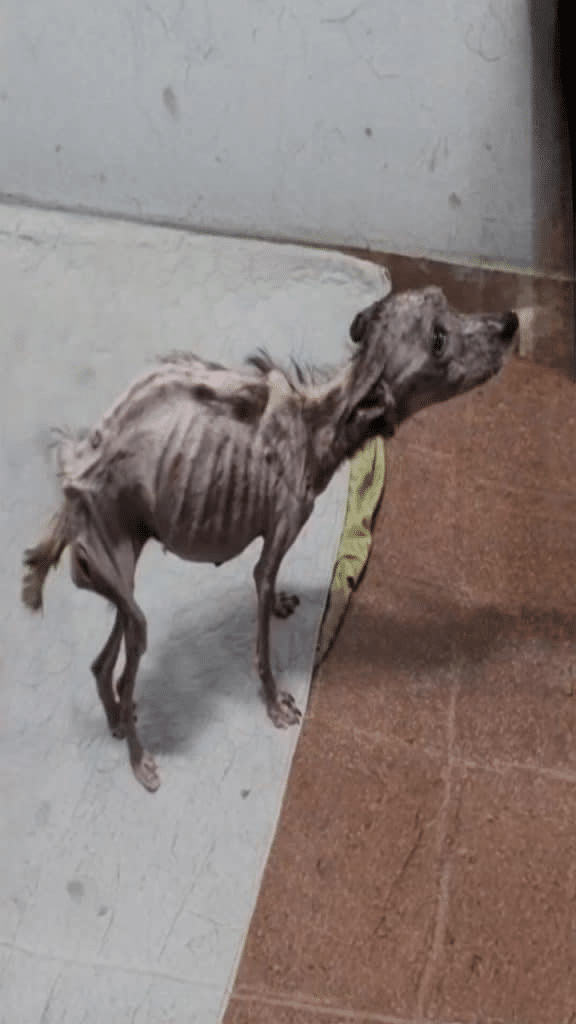
By that point, Angela was so weak that she could barely move.
But the discovery came before her story was over.
After Years Out of Sight, Angela Was Finally Found
The people who discovered Angela had not been looking for a dog.
They were dealing with the property after it had been sold when they came across her enclosure.
Inside was an animal whose body showed the effects of long-term neglect.
Angela was extremely thin.
Her strength was severely limited.
She remained mostly still as people approached.
No one could know exactly what every year in that enclosure had been like for her.
They could only see what those years had left behind.
Angela needed veterinary care immediately.
Rescuers approached slowly and spoke quietly while preparing to move her.
She did not attempt to run.
She did not have much strength to resist.
They lifted her carefully and transported her to an animal hospital.
After nearly a decade in the same forgotten space, Angela was finally leaving it.
VIDEO: Angela Spent Nearly Ten Years Hidden Away—Then Rescuers Found Her Barely Able to Move
At the Hospital, Everything Had to Begin Slowly
Angela arrived in critical condition.
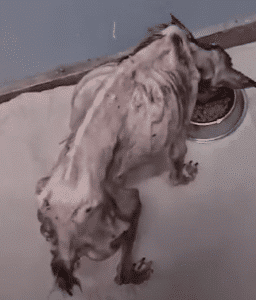
She was dangerously underweight.
Her body temperature was low.
According to the rescue account, veterinarians were also concerned about how the prolonged neglect had affected her overall organ function.
Her body could not simply be asked to recover all at once.
So treatment began with the most basic needs.
Warmth.
Hydration.
Small amounts of carefully managed food.
Rest.
The veterinary team monitored her closely while allowing her weakened system time to adjust.
Angela remained quiet during those first days.
She accepted treatment without much resistance and spent long periods resting.
There was no dramatic turnaround.
No sudden burst of energy.
For a dog who had been depleted for years, survival itself was the first goal.
The people caring for her watched for tiny changes.
A stronger breath.
More awareness.
A slight shift in posture.
Anything that suggested her body was beginning to respond.
Then a Veterinarian Saw One Tiny Toe Move
A few days into treatment, the team noticed something small.
One of Angela’s toes moved.
Just slightly.
It would have been easy to miss.
But for caregivers who had been watching a dog with so little movement, that tiny response mattered.
The motion did not mean Angela was suddenly ready to stand.
It did not guarantee how far her recovery would go.
But it gave the team another reason to continue.
Her body was responding.
From that point, rehabilitation became part of her daily care.
The exercises were intentionally gentle.
Angela was still far too fragile for anything demanding.
Instead, caregivers worked with small movements designed to encourage circulation, flexibility, and muscle activity.
Warm massage helped loosen stiff areas.
Light assisted exercises allowed her body to move without forcing it to support more weight than it could handle.
Every session was adjusted to what Angela could tolerate that day.
Rehabilitation Was Measured in Inches, Not Miles
Angela had spent years with very limited activity.
Her muscles needed time.
So did her balance.
Even holding herself differently required effort.
Some days, the progress was almost invisible.
A leg moved a little more freely.
Her head remained lifted longer.
She shifted her body without as much assistance.
Then those small changes began accumulating.
Regular nutrition gradually added strength to her frame.
Her posture improved.
Her coat began looking healthier.
And the elderly dog who had once remained nearly motionless started becoming more aware of what was happening around her.
The team did not rush her.
If Angela became tired, they stopped.
If she needed rest, she rested.
Recovery was not treated like something she had to perform for anyone.
The goal was simply to help her regain as much comfort and independence as her body would allow.
The Bigger Change Appeared in the Way She Met People
Physical recovery was easy to track through weight, movement, and veterinary examinations.
Another kind of change appeared more quietly.
Angela began paying more attention to the people around her.
At first, she mostly remained where she was placed.
Over time, she started watching caregivers enter the room.
She became more comfortable with gentle touch.
Then she began moving toward people instead of simply waiting for them to approach.
There was no single moment when fear disappeared.
Trust grew through routine.
The same people returned.
Meals arrived consistently.
Hands remained gentle.
Her bed stayed warm.
Nothing was demanded from her in exchange.
Those repeated experiences gave Angela a different kind of life to learn from.
One where human presence did not automatically mean discomfort or neglect.
Ordinary Comforts Became New Experiences
As Angela became stronger, she began enjoying things that had once been missing from her life.
A soft bed.
Regular meals.
A warm place to sleep.
Gentle attention.
Time near people without needing to protect herself.
For another dog, these things might seem completely ordinary.
For Angela, they represented a world very different from the enclosure where she had spent so many years.
She could rest without lying on cold ground.
She could eat without wondering when the next meal would come.
She could settle near someone and remain there.
Her recovery was not about turning her into a young dog again.
Years had passed, and her body carried the effects of them.
The goal was something simpler.
Comfort.
Dignity.
And as much good time as Angela could still have.
Eventually, Angela Was Ready to Leave the Clinic
The hospital had been the place where Angela’s second chance began.
But it was never meant to be the rest of her world.
As her condition stabilized and her strength improved, the next step became possible.
A family welcomed her into their home.
Angela did not enter that home as a perfectly restored dog.
She was older.
She had a history that could not simply be erased.
And she still needed patience.
But now there were people prepared to provide it.
She had warm places to sleep.
Familiar routines.
Food that arrived every day.
People who noticed when she needed help.
The forgotten enclosure was no longer the place where she woke up each morning.
Angela finally had a home where someone expected to see her.
Ten Years of Silence Did Not Have to Decide the Rest of Her Life
Angela’s story is difficult because so much time had already passed before anyone intervened.
Those years could not be returned to her.
No treatment could make her young again.
No loving home could erase the fact that she had spent nearly a decade with very little of what a companion animal should know.
But rescue was still worth doing.
Because Angela was still there.
Still capable of responding.
Still capable of becoming stronger.
Still capable of finding comfort in a soft bed and familiarity in a gentle hand.
Her transformation did not begin with something dramatic.
It began with someone discovering her.
Then warmth.
Food.
Veterinary care.
One tiny toe moving.
One rehabilitation session after another.
And eventually, a home.
Once, Angela lived almost completely out of sight.
Today, there are people who know exactly where she is.
People who notice when she eats.
When she rests.
When she moves closer.
After years spent forgotten in one small enclosure, Angela no longer has to disappear quietly into the background.
She is seen.
She is cared for.
And whatever time remains belongs to her.


