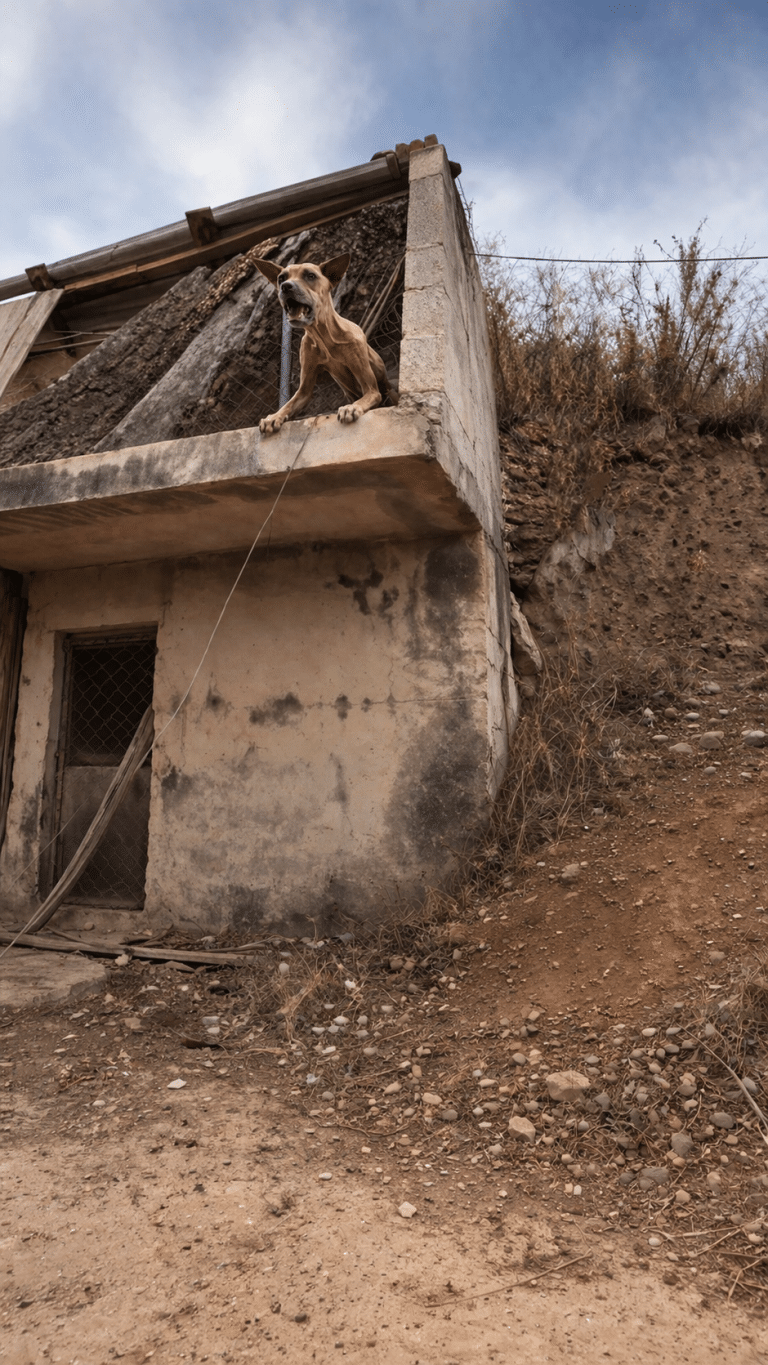
For years, Chata lived above everyone else.
Not in comfort.
Not with freedom.
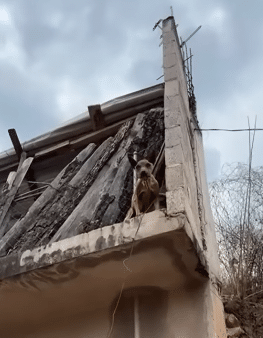
But behind a mesh barrier on a rooftop, separated from the streets below and dependent on whatever food happened to reach him.
By the time rescuers finally climbed up to see him, his body had become painfully thin.
His ribs stood sharply beneath his skin.
His movements were slow.
And yet, when strangers approached the place where he had spent so much time alone, Chata did something they did not expect.
His tail moved.
Just a little.
The Rooftop Had Become His Entire World
According to the rescue account, Chata had once been used repeatedly for breeding.
Then, when he was no longer wanted for that purpose, his life became increasingly isolated.
He was left on the rooftop for years.
The story describes more than eight years passing under those conditions.
A mesh barrier limited where he could go.
Regular care was absent.
Food reportedly came largely from scraps tossed to him by people who knew he was there.
That was enough to keep Chata alive.
It was not enough to keep him healthy.
By the time help arrived, the consequences were visible across his entire body.
He was severely underweight.
Weak.
Dehydrated.
And far older than the dog who had first been left there.
The rescuers could not change those lost years.
They could only make sure another one did not begin the same way.
VIDEO: Chata Spent Years Forgotten Behind Rooftop Mesh—Then Rescuers Finally Climbed Up to Reach Him
He Didn’t Run When the Ladder Reached Him
The rescue team arrived with a ladder and climbed toward the enclosed rooftop.
For Chata, unfamiliar people entering his small world could easily have been frightening.
But he did not try to hide.
He did not challenge them.
Instead, rescuers saw that small movement of his tail.
His weakened body did not have much energy to spare, but he was still responsive to the people approaching him.
They moved carefully.
Chata was fragile enough that even handling him required attention.
Once they reached him, there was little question about what needed to happen next.
He had to leave.
After years spent above the neighborhood, surviving inside the same confined space, Chata was brought down from the rooftop.
Then he was taken directly for veterinary care.
For perhaps the first time in years, the place where he woke up tomorrow would be somewhere different.
The Clinic Revealed How Much His Body Had Endured
At the clinic, veterinarians began evaluating the effects of prolonged neglect.
Chata was severely malnourished.
He was dehydrated.
His muscles had weakened enough that ordinary movement required significant effort.
His body needed careful nutritional support rather than a sudden return to unrestricted feeding.
Then the veterinary team found another serious concern.
A large tumor.
The rescue account does not provide enough detail to establish exactly what type of growth it was or the complete treatment plan.
What was clear was that Chata now needed ongoing medical attention in addition to rebuilding his basic strength.
So recovery had to happen in stages.
Fluids helped address dehydration.
Small meals were introduced gradually.
Vitamins and medical monitoring supported a body that had been depleted for a long time.
No one expected eight years of hardship to disappear in a few days.
The first objective was simply to help Chata stabilize.
His First Victories Were Almost Ordinary
Progress came slowly.
At first, the important things were small.
Finishing food.
Resting comfortably.
Remaining alert for longer periods.
Standing with a little more strength.
Chata’s body had been surviving on too little for too long, so every improvement needed time to build on the one before it.
As nutrition became consistent, his energy began returning.
His eyes appeared more attentive.
Movement became less exhausting.
And through those early weeks, caregivers noticed something about him that his condition had not taken away.
Chata remained gentle around people.
He accepted care.
He allowed affection.
Sometimes he leaned toward the people helping him.
No one could know exactly how he understood those new experiences.
But they could see that he was becoming comfortable enough to participate in them.
Stability Was Something Chata Had Never Been Able to Count On
For years, Chata’s days had depended on circumstances outside his control.
Whether food appeared.
What the weather was like.
Whether anyone noticed what he needed.
Rescue changed those uncertainties.
Meals came on schedule.
Water was available.
His health was monitored.
When something was wrong, someone responded.
That consistency may sound unremarkable.
For Chata, it changed the structure of every day.
He no longer had to remain behind mesh waiting for scraps.
He could rest knowing food would return.
He could receive treatment instead of simply adapting to discomfort.
And as his strength improved, he became increasingly comfortable with the humans around him.
The dog who had been physically isolated for so long was beginning to experience another kind of routine.
One built around care.
His Recovery Was Never About Making Him Forget the Rooftop
Chata’s appearance gradually changed as his body received proper nutrition and treatment.
He looked stronger.
His posture improved.
His eyes appeared more alert.
But recovery did not mean pretending those years had never happened.
He had lost a significant part of his life to isolation and neglect.
His medical problems still required attention.
The tumor still needed veterinary management.
And rebuilding an older, weakened body could not be rushed.
What rescuers could give him was something the past had not provided.
A different present.
Chata did not have to prove that he could become perfectly healthy.
He did not have to behave like a younger dog.
He only needed the chance to live whatever came next with food, comfort, medical care, and people paying attention.
One Important Part of Chata’s Story Is Still Unfinished
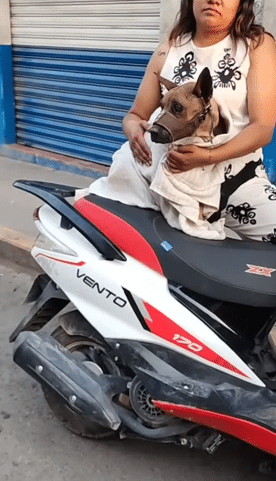
Today, Chata is no longer living on the rooftop.
His body is stronger than when rescuers first reached him.
He is receiving treatment.
He has regular meals.
And he is surrounded by people who know his condition and notice what he needs.
But according to his rescue story, there is still one chapter waiting.
A permanent home.
Chata has already experienced the difference between being kept somewhere and being cared for somewhere.
Now he needs a place where that care does not feel temporary.
A home where his age and medical needs are understood.
Where he can rest without wondering whether he will be moved again.
Where the routines he has only recently learned can continue for the rest of his life.
After Eight Years Above the World, Someone Finally Looked Up
Chata survived for years in a place most people would never think to search.
Above the street.
Behind mesh.
Thin enough that every rib became visible.
Living largely on whatever scraps reached him.
That could have remained his entire story.
Instead, someone made a call.
A rescue team brought a ladder.
People climbed to the rooftop and saw the dog who had been living there all along.
Then Chata’s world began to change.
First came the trip down.
Then the clinic.
Food.
Fluids.
Medical care.
A little more strength.
A little more trust.
The years he lost cannot be returned.
But the years ahead do not have to look like them.
Once, Chata survived because scraps occasionally reached the rooftop.
Now people come to him deliberately.
They feed him.
Treat him.
Touch him gently.
And pay attention when something changes.
For a dog who spent so long out of sight, perhaps that is one of the biggest differences of all.
Chata no longer has to wait for someone to remember he is there.


