For nearly seven hours, the cardboard box sat beside the road.
Inside was a puppy.
No food.
No water.
No soft place to lie down.
By the time a woman named Fernanda finally stopped and looked inside, the little dog was barely responding.
He did not bark.
He did not try to climb out.
He could hardly lift his head.
His body trembled weakly against the bottom of the box, and his breathing was faint enough to make every passing moment feel important.
Fernanda did not know how long the puppy had been struggling before someone left him there.
She only knew he needed help immediately.
When Fernanda Opened the Box, He Barely Reacted
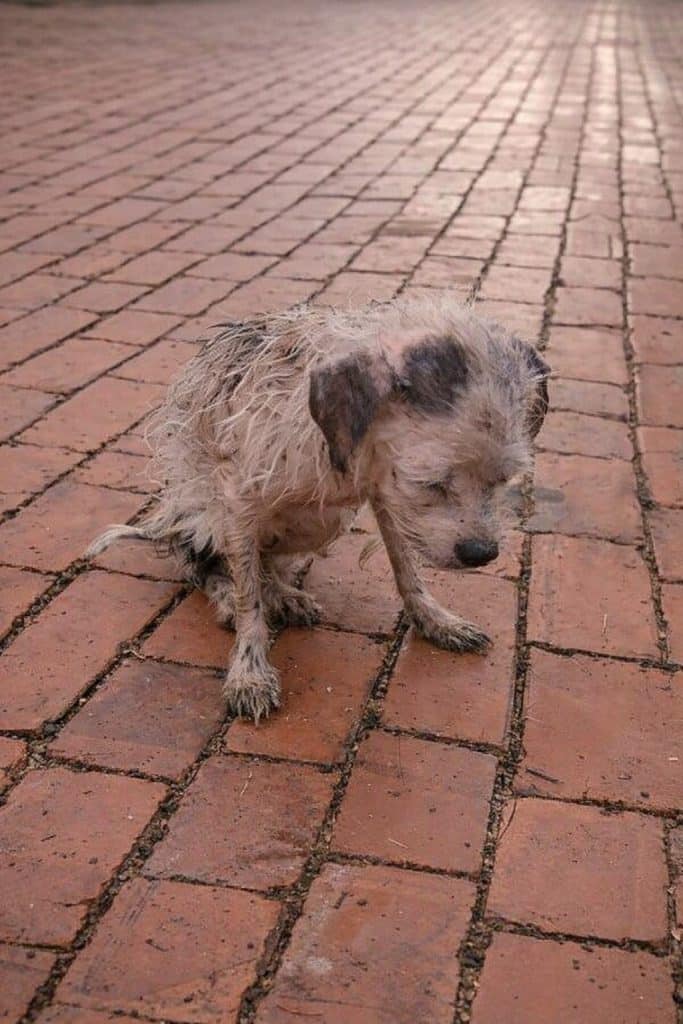
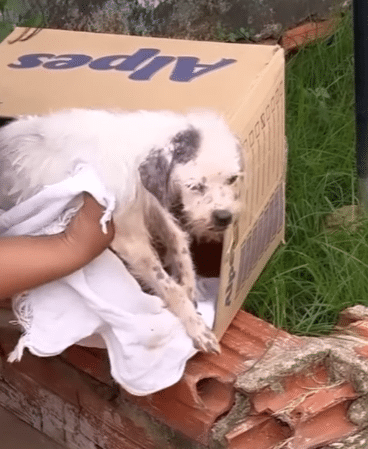
Up close, the puppy’s condition was even more concerning.
He was severely underweight.
Much of his fur was gone, leaving damaged skin exposed underneath.
His gums appeared pale.
His eyes were highly sensitive, and even ordinary light seemed uncomfortable for him.
Most troubling of all was his lack of strength.
The puppy could not hold his head up normally.
He made almost no attempt to move away when Fernanda reached toward him.
For a young dog, that level of stillness was alarming.
She carefully lifted him from the cardboard box and rushed him to a veterinary clinic.
There was no guarantee that he would recover.
But at least he was no longer waiting beside the road for someone to notice.
VIDEO: He Spent Seven Hours Inside a Cardboard Box—Then Fernanda Found Him Barely Able to Lift His Head
At the Clinic, Even Basic Treatment Was Difficult
The veterinary team immediately began assessing how badly the puppy’s body had deteriorated.
According to the rescue account, he was more than 4.3 kilograms—about 9.5 pounds—below the weight expected for his condition and size.
His gums were extremely pale.
His circulation was poor enough that accessing his veins for treatment became difficult.
His damaged skin also required attention, while the severe loss of fur suggested a problem that had been developing for some time.
The team focused first on keeping him stable.
Fluids.
Warmth.
Careful monitoring.
Everything had to be done gradually because his body had almost no reserve left.
Then another concern became impossible to ignore.
His blood values were poor enough that veterinarians decided he needed a transfusion.
For a puppy already so weak, it was a significant step.
But without additional support, his chances of recovery appeared limited.
Then Someone Spoke to Him—and His Tail Moved
During those fragile early hours, one caregiver spoke softly near him.
The puppy barely had enough strength to reposition himself.
But his tail moved.
Just slightly.
It was not a dramatic wag.
It did not mean the danger had passed.
But everyone noticed it.
The puppy was still responding to the people around him.
For the veterinary staff, that tiny movement became one more reason to continue taking recovery hour by hour.
The blood transfusion was completed.
He remained under close observation.
And rather than expecting a sudden transformation, the team watched for the smallest possible improvements.
A steadier breath.
More awareness.
A little movement.
Anything that suggested his body was beginning to use the support it had been given.
By Day Three, His Body Was Ready for the Next Stage
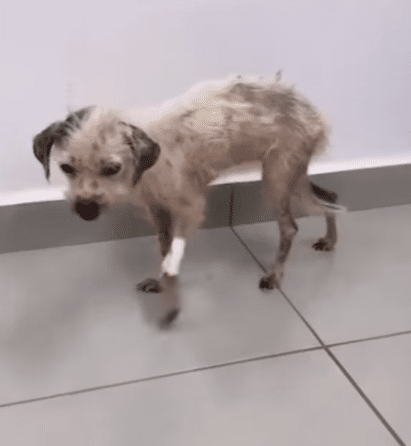
Once the puppy became somewhat more stable, treatment for his severe skin condition could begin.
That happened around the third day.
His skin required careful, repeated care rather than one quick treatment.
The veterinary team also continued monitoring his eyes and overall condition.
Gradually, something else changed.
The puppy became interested in food.
For the first time since rescue, he began eating on his own.
That mattered because nutrition was essential to rebuilding everything his body had lost.
His meals gave him energy.
Energy allowed his body to heal.
And as the days passed, he became increasingly alert to what was happening around him.
The puppy who had once remained almost motionless in a cardboard box was beginning to participate in his own daily routine.
Eat.
Rest.
Receive treatment.
Then wake up and do it again.
Fourteen Days Later, He Finally Had a Name
By the second week, the puppy had already survived the most uncertain part of his recovery.
His caregivers gave him a name.
Chanel.
By then, he was no longer simply “the puppy from the box.”
He was an individual animal whose habits and personality were beginning to emerge.
He recognized familiar people.
His appetite was stronger.
His body had enough energy for more movement.
The damaged skin was slowly improving.
None of this meant his recovery was finished.
But the differences from his first day were becoming increasingly difficult to miss.
On the day Fernanda found him, holding up his own head had been a challenge.
Now Chanel was looking around.
Moving.
Responding.
And beginning to behave more like the young dog he had always been underneath the illness and exhaustion.
By Day Twenty-Two, Fur Was Beginning to Return
A little more than three weeks after rescue, Chanel’s appearance had changed noticeably.
His skin had responded well to treatment.
Areas that had once looked inflamed were healing.
Fine fur began appearing where his coat had been missing.
His body was also becoming stronger as regular meals helped replace the weight he had lost.
But perhaps the more meaningful transformation was in the way Chanel used that new energy.
He became curious.
Then playful.
He explored his surroundings.
He interacted with other dogs.
He started running rather than remaining still in one place.
The contrast was striking.
The puppy found unable to lift his head now had enough energy to chase, investigate, and play.
His caregivers had not created a different dog.
They had simply helped remove the physical problems that had prevented Chanel from behaving like himself.
On Day Thirty-One, Someone Chose Him for a Permanent Home
Just over a month after Fernanda opened that cardboard box, Chanel reached another milestone.
A family in the United Kingdom wanted to adopt him.
For the puppy who had once been left without even a bowl of water, the change was difficult to imagine.
Now there were people preparing specifically for his arrival.
A home.
Regular meals.
A place to sleep.
Someone who would notice if he was sick.
Someone who would expect him to still be there tomorrow.
Chanel was not chosen because he had survived something dramatic.
He was chosen for the dog he had become once given the opportunity to recover.
Playful.
Curious.
Social.
And finally strong enough to enjoy the ordinary things a puppy should have known from the beginning.
Seven Hours Could Have Been the End—Instead, Someone Looked Inside
Chanel’s story changed because a person stopped beside an ordinary cardboard box.
Nothing about the box itself demanded attention.
Someone could easily have driven past.
Walked around it.
Assumed there was nothing inside worth checking.
Fernanda looked anyway.
That decision led to a veterinary clinic.
A blood transfusion.
Skin treatment.
Careful meals.
Fourteen days until the puppy had a name.
Twenty-two days until his recovering coat made the transformation increasingly visible.
And thirty-one days until a family was preparing to give him a permanent home.
None of those things were guaranteed when Chanel first arrived at the clinic.
At that point, even lifting his head seemed difficult.
All rescuers had was a severely weakened puppy and one tiny movement of his tail.
It was enough to begin.
Once, Chanel spent hours inside a cardboard box while the world passed beside him.
Now there are people who know his name.
People who know when he wants to play.
People who will notice when he needs something.
His life changed because someone did one very simple thing.
They stopped.
And they looked inside.


