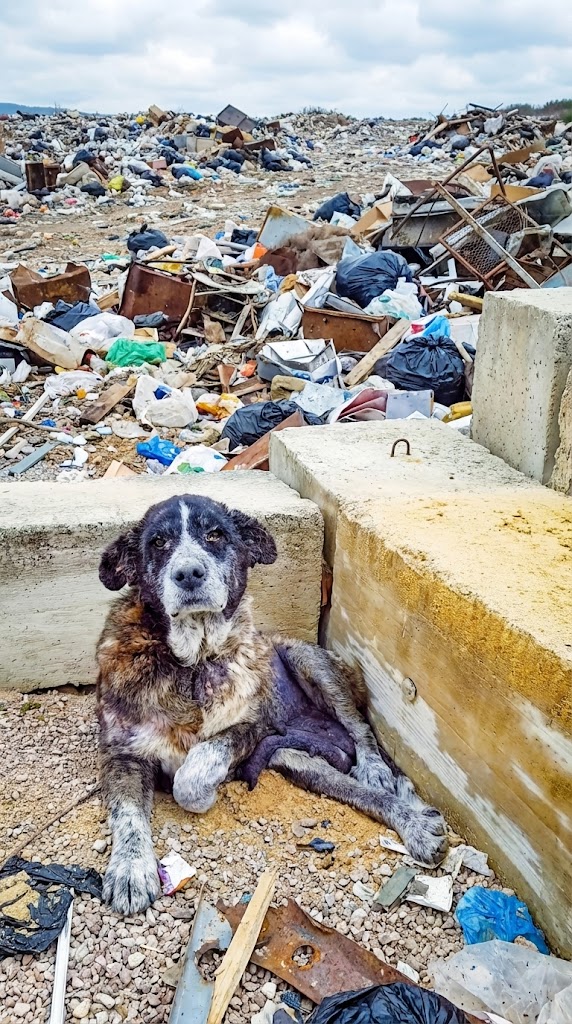
Maya was standing among piles of discarded metal and debris when volunteers first noticed her.
She was a large dog, difficult to miss once someone actually looked in her direction.
But the landfill had become her world.
There was no proper shelter.
No reliable source of clean water.
And no clear sign that anyone intended to take her away from the place.
Volunteers initially thought the biggest challenge would be getting Maya out.
They were wrong.
The more dangerous problem would only become visible after she reached safety.
Volunteers Could Feed Her—But They Couldn’t Simply Take Her Away
The landfill was located on private property, which complicated the rescue.
Volunteers could not simply walk in and remove Maya without considering the consequences.
So while they tried to find a way forward, they began doing what they could.
They brought food.
Water.
And eventually materials for a small makeshift shelter that offered at least some protection from the weather.
Each visit allowed them to observe Maya more closely.
Despite her size, she did not behave aggressively toward the people trying to help.
She remained relatively calm as they approached.
The rescuers continued returning, knowing that temporary food and shelter could not be the permanent solution.
Eventually, they decided that waiting carried its own risk.
They returned after dark and prepared to take Maya out.
VIDEO: Maya Was Living Alone Among Landfill Debris—Then Rescuers Returned After Dark to Bring Her Out
The Giant Dog Didn’t Fight Them When Rescue Finally Came
When the team approached Maya that night, they were prepared for uncertainty.
A frightened dog of her size could have made the rescue extremely difficult.
Instead, Maya remained quiet.
She did not run.
She did not resist being moved away from the landfill.
For volunteers who had spent time worrying about how they would get her out, the moment was almost surprisingly calm.
Maya was finally leaving behind the debris, exposed ground, and improvised shelter that had defined her days.
At that point, rescuers believed the worst part might already be over.
She would receive food.
Rest.
A medical examination.
Then, they hoped, she could begin recovering from whatever neglect had brought her to the landfill.
But once she was under veterinary care, Maya’s condition did not improve as expected.
It became worse.
Her Skin Kept Deteriorating Even After She Was Safe
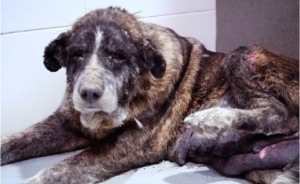
At the clinic, caregivers began noticing increasingly serious problems with Maya’s skin.
Lesions appeared.
Existing areas worsened.
Discomfort increased rather than fading with ordinary care.
The fact that Maya was now clean, fed, and protected did not stop the progression.
Veterinarians continued testing until, according to the rescue account, they reached a diagnosis.
Pemphigus.
Pemphigus refers to a group of autoimmune diseases in which the immune system mistakenly attacks structures within the skin.
For Maya, that meant the problem was not simply something she had picked up while living at the landfill.
Her own immune system was contributing to the damage.
The diagnosis changed her treatment completely.
This was not something a bath, better food, or a short course of medication could quickly solve.
Treatment Became a Long Effort to Control Her Immune System
Maya needed intensive medical management.
According to the rescue account, treatment included high-dose medication and close supervision.
Those medications could carry significant side effects, so caregivers had to watch both the disease and Maya’s response to treatment.
For a time, the outcome remained uncertain.
Her skin had already been badly affected.
Her body had to cope with both the illness and the treatment required to control it.
Progress was slow enough that caregivers could not judge success from one day to the next.
They looked for smaller changes.
A lesion beginning to close.
A better appetite.
A little more energy.
Longer stretches of comfort.
Gradually, those changes began appearing.
The wounds started improving.
Maya’s strength returned.
She began eating more consistently.
The dog who had survived the landfill was now getting through a completely different kind of struggle.
Recovery Revealed How Calm Maya Really Was
As treatment began controlling the disease, Maya’s personality became easier to see.
She was large and physically imposing.
But caregivers described her as calm.
Steady.
Comfortable around people.
She did not need to demand attention to be noticed.
Her presence did that on its own.
As her skin improved and her energy returned, the rescue team could finally begin thinking beyond medical survival.
Maya would need a permanent home.
Not simply someone attracted to her dramatic transformation.
She needed people prepared to understand her history and any ongoing medical needs associated with her condition.
Eventually, a family came forward.
They had lived in several countries, including Venezuela, Italy, and Spain.
And when they met Maya, they did not seem intimidated by her size or her past.
They wanted her.
In Her New Home, Maya Became the Calm Center of the Family
Maya’s new life was very different from the place where rescuers first saw her.
She joined a family that already included three other dogs.
Instead of struggling to find her place among them, Maya reportedly settled in with remarkable ease.
She was not described as pushy or aggressive.
She simply seemed comfortable being there.
Her new family began referring to her with the affection usually reserved for someone who quietly controls the room.
A queen.
The nickname fit.
Maya appeared in family photographs.
Walked through the countryside.
Joined holiday moments, sometimes wearing festive antlers with the same composed expression she seemed to bring to everything else.
The dog once surrounded by broken objects in a landfill was now surrounded by animals and people who expected her to be part of everyday life.
Months Later, Her Rescuers Saw a Dog Who No Longer Looked Like a Survivor
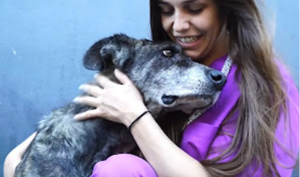
After Maya had been adopted, some of the people involved in her rescue visited her again.
They already knew she was safe.
They knew her medical condition had improved.
But seeing her in a home offered a different kind of confirmation.
Maya no longer looked like a dog temporarily recovering from something terrible.
She looked settled.
Comfortable.
At ease in her surroundings.
The autoimmune disease remained part of her medical history, and the source does not suggest that such a condition simply disappeared forever.
What had changed was the life around it.
Maya had people who knew her condition.
People who could notice changes.
People willing to continue providing the care she might need.
And she no longer faced any of it alone.
The Landfill Was Where Maya Was Found—Not Where She Belonged
Maya’s story could easily have been defined by the first place rescuers saw her.
A giant dog standing among rusted metal and discarded objects.
Waiting in a place built for things people no longer wanted.
But getting her out of the landfill turned out to be only the first rescue.
The second began at the clinic.
When her skin deteriorated instead of improving, veterinarians kept searching for an explanation.
They found pemphigus.
Treatment followed.
Slowly, the lesions improved.
Her appetite returned.
Her strength came back.
And eventually, Maya traveled into a completely different life.
Today, she walks through the countryside rather than among piles of debris.
She shares her home with other dogs.
She appears in family photographs instead of rescue updates.
The place where Maya was discovered once suggested that she had been discarded.
Everything that followed proved something else.
She had never belonged among the things people had thrown away.


