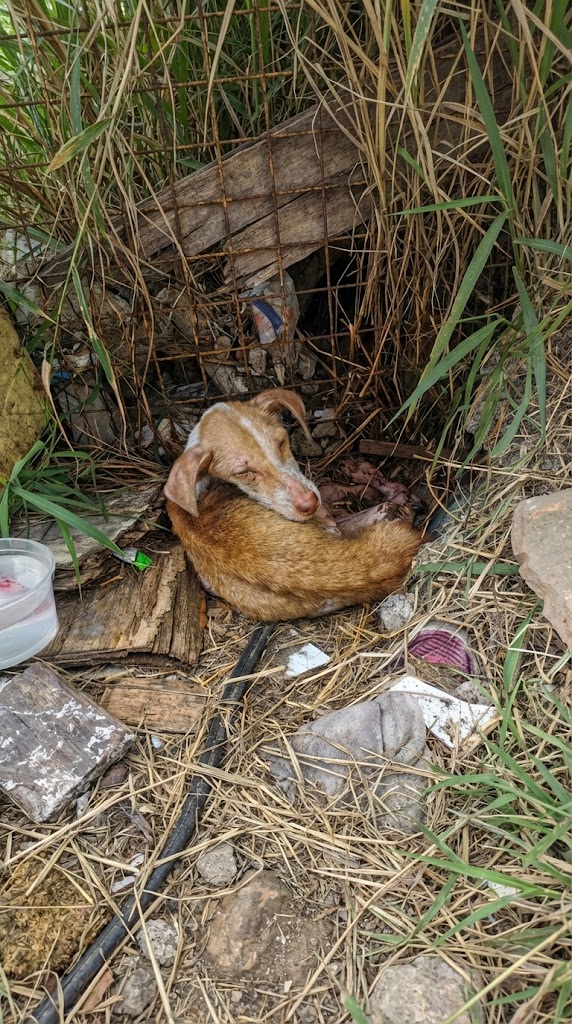
The rescuer was already driving to a veterinary clinic when an urgent message appeared on the phone.
A puppy had been spotted near the highway.
He was severely malnourished.
And his location happened to be directly along the route.
Beneath a towering roadside billboard, almost blending into the dusty ground, lay a puppy who seemed to have very little strength left.
He did not bark when help arrived.
He did not try to run.
But when footsteps came closer, the little dog slowly lifted his head.
That small movement was enough.
Beneath the Billboard, Lankrus Could Barely Move
Up close, the puppy’s condition was much more serious than it had appeared from the road.
His body was painfully thin.
His ribs showed clearly beneath his skin.
Large areas of fur were missing, and his skin had been badly affected by parasites and what the rescue account describes as scabies.
Most concerning was his weakness.
Lankrus could not stand.
His muscles appeared too depleted to support his body, leaving him almost completely dependent on whoever had finally stopped to help.
The rescuer carefully lifted him and continued toward the veterinary clinic.
The trip that morning had originally been for another animal.
Now there was one more life in urgent need of care.
VIDEO: Lankrus Was Found Too Weak to Stand Beneath a Highway Billboard—Then Someone Finally Stopped
At the Clinic, His Body Had Almost Nothing Left to Draw From
Veterinarians quickly confirmed how depleted Lankrus had become.
He was severely malnourished.
His damaged skin required treatment.
Parasites had weakened a body that was already struggling to maintain basic strength.
And because he could not stand, even ordinary puppy behavior—walking toward food, exploring a room, following someone—was temporarily beyond him.
The veterinary team could not promise a fast recovery.
His condition had developed over time, and rebuilding him would require the same.
Treatment began with the essentials.
Nutrition.
Skin care.
Rest.
Close monitoring.
The rescuer stayed near him during those early days, offering gentle contact while Lankrus adjusted to unfamiliar people and surroundings.
There was no dramatic breakthrough.
At first, there was simply a puppy lying quietly while other people did the work his body could no longer do alone.
The First Few Days Were Almost Completely Still
Lankrus needed time before anyone could expect him to behave like a normal puppy.
His muscles had become so weak that caregivers began gently massaging his legs as part of his supportive care.
At first, he sometimes flinched at the contact.
The reaction was not surprising.
Everything was unfamiliar.
The clinic.
The people.
The hands touching a body already irritated by skin problems.
So the interactions remained slow.
No one forced affection.
They simply repeated the same safe experiences.
Food arrived.
Treatment continued.
Gentle hands touched his legs and then moved away.
Nothing frightening followed.
Little by little, Lankrus became more comfortable.
And on the fifth day, he attempted something he had not been able to do when he was found.
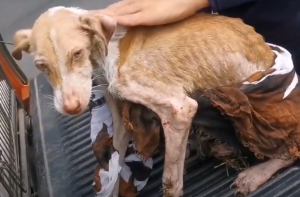
On Day Five, Four Paws Touched the Ground
Lankrus tried to stand.
His legs trembled beneath him.
The effort clearly demanded nearly everything he had.
For a moment, it looked as though his body might immediately sink back down.
Then he managed to hold himself up.
Four paws on the floor.
Unsteady.
Weak.
But supporting his own weight.
It was only a brief milestone.
Lankrus was still thin.
His skin was still healing.
He had not suddenly recovered from severe malnutrition in five days.
But standing changed what his caregivers could reasonably hope for next.
His body was beginning to respond.
The muscles that had been almost unused were working again.
And once Lankrus could stand, he could begin discovering what else those legs might still be able to do.
Ten Days Later, He Had Enough Energy to Play
By around the tenth day, the difference was becoming easier to see.
Lankrus was more alert.
He was moving around.
And rather than spending every moment conserving energy, he began using some of it on other dogs.
He approached them.
Engaged with them.
Attempted small, awkward bursts of play.
His body still showed how recently he had been rescued.
His ribs remained visible.
His coat had not completely recovered.
The skin condition still required time.
But the puppy beneath those medical problems was becoming more apparent.
That mattered.
During his first hours at the clinic, almost all of Lankrus’s available energy had gone toward basic survival.
Ten days later, he had enough left to be curious.
To interact.
To play.
Those were not signs that treatment was finished.
They were signs that life was no longer being spent only on staying alive.
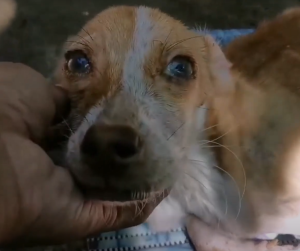
His Recovery Was Still Far From Finished
It would be easy to turn Lankrus’s ten-day improvement into a complete transformation.
The source does not support that.
He was still recovering.
He still needed to gain weight.
His skin and coat needed additional time.
A body weakened by severe malnutrition does not rebuild itself in a matter of days.
So the work continued.
Regular meals gave him the nutrition he had been missing.
Treatment addressed his skin problems and parasites.
Movement helped him begin rebuilding strength.
And being somewhere safe gave him something the roadside never could.
Time.
Time to rest without traffic rushing nearby.
Time to eat without searching.
Time for his muscles to become stronger before being asked to do more.
The important change was not that Lankrus had suddenly become a perfectly healthy puppy.
It was that he finally had the conditions needed to keep improving.
The Puppy Under the Billboard Had Finally Been Given Somewhere Safe to Recover
There was nothing dramatic about the place where Lankrus was found.
Cars passed.
The billboard towered overhead.
Dust covered the ground beneath it.
A person could have driven past without realizing a puppy was lying there at all.
That morning, someone did notice.
The rescuer changed course.
Lankrus was picked up.
Veterinarians treated the body that could no longer stand.
For several days, progress remained quiet.
Then, on day five, he pushed himself onto trembling legs.
By day ten, he was beginning to play.
His story was not finished at that point.
Recovery still lay ahead.
But the most dangerous part of his situation had already changed.
Lankrus was no longer beneath a billboard waiting for his weakened body to decide how much longer it could continue.
Someone knew where he was.
Someone noticed whether he ate.
Someone treated his skin.
Someone was there when he tried to stand.
Sometimes rescue begins with an extraordinary act.
And sometimes it begins because a person already driving somewhere else sees one urgent message—and decides to stop along the way.


