At first, there was almost nothing to see.
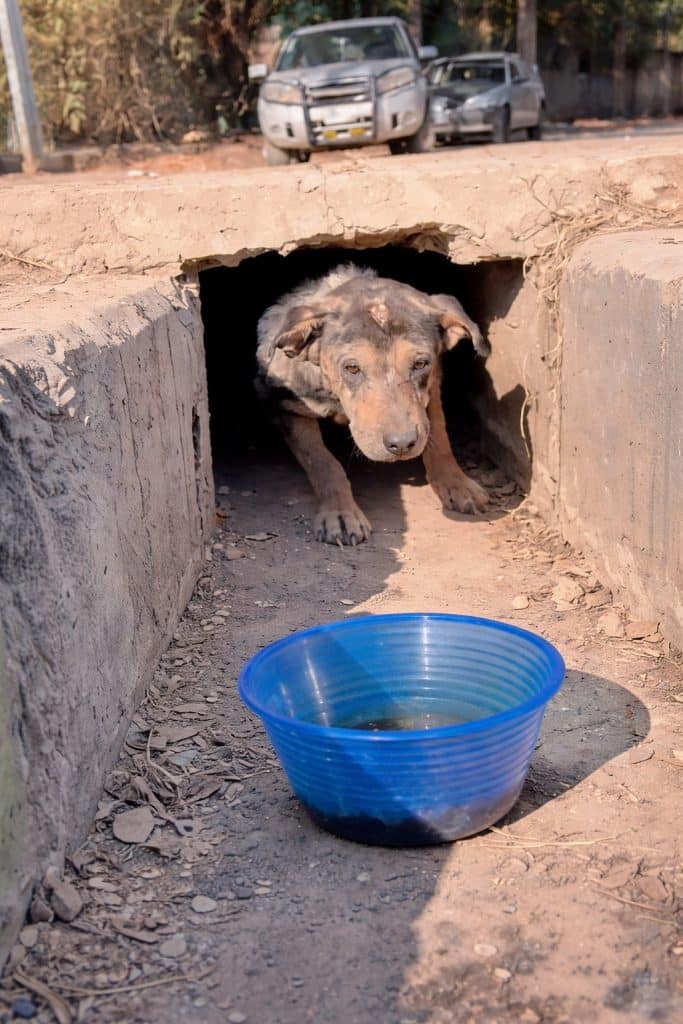
Just a narrow drainage opening beneath the edge of a quiet road. Cars passed nearby. People went about their day. From the outside, it looked like another forgotten corner most people would never think to examine.
But something was living inside.
Deep in the darkness, an elderly dog had curled himself into the cramped space.
He was thin.
His coat was patchy.
And instead of approaching the outside world, he remained tucked inside the pipe, watching from the shadows.
Later, rescuers would call him Buddy.
But before he had a name, he was simply an old dog trying to make it through another day without anyone noticing him.
A Small Movement Revealed Someone Was Inside
Buddy might easily have remained hidden.
The entrance to the drain was low to the ground, and his dark shape blended into the shadows behind it.
Then someone noticed movement.
They stopped.
Instead of continuing down the road, they looked closer.
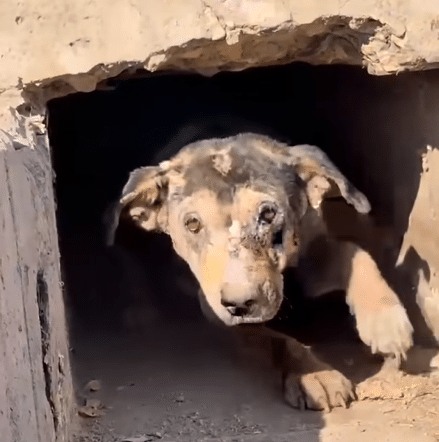
Two cautious eyes stared back from inside the pipe.
Buddy did not bark.
He did not rush toward them.
He simply watched.
From that distance, rescuers could already see that something was wrong. His body appeared much too thin, and large areas of his coat looked rough and sparse.
The drain may have offered protection from the open roadside, but it offered little else.
There was no comfortable bedding.
No reliable source of food.
No bowl of clean water waiting for him.
And Buddy appeared to have been surviving there largely on his own.
The rescuers knew that pulling him out immediately could frighten him deeper into the narrow space.
So they did something simpler.
They stayed.
VIDEO: An Elderly Dog Was Hiding Inside a Roadside Drain — Then Rescuers Finally Saw Him
They Did Not Pull Him Out — They Gave Him a Reason to Come Closer
Buddy had no way of knowing what the strangers outside wanted.
For an animal already hiding in such a confined place, sudden movement could easily feel threatening.
The rescuers therefore kept their distance.
A bowl of fresh water was placed near the opening.
Then everyone waited.
Buddy stared at it from inside.
For a while, nothing happened.
His hesitation was understandable. Whatever experiences had brought him to the roadside drain, he had learned to be cautious enough to survive.
Eventually, thirst became stronger than uncertainty.
Buddy shifted forward.
Just a little.
Then again.
His body slowly emerged from the darkness.
That was when the rescuers could finally see him clearly.
He was elderly and visibly underweight.
His coat had thinned into irregular patches, exposing areas of irritated skin underneath. His frame looked fragile, and each step appeared slow and deliberate.
Yet Buddy kept moving.
One cautious step brought him closer to the water.
Then another carried him farther from the drain.
No one rushed toward him.
They allowed him to decide how quickly the distance between them disappeared.
And eventually, Buddy was standing outside.
Once Buddy Stepped Into the Light, His Condition Was Hard to Miss
The darkness of the pipe had hidden much of Buddy’s condition.
Outside, there was nowhere for it to hide.
His thin body showed how much weight he had lost.
The condition of his skin and coat suggested that he had gone without consistent care for some time.
Even standing seemed to require concentration.
But something important happened when the rescuers finally came close enough to touch him.
Buddy did not fight them.
He remained cautious, but he allowed the contact.
For the people who had spent time waiting beside the drain, that small acceptance was enough to move forward.
Buddy was gently secured and lifted away from the roadside.
The pipe disappeared behind him.
It had helped conceal him when he was vulnerable, but now he was heading somewhere that could offer more than a place to hide.
For perhaps the first time in a long while, someone else was responsible for finding his next meal.
Someone else would notice whether he had water.
Someone else would be there if his condition worsened.
Buddy no longer had to manage everything by himself.
His Recovery Started With Things Most Dogs Never Have to Think About
At the rescue center, there was no single dramatic treatment that changed Buddy immediately.
His recovery began with ordinary things.
A veterinary examination.
A bath.
Treatment for his irritated skin.
Regular meals.
Clean drinking water.
A comfortable place where he could sleep without remaining alert to everything happening outside.
For a healthy dog, those things might seem unremarkable.
For Buddy, they represented a complete change in his daily life.
Food no longer depended on what he could find near the road.
Water did not disappear after one drink.
Rest no longer meant curling into the narrowest dark space available.
The caregivers could also begin paying attention to details that had been impossible to address while Buddy was surviving outside.
His skin could be cleaned and treated.
His weight could be monitored.
His meals could be adjusted to help his weakened body recover gradually.
And whenever someone approached, it happened calmly.
Buddy did not need to understand everything at once.
He only needed enough repeated experiences to discover that the new routine was safe.
The Changes Were Small at First — But They Kept Coming
Buddy did not transform in a day.
Older dogs, especially those arriving thin and neglected, often need time before improvement becomes obvious.
So his caregivers paid attention to smaller signs.
He began eating consistently.
He drank without the hesitation he had shown beside the drain.
He could settle into his resting area instead of remaining constantly watchful.
As treatment continued, his irritated skin gradually had a chance to recover.
The regular nutrition began addressing the weakness visible when he first stepped from the pipe.
There was also another kind of progress.
Buddy was becoming accustomed to people.
The hands around him no longer appeared only once and disappeared.
The same caregivers returned.
Meals arrived predictably.
Voices became familiar.
Nothing required Buddy to suddenly become playful or affectionate.
If he wanted to rest, he could rest.
If he remained cautious, people respected the space he needed.
That consistency gave him something the roadside could not.
Predictability.
For a dog who had apparently spent so much time managing life alone, knowing what would happen next may have been one of the greatest comforts of all.
He Did Not Need a Miracle — He Needed Someone to Keep Showing Up
It can be tempting to measure a rescue only by dramatic milestones.
A dog taking his first steps.
A severely damaged coat growing back.
A frightened animal suddenly wagging its tail.
Buddy’s story was quieter.
His progress could be found in ordinary moments.
Finishing a meal.
Resting comfortably.
Allowing someone to examine his skin.
Watching a caregiver approach without retreating into a dark corner.
None of those moments would have attracted the attention that his discovery inside the drain might have.
But together, they represented something far more important.
Buddy was learning that survival no longer depended entirely on him.
There were now people checking whether he ate.
People noticing changes in his condition.
People making sure his water remained full.
People giving him treatment rather than leaving his discomfort unattended.
The dark pipe had required Buddy to disappear in order to feel protected.
His new environment asked nothing like that from him.
He could be visible.
And still be safe.
The Roadside Drain Became Something Buddy No Longer Needed
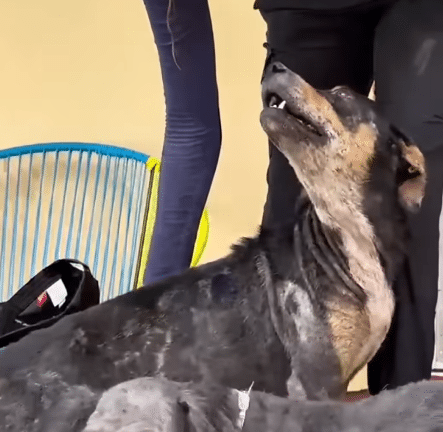
The image of Buddy inside the drain is difficult to forget.
A thin elderly dog.
A narrow concrete opening.
Two eyes watching cautiously from the darkness.
At that moment, his world appeared very small.
Then someone stopped.
That single decision did not immediately heal his skin or restore the weight he had lost.
It simply allowed everything else to begin.
Someone noticed the movement.
Someone looked inside.
Someone placed water nearby instead of trying to force him out.
Someone waited until Buddy was ready to move.
Then came the rescue center.
The examination.
The treatment.
The meals.
The clean place to rest.
Buddy’s story changed through a series of actions that individually seemed almost ordinary.
Together, they meant he no longer needed a drainage pipe as his safest option.
Sometimes Rescue Begins by Looking Where Everyone Else Passes By
Buddy was not calling loudly for help.
He was not standing in the middle of the road where no one could miss him.
He had done the opposite.
He had hidden.
That is what makes his story especially easy to understand.
Animals struggling outside are not always visible.
Sometimes they retreat beneath buildings.
Behind abandoned objects.
Into narrow spaces.
Or, in Buddy’s case, inside a roadside drain that hundreds of people could pass without ever knowing someone was there.
Buddy survived long enough for one person to notice something unusual and stop.
That was the first turning point.
Everything afterward depended on people continuing to care after the initial rescue was over.
Today, Buddy no longer has to wait in darkness wondering where his next drink or meal will come from.
He has care.
He has a clean place to rest.
And when someone looks toward him now, it is not because they happened to notice movement inside a drain.
It is because Buddy matters to the people watching over him.
Once, disappearing into the shadows may have been the safest choice he had.
Now he no longer needs to hide to survive.


