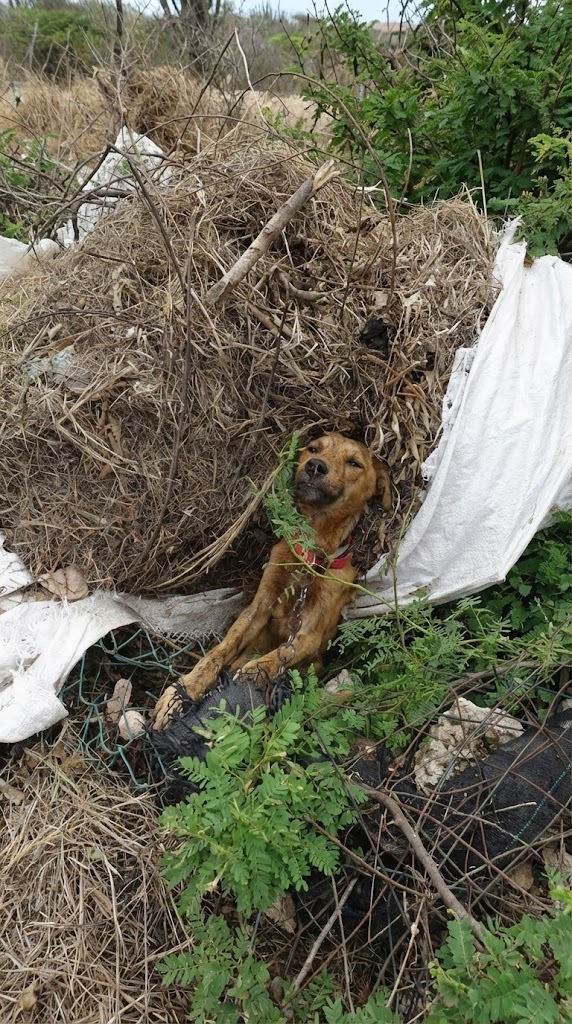
There was almost nothing around him.
No nearby homes.
No busy road.
No regular stream of people passing through.
Just open land, dirt, scattered debris — and a dog trapped at the end of a chain.
The chain had become tangled and fixed into the ground so tightly that Alex could barely move beyond a small circle.
He could not search for food.
He could not reach safety.
He could not simply walk away.
By the time anyone found him, his body had already become painfully thin from hunger and dehydration.
He lay quietly near the ground, conserving what little strength remained.
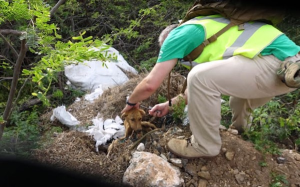
Then, by chance, a cleanup crew entered the area.
They were not looking for a dog.
But one of them noticed something among the debris.
And instead of continuing with the work, they stopped.
He Had Been Left in a Place Where Almost No One Passed
Alex’s location made his situation especially dangerous.
A dog abandoned near a busy street might eventually be noticed.
Alex had been left somewhere much quieter.
The area was isolated enough that there was no guarantee anyone would pass close enough to see him.
And even if he wanted to leave, the chain made that impossible.
By the time the cleanup crew approached, his physical condition showed how much he had already endured.
His body was severely underweight.
He appeared dehydrated.
A neglected wound had become badly infested, making veterinary attention even more urgent.
Alex did not react with the energy of a dog expecting to escape.
He was simply too weak.
The team leader understood that leaving him there was not an option.
The chain was removed.
Alex was lifted from the ground.
And the dog who had been unable to travel farther than the length of his tether was finally carried away from the place where he had been trapped.
Later, he was given the same name as the man who had chosen to help him.
Alex.
VIDEO: Alex Was Chained in an Isolated Field — Then a Cleanup Crew Found Him Barely Moving
Freedom Came First — Recovery Would Take Much Longer
Alex was taken into the care of the Feed Friends Foundation.
Being released from the chain solved only the most immediate problem.
His body was still extremely weak.
Even basic movement required effort.
Standing was difficult.
Walking comfortably was still beyond him.
The rescue team did not expect a dramatic transformation after a single meal or medical visit.
Alex had spent too long without the things his body needed.
Food.
Water.
Treatment.
Rest.
Those needs would have to be addressed gradually.
What surprised the people caring for him was his temperament.
Despite everything surrounding his rescue, Alex did not respond with aggression.
He remained quiet and gentle while people worked around him.
No one could know exactly what he understood about the change in his circumstances.
They could only see that he allowed care.
That gave them somewhere to begin.
A Foster Home Gave Alex Something the Open Land Never Could
Once he was stable enough, Alex moved into foster care in Alle Hadoc with a caregiver named Thea.
The environment was completely different from the place where he had been found.
There was a soft place to sleep.
Meals arrived regularly.
Water remained available.
And there was room to move without a chain stopping him.
For a healthy dog, those things might seem ordinary.
For Alex, they represented an entirely new daily routine.
He no longer needed to conserve every movement because food might not come again.
He no longer had to remain within the same small patch of ground.
He could rest somewhere protected.
And most importantly, the people around him continued returning.
Recovery now had something it had not had before.
Consistency.
At First, Even Walking Freely Seemed Unfamiliar
Alex’s physical weakness meant that movement returned slowly.
His steps were cautious.
His body needed time to regain strength after prolonged malnourishment and dehydration.
But foster life exposed him to something else as well.
Other animals moved around without restraint.
Dogs ran through the space.
Cats came and went.
People approached without tying him down or forcing him into a small area.
Alex watched.
Day after day, those ordinary scenes became part of his new environment.
Nothing dramatic happened.
He simply began participating more.
His eyes followed activity around him.
He became more curious.
His posture improved.
His body gradually filled out as regular meals helped restore weight.
And the coat that had looked unhealthy during his rescue slowly began to recover.
The dog found almost motionless beside a chain was becoming more physically present in the world around him.
His Tail Began Moving Before His Past Had Completely Faded
Weeks became months.
Alex’s progress grew easier to see.
The sharp outline of starvation softened as he gained weight.
He could move with greater stability.
His coat continued improving.
Then another small change appeared.
His tail began to move when familiar people were nearby.
For the foster family, the importance of that moment did not require exaggeration.
Alex was becoming increasingly comfortable around the people caring for him.
Instead of always remaining separate, he started following them.
He sought proximity.
He watched what they were doing.
The dog who had once been physically prevented from choosing where to go was now making choices of his own.
Sometimes he chose to stay close.
Trust had not appeared in one dramatic breakthrough.
It had developed through hundreds of ordinary days in which nothing bad happened.
Food arrived.
Hands remained gentle.
Doors opened.
And no chain followed him outside.
Eventually, Someone Saw More Than the Dog Who Had Been Chained
As Alex became healthier, another possibility opened.
Adoption.
By then, people could see far more than the condition in which he had originally been found.
He was not simply “the chained dog.”
He had become a gentle companion who enjoyed being around people.
His body had recovered enough that the starvation no longer defined his appearance.
His behavior showed increasing confidence.
Eventually, a family learned about Alex and chose him.
They knew where he had come from.
They knew recovery had taken time.
And they still wanted the dog standing in front of them now.
Alex left foster care for something permanent.
A home.
The Chain Stayed in the Past
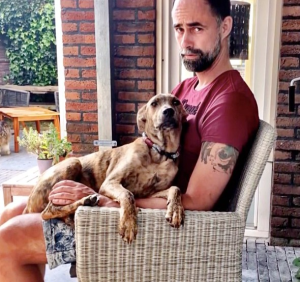
Today, Alex’s daily life bears little resemblance to the isolated place where the cleanup crew first saw him.
He can rest indoors.
He can walk without being limited to a small circle of ground.
Meals are part of a routine rather than something uncertain.
When sunlight reaches the floor, Alex can choose to lie there.
When someone moves through the home, he can follow if he wants.
There is no chain determining how far he is allowed to go.
His rescue did not erase the condition in which he was found.
It changed what came afterward.
The severely thin body regained weight.
The neglected wound received care.
Movement returned.
His coat improved.
And the dog who once had no control over where he could go eventually reached a home where he was wanted.
Alex Was Found Because Someone Looked Where No One Was Supposed to Be Looking
Perhaps the most unsettling part of Alex’s story is how easily it might never have happened.
The cleanup crew was not searching for an abandoned dog.
They simply happened to enter the area.
Had they worked somewhere else that day, Alex might have remained hidden much longer.
But they came close enough to notice him.
Then someone chose to investigate instead of assuming the small figure on the ground was none of their concern.
That first decision created every opportunity that followed.
The chain could be removed.
Veterinary care could begin.
Food and water could be provided.
A foster home could be found.
And eventually, Alex could meet the family who would keep him.
His transformation did not begin with Alex suddenly finding the strength to save himself.
He could not.
He was physically trapped.
It began because someone entered a quiet place, noticed a dog almost no one else could see, and refused to leave him there.
Once, Alex’s entire world ended where the chain did.
Today, he can choose where to walk, where to rest, and which person to follow through the house.
The chain did not define the rest of his life.
It only marked the place where someone finally found him.


