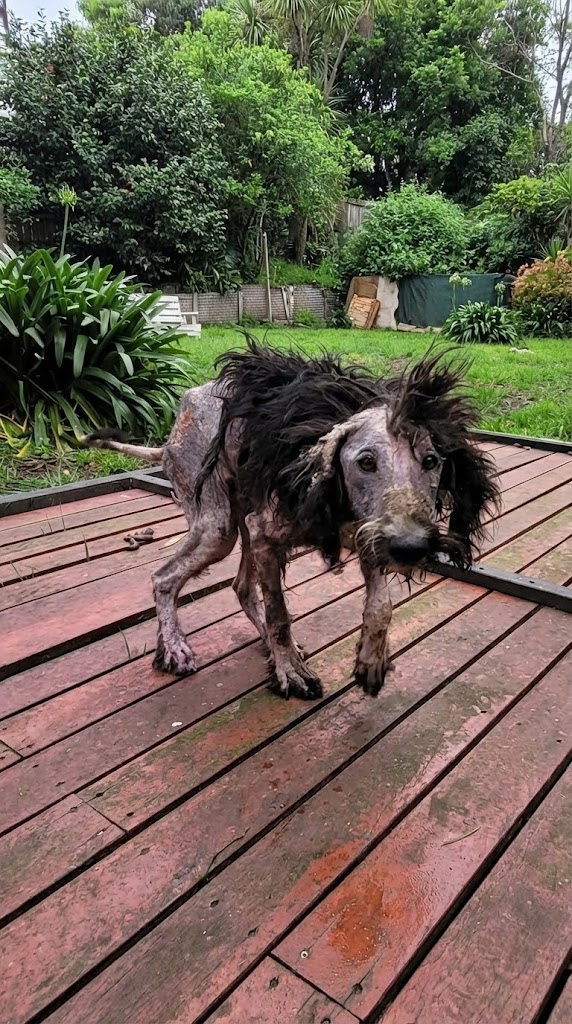
Vera had been hidden from view for so long that the outside world seemed almost separate from his life.
Behind closed doors, the dog lived in isolation with unreliable access to the most basic things he needed.
Food.
Clean water.
Fresh air.
Regular care.
By the time rescuers learned about him, neglect had already changed the way he looked.
His body was painfully thin.
His coat had become thick with hardened mats.
And beneath all that tangled fur was a dog whose strength had been worn down over time.
Reaching Vera should have been simple.
Open the door.
Take him somewhere safe.
But the person responsible for him would not cooperate.
Eventually, rescuers realized they could not remove Vera safely on their own.
Police had to become involved.
Only then could the door finally open.
The Dog Behind the Door Was Far Weaker Than Anyone Expected
When rescuers finally reached Vera, the condition of his body answered many questions without anyone needing to ask them.
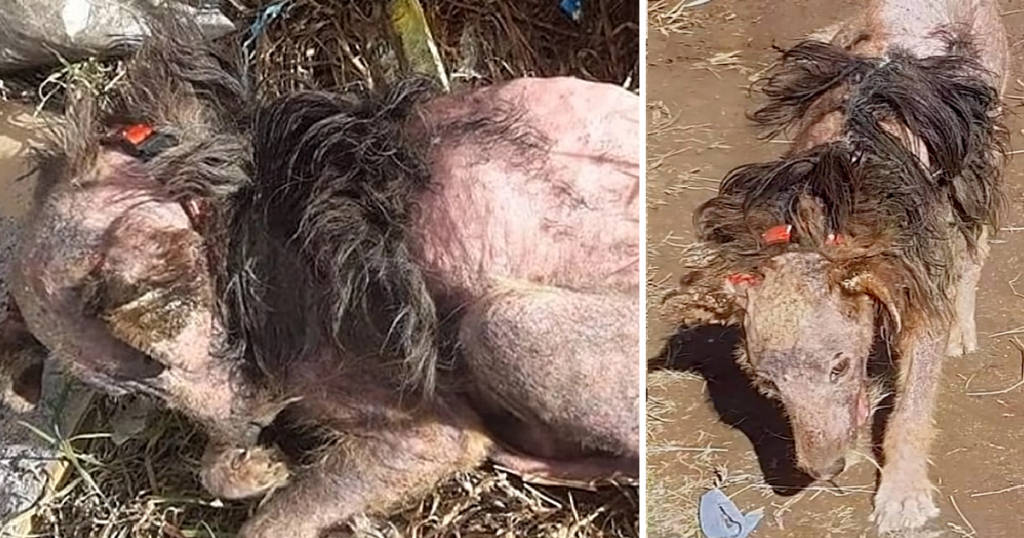
He had lost a significant amount of weight.
His frame was so thin that the shape of his bones could be seen beneath his neglected coat.
The fur itself had become another problem.
Without regular grooming, it had formed dense mats across his body, pulling against the skin and making basic care difficult.
Vera appeared exhausted.
There was no energetic attempt to rush outside.
No burst of excitement when unfamiliar people entered.
He simply allowed the rescuers to approach.
The team moved carefully.
Whatever had happened inside that home, Vera had already endured enough disruption.
The priority was straightforward.
Get him somewhere safe.
Then determine what his weakened body needed.
For the first time in a long while, Vera was carried away from the place where his world had become so small.
VIDEO: Vera Was Locked Away and Severely Neglected — Then Police Helped Rescuers Bring Him Into the Light
At the Clinic, the Most Dangerous Problem Was Hidden Inside
The condition of Vera’s coat and body was immediately visible.
The veterinary examination revealed something more serious.
He had an intestinal obstruction.
That meant the problem was no longer only weight loss or neglected grooming.
Something inside his digestive system was preventing normal passage and required medical attention.
The exact reason Vera had developed the obstruction was not clear from the rescue account.
His caregivers knew only that he had spent a prolonged period without proper nutrition and that his digestive health was now compromised.
For a dog already severely weakened, that made treatment particularly important.
His body could not simply be overwhelmed with food.
He needed medical care first.
Then nutrition had to be reintroduced carefully.
The rescue team had finally removed Vera from confinement.
Now the veterinary team had to help his body adjust to being cared for again.
He Was Frighteningly Thin — But He Never Responded With Aggression
One detail about Vera surprised the people working around him.
He remained gentle.
Medical examinations can be stressful even for healthy dogs.
For an animal arriving weak, uncomfortable, and unfamiliar with his surroundings, fear would have been understandable.
Vera did not lash out.
He allowed people close.
At times, he even leaned toward the hands touching him.
No one could know precisely what he understood about his rescue or how he interpreted the sudden change in his surroundings.
The behavior itself was enough.
Vera was accepting contact.
That gave caregivers a way to help without adding unnecessary stress.
There was no need to describe him as forgiving anyone.
His past could not be interpreted through a single look or gesture.
What rescuers could see was simpler and, in its own way, more meaningful.
After a life in which care had been inconsistent, Vera was still willing to let people care for him.
Recovery Began With Food His Body Could Handle
Feeding Vera required restraint rather than abundance.
A severely weakened dog cannot necessarily recover safely by eating as much as possible immediately.
So his meals were carefully managed.
Small portions.
Regular monitoring.
Time for his digestive system to respond.
Medical treatment addressed the obstruction while caregivers watched for changes in appetite, energy, and comfort.
At the same time, Vera’s neglected coat had to be dealt with.
The hardened mats were removed gradually.
Sections of fur that had concealed his body came away.
Underneath was the full extent of his thinness.
There was very little healthy body mass left.
But now every part of the recovery process was moving in the opposite direction.
Instead of losing weight, Vera was receiving nutrition.
Instead of untreated discomfort, he had medical care.
Instead of a coat growing more tangled each day, his skin could finally be cleaned and monitored.
Nothing changed overnight.
That was fine.
Vera had spent too long deteriorating for anyone to expect his body to rebuild itself in a matter of days.
Then His Body Slowly Started Filling Out Again
The earliest changes were modest.
Vera ate.
Then he continued eating.
His body began holding onto the nourishment it had been missing.
As the weeks passed, the sharp outline of his frame gradually softened.
He had more energy when moving around.
His posture improved.
The coat that had once formed painful mats began growing back under healthier conditions.
There was no dramatic point when the frail dog simply disappeared.
Recovery accumulated.
Another meal.
Another night somewhere warm.
Another day without being confined in the conditions from which he had been removed.
Eventually, comparing Vera with the dog who had first arrived became startling.
His appearance was changing.
But caregivers also began noticing a behavioral transformation.
He seemed increasingly comfortable in the presence of people.
The dog who had entered veterinary care exhausted and uncertain was beginning to engage with the world around him.
Once He Felt Better, His Gentle Personality Became Easier to See
Physical weakness can hide almost everything about a dog.
When every movement takes effort, there is little energy left for play, exploration, or affection.
As Vera grew stronger, those parts of him began appearing.
He became more attentive when people entered.
He stayed near caregivers.
He accepted affection calmly.
His expression became more alert.
The people who cared for him began affectionately describing him as an “angel.”
Not because they could know what Vera thought about his past.
And not because suffering had somehow made him more deserving of admiration.
They called him that because of the dog they were getting to know.
Gentle.
Calm.
Affectionate.
Even after everything required to bring him out of that home, Vera was remarkably easy to love.
The dog hidden behind a door was becoming an individual people looked forward to seeing.
The Closed Door No Longer Defines His Life
Today, Vera’s world is no longer limited to the place where rescuers first found him.
He has regular food.
Clean water.
A safe environment.
Medical needs that are noticed rather than ignored.
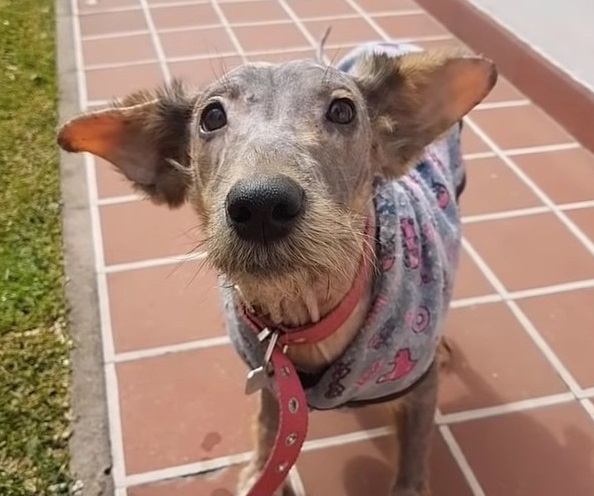
His coat has improved.
His body has regained strength.
And he no longer has to depend on someone who is unwilling or unable to provide the care he needs.
The difference is not only visible in photographs.
It appears in ordinary moments.
Vera resting comfortably.
Vera accepting affection.
Vera moving without the same exhaustion that shaped his earliest days after rescue.
Those are simple experiences.
They are also experiences he once did not reliably have.
Vera Was Saved Because Someone Refused to Let a Closed Door End the Story
There is something especially troubling about neglect that happens out of sight.
A dog on a street can sometimes be noticed by a passerby.
A dog behind a closed door depends on someone learning what is happening and being willing to intervene.
That was the barrier in Vera’s case.
The rescuers knew he needed help.
But knowing was not enough.
When cooperation failed, they involved authorities.
Police intervention finally made it possible to remove him safely.
Then came the clinic.
The intestinal obstruction.
The carefully managed meals.
The grooming.
The slow return of strength.
The weeks required for a severely depleted body to begin looking healthy again.
None of those later moments could have happened if the first barrier had remained closed.
Vera did not rescue himself.
He could not open the door.
He could not arrange veterinary treatment.
He could not prepare the controlled meals his body needed.
Other people had to make those choices for him.
And they did.
Once, Vera lived somewhere the world could not easily see him.
Today, there are people who notice the smallest changes in his health and comfort.
The door that once kept him hidden eventually opened.
And when it did, Vera finally had the chance to become more than the neglected dog behind it.
He could simply become Vera.
Safe.
Cared for.
And no longer forgotten.


