Late one evening in Abilene, Texas, someone noticed something unusual near a neighborhood church.
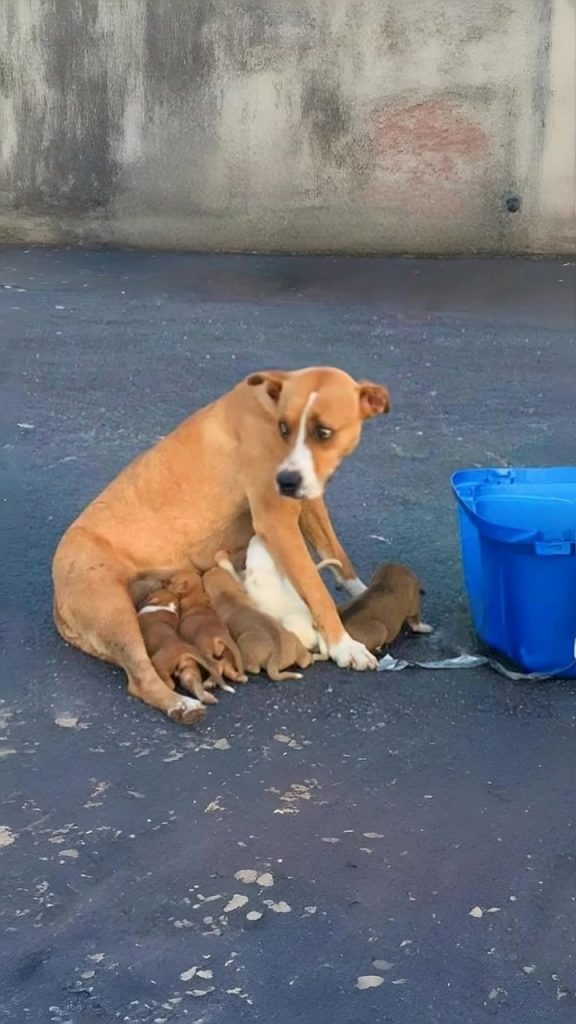
Under the dim light of a nearby streetlamp, a young mother dog was lying on the bare parking lot concrete.
She was not alone.
Pressed tightly against her body were nine newborn puppies, so young they appeared to have entered the world only hours earlier.
There was no bed beneath them.
No food beside their mother.
No sign that anyone was returning.
Yet the exhausted dog remained curled around every tiny body, using herself as the only shelter they had.
By the following morning, one photograph of that little family had begun spreading online.
And before long, people who had never met them were trying to figure out how to save them.
A Mother Who Had Nowhere Else to Protect Them
The scene was painfully simple.
A mother.
Nine newborn puppies.
And concrete.
The puppies were far too young to understand where they were. Their entire world consisted of warmth, milk, and the body of the mother surrounding them.
For her, however, the situation was different.
She had to remain alert.
Every movement around the parking lot could mean danger. Every unfamiliar sound gave her another reason to keep the puppies tucked close.
She appeared thin and exhausted, yet she did not leave them to search elsewhere.
Whenever one of the puppies shifted away from the group, she nudged the tiny body back toward her.
Again and again, she kept them together.
Nothing about the location was suitable for a newborn litter.
But it was apparently all she had.
Then someone took a photograph.
There were no dramatic effects and no carefully arranged scene.
Just a tired dog lying beside the lives depending entirely on her.
That photograph would become the beginning of everything that happened next.
VIDEO: A Mother Dog Was Found Guarding Nine Newborn Puppies on Bare Church Concrete
One Photograph Reached the People Who Could Help
By morning, the image had begun circulating on social media.
It eventually reached Paw Angel Animal Rescue, a nonprofit rescue organization serving the Abilene area.
The situation immediately presented a problem.
The rescue’s foster network was already heavily stretched.
Taking in one dog can require food, veterinary care, space, transportation, and time.
Taking in a nursing mother with nine newborn puppies meant multiplying those needs almost overnight.
There was little room available.
But leaving the family where they were was not a realistic option.
So Paw Angel did what rescue groups often have to do when resources are already strained.
They asked the community.
A public appeal went out for foster help, supplies, and support.
Then something unexpected happened.
People responded.
Messages began arriving.
Offers of assistance followed.
The picture of the mother dog on the concrete had reached people who could not simply scroll past it.
Among them were Misty Boerger and Angel Urban.
Misty later described being unable to get the image out of her mind. She had seen the mother surrounded by those tiny puppies and found herself thinking about them long after putting down her phone.
By the following morning, she and Angel had reached a decision.
They were going to help personally.
When Misty and Angel Arrived, She Was Still There
When the two volunteers reached the church parking lot, the scene had not changed much.
The mother was still with her puppies.
She appeared thin.
Tired.
Careful.
But she had not left.
The volunteers did not know how she would respond when strangers approached her newborn litter.
A frightened mother dog can become defensive when she believes her puppies are threatened, and there was no reason to assume this dog understood that the approaching people were there to help.
So Misty and Angel moved slowly.
They spoke quietly.
They allowed the mother to watch them.
She did not charge at them.
She did not attempt to flee and leave the litter behind.
Instead, she remained close to her puppies and followed the women’s movements with cautious attention.
Whenever one of the newborns shifted, she continued drawing it back toward the others.
The volunteers could see that whatever hardships had brought her to that parking lot, she was still doing everything possible to care for them.
They gave her the time she needed.
Gradually, they moved close enough to begin helping the little family.
Soon, the mother and all nine puppies were carefully gathered.
For the first time since anyone had noticed them beneath that streetlamp, they were leaving the church parking lot behind.
The mother would soon receive a name.
Dory.
And the strangers lifting her babies from the concrete were about to become part of a much larger effort to keep her family safe.
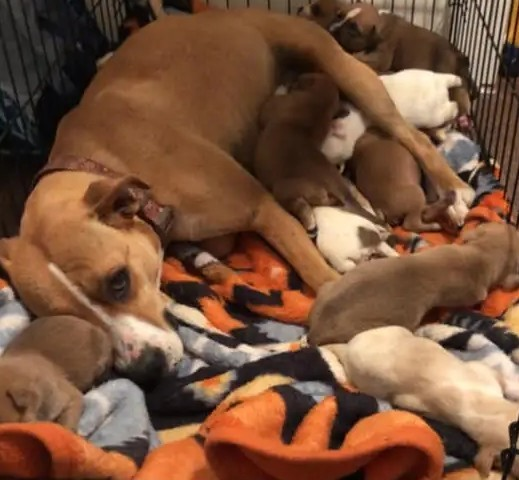
At the Clinic, One Tiny Puppy Was in Serious Trouble
Getting the family away from the parking lot was only the beginning.
Newborn puppies are exceptionally fragile.
Even under ideal circumstances, their earliest days can be difficult. For puppies beginning life outdoors with an exhausted mother, the risks were even greater.
Veterinary care quickly revealed that one of Dory’s smallest puppies was struggling.
She would be named Peach.
Despite the attention given to her, veterinarians determined that Peach had a severe medical condition that could not be successfully treated.
Her strength continued to fade.
For the people who had worked so quickly to save the litter, it was a painful reality.
They had reached the family.
They had brought everyone to safety.
But rescue cannot always reverse every medical problem that existed before help arrived.
After careful consideration, the veterinary team made the compassionate decision to let Peach go peacefully rather than prolong her suffering.
One of Dory’s nine puppies was gone.
Eight remained.
And those eight still needed their mother.
Dory herself also needed care.
There was grief in losing one of the newborns, but the work surrounding the family could not stop.
Eight tiny lives still depended on regular feeding, warmth, monitoring, and protection.
Their mother needed enough nutrition and stability to recover while continuing to nurse them.
So the rescue team focused on what they could still change.
Everything that came next.
Dory Slowly Learned She No Longer Had to Keep Watch Alone
The difference between the parking lot and Dory’s new environment was immediate.
There was food.
There was clean water.
There was a secure place for the family to rest.
And there were people checking on them.
At first, however, Dory remained watchful.
Safety was new.
Her puppies were still very young, and the habit of monitoring everything around them did not disappear simply because a roof was now overhead.
Caregivers gave her space while making sure her basic needs were consistently met.
Meals arrived regularly.
The puppies remained close.
No one demanded affection from her.
Day after day, the same people returned without harming her or taking away the babies she had fought so hard to protect.
Gradually, subtle changes appeared.
Her posture became less tense.
She rested more comfortably.
Familiar people could enter without causing the same degree of concern.
Her tail relaxed.
Her expression softened.
Meanwhile, the puppies were changing almost every day.
At first, they did little more than nurse and sleep beside their mother.
Then came movement.
Tiny bodies began crawling farther.
Legs that had barely supported them started pushing underneath them.
Eventually, they began wobbling around their space.
Each puppy started showing a different temperament.
Some appeared eager to explore.
Others stayed closer to Dory.
A litter that had once been almost completely hidden beneath their mother’s body was becoming increasingly difficult to contain.
The little family was moving forward.
The People Following Their Story Became Part of the Rescue
Paw Angel continued sharing updates about Dory and her puppies.
And the community continued responding.
Some people could not foster a dog themselves.
Others lived too far away to physically help.
But there were still ways to contribute.
Supplies began arriving.
Blankets.
Food.
Formula.
Toys.
Financial donations helped with medical expenses and the continuing costs of caring for such a large canine family.
Messages of encouragement appeared beneath the updates.
People wanted to know how Dory was doing.
They wanted to see the puppies growing.
They had become emotionally invested in a family most of them had first encountered through a single photograph.
Then the support became something tangible.
A 10-by-10-foot kennel was built for Dory and the puppies.
On paper, it was simply a clean, secure enclosure.
But compared with where they had begun, it represented something much larger.
Their first shared space had been an exposed church parking lot.
Now they had somewhere protected.
Somewhere people had intentionally prepared for them.
Somewhere Dory could lie beside her puppies without the uncertainty of traffic, weather, or strangers passing nearby.
One photograph had shown a mother with almost nothing.
Now an entire group of people was helping provide what she lacked.
Eight Tiny Puppies Began Becoming Dogs of Their Own
Weeks passed.
The changes accelerated.
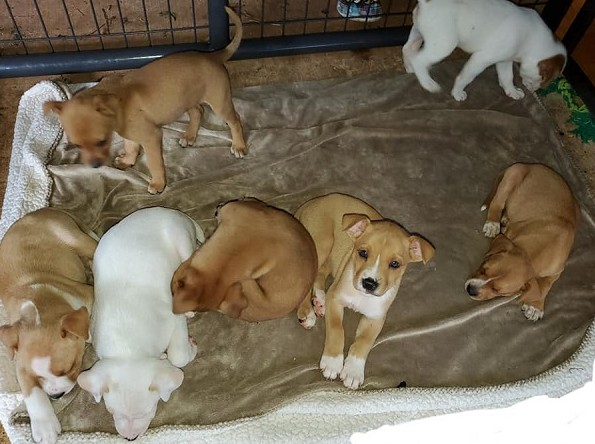
The puppies who had once fit tightly against Dory’s belly were now moving around independently.
They played.
They explored.
They investigated toys and one another.
Their personalities became easier to recognize.
Some were bold enough to approach new things immediately.
Others observed before joining in.
The quiet newborn litter from the church parking lot had become a group of active young dogs preparing for lives beyond their mother.
Dory changed with them.
As her puppies became increasingly independent, she no longer needed to remain constantly curled around them.
She could rest while they played.
She could eat without immediately returning to gather them together.
She appeared increasingly comfortable around the familiar people caring for the family.
That mattered because Dory’s future could not end simply because her puppies survived.
She needed a home too.
Mother dogs can easily become secondary characters in rescue stories once their puppies grow large enough for adoption.
But Dory had been at the center of this one from the first photograph.
She was the exhausted young mother who had kept nine newborn puppies close on bare concrete.
She deserved the same chance at a permanent home that each of her surviving babies would receive.
Eventually, Paw Angel announced that the family had reached another milestone.
Dory and her eight puppies were becoming ready for adoption.
And once again, the community responded.
This Time, People Were Waiting for Them
Applications began arriving.
Some families hoped to adopt one of the puppies they had watched grow through rescue updates.
Others were interested in Dory herself.
For the people who had seen the family’s first night, the contrast was difficult to ignore.
When Dory was first discovered, there had been no one visibly waiting for her.
She lay in a church parking lot surrounded by newborn puppies and uncertainty.
Now people were actively asking for the chance to give members of that same family a home.
That transformation had not happened through one person’s actions alone.
A passerby noticed.
Someone shared the photograph.
A rescue organization answered.
Misty and Angel went to the parking lot.
Veterinary professionals cared for the family.
Fosters and volunteers provided daily support.
Other people donated supplies and money.
Still more followed the story and helped spread the call for assistance.
Each contribution looked small when viewed separately.
Together, they changed what was possible for Dory and her puppies.
That may be the most remarkable part of their story.
There was no single dramatic hero.
There was a chain of people who each decided to do something.
And the chain began because someone noticed a dog lying beneath a streetlamp.
One Mother on Concrete Became a Community’s Family
Dory’s story began in a place no newborn puppy should have entered the world.
Bare concrete.
An exhausted mother.
Nine tiny bodies relying completely on her.
She did what she could with what she had.
She stayed close.
She kept the puppies gathered against her.
And she continued caring for them until people arrived who could share that responsibility.
Not every part of the journey had a happy outcome.
Peach could not be saved.
That loss remained part of the family’s story.
But eight puppies continued growing.
Dory recovered.
And a community that had once known nothing about them came together to give them food, medical care, shelter, and the possibility of permanent homes.
It would be easy to say that social media saved them.
But a photograph cannot rescue a dog by itself.
People have to respond to what they see.
Someone has to stop.
Someone has to make the call.
Someone has to drive to the parking lot.
Someone has to open a home, carry a crate, bring a blanket, donate a bag of food, or provide veterinary care.
Dory and her puppies survived because enough people chose not to assume that somebody else would handle it.
That is what turned one lonely photograph into an entire rescue effort.
Late one evening, Dory had only her own body to protect nine newborn lives.
By morning, strangers were beginning to care about them.
And soon, she no longer had to protect her family alone.


