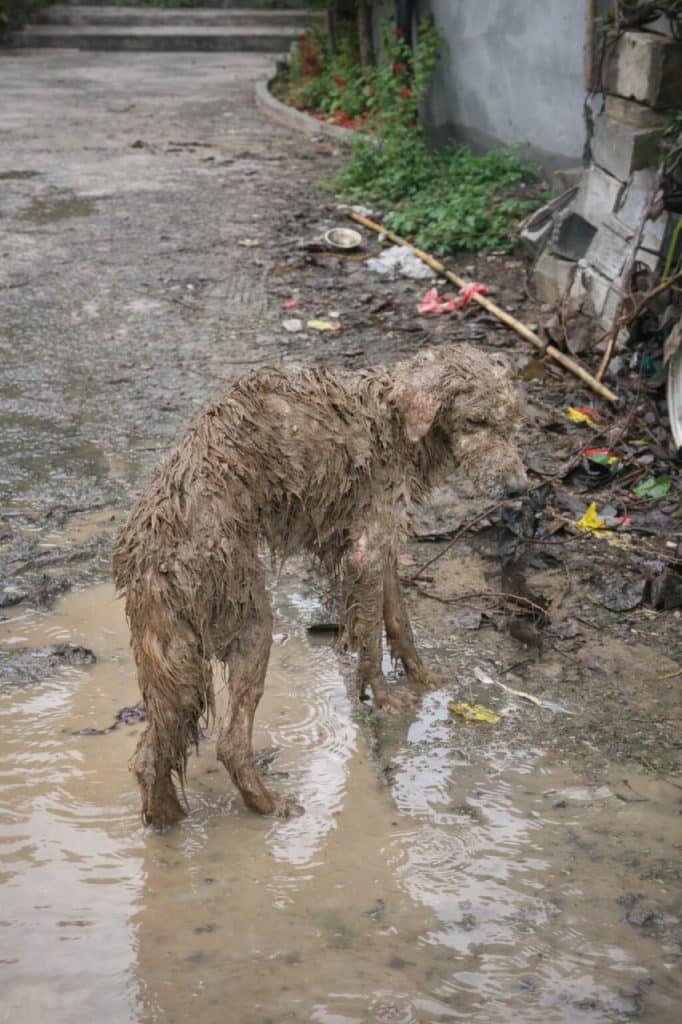
The rain had already turned the yard into mud when rescuers saw him.
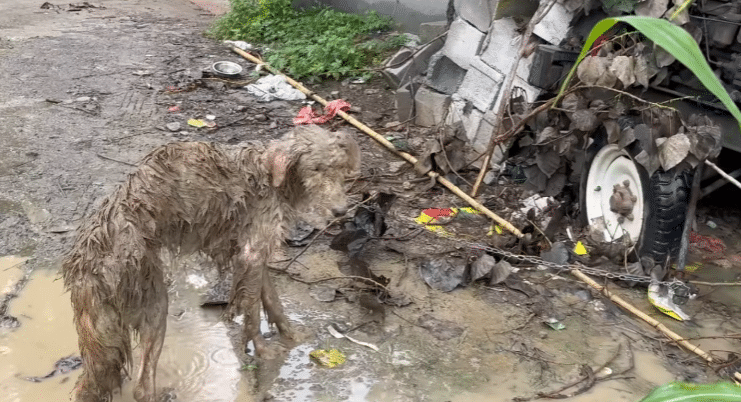
A thin dog stood outside beside old machinery, tethered to a post with nowhere dry to retreat.
Water ran through his tangled coat.
His ribs showed beneath it.
The ground beneath his paws had become cold, wet earth.
There was no shelter nearby.
No raised bed.
No protected corner where he could escape the weather.
Only the dog.
The chain.
And the rain.
Then the rescuers looked toward the house.
There was another dog inside.
Dry.
Protected.
Living only a short distance from an animal who had been left standing outdoors in the storm.
That was the moment the visit became something they knew they could not simply walk away from.
One Dog Was Inside — The Other Had Only a Chain
From the outside, the difference was difficult to ignore.
The dog tethered in the yard appeared thin and neglected. His fur was wet and tangled, and the continuing rain had soaked both him and the ground around him.
There was nowhere obvious for him to get dry.
Yet inside the nearby house was another dog living under completely different conditions.
The rescuers could see that this was not simply a case of a dog being caught outside during a passing shower.
The chained dog had been left exposed.
When the owner appeared, the rescuers began discussing his condition.
They pointed to what was in front of them.
His thin frame.
His lack of shelter.
The rain.
The chain keeping him in the same small area.
Whatever circumstances had led to this situation, one thing seemed clear to the people standing in that yard:
Leaving him exactly where he was would mean leaving all of those conditions unchanged.
The rescuers had come close enough now to see the dog clearly.
Walking away became much harder.
So they stayed.
And they began trying to find a way to take him with them.
VIDEO: He Stood Chained in the Pouring Rain — Then the Tether Finally Came Off
The Chain Finally Came Off
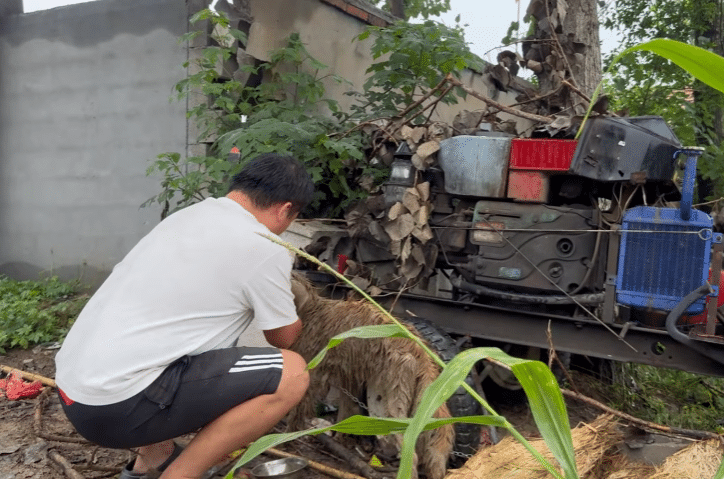
The rescuers approached the dog slowly.
He was already cold and physically depleted, and there was no reason to add more stress by surrounding him or moving too quickly.
They spoke softly.
They allowed him to watch.
Then someone reached for the tether.
For a dog that had been restricted to the same muddy patch of ground, what happened next was remarkably quiet.
The chain was loosened.
Then removed.
There was no dramatic sprint toward freedom.
No sudden burst of excitement.
The dog remained close while the rescuers worked around him.
But one important thing had changed.
For the first time during the rescue, he was no longer attached to that post.
The rain continued falling.
The mud was still beneath his feet.
The yard looked exactly as it had moments earlier.
Yet the situation was no longer the same.
Now there was a possibility that he could leave it.
Getting Him Out Required One More Difficult Decision
Removing the chain did not immediately mean the rescuers were free to take the dog.
A difficult conversation with the owner followed.
According to the account of the rescue, the owner wanted payment before allowing the dog to leave.
For the rescuers, that created an uncomfortable choice.
They had seen his condition.
They had seen where he was being kept.
And the dog was standing directly in front of them while the rain continued.
The discussion took time.
There was disagreement over what should happen and what it would take for the owner to release him.
Eventually, the rescuers agreed to pay.
It was not presented as approval of the situation.
It was the practical decision they believed would allow them to remove the dog immediately rather than risk leaving him behind while the dispute continued.
Once an agreement was reached, there was no longer anything keeping him in that yard.
The dog could finally go.
But before the rescuers placed him in the vehicle, they offered him something his thin body clearly needed.
Food.
His reaction told its own story.
He Ate as Though the Food Might Disappear
The dog did not need encouragement.
Once food was placed in front of him, he began eating quickly.
There was little hesitation.
No wandering away.
No cautious sniff followed by disinterest.
He focused on the meal in front of him and ate with urgency.
Rescuers stayed close while he finished.
They could not know exactly when he had last eaten or what his normal feeding routine had been.
They could only observe what was happening now.
A visibly thin dog was consuming food as soon as it became available.
The meal was simple.
Yet it marked another change.
Minutes earlier, everything around him had belonged to the old routine.
The post.
The tether.
The wet ground.
Now unfamiliar people were offering food and preparing to take him somewhere else.
Soon, he was lifted into the vehicle.
The door closed.
And the yard began disappearing behind him.
For the first time in the story rescuers witnessed, the dog was moving away from that chain rather than waiting beside it.
Dry Towels Replaced the Rain
At the rescue center, the contrast was immediate.
The rain was gone.
So was the mud.
The dog was brought into a dry, protected environment where caregivers could finally see and assess him without water continuously running through his coat.
They dried him.
They provided a warm place to settle.
Then they offered food again.
This time, the atmosphere was different.
There was no storm around him.
No post beside him.
No tether restricting where he could move.
The rescuers could begin focusing on the slower work that comes after the dramatic moment of removal.
Helping a depleted animal recover is rarely accomplished through one meal or one night indoors.
His body still needed time.
His coat needed care.
His thin frame would not change immediately.
And a dog who has lived with uncertainty may need repeated experiences before a new routine becomes familiar.
So the caregivers began with the basics.
Warmth.
Food.
Rest.
A dry place to sleep.
Then they repeated them.
The first rescue had been getting him out of the yard.
The next one would be showing him that he did not have to return there.
The Smallest Changes Began to Matter
Once the immediate discomfort of the rain was gone, the dog had an opportunity to settle.
He could lie down without pressing himself into wet ground.
He could eat without being exposed to the weather.
He could rest while people moved around him rather than remaining tethered outside.
At first, those changes may have seemed almost ordinary.
For the rescuers, they were exactly what he needed.
No one expected an instant transformation.
A dog does not regain lost body condition in a day.
A neglected coat does not immediately become healthy.
And trust cannot be measured simply because an animal accepts food.
Instead, caregivers watched for smaller signs.
Whether his body relaxed while resting.
Whether he became more comfortable when familiar people approached.
Whether meals stopped feeling like something that needed to be consumed as quickly as possible.
Little by little, the atmosphere around him became predictable.
Food arrived.
People returned.
The room remained dry.
Nothing pulled him back toward the post.
Those repeated experiences created the foundation for everything that would come afterward.
His recovery had finally begun somewhere safe enough for recovery to be possible.
Rescue Meant More Than Unlocking a Tether
The most visible moment in this story was the chain coming loose.
But freedom alone could not repair everything that had happened before rescuers arrived.
Taking a dog away from neglect solves the immediate danger.
What follows requires something quieter.
Consistent meals.
Veterinary attention when needed.
Grooming.
Rest.
Patience.
And people willing to continue caring after the dramatic part of the rescue is over.
That was what this dog now had.
The people who removed him from the yard could not rewrite the days he had already spent there.
They could not make the rain disappear from those earlier hours.
They could not explain why one dog had been protected indoors while he remained outside.
But they could change what happened next.
They could make sure his next night was dry.
His next meal was available.
His next resting place was safe.
Sometimes rescue begins with a huge operation.
Other times, it begins with people standing in an uncomfortable place and deciding they are not willing to leave the situation exactly as they found it.
For this dog, that decision became the dividing line between two very different lives.
The Storm Is Behind Him Now
The image of the chained dog standing in the rain is difficult to forget.
A thin body.
Wet fur.
Mud beneath his feet.
A tether limiting how far he could go.
But that is no longer the only image in his story.
There is another one now.
The same dog indoors.
Dry.
Fed.
Able to rest without a chain connecting him to a post.
He still had healing ahead of him when the rescue was complete.
His body needed recovery.
His condition would require continued care.
But he was no longer trying to recover while exposed to the same environment that had worn him down.
That distinction matters.
Rescue does not always create a perfect ending in one afternoon.
Sometimes it simply gives an animal access to a different tomorrow.
The people who entered that rainy yard were faced with several opportunities to leave.
They could have decided the situation was someone else’s responsibility.
They could have walked away when the conversation became difficult.
They could have concluded that helping him was becoming too complicated.
Instead, they remained.
And eventually, one small sound marked the beginning of everything that followed:
the chain coming free.
The rain did not stop at that moment.
But the dog no longer had to remain beneath it.
Someone had finally made the decision that mattered most.
He was leaving with them.


