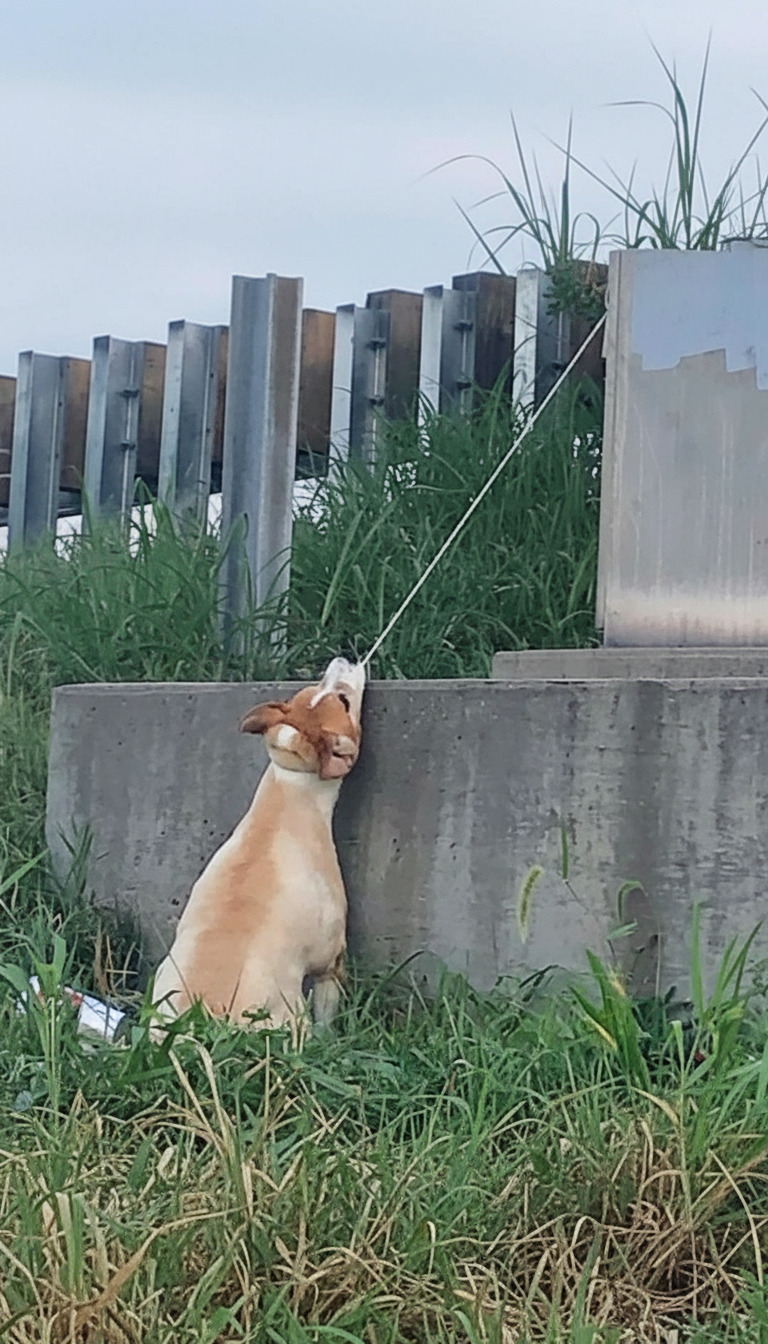
David Fredman was driving to work when something beneath an Interstate 70 overpass caught his attention.
At first, his mind could not make sense of what he was seeing.
It was suspended above the ground.
Too large to be ordinary debris.
Too strangely positioned to belong there.
Then David realized what it was.
A dog.
An elderly dog was hanging beneath the highway with an electrical cord wrapped tightly around his neck.
His back paws were barely reaching the ground.
And David understood almost immediately that there was no time to keep driving.
His Paws Were Barely Touching the Ground
David pulled over and rushed toward the dog.
Up close, the situation was even worse.
The dog, later identified as Max, was suspended by an electrical cord around his neck. His body hung awkwardly while his rear paws struggled to maintain the slightest contact with the ground.
Max was 16 years old.
His head moved urgently from side to side.
His eyes were wide.
Yet according to the account, he made almost no sound.
There was no barking that might have drawn attention from passing motorists.
No obvious cry carrying above the traffic.
Only an elderly dog struggling beneath an overpass while vehicles continued moving nearby.
David called 911.
But standing there and watching Max, he quickly became afraid that waiting for responders could cost the dog his life.
The cord was still tight.
Max was still struggling to breathe.
Seconds mattered.
David had to decide whether to wait for help—
or become the help Max needed immediately.
VIDEO: An Elderly Dog Was Found Hanging Beneath a Highway — Then One Driver Realized He Couldn’t Wait
David Reached for a Knife
There was little time for a carefully planned rescue.
David needed to relieve the pressure around Max’s neck as quickly as possible.
He reached for a knife.
Then he cut the cord.
It snapped.
Max dropped to the ground.
The most immediate danger was over.
But David quickly realized that getting Max down did not mean the elderly dog was safe.
Max remained on the ground.
He could not stand.
His breathing was rapid after the ordeal, and his aging body appeared completely overwhelmed by what it had just endured.
David stayed close.
A dog who had been suspended by the neck could have injuries that were not immediately visible. Breathing complications and trauma remained serious concerns.
Leaving Max there was not an option.
So David carefully lifted him.
The morning commute he had begun only minutes earlier was forgotten.
Instead of continuing toward work, he headed for KC Pet Project with a 16-year-old dog whose life had almost ended beneath the highway.
Getting Him Down Was Only the First Rescue
Staff at KC Pet Project took Max in quickly.
The dog had survived being suspended, but the team still needed to watch him carefully.
According to the rescue account, Max was monitored for trauma and possible breathing complications.
His age made the situation especially concerning.
At 16, Max was already a senior dog.
His body had far less reserve than that of a young, healthy animal, and the ordeal had pushed him hard.
For David, the transition from the overpass to professional care offered the first chance to process what had happened.
Only a short time earlier, he had been driving through an ordinary morning.
Then he noticed something that did not belong beneath the highway.
Had he dismissed it as garbage or kept moving because he was late for work, the outcome could have been very different.
Instead, Max was now surrounded by people capable of evaluating him.
He was breathing.
He was alive.
But another part of the story was unfolding elsewhere.
Because Max had not been abandoned by a family who no longer wanted him.
Someone was already desperately looking for him.
While David Was Saving Max, His Family Was Searching
That morning, Max’s owner, D-Von, discovered that the elderly dog had disappeared from the yard.
For the family, there was no explanation.
Max was suddenly gone.
D-Von began searching.
For someone caring for a 16-year-old dog, every passing minute could bring another reason to worry.
Senior dogs can be vulnerable even under ordinary circumstances. The longer Max remained missing, the greater the fear that he might be injured, lost, or unable to find his way home.
D-Von had no idea that while the search was unfolding, a stranger had already encountered Max in circumstances far more frightening than anyone could have anticipated.
Then, roughly two hours later, the call came.
Max had been found.
He was alive.
Relief arrived first.
Then D-Von saw what had happened to him.
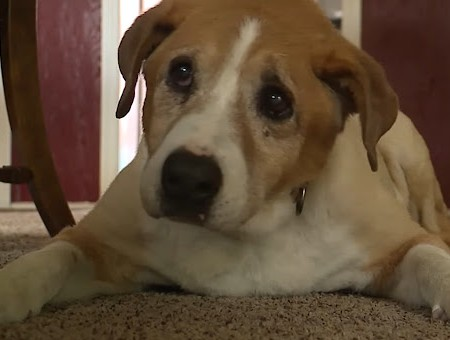
A pronounced mark remained around Max’s neck where the cord had been.
The family had begun the morning fearing their elderly dog was lost.
Now they were learning how narrowly they had avoided losing him completely.
The Man Who Stopped Finally Met the Family Who Was Searching
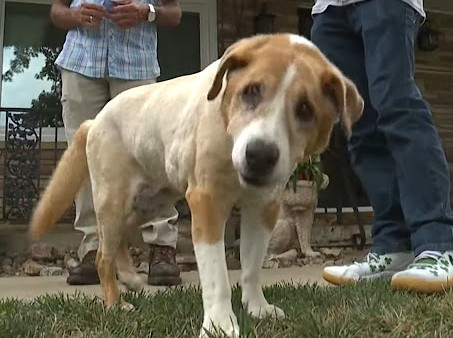
Eventually, David and D-Von met.
For D-Von, the person standing in front of him was no longer simply another stranger.
He was the driver who had noticed Max.
The person who had pulled over.
The person who had called for help but then realized there might not be enough time to wait.
And the person who had cut the cord.
D-Von embraced him.
“Thank you… thank you so much,” he told David.
The gratitude was understandable.
Their entire reunion existed because of a sequence of decisions that could easily have gone another way.
David could have assumed someone else would stop.
He could have called authorities and remained inside his vehicle.
He could have decided intervening personally was too risky.
Instead, he acted when he believed Max could not afford more time.
But amid the relief, another question remained.
How had a 16-year-old family dog disappeared from his yard and ended up suspended by an electrical cord beneath an interstate overpass?
No one involved had an immediate answer.
And David, after seeing the scene firsthand, found it difficult to dismiss the question.
One Detail Made the Situation Hard to Explain
According to the original account, David said the scene did not appear accidental to him.
That was his impression—not a confirmed conclusion.
Authorities still had to determine what had actually happened.
The circumstances raised obvious questions.
Max had vanished from home.
Not long afterward, he was found underneath I-70.
An electrical cord was tightly positioned around his neck.
His hind paws were barely touching the ground.
How he reached that position was not immediately known.
The account stated that authorities were reviewing available surveillance footage in an effort to understand what had happened and determine whether the incident resulted from an accident or deliberate human action.
Until that investigation produced an answer, speculation could not replace evidence.
For Max’s family, however, one fact mattered more urgently than the unanswered questions.
He had survived.
And he could go home.
The marks around his neck were a visible reminder of the ordeal.
But the dog himself was back with the people who had been searching for him.
At 16 Years Old, Max Made It Back Home
Senior dogs often settle into familiar routines.
The same sleeping places.
The same people.
The same yard.
The same small rituals repeated year after year.
For Max, one ordinary morning suddenly became something entirely different.
He disappeared from home.
He ended up beneath a highway.
His life came down to a stranger noticing something unusual while driving to work.
Then, just hours later, he was back with his family.
The return mattered particularly because Max was already 16.
At that age, every additional year together carries weight.
D-Von had started the morning without knowing whether he would ever see his dog again.
By the end of it, Max was back where he belonged.
Not because the danger had somehow resolved itself.
Not because help happened to arrive automatically.
But because someone noticed.
That distinction is what makes David’s role in the story difficult to overlook.
David Could Have Been One More Car That Passed
Highways are built around movement.
People have somewhere to be.
Drivers watch traffic, exits, clocks, and the road ahead.
Stopping beneath an overpass because something in the distance looks unusual is not part of anyone’s normal commute.
That morning, David did it anyway.
At first, he did not even know what he was looking at.
He could have dismissed the shape as debris.
He could have kept driving.
Instead, curiosity became concern.
Concern became action.
He pulled over.
Approached.
Called 911.
Then reassessed the situation when Max continued struggling.
That final choice may have been the most important.
David did not know exactly how much time Max had.
He only knew the dog was suspended by the neck and appeared unable to breathe normally.
So he cut the cord.
There are moments when rescue looks organized and carefully coordinated.
Teams arrive with specialized equipment.
Plans are made.
Roles are assigned.
Max’s rescue was nothing like that.
It was one driver.
One elderly dog.
One knife.
And a decision made beneath a highway because waiting suddenly felt more dangerous than acting.
The Most Important Part of Max’s Story Happened in Seconds
There were still unanswered questions after Max returned home.
How had he left the yard?
How had the electrical cord become wrapped around his neck?
How did he end up suspended beneath the highway?
Those questions mattered.
But they came after the question David faced in the moment:
Do I stop?
Everything else depended on that answer.
Max could not explain what had happened.
He could not free himself.
At 16 years old, with his back paws barely touching the ground, there was little he could do except keep struggling.
David became the variable that changed the outcome.
He noticed.
He stopped.
He walked toward something other people might have passed without understanding.
And when the situation became clear, he acted.
Max’s story did not end beneath I-70.
Instead, an elderly dog returned to the family who had spent the morning looking for him.
A frightened owner met the stranger who had saved his companion.
And one ordinary commute became a reminder of how much can depend on a few seconds of attention.
Sometimes compassion requires resources.
Sometimes it requires training.
Sometimes it requires an entire rescue organization.
And sometimes, it begins with something far simpler.
A person sees that something is wrong—
and refuses to keep driving.


