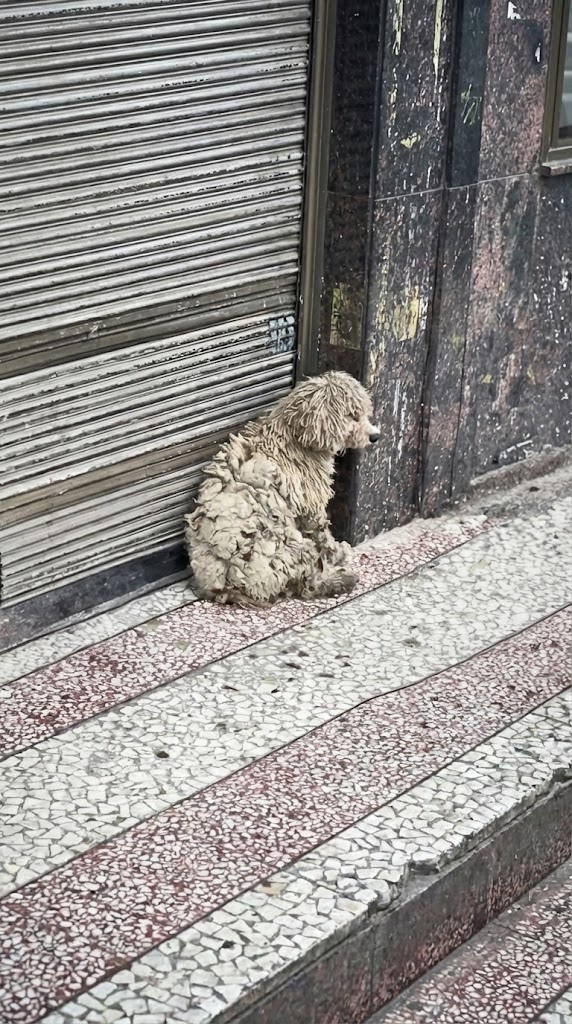
The little dog did not run toward the person who found her.
She did not bark.
She did not cry for attention.
On a bitter winter morning, she was curled into a corner, trembling beneath a coat so tangled and dirty that it was difficult to tell what she might once have looked like.
Cold air surrounded her.
Hunger had left her body small and tired.
And when someone gently called to her, she lifted her head for only a moment before looking away again.
The stranger did not move closer.
He simply stayed where he was and kept speaking softly.
After a while, the dog stood.
She took one cautious step.
Then another.
And little by little, the distance between them disappeared.
She Was Afraid to Come Closer — But She Didn’t Run Away
There was something particularly fragile about the way the dog responded that morning.
She clearly noticed the person nearby.
But instead of immediately approaching, she watched from a distance.
Her body continued trembling.
Her matted fur was packed with dirt, and she repeatedly shook her head, rubbed at her face, and licked herself.
Something was making her uncomfortable.
Still, when the stranger remained calm, she began moving toward him.
No sudden gestures.
No reaching for her before she was ready.
Only a quiet voice and enough patience for the dog to make the decision herself.
Eventually, she came close enough to be touched.
Despite everything visible about her condition, she did not react aggressively.
She allowed gentle contact.
Then the rescuer opened the car door.
There was another moment when she could have backed away.
Instead, the tiny dog climbed inside.
No one could know exactly what she understood in that moment.
But for the first time that morning, she was no longer sitting outside in the winter cold.
VIDEO: She Was Shivering Alone in the Cold — Then She Slowly Walked Toward the Stranger Who Waited
Beneath the Matted Coat Was a Much Smaller Dog
At the veterinary clinic, caregivers could finally examine her properly.
The condition of her coat made that difficult at first.
Her fur had become so severely tangled that brushing it out was no longer realistic.
It had to be removed.
As the mats came away, the little dog underneath became visible.
She looked even smaller without the heavy coat surrounding her.
Veterinary examination also revealed why she had been scratching and shaking her head so often.
Fleas had spread across her body, contributing to the constant itching and irritation.
Her ears also needed treatment.
After spending months surviving outdoors, there were several problems that would take time to resolve.
Then caregivers learned something else about her recent past.
She had given birth not long before she was found.
Her puppies had not survived the freezing conditions.
There was no way to know how much of that experience the dog understood in the way a person might.
What rescuers could see was a mother whose body had recently carried and nursed puppies while she herself was trying to survive outdoors.
Now she was thin, exhausted, and without them.
The team could not change what had already happened.
They could only begin caring for the dog who remained.
Even During Treatment, She Continued Allowing People Close
Shaving away the coat left her body exposed.
For a dog already trembling in winter weather, warmth immediately became important.
Caregivers cleaned her skin.
They treated the fleas.
Her ears received attention.
And through the unfamiliar handling, the little dog remained remarkably tolerant.
She did not repeatedly try to bite.
She did not fight every touch.
She stayed close while people worked around her.
Once the grooming and initial treatment were finished, someone placed a small red shirt over her body to help keep her warm.
The sight was simple but striking.
Hours earlier, she had been outside beneath a coat that had become part of her discomfort.
Now the damaged fur was gone, and something clean and warm covered her instead.
Her medical recovery would take longer.
Her skin needed time.
Her ears needed treatment.
Her weight needed to improve.
But the conditions around her had already changed completely.
There would be no return to the freezing corner that night.
She was going home with the person who had stopped for her.
Once She Found Warmth, She Wanted to Stay Near It
The first days in a home introduced her to things that had been absent from street life.
A fire.
A soft place to sleep.
Regular meals.
A person moving through rooms without forcing her back outside.
She quickly found the warmest places.
Sometimes she curled near the fire and simply rested.
But another pattern became noticeable.
She also wanted to know where her rescuer was.
When he moved into another room, she often followed.
If he disappeared from sight, she would get up and search.
Once she found him again, she settled.
No one needed to interpret that behavior as something mystical.
After months of uncertainty, the dog had discovered a predictable source of food, warmth, and safety.
Staying close made sense.
Her rescuer allowed her to do it.
There was no expectation that she become independent immediately.
No frustration when she followed too closely.
The home was new.
The routines were new.
Even sleeping somewhere safe was new.
So she was given the time to learn.
Eventually, she received a name.
Duoduo.
And slowly, the frightened little stray began looking less like a dog who had just been pulled from winter streets.

Her Fur Grew Back — And So Did Her Curiosity
The physical changes appeared gradually.
First, the constant itching eased as the flea problem was treated.
Her ears improved, and the repeated head shaking became less frequent.
Then new fur began appearing across the areas that had been shaved.
The coat that grew back was soft and clean.
Regular meals helped strengthen her small body.
But Duoduo’s recovery could also be seen in what she started doing.
She became interested in her surroundings.
She began playing.
Toys, once irrelevant to a dog focused on staying warm and finding food, became things worth investigating.
She learned to walk on a leash.
Stairs were another unfamiliar challenge.
At first, every new experience required hesitation.
Then repetition made it ordinary.
Up the steps.
Back down.
Outside for a walk.
Inside again.
Dinner.
Rest.
Another day with the same person still there.
Those routines mattered because Duoduo’s new life was not built around one dramatic rescue moment.
It was built around what happened afterward.
A dog can be removed from danger in minutes.
Learning how to live without that danger can take much longer.
Duoduo Began Discovering the Ordinary Life She Had Missed
As the months passed, Duoduo’s world became much larger.
She met other dogs.
She learned how to play with them.
She chased toys.
She became comfortable enough to roll over and invite belly rubs.
Her movements became more confident.
Her eyes appeared brighter.
And the small dog who once sat trembling in a corner began participating fully in the household around her.
One of her strongest routines involved the person who had rescued her.
In the evenings, Duoduo would wait near the door.
She learned the sounds associated with his return.
When he came home, she was ready.
On one occasion, when he tried to leave without taking her, Duoduo became visibly distressed.
She scratched near the door and tried to look through the smallest opening she could find.
The reaction showed that being separated from her familiar person was still difficult.
Her new life had given her security.
But security was something she was still learning how to trust.
The response from her family was not punishment.
It was patience.
Duoduo had already learned many new things.
Being comfortable when someone left—and believing they would return—would simply be another.
The Dog Once Hidden Beneath Mats Became Almost Unrecognizable
Looking at Duoduo later, it became difficult to connect her with the dog found on that winter morning.
Her coat had grown back.
Her body was stronger.
Her skin was no longer hidden beneath dirty, painful mats.
She could walk comfortably on a leash.
She played with other dogs.
She sought affection.
And instead of spending her days trying to remain unnoticed, she actively looked for the people she cared about.
None of that erased her first condition.
The story still included months outdoors.
It included untreated fleas and irritated ears.
It included the discovery that she had recently given birth and that her puppies had not survived the cold.
Those parts could not be rewritten.
What changed was everything that followed them.
Duoduo no longer needed to curl into herself to conserve warmth.
She no longer needed to search the street for somewhere to sleep.
When her skin bothered her, there were people who noticed.
When she became hungry, food arrived.
When she rested, no one drove her away.
Those may sound like ordinary comforts.
For Duoduo, they represented an entirely different way of living.
Everything Changed Because Someone Was Willing to Wait
There was no dramatic chase at the beginning of Duoduo’s rescue.
No complicated equipment.
No team surrounding her.
The first important moment was much quieter.
A person saw a small dog shaking in the cold.
He called to her.
She hesitated.
And instead of walking toward her too quickly or giving up when she did not immediately respond, he remained still.
That gave Duoduo a choice.
She could stay where she was.
She could retreat.
Or she could take one step toward him.
She chose the step.
Then another.
From there, the changes accumulated.
A car ride replaced the freezing street.
Veterinary care replaced untreated discomfort.
A red shirt replaced the filthy coat that had to be shaved away.
A fire replaced the cold.
A name replaced anonymity.
And daily routines replaced uncertainty.
Today, Duoduo no longer resembles the little dog trembling alone that winter morning.
Her fur is full again.
Her body is healthy.
She plays.
She rests somewhere warm.
And when she searches for someone now, there is a very good chance that person is coming back.
Her rescue did not begin because she suddenly trusted a stranger.
It began because the stranger gave her enough time to decide whether she wanted to try.
Sometimes that is what frightened animals need most.
Not someone who rushes toward them.
Someone who notices.
Someone who stays.
And someone patient enough to let the first step belong to them.


