The man almost walked past.
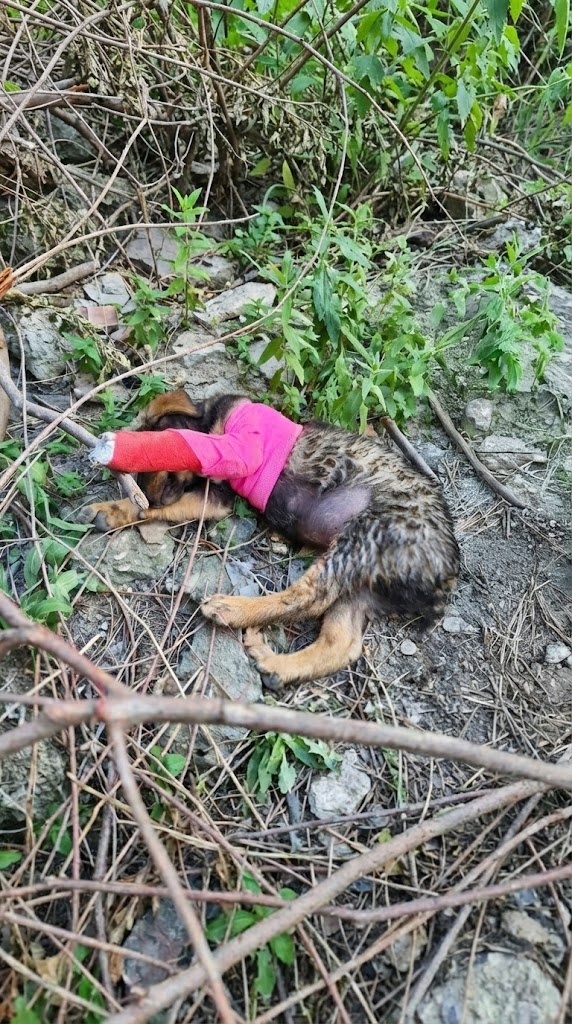
Along a quiet forest trail, something small lay motionless beneath the trees, partly hidden by leaves and dirt.
At first, it looked like discarded fabric.
Then it moved.
A tiny puppy was lying there alone.
One of his legs was wrapped in old, filthy bandages. The limb beneath them had become badly swollen, and the puppy seemed too weak to do much more than lift his head.
There was no owner nearby.
No carrier.
No food.
Just a very young dog left more than two kilometers from the nearest home, unable to properly walk away even if he wanted to.
The man stayed beside him and called for help.
Soon, rescuers arrived and carried the puppy from the forest.
They named him Kompot.
But when they rushed him into a veterinary clinic, something unexpected happened.
The staff looked at the puppy—
and recognized him.
The Puppy in the Forest Had Been at This Clinic Before
Only about a week earlier, Kompot had been brought to the same veterinary clinic by a woman.
He had suffered a serious fracture in one of his legs.
At the time, veterinarians had done what they could to give the tiny puppy a chance to heal.
The wound was cleaned.
The broken limb was treated and stabilized.
A bandage was carefully placed around the injured area.
But the treatment came with an important instruction.
The dressing could not simply remain there indefinitely.
It needed regular attention and daily care.
Without proper cleaning and bandage changes, moisture and bacteria could become trapped around the injury, creating the risk of serious infection.
The clinic expected Kompot to return for follow-up treatment.
He never did.
Now, a week later, the same puppy had arrived again.
Only this time, he had not been carried through the door by the person responsible for him.
A stranger had found him abandoned in the forest.
And the leg veterinarians had tried to save was in far worse condition.
VIDEO: A Puppy Was Found Abandoned in the Forest — Then the Veterinarian Realized He Had Treated Him Before
Beneath the Bandage, a Treatable Injury Had Become Something Far More Dangerous
Once the old dressing was removed, the extent of the damage became clearer.
Kompot’s leg was severely swollen.
The tissue around the original injury was inflamed and infected.
What had started as a fracture requiring careful follow-up had been left without the treatment veterinarians had specifically said was necessary.
The infection had progressed.
Kompot was only around two months old.
At an age when most puppies are learning to chase toys and explore everything around them, he was dealing with an injured limb that had become increasingly painful.
X-rays also revealed signs of further trauma.
According to the rescue account, veterinarians believed Kompot may have suffered another accident or injury after the initial fracture, although the exact cause of that additional damage was not established.
Whatever had happened, the result was unmistakable.
His leg was deteriorating.
The untreated condition had progressed into a serious bone infection.
And time was becoming increasingly important.
Yet Kompot’s behavior did not entirely match the severity of what his body was enduring.
When someone approached gently, his tail could still move.
He tried to engage.
At moments, he even attempted to play.
Then the pain returned, and those brief glimpses of puppy energy disappeared again.
He was young enough to still be curious about people.
But medically, he was running out of room to wait.
The Veterinarian Knew They Could No Longer Treat This With Bandages Alone
The team evaluated the leg carefully.
If Kompot had returned for proper follow-up after his first treatment, his recovery might have followed a much simpler path.
That opportunity was gone.
The infection had spread too deeply.
The damaged tissue needed to be addressed surgically, and the affected bone required direct treatment.
Without intervention, the consequences could become much more serious.
Kompot could lose the limb.
A severe infection could also threaten far more than just the leg.
For the veterinary team, surgery was no longer something to consider later.
It had become necessary.
Kompot was prepared for the procedure.
For a puppy only a few months old, already weakened by pain and infection, anesthesia and surgery carried their own concerns.
But leaving the leg as it was carried greater ones.
The little dog who had been found lying beneath the trees was taken into the operating room.
What followed would last almost three hours.
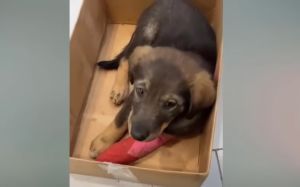
For Nearly Three Hours, the Team Worked to Save His Leg
The surgeons carefully opened the affected area.
Infected tissue had to be removed.
The compromised portion of the bone was cleaned.
The fracture was stabilized again so the limb would have a chance to heal properly.
Antibiotic treatment was started to fight the infection that had been allowed to progress.
Every step required precision.
Kompot was tiny.
His leg was already damaged.
And veterinarians needed to remove diseased tissue without creating additional harm to healthy structures around it.
The procedure continued.
Then, finally, it was over.
Kompot had made it through surgery.
But no one treated that as the end of the danger.
The hours and days afterward would show whether his body could respond to treatment.
When Kompot woke, he was weak and quiet.
His leg was properly treated now.
The infection had been addressed as aggressively as possible.
But healing still required time.
The puppy would need medication.
Monitoring.
Food.
Rest.
And perhaps most importantly, someone willing to follow through with his care every single day.
This time, he would have that.
The First Signs of Recovery Were Small
Kompot did not bounce back immediately.
There was no dramatic moment when the tiny puppy suddenly stood and ran across the room.
His recovery began with much simpler changes.
His appetite improved.
That mattered.
A growing puppy fighting infection and recovering from surgery needed nutrition, and every proper meal gave his body more resources to repair itself.
Then the swelling began decreasing.
The injured area looked better as the days passed.
His discomfort became easier to manage.
And Kompot started showing more of the personality rescuers had glimpsed even before surgery.
His tail moved more often.
He became interested in people entering the room.
He wanted to investigate.
Sometimes he tried to play before his recovering leg was ready for the enthusiasm his mind had already rediscovered.
Caregivers had to keep him from doing too much too soon.
That was a very different problem from the one they had faced when he was first carried out of the forest.
Then, he had barely enough strength to move.
Now they were beginning to see a puppy who wanted to use the second chance his body had been given.
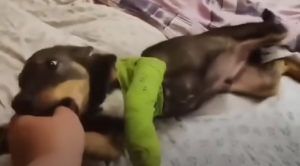
The Puppy Who Had Been Left Alone Was About to Get Something Permanent
Medical recovery gave Kompot something he had almost lost.
A future.
But a healthy leg alone could not provide everything he needed.
He still needed a home.
A two-month-old puppy requires consistency.
Meals on schedule.
Vaccinations.
Follow-up veterinary appointments.
A safe place to sleep.
Someone who notices when something seems wrong and actually responds.
After what had happened following his first veterinary visit, those ordinary responsibilities carried particular importance.
Then a family learned about Kompot.
They chose to welcome him into their home.
The difference was visible almost immediately.
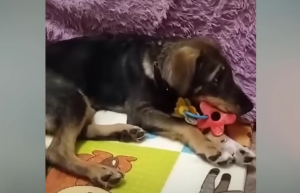
Soft places replaced the forest floor.
Toys appeared.
People were nearby when he woke.
His medical instructions were followed.
And he was finally able to experience the things that should have defined puppyhood from the beginning.
Play.
Curiosity.
Rest.
Affection.
His leg continued healing.
His strength increased.
And as the pain receded, Kompot became increasingly active.
He no longer looked like the small bundle a passerby had almost mistaken for discarded cloth beneath the trees.
He looked like what he had always been.
A puppy.
Questions About How He Ended Up There Did Not Simply Disappear
Kompot was safe, but the circumstances surrounding his abandonment still mattered.
According to the rescue account, authorities later identified the woman who had originally brought Kompot to the veterinary clinic.
When questioned, she initially claimed that the puppy had run away.
That explanation conflicted with what rescuers had been told about where Kompot was found.
The forest location was reportedly more than two kilometers from her home.
Kompot also had a badly injured leg and an unchanged bandage, making the circumstances difficult to ignore.
Eventually, according to the account, she admitted leaving him there.
Caring for his injury had become too difficult.
So instead of returning to the clinic for the follow-up treatment veterinarians had instructed her to provide, Kompot was taken away and abandoned.
That decision had consequences almost immediately.
A fracture that had already received treatment became infected.
The bandage remained unchanged.
The tissue deteriorated.
A puppy who should have been receiving daily medical attention instead spent time alone in a forest while his condition worsened.
It would be easy to make that decision the center of Kompot’s entire story.
But it is not where his story ends.
Kompot’s Life Was Changed by the People Who Did the Opposite
One person left him in the forest.
Another person saw something small lying beside a trail and stopped.
That contrast shaped everything that followed.
The passerby could have assumed the bundle beneath the trees was trash.
Instead, he looked again.
When he realized it was a living animal, he did not walk away or leave Kompot for someone else to deal with.
He stayed.
Rescuers came.
Veterinarians recognized the puppy and understood how urgently his condition had changed.
Surgeons spent nearly three hours treating an infection that should never have been allowed to progress that far.
Caregivers handled the slow recovery afterward.
And eventually, a family accepted the responsibility that someone else had abandoned.
Kompot did not save himself through determination alone.
He needed all of those people.
That is an important part of stories like his.
A puppy can be resilient.
A tail can still wag despite pain.
A young dog can remain affectionate even after being failed.
But resilience should never become an excuse to overlook how dependent vulnerable animals are on human choices.
Kompot survived because when his second chance appeared, people followed through.
Today, the Forest Is No Longer the Place That Defines Him
Kompot continued growing stronger.
His appetite returned.
The swelling faded.
His injured leg recovered enough for him to move more comfortably.
Eventually, running and playing became part of his daily life.
That may be the most striking contrast of all.
The first man to find Kompot saw a puppy who could barely move.
His leg was wrapped in dirty bandages.
The forest around him was empty.
There was no indication that anyone responsible for him intended to return.
Now there are people who expect him home.
There is veterinary care when he needs it.
There are toys.
Meals.
A safe place to sleep.
And a family watching a young dog grow instead of wondering whether he will survive another night.
The old injury remains part of Kompot’s story.
So does the infection.
So does the decision that left him alone among the trees.
But none of those things have the final word anymore.
What came afterward matters too.
A passerby who looked twice.
A rescue team that arrived.
A veterinarian who recognized a familiar patient.
A surgery that gave an infected leg another chance.
And a family willing to do something very ordinary, but incredibly important:
stay responsible for him.
Kompot was found because one stranger happened to walk down the right trail.
He recovered because many people chose not to leave the rest to chance.
Once, he was a tiny puppy lying alone beneath the trees, wrapped in a bandage that was slowly making his condition worse.
Today, he runs toward people who know his name.
And this time, when they take him home—
they take him with them.


