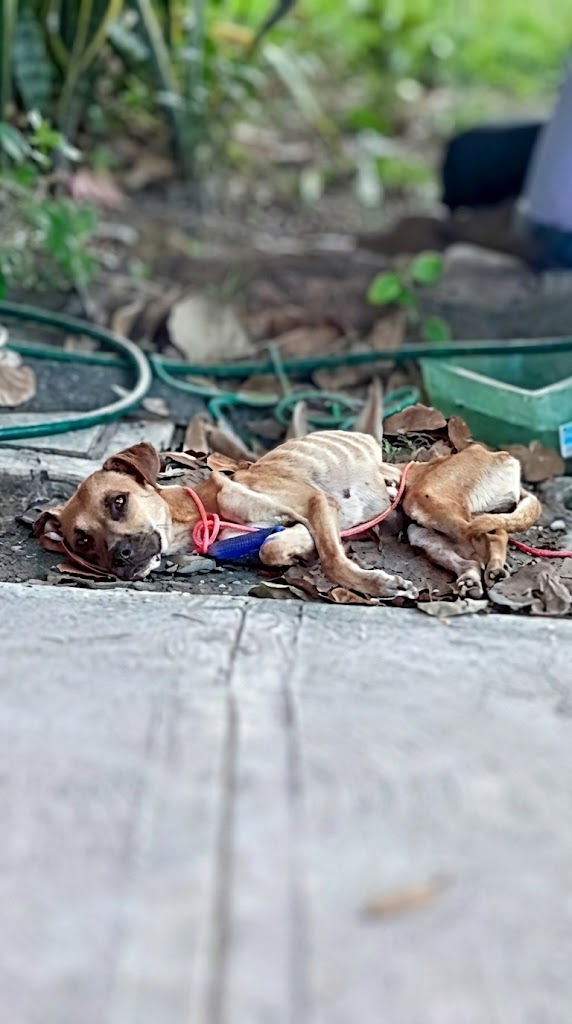
Eva was not found wandering along a road.
She was not searching for food or following strangers for help.
She was tied to a tree.
Someone had taken a dog who was already sick, secured her in a quiet place away from the road, and left.
By the time rescuers reached her, Eva could barely respond.
Her body was thin.
She was severely dehydrated.
And when people tried to help her stand, something became immediately clear.
Her legs would not support her.
There were no obvious broken bones.
No large wound that explained why she could not walk.
Whatever had happened to Eva was hidden deeper inside her body.
And finding the answer would be only the beginning of a recovery that had no quick solution.
She Could Not Stand — And No One Knew Why
The first priority was getting Eva away from the tree and into medical care.
She was weak enough that walking was impossible.
Rescuers had to support her body as they moved her, careful not to make an unknown injury worse.
At the clinic, dehydration and exhaustion could be treated immediately.
The paralysis was more complicated.
Eva’s legs were not functioning normally, yet there was little on the outside of her body to explain it.
Veterinarians examined her.
They looked for fractures.
They searched for visible injuries.
Still, the source of the problem remained unclear.
Eva needed advanced imaging.
An MRI was arranged in the hope that it would show what ordinary examination could not.
The images finally provided an answer.
The problem was in her spine.
VIDEO: Eva Was Found Tied to a Tree Unable to Walk — Then Doctors Discovered the Damage Hidden in Her Spine
The MRI Revealed Damage No One Could See From the Outside
Eva’s spinal cord was badly affected.
The MRI showed inflammation and damage involving two vertebrae.
This was not a minor strain that would disappear after a few days of rest.
Her nervous system had been injured seriously enough to interfere with the signals controlling her legs.
According to the veterinary assessment described in Eva’s rescue story, the damage was consistent with blunt-force trauma, with a vehicle accident considered a likely explanation.
Exactly what had happened to Eva before she was abandoned could not be known with certainty.
What rescuers did know was what had been left untreated.
She had suffered a serious spinal injury.
She had lost the ability to walk normally.
And instead of receiving the long-term medical care such an injury required, she had eventually been tied to a tree and left behind.
The diagnosis answered one question.
It created another.
Could Eva ever walk again?
There was no simple answer.
Surgery was not considered an option.
No procedure could instantly restore her mobility.
If Eva was going to improve, the process would have to be much slower.
Rehabilitation would become part of her life every single day.
There Was No Operation That Could Fix Everything
Eva’s treatment began with repetition.
Gentle massage helped stimulate her muscles.
Electrical stimulation was used as part of her rehabilitation.
Pain had to be carefully managed so she could participate without unnecessary discomfort.
And then there was exercise.
At first, even the smallest effort was difficult.
Caregivers supported Eva as she tried to push herself upward.
Her legs trembled.
Her body rose.
Then she fell back down.
They helped her reset.
She tried again.
Some days produced almost no visible progress.
There was no dramatic moment when paralysis suddenly disappeared.
Instead, recovery was measured in tiny changes that could easily have been overlooked.
A little more control in one leg.
A few seconds longer while standing.
A movement that had not been possible the week before.
For Eva, those details mattered.
Her caregivers did not expect her body to move faster simply because everyone wanted a happy ending.
They worked with the body she had.
And they kept returning to the exercises.
Day after day.
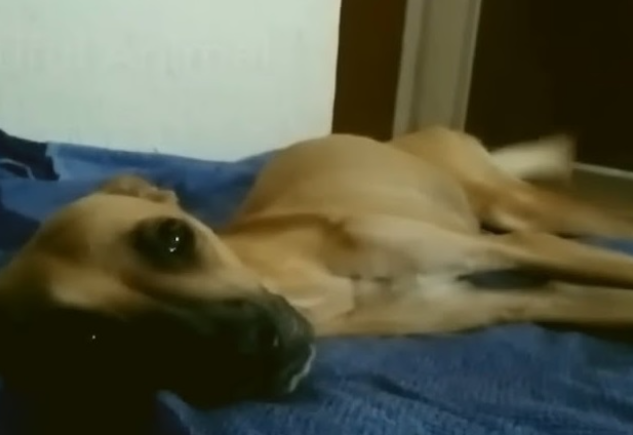
Then a Few Unsteady Steps Changed the Mood in the Room
Eva’s treatment later included plasma therapy, described in the rescue account as a weekly injection.
Like everything else in her rehabilitation, it did not transform her overnight.
The changes remained gradual.
But over time, caregivers began noticing that she appeared more comfortable.
Her movement improved.
Her legs started responding more consistently.
Then came the milestone everyone had been waiting for.
Eva stood.
And instead of immediately collapsing, she moved forward.
Only a few steps.
They were unstable.
They were slow.
But Eva had moved under her own power.
After weeks of supporting her weight, massaging muscles, managing pain, and repeating the same exercises, those few steps meant that her body was beginning to regain usable movement.
Interestingly, her back legs began showing more strength than her front legs.
Her gait was far from perfect.
It did not need to be.
The goal had never been perfection.
The goal was function.
More movement.
More independence.
Less pain.
Every step Eva gained gave the rehabilitation team something new to build upon.
And then they discovered one environment where moving seemed to become much easier for her.
Water.
In the Water, Eva Could Move Without Carrying All Her Weight
Eva loved swimming.
For a dog struggling to support herself on land, water changed the problem.
Buoyancy supported part of her body weight, giving her an opportunity to move her legs with less pressure on them.
The pool became more than recreation.
It became another place to practice.
Eva could paddle.
Stretch.
Move her limbs repeatedly without the same challenge of holding her entire body upright.
Her caregivers watched her confidence grow.
On land, every difficult step reminded them how much rehabilitation remained.
In the water, Eva could simply move.
That freedom appeared to suit her.
Her sessions continued.
So did her exercises outside the pool.
Slowly, the distances she could manage increased.
A few steps became more.
Standing became easier.
Exploring replaced lying in one place.
The dog once carried away from a tree because she could not walk was beginning to travel under her own power.
The transformation was not the result of one extraordinary treatment.
It came from weeks of ordinary work repeated consistently.
Massage.
Therapy.
Exercise.
Rest.
Another attempt.
And another.
Then Rescuers Learned Eva Had Never Really Known Freedom
As Eva became stronger, another detail about her earlier life emerged.
According to the rescue story, she had been kept chained since she was a puppy.
The tree where rescuers found her may have been the most extreme final image of that life, but restriction itself was nothing new to Eva.
She had grown up without the freedom most dogs take for granted.
Running because she wanted to.
Exploring a yard.
Choosing where to lie down.
Following someone from room to room.
Even moving a few feet without reaching the end of a tether.
That history changed the meaning of her recovery.
Eva was not only relearning how to walk after a spinal injury.
She was also discovering what she could do with that mobility.
As her body became stronger, caregivers introduced more of the world around her.
She walked farther.
She investigated unfamiliar surroundings.
She spent time in the water she enjoyed so much.
And her behavior became increasingly relaxed.
The dog who had arrived dehydrated and barely responsive now showed far more interest in what was happening around her.
There was another major change ahead.
For the first time, Eva would have a family of her own.

Her New Life Would Take Her All the Way to Canada
Eventually, Eva was adopted.
Her new home was in Canada.
For a dog whose earlier world had been defined by chains and physical limitation, the move represented an enormous change.
Her new family understood that adoption did not mean rehabilitation was finished.
Eva still needed continued support.
Her mobility still required attention.
The work that had helped her regain strength needed to continue rather than disappear the moment she left rescue care.
Her adopters committed to that.
They gave her room to move.
They continued working with her.
And because Eva had shown such enthusiasm for swimming during rehabilitation, her new life included a larger pool where she could continue enjoying the activity that had helped her move so freely.
There were still limitations.
There were still days when her body required patience.
But Eva was no longer living somewhere that measured her world by the length of a chain.
She could explore.
She could rest in comfort.
She could enter the water.
And the people around her were now helping her become more mobile instead of leaving her to manage an injury alone.
The Dog Left Beside a Tree Finally Had Somewhere to Go
Eva’s story is easy to reduce to one cruel image.
A sick dog tied to a tree.
But doing that would overlook everything that came afterward.
The MRI.
The diagnosis.
The first supported attempts to stand.
The collapses.
The repeated exercises.
The weekly treatments described by her caregivers.
The first few independent steps.
The pool.
The longer walks.
And eventually, a journey to a permanent home.
None of those moments erased what happened to Eva.
Her spinal injury remained part of her history.
So did the years she reportedly spent chained.
But rescue changed which part of that history controlled her future.
When Eva could not stand, people lifted her.
When surgery could not provide an easy answer, they committed to rehabilitation.
When progress came slowly, they continued.
And when she became ready for life beyond treatment, a family was willing to take responsibility for everything that came next.
That consistency may be the most important difference between the life Eva lost and the one she found.
Once, difficulty made her disposable to someone.
Now, difficulty was simply something her caregivers worked through with her.
Eva’s Freedom Arrived One Step at a Time
Today, the most important image of Eva is no longer the dog beside the tree.
It is the dog moving.
Walking farther than she once could.
Exploring.
Swimming.
Living with people who understand that her body may always need a little more care.
There was no single miracle in her recovery.
No moment when everything damaged became perfect again.
Her second chance was built through smaller victories.
Standing for a little longer.
Moving one paw forward.
Then another.
Discovering that water could support her body.
Building enough strength to leave the hospital.
Then reaching a home where rehabilitation did not stop simply because the rescue story had become less dramatic.
Eva was once left in a place where she had almost no control over what happened next.
Her body was weak.
Her mobility was limited.
A tether kept her where someone else had decided she should remain.
Now her life contains choices that would once have seemed impossible.
Where to walk.
Where to rest.
When to swim.
Whom to follow.
Her story did not change because one person performed a perfect rescue.
It changed because different people kept making the same decision over and over:
Do not give up on her yet.
Eva answered that patience in the only way she could.
One attempt.
One fall.
One more attempt.
And eventually—
one step forward.


