By the time someone noticed them, the water was already dangerously high.
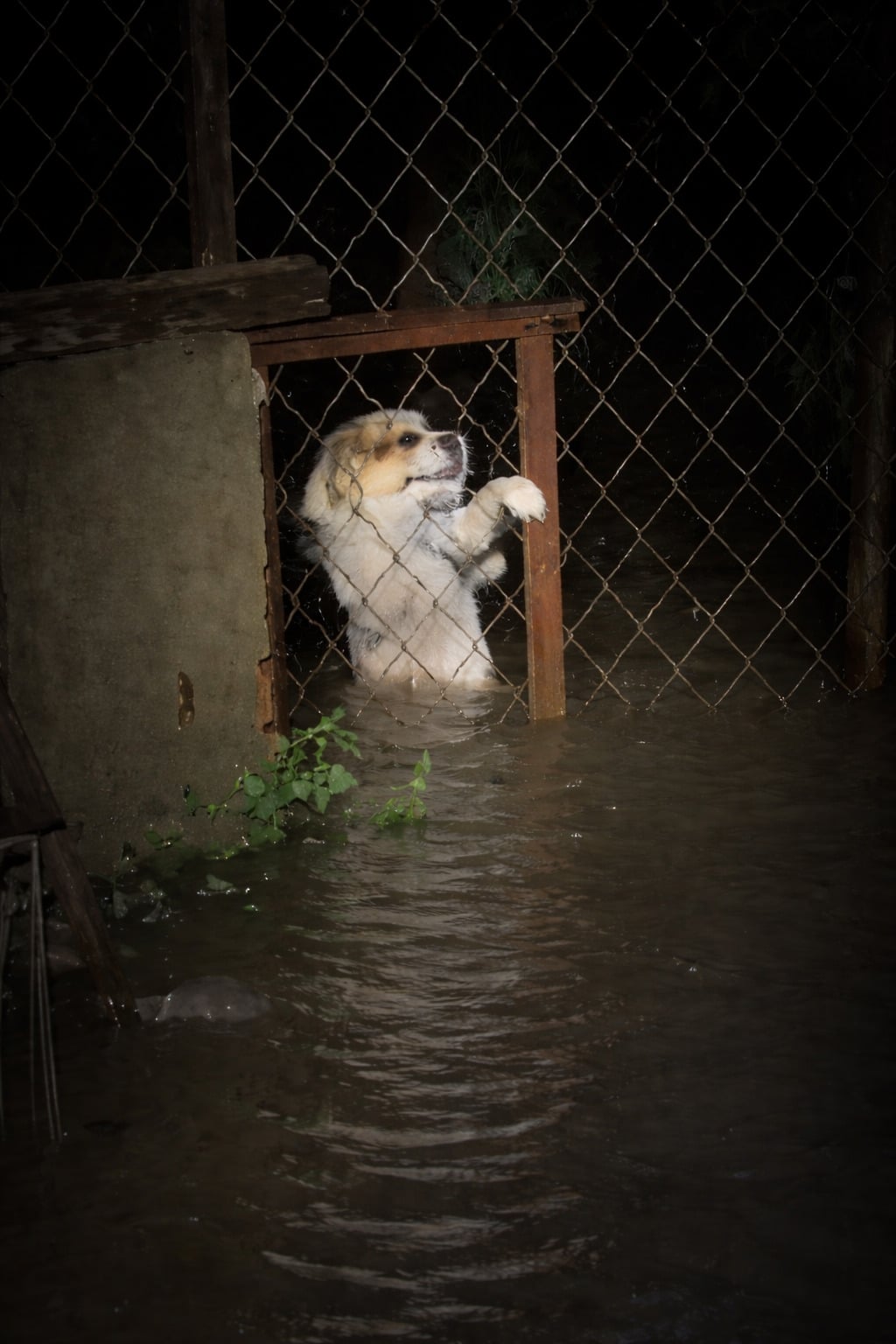
A group of dogs stood trapped behind a metal fence while floodwater pressed against their bodies.
There was nowhere higher to climb.
No opening they could reach.
No way to understand when—or whether—the water would stop rising.
Some pressed themselves close to the bars, trying to keep their heads above the surface. Others simply remained together in the limited space that was left.
Outside the fence, the flooded street stretched into darkness.
Then a man passing through the area looked toward the enclosure.
He stopped.
And once he realized what was happening behind those bars, continuing on was no longer an option.
The Fence That Once Kept Them In Had Become a Trap
Heavy rain had been falling for hours.
What began as water collecting along the ground had gradually become something much more dangerous.
The level continued climbing.
By the time the dogs were seen, the flood had already reached roughly chest height on some of them.
Under ordinary circumstances, the metal fence surrounding their area may not have seemed threatening.
Now it prevented them from escaping.
The dogs could not simply move toward higher ground.
The gate remained closed.
The bars offered nowhere to climb.
And with water filling the enclosure from below, every inch that disappeared beneath the surface reduced the space they had left.
There was little frantic movement.
There was nowhere useful for them to go.
Instead, the animals stayed close to the fence and to one another, adjusting their bodies as the water moved around them.
It was a quiet kind of emergency.
From farther away, someone might not immediately have understood how serious it had become.
But the man who saw them looked closer.
Then he understood.
If the water continued rising, the dogs would eventually lose the small amount of safe space they still had.
VIDEO: Floodwater Had Reached the Dogs’ Chests — But a Locked Fence Left Them With Nowhere to Go
One Man Stepped Into the Water Instead of Walking Away
The man did not remain safely on the edge of the flooded street.
He entered the water.
There was no guarantee that doing so would be easy.
Floodwater can hide uneven ground and obstacles beneath the surface. Moving through it becomes more difficult as the depth increases.
But the dogs were still behind the fence.
So he kept moving toward them.
The water pushed against his legs as he approached.
On the other side of the bars, the dogs watched.
They had no way to know why this stranger was coming toward them.
They only knew that someone was now entering the same water they had been unable to escape.
The man did not rush at them.
He kept his movements controlled.
He spoke calmly as he worked his way toward the gate.
Getting close was only the first problem.
The fence still stood between the dogs and the flooded street beyond it.
Until that gate opened, they remained trapped.
Reaching Them Wasn’t Enough — He Still Had to Open the Gate
By now, the situation had become a race against the rising water.
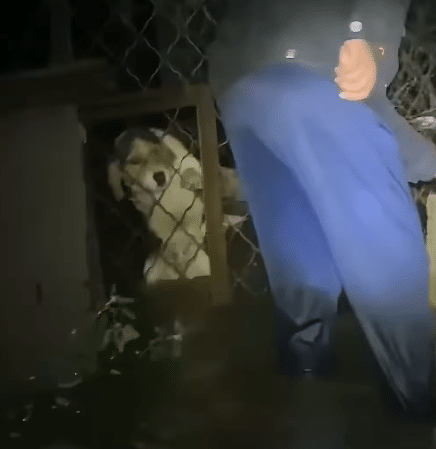
The man reached the enclosure and began working on the gate.
The dogs stayed nearby.
Some appeared uncertain.
That hesitation mattered.
Opening an escape route does not guarantee frightened animals will immediately understand they are supposed to use it.
Everything around them had suddenly changed.
Darkness.
Rain.
Moving water.
A stranger standing at the entrance to the only space they knew.
The safest option from a dog’s perspective may have seemed to be staying exactly where they were.
But staying was becoming increasingly dangerous.
The man continued working.
He held the gate.
He kept the opening available.
He did not charge into the group or force the dogs into deeper panic.
Instead, he created a path.
Then he waited for one of them to recognize it.
For several tense moments, nothing happened.
The water kept moving.
The dogs watched.
Then one finally stepped forward.
One Dog Took the First Step — Then the Others Followed
The first dog moved toward the opening cautiously.
There was no dramatic leap through the gate.
Only a hesitant step into unfamiliar water.
Then another.
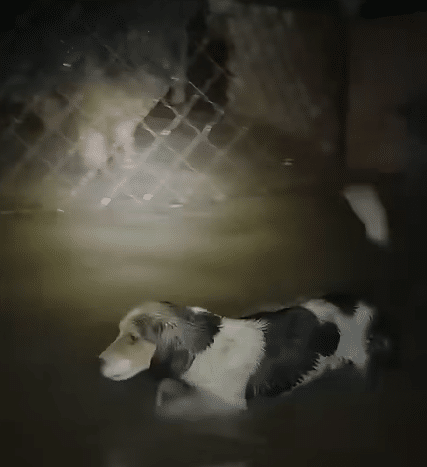
The dog passed through.
For the first time since the flooding had surrounded them, one animal was now on the other side of the fence.
That small movement seemed to change the situation for the rest.
Another dog followed.
Then another.
One by one, the animals began moving through the opening the man was holding for them.
The barrier that had kept them trapped was finally behind them.
But being outside the enclosure did not mean the danger was over.
Water still covered the surrounding area.
The dogs still needed somewhere safer to go.
And after spending so long confined behind the bars, they did not simply scatter into the darkness.
They remained close.
The man stayed with them.
Then he began guiding the group away from the flooded enclosure.
Freedom Was Only Useful If They Could Reach Higher Ground
Once all the dogs were outside, the rescue entered another stage.
They needed solid ground.
The flooded area around them was still unstable, and the safest route was not necessarily obvious to animals already stressed by the rising water.
The man continued moving with them rather than assuming that opening the gate was enough.
Step by step, he led them away from the enclosure.
The water gradually became shallower.
Their bodies emerged farther above the surface.
Eventually, paws that had been standing underwater reached firmer, drier ground.
Only then could the dogs stop.
There was no longer a fence preventing them from moving away from the flood.
There was no water pressing against their chests.
For the first time that night, they had room to simply stand and recover.
The change had happened remarkably quickly.
Minutes earlier, they were trapped.
Now the fence was behind them.
What separated those two moments was one person noticing something was wrong and being willing to enter the water.
The Dogs Didn’t Need a Dramatic Rescue — They Needed an Exit
Many rescue stories involve specialized equipment, large teams, or complex medical procedures.
This one came down to something much simpler.
The dogs had an immediate problem.
They were trapped behind a barrier while water rose around them.
What they needed most was a way out.
The man did not need to understand every part of their history.
He did not need to know who owned them or how long they had been behind the fence.
The urgent facts were already visible.
The water was high.
The enclosure was closed.
The dogs could not leave without help.
So he solved the problem in front of him.
He reached the gate.
Opened it.
Kept it open.
And gave the animals enough time to choose the escape route he had created.
That patience was important.
A frightened dog does not always respond to rescue by immediately cooperating.
Fear can make an animal hesitate even when an open gate leads directly toward safety.
The man did not interpret that hesitation as refusal.
He remained there.
Eventually, one dog trusted the opening enough to move.
The rest followed.
A Few More Minutes Could Have Made the Night Very Different
Floods change quickly.
A place that seems manageable can become dangerous as water continues rising.
For animals confined behind fencing, that danger becomes particularly severe because instinct alone cannot provide an escape.
The dogs could stand.
They could press against the bars.
They could search the perimeter.
But unless there was an opening, the enclosure determined how far they could go.
That is what made the timing of this rescue so important.
The man reached them while the dogs could still keep their heads comfortably above the surface.
There was still enough time to work with the gate.
There was still enough room for the animals to move toward the exit.
Had the water risen much farther, every part of the rescue would have become more difficult.
The dogs might have become exhausted.
The current might have become stronger.
The enclosure might have become harder to enter safely.
None of that happened.
Not because the flood stopped on its own.
Because help arrived before the situation crossed that line.
Sometimes the Most Important Part Is Simply Noticing
There was nothing about the beginning of that night suggesting one man’s decision would matter to a group of dogs.
He was simply moving through a flooded area.
Then he saw something behind a fence.
It would have been easy to assume the animals belonged there and that someone else was responsible for them.
It would have been easy to decide that entering floodwater was too difficult.
It would have been easy to make a call and continue on.
Instead, he looked long enough to understand that the dogs did not have the luxury of waiting.
That distinction matters.
Animals trapped during natural disasters cannot explain what they need.
They cannot unlock gates.
They cannot call for help.
And sometimes their emergency is quiet enough that it disappears into everything else happening around them.
These dogs were not running through the streets where everyone could see them.
They were behind a fence.
Their movement was limited.
Their world was getting smaller with every inch the water rose.
Someone had to notice what that meant.
Eventually, someone did.
The Fence Is No Longer Where Their Story Ends
The strongest image from that night may always be the dogs standing in deep floodwater behind metal bars.
Bodies pressed close to the fence.
Water around their chests.
No obvious way out.
But there is another image that matters just as much.
An open gate.
One dog stepping through.
Then another.
A man standing in the water long enough to make sure they all had a chance to follow.
Finally, the group reaching safer ground together.
There is no need to turn that moment into something more dramatic than it already was.
The facts are enough.
A flood was rising.
Dogs were trapped.
One person saw them.
And instead of assuming someone else would handle it, he stepped into the water.
He could not make the storm stop.
He could not lower the flood.
He could not undo the fact that the dogs had become trapped.
He could do one thing.
Open the way out.
For those animals, that was everything they needed.
Sometimes a second chance does not arrive as a complicated plan.
Sometimes it is a gate being forced open in the middle of a flood.
A stranger holding it steady.
One frightened dog deciding to step through.
And then the others realizing they can follow.
That night, the water kept rising.
But the dogs were no longer there when it did.


