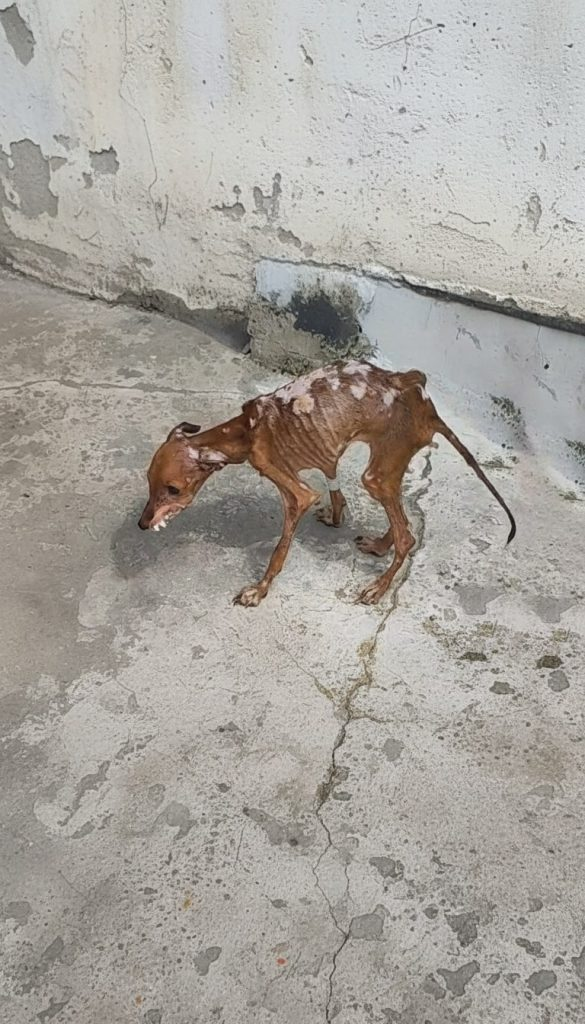
Mangito did not cry out for help.
He did not chase anyone passing nearby.
By the time someone finally noticed him, he seemed to have almost nothing left to give.
His thin body lay stretched across the ground, ribs visible beneath fragile skin. He was so weak that even curling into a more comfortable position appeared beyond him. His eyes remained open, but there was little movement behind them.
People had passed this place before.
Mangito was still there.
Then one man noticed something that made him stop.
The dog was not sleeping.
He was barely responding at all.
And from that moment, Mangito’s life began moving in a direction he could never have reached on his own.
The Silence That Made One Man Stop
There was no dramatic rescue call.
No barking.
No attempt to follow.
Mangito simply lay there.
The man approached carefully and crouched beside him, waiting for some reaction. A frightened street dog might normally pull away, tense its body, or try to escape.
Mangito did none of those things.
He looked toward the stranger but remained almost completely still.
When the man reached down and gently lifted him, another detail became impossible to ignore.
Mangito was frighteningly light.
His body had been depleted by prolonged hunger, and there was little strength left in his legs. Even being carried seemed to require energy he could barely spare.
The man did not leave him there.
He wrapped Mangito carefully and began the drive toward veterinary care.
Inside the vehicle, the dog rested quietly beneath a blanket. His breathing was shallow, and his body trembled from weakness.
No one knew yet what the examination would reveal.
But one thing was already different.
For the first time in a long while, Mangito was no longer facing the next few hours alone.
VIDEO: Mangito Was Too Weak to Stand — Then One Stranger Refused to Leave Him Behind
A Body With Almost Nothing Left
At the clinic, the veterinary team began examining Mangito immediately.
His appearance had already revealed severe neglect, but the medical evaluation showed how much his body had been struggling.
He was profoundly malnourished.
His blood levels were dangerously low because of anemia.
His skin showed the effects of prolonged poor health, and his weakened condition meant his body had little reserve left for recovery.
The concern was not only that Mangito needed food.
After severe starvation, feeding has to be managed carefully. A body that has gone without proper nutrition cannot always handle large meals immediately.
So there would be no overflowing bowl placed in front of him.
No attempt to make up for months of hunger overnight.
His recovery had to begin slowly.
Small meals.
Medication.
Rest.
Gentle skin care.
Close observation.
The veterinarian made it clear that Mangito had a difficult road ahead. His condition was serious, and improvement could not be guaranteed simply because he had reached a clinic.
His rescuer understood.
He stayed anyway.
Recovery Had to Begin One Small Step at a Time
Mangito’s first days in treatment were quiet.
Caregivers offered carefully controlled portions of food so his weakened system could adjust. Medication supported his condition, while gentle baths helped clean and soothe his damaged skin.
There was no dramatic overnight transformation.
Some mornings, Mangito barely moved.
He rested for long periods and seemed exhausted by even the smallest activity. Getting stronger required energy, but his body was still learning how to use nourishment again.
The people caring for him watched closely.
They did not push him to stand.
They did not expect affection.
They did not measure progress by how quickly he could become the cheerful dog everyone hoped to see.
For now, progress meant simpler things.
Finishing a little more food.
Sleeping comfortably.
Breathing steadily.
Showing awareness when someone entered.
Those changes were easy to overlook.
But with Mangito, they mattered.
Day after day, the same routine continued.
Food arrived.
Medicine arrived.
Gentle hands cleaned his skin.
A blanket remained beneath him.
And every time Mangito opened his eyes, someone was still there.
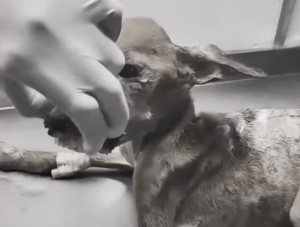
Then Mangito Began Looking Up
The first real changes appeared in his attention.
Mangito started lifting his head when someone entered the room.
At first, the movement was small.
He would hear footsteps, open his eyes, and follow the sound.
Then he began watching the people around him.
For a dog who had previously seemed too exhausted to respond to much of anything, that curiosity felt significant.
His body was still fragile.
But Mangito was engaging with the world again.
One day, a caregiver reached toward him.
Instead of shrinking away, Mangito remained still.
Then he leaned slightly toward the touch.
It was not a dramatic display of affection.
It was something quieter.
Permission.
Trust beginning in the smallest possible way.
As his meals continued and his condition stabilized, Mangito became more alert. His eyes looked clearer. His posture changed. He began showing interest in what happened around him rather than simply lying through the hours.
Then came another moment no one in the room wanted to miss.
His tail moved.
Only a little.
But it moved.
For the people who had watched him arrive almost motionless, that brief wag said more than any dramatic transformation could have.
Mangito was not merely being kept alive.
He was beginning to participate in his own recovery.
His Body Grew Stronger, but Trust Changed Him Most
The weeks that followed brought more visible progress.
Mangito gained weight.
His skin gradually improved.
His coat began growing healthier.
His legs became strong enough to support him for longer periods, and the dog who had once been carried everywhere started moving on his own.
But the physical changes were only part of what caregivers noticed.
Mangito was becoming interested in people.
He watched familiar faces.
He accepted gentle touch.
He rested more comfortably when someone sat nearby.
Soon, he began seeking that closeness himself.
The dog who had once remained completely still when a stranger approached now seemed to understand that human hands could bring something other than uncertainty.
Food.
Warmth.
Comfort.
Safety.
His recovery did not erase whatever had happened before he was found.
There were no words that could tell rescuers exactly how long he had been struggling or how many people had passed without realizing how serious his condition had become.
They could only respond to the dog in front of them.
And day after day, Mangito gave them a little more of himself.
The Man Who Stopped Became the Person Who Stayed
Eventually, the veterinary team reached the milestone everyone had hoped for.
Mangito was strong enough to leave clinical care.
His body still needed good nutrition and continued attention, but the immediate crisis had passed.
Now came another question.
Where would he go?
For the man who had carried Mangito from the ground that first day, the answer had already become clear.
He took him home.
There was no street pavement waiting for him there.
No uncertainty about where his next meal would come from.
Mangito had a bed.
Regular food.
A quiet place to sleep.
And, perhaps most importantly, the same person who had stopped when everyone else kept moving.
At first, Mangito explored cautiously.
He followed his rescuer from one room to another, learning the unfamiliar sounds and smells of a home.
Then he began settling into routines.
Meals came at predictable times.
His bed remained in the same place.
A gentle voice greeted him every day.
Nothing disappeared unexpectedly.
The small details of ordinary life slowly became the foundation of something Mangito had been missing.
Security.
He No Longer Had to Spend Every Day Surviving
As Mangito became healthier, more of his personality appeared.
He wandered through the house with growing curiosity.
He followed his rescuer simply because he wanted to be nearby.
He slept deeply instead of remaining tense and alert.
His body filled out, and the sharp outline of his ribs faded beneath a healthier coat.
His eyes changed too.
The distant expression from the day he was found was replaced by something brighter and more attentive.
Mangito had learned that waking up no longer meant beginning another search for food.
He did not have to conserve every bit of strength.
He did not have to remain unnoticed to survive.
There was space in his life now for ordinary things.
Rest.
Curiosity.
Companionship.
Joy.
None of them arrived in one dramatic moment.
They were built through hundreds of small experiences that repeatedly told him the same thing:
You are safe here.
One Person Stopping Was Enough to Change the Ending
Today, Mangito looks very different from the dog who once lay motionless on the ground.
He has regained weight.
His coat and skin have recovered.
He moves with strength that once seemed impossible.
And he lives beside the person who decided that his silence was worth investigating.
Mangito’s story did not change because someone performed an impossible miracle.
It changed because someone noticed.
A man stopped.
He knelt down.
He looked closely enough to understand that the dog in front of him was not simply resting.
Then he acted.
Everything that followed—the clinic, the careful meals, the medicine, the first lifted head, the tiny wag of a tail, the warm bed waiting at home—began with that one decision.
Mangito had been too weak to ask anyone to stay.
Fortunately, one person stayed anyway.
And for a dog who had almost disappeared in plain sight, that was enough to give him an entirely different life.


