Not every dog enters rescue with the same kind of wound.
For one, the burden was visible immediately—a coat so severely matted that simply moving had become difficult.
For another, nothing obvious appeared wrong with her body, yet fear kept her pressed close to the ground and unable to take ordinary steps.
And then there was Shania, a pregnant mother who kept moving because staying near people did not yet feel safe.
Three dogs.
Three very different beginnings.
But each transformation shared something important.
No one forced them to change.
Someone simply stayed long enough for change to become possible.
Beneath the Matted Coat Was a Dog No One Could Clearly See
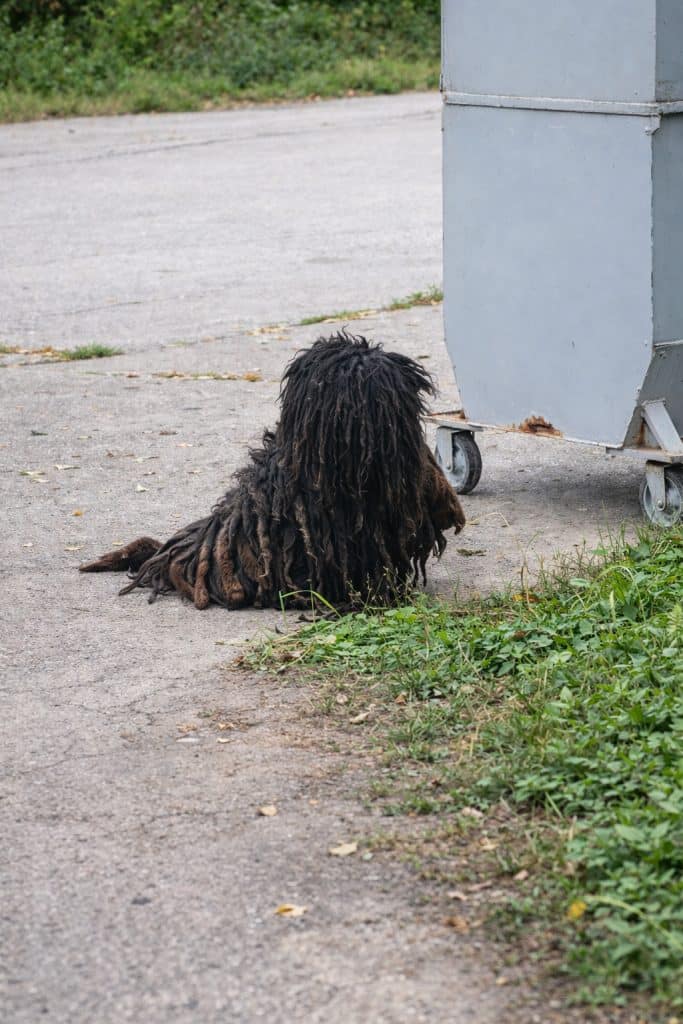
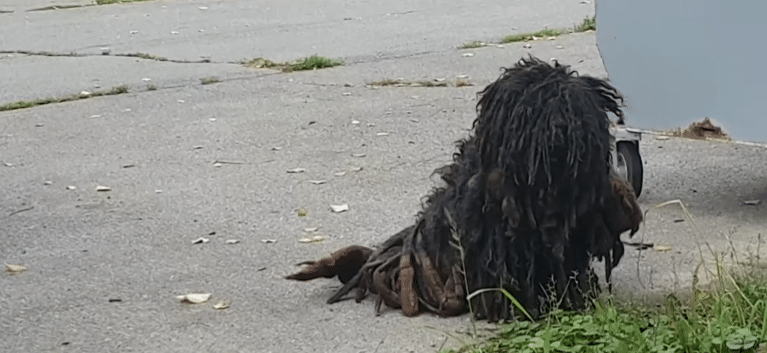
In Serbia, rescuers first noticed something moving strangely in the distance.
It did not immediately resemble a dog.
The dark shape moved slowly and unevenly, almost as though something heavy was being dragged along with it.
When rescuers came closer, they understood why.
The dog’s coat had become severely matted.
Dense layers of fur had compacted together until they formed thick sections around his body. What should have been a protective coat had become something that restricted ordinary movement.
Even walking appeared difficult.
But reaching him presented another challenge.
He was frightened.
Rather than chasing or cornering him, rescuers allowed the process to move slowly.
Nearly two hours passed before they could approach closely enough to help.
There was no shortcut.
The dog needed time to decide that the people near him were not another threat.
Eventually, he allowed them close.
And the next stage of his life began.
VIDEO: His Matted Coat Had Hidden Him Completely — Then Rescuers Began Cutting Away the Weight
Piece by Piece, a Completely Different Dog Appeared
At the clinic, the mats were removed carefully.
Sections of compacted fur fell away one after another.
Underneath was a much smaller dog than his appearance had suggested.
A Poodle mix.
Delicate beneath the enormous coat that had hidden his actual size and shape.
With the heavy mats gone, movement immediately became easier.
His body was no longer fighting against layers of hardened fur every time he tried to take a step.
The change was physical and easy to see.
He could stand differently.
Move more freely.
And finally be seen as the dog who had been concealed beneath the neglected coat.
His story was not about becoming someone new.
It was about removing what had prevented everyone—including perhaps the dog himself—from moving comfortably through the world.
For Trinity, however, the obstacle could not be cut away with clippers.
Trinity Was Young and Healthy Enough to Walk — But Fear Kept Her Still
Trinity was a young German Shepherd.
There was no dramatic physical injury preventing her from moving.
Yet when people tried to encourage her forward, she remained low to the ground.
Her body appeared locked in fear.
She did not explore.
She did not walk outside willingly.
At times, she had to be carried because taking those first steps seemed overwhelming.
Her caregivers did not solve the problem by pulling harder on a leash or demanding that she move.
Instead, another dog entered the picture.
Topaz.
Topaz behaved in a way Trinity could observe without pressure.
He explored.
Played.
Moved through the environment as though nothing unusual was happening.
No one needed Topaz to teach a formal lesson.
He simply showed Trinity what relaxed movement looked like.
And she watched.
One Day, Trinity Finally Followed
At first, Trinity remained where she was.
Topaz moved ahead.
Trinity watched.
Then, eventually, she stood.
One step followed.
Then another.
For the first time, she began following the other dog across the ground rather than remaining frozen in place.
Grass touched her paws.
Nothing terrible happened.
She continued.
Over time, her posture changed.
Her tail began moving more freely.
She explored rather than remaining pressed close to the ground.
Then came another behavior that showed how much more comfortable she had become.
Trinity rolled onto her back.
Her body, once tense and guarded, could finally relax enough to expose itself completely.
There was no single command that created that change.
It grew from repeated experiences in which the world around her remained safe.
Shania Had a Different Reason to Keep Her Distance
Shania’s story unfolded under very different circumstances.
When rescuers first encountered her, she was pregnant.
Winter was approaching, and a storm was not far away.
That made time important.
But Shania would not simply allow people to walk up and take her to safety.
She kept moving.
She shifted from one temporary sheltering place to another and remained alert to anyone approaching.
The rescuers could have chased her.
They did not.
Cornering a frightened pregnant dog could have made an already difficult situation worse.
So they watched.
Waited.
Stayed aware of where she was moving.
And looked for an opportunity that would allow them to help without creating unnecessary panic.
Eventually, Shania gave birth.
That was when rescuers were finally able to bring the mother and her puppies into safety.
But getting her indoors did not mean trust arrived with her.
Safety Came First — Trust Came Much Later
Shania remained cautious after rescue.
She watched people closely.
She kept distance when she could.
Her behavior did not suddenly change simply because the surroundings were safer.
The people caring for her understood that.
So once again, the work became quiet and repetitive.
Food was offered gently.
Voices remained low.
Hands did not rush toward her.
No one expected Shania to behave affectionately simply because she had been rescued.
Instead, they allowed her to observe what happened every day.
Meals arrived.
The puppies remained safe.
People entered and left without harming her.
Eventually, Shania accepted food directly from a hand.
Later, she moved forward on a leash.
Each step looked ordinary from the outside.
For a dog who had previously kept moving away from people, they represented something much larger.
Then another dog entered her world.
Otis.
The Mother Who Once Ran Away Began Running Toward a Friend
Otis was calm around Shania.
He did not overwhelm her.
He simply stayed nearby and interacted without pressure.
Over time, Shania began showing a different side of herself.
She played.
Then one morning, caregivers saw her running toward Otis.
The movement looked completely different from the running that had defined her earlier days.
Before, Shania had moved to create distance.
Now she was closing it.
She was approaching another dog because she wanted to.
That contrast captured the distance she had traveled emotionally.
The circumstances around her had changed first.
Then, slowly, her behavior followed.
She no longer needed every movement to be an escape.
Some movement could simply be play.
None of the Three Dogs Changed Because Someone Forced the Moment
The Serbian dog needed nearly two hours before rescuers could approach.
Trinity needed time to watch another dog move through the world before she attempted to follow.
Shania needed repeated, predictable experiences before she allowed people—and eventually another dog—to come closer.
Their problems were not identical.
Neither were their recoveries.
One carried a physical burden wrapped around his body.
One appeared trapped by fear.
One had learned to keep moving away while protecting her puppies.
Yet each story required the same quality from the people trying to help.
Patience.
Not passive waiting.
Patient action.
Approaching slowly.
Removing mats carefully.
Allowing observation.
Offering food without pressure.
Giving frightened dogs enough time to discover that the environment around them had changed.
Sometimes the Most Important Transformation Is Simply Moving Differently
For the first dog, progress meant moving without a heavy matted coat restricting his body.
For Trinity, it meant standing and following Topaz into the grass.
For Shania, it meant running toward Otis instead of away from everyone around her.
None of those moments were enormous by themselves.
A haircut.
A few steps.
A short run toward another dog.
But placed beside where each animal began, they told the entire story.
Rescue did not instantly erase fear or neglect.
It created the conditions in which something else could slowly replace them.
Comfort.
Curiosity.
Trust.
Play.
Three dogs arrived carrying very different kinds of weight.
None of them put that weight down all at once.
It happened gradually.
A little less fear.
A little more movement.
Another safe interaction.
Then another.
Until one day, the burden that had once defined everything was no longer the first thing anyone saw.
What remained was the dog underneath.


