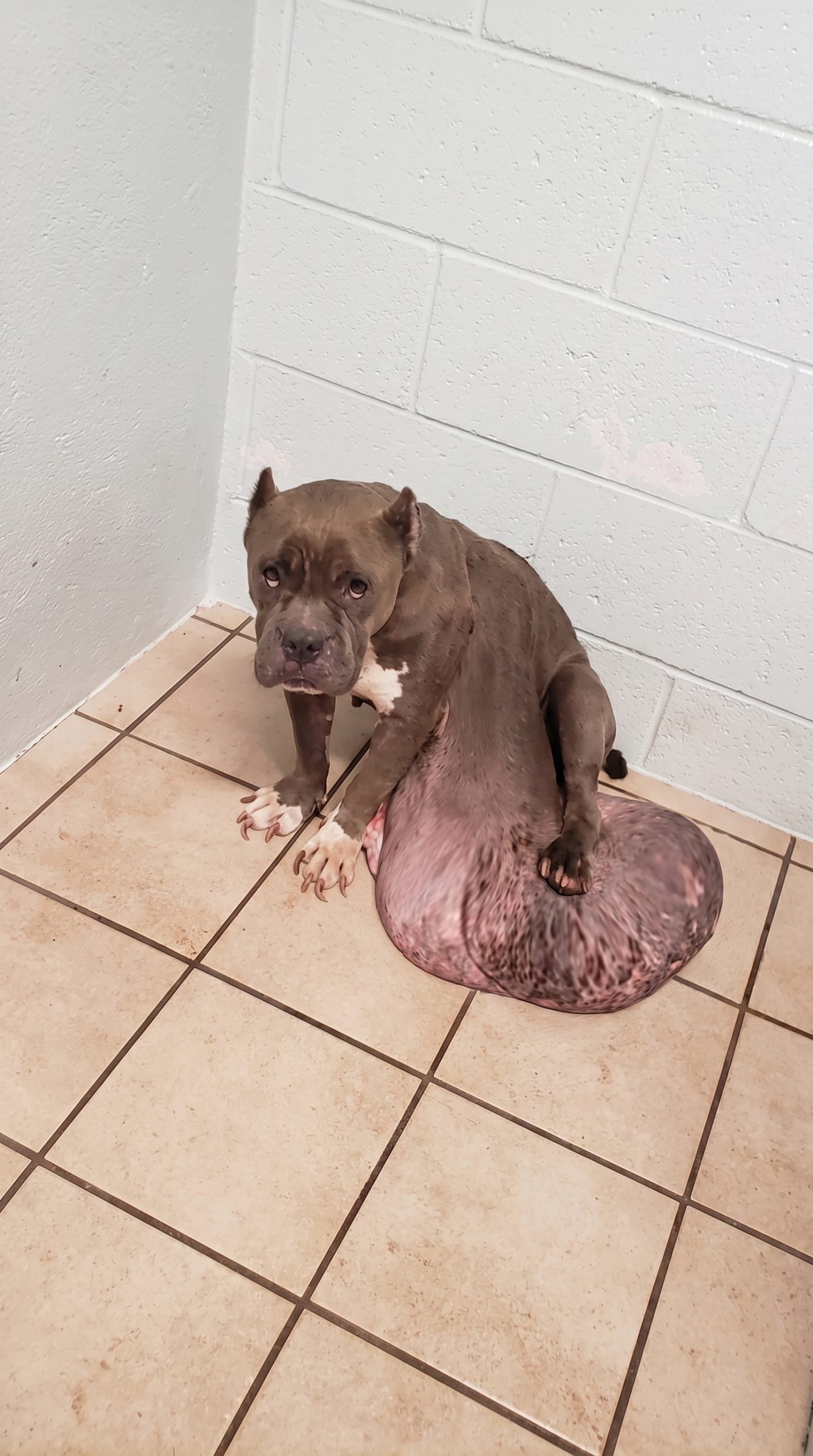
Every step Magnolia took came with extra weight.
Not a few pounds.
Nearly 15 pounds hanging from her body.
By the time she was found wandering alone, a massive tumor had grown so large that it affected the way she moved. Her body looked exhausted beneath the burden, and according to the rescue account, the people who had previously cared for her had left her behind rather than seeking treatment.
No one knew exactly how long Magnolia had been struggling this way.
But once rescuers saw her, there was no question that she needed medical attention.
She was brought to a veterinary clinic.
And when the team examined the enormous mass attached to her body, they knew this would not be a routine case.
The Tumor Had Become Almost Impossible for Her Body to Carry
Magnolia remained calm as the veterinary team began evaluating her.
The size of the tumor was immediately concerning.
It pulled heavily against her body and made ordinary movement difficult. For a dog already weakened by prolonged illness, simply walking had become an exhausting task.
Imaging was performed to determine whether there were signs that the disease had spread internally.
The initial results brought an important piece of encouraging news.
According to the rescue account, doctors did not find evidence that the cancer had spread to her vital organs.
That did not make Magnolia’s condition simple.
The mass was still enormous.
And removing something that large from an already weakened dog would carry serious risks.
But there was now a path forward.
Surgery.
VIDEO: Magnolia Could Barely Walk Beneath a Giant Tumor — Then Surgeons Prepared to Remove It
Removing It Would Be Dangerous Too
The surgical team prepared carefully.
A tumor of this size could involve extensive blood supply, creating a serious risk of blood loss during removal.
Magnolia’s weakened condition added another concern.
Her body had already spent considerable energy simply carrying the mass.
Now it would have to endure anesthesia and a lengthy operation.
The team knew what they needed to watch closely.
Blood pressure.
Bleeding.
Fluid balance.
Her response to anesthesia.
Once the operation began, every stage required careful attention.
At one point, Magnolia’s blood pressure dropped.
The team adjusted her support and continued monitoring her closely while working to keep her stable.
There was no rushing.
The surgeons continued until the enormous mass was finally separated from her body.
Then it was weighed.
14.9 pounds.
For the first time in a long while, Magnolia no longer had to carry it.
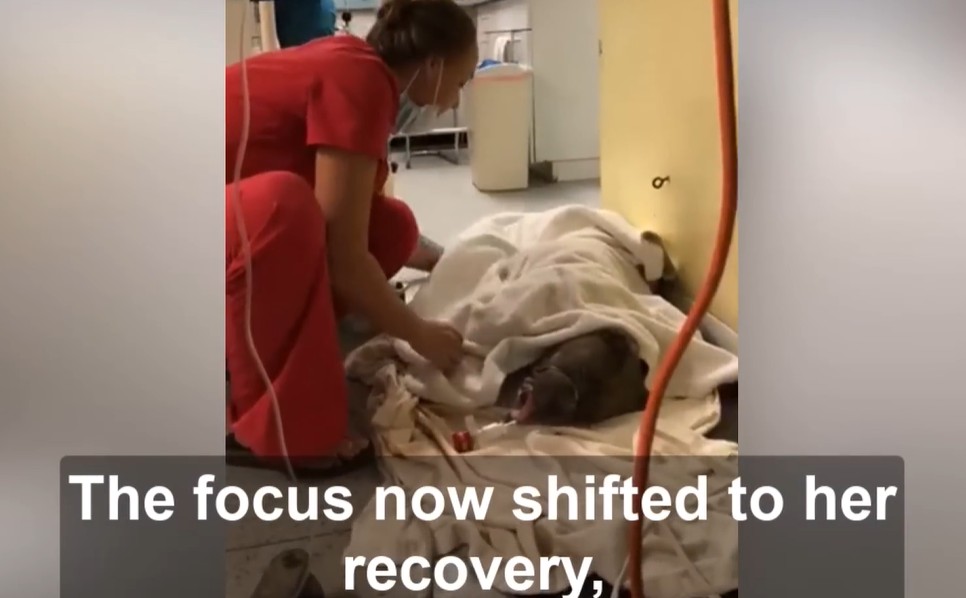
She Survived the Operation
When the surgery ended, Magnolia was moved into recovery.
The immediate danger had passed, but the following hours still mattered.
Her body had just undergone a major procedure.
She needed rest.
Pain management.
Monitoring.
And time for her system to adjust to an enormous physical burden suddenly being gone.
That first night, Magnolia remained in a quiet recovery area.
The following morning, caregivers noticed something encouraging.
She was awake.
Alert.
And interested in food.
Magnolia ate.
After everything her body had endured, a normal appetite was a welcome sign.
Her strength would not return overnight.
But she had made it through the surgery.
Now recovery could begin.
Then Magnolia Tried to Walk Without the Weight
Day by day, her condition improved.
Her appetite became more consistent.
She appeared increasingly alert.
Then came the moment everyone had been waiting to see.
Magnolia stood.
For so long, movement had meant compensating for a tumor weighing almost fifteen pounds.
Now her body had to rediscover its balance without it.
She took a step.
Then another.
Her movements were still cautious, and her muscles needed time to rebuild.
But she was walking.
The difference was impossible to miss.
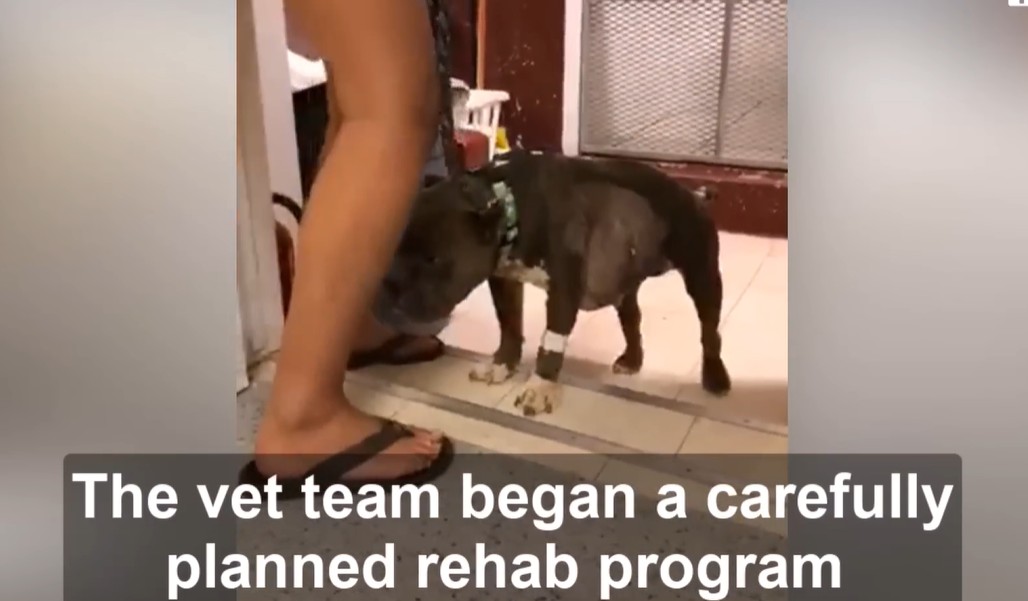
Rehabilitation Helped Her Discover What Her Body Could Do Again
Surgery had removed the tumor.
It could not instantly restore the strength Magnolia had lost while carrying it.
So rehabilitation became the next part of her recovery.
Activity was introduced gradually.
Short movements helped her rebuild muscle.
Caregivers watched her closely and allowed her body to adjust at a manageable pace.
As the days passed, Magnolia became more comfortable moving.
Her steps grew steadier.
Her tail began wagging more often.
She showed more interest in the people around her.
Eventually, play became part of her routine.
The dog who had once spent so much energy simply carrying her own body could now use that energy for something else.
Exploring.
Interacting.
Enjoying attention.
A Foster Home Showed Her What Ordinary Life Could Feel Like
Once Magnolia no longer required the same level of clinical care, she moved into a foster home.
The change of environment gave her another opportunity to heal.
There were no examination tables.
No constant activity of a veterinary clinic.
Instead, there were quieter routines.
A comfortable place to sleep.
Regular meals.
People nearby.
Space to move at her own pace.
That was where more of Magnolia’s personality began to appear.
She sought attention.
She played.
She became increasingly comfortable around the people caring for her.
The enormous tumor that had once dominated every photograph of her was gone.
Now people could simply see Magnolia.
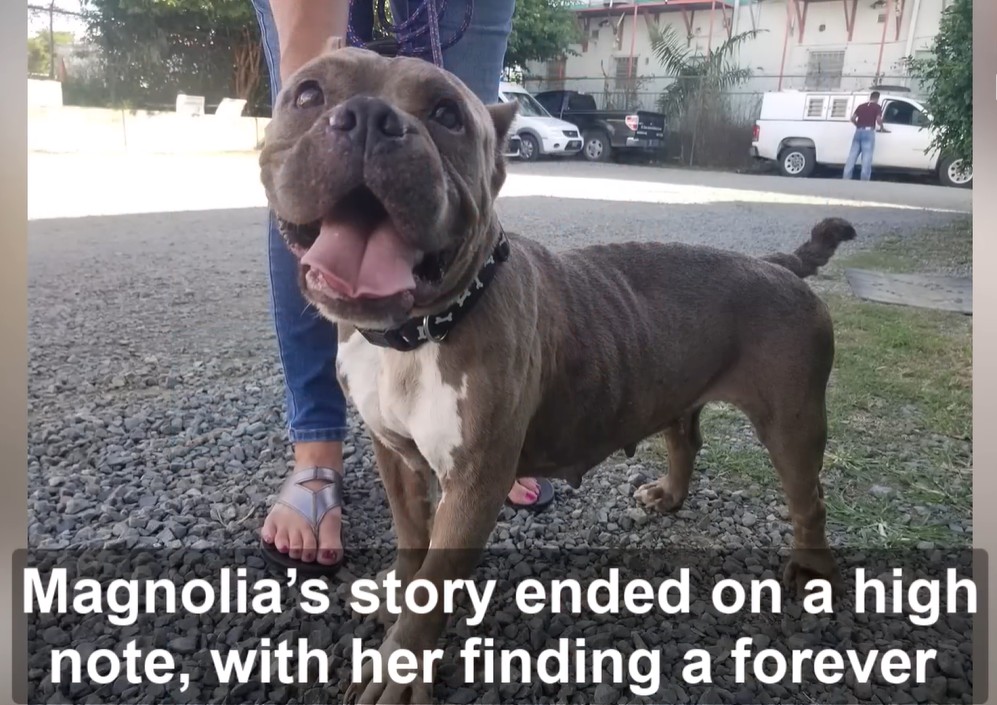
The Temporary Home Eventually Led to Something Permanent
Magnolia continued gaining strength.
Her surgical recovery progressed.
Movement became easier.
And eventually, another milestone arrived.
She was adopted.
The dog who had once been found alone while carrying a mass that weighed nearly fifteen pounds now had a permanent home.
Her daily life was no longer built around untreated illness.
There were people watching her health.
People providing food.
People expecting her to be there.
The difference was not only visible in her body.
It could be seen in the ordinary things she was finally able to do.
Walk comfortably.
Rest.
Play.
Approach people for affection.
None of those things should be remarkable for a dog.
For Magnolia, each one marked how far she had come.
Magnolia Was Never the Burden She Carried
When Magnolia was found, the enormous tumor was almost impossible to look past.
It had changed the shape of her body.
Affected her movement.
And become the most visible evidence that she had gone without treatment.
But the tumor was something happening to Magnolia.
It was never who she was.
Once rescuers brought her to veterinary care, a chain of difficult decisions followed.
Testing.
A high-risk operation.
A dangerous drop in blood pressure.
A tumor weighing 14.9 pounds finally being removed.
Then food.
Rest.
Rehabilitation.
A foster home.
And eventually, adoption.
Magnolia’s recovery did not erase everything that came before it.
But it gave her something much more important.
A future that was no longer defined by the weight hanging from her body.
Once, every step required Magnolia to carry nearly fifteen extra pounds.
Today, she can simply walk forward.
And this time, there are people walking with her.


