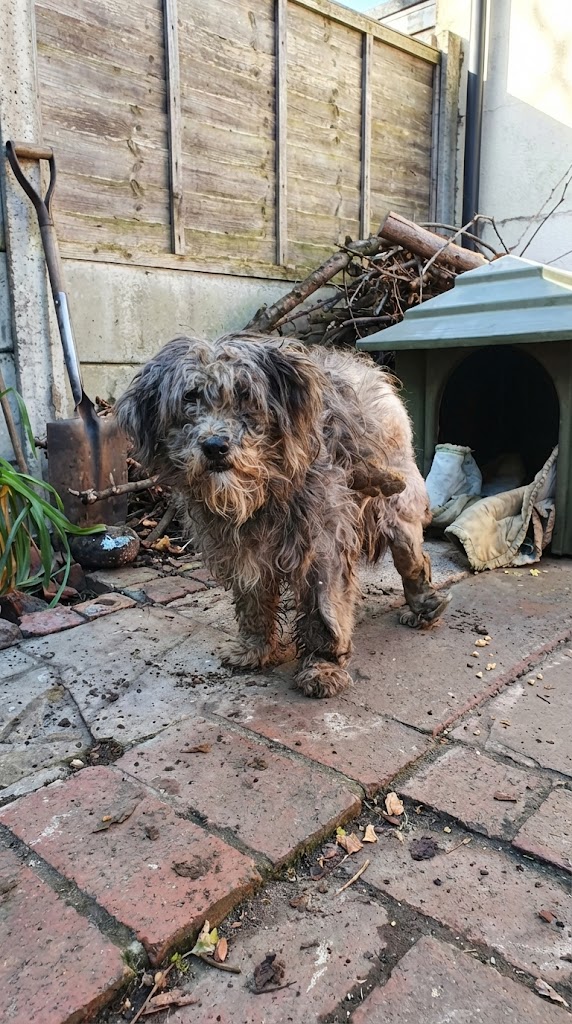
When rescuers first met her, it was difficult to tell what the senior dog looked like beneath her coat.
Her fur had grown into thick, tangled mats that clung tightly to her body and collected dirt around her legs and sides.
She moved cautiously.
Inside the shelter, sudden sounds made her flinch, and unfamiliar hands caused her to pull away.
At that point, she was still known as Bronty.
She was an older dog who had arrived carrying both the visible effects of neglect and a deep uncertainty around people.
But before anyone could discover her personality, they first had to help her become comfortable inside her own body again.
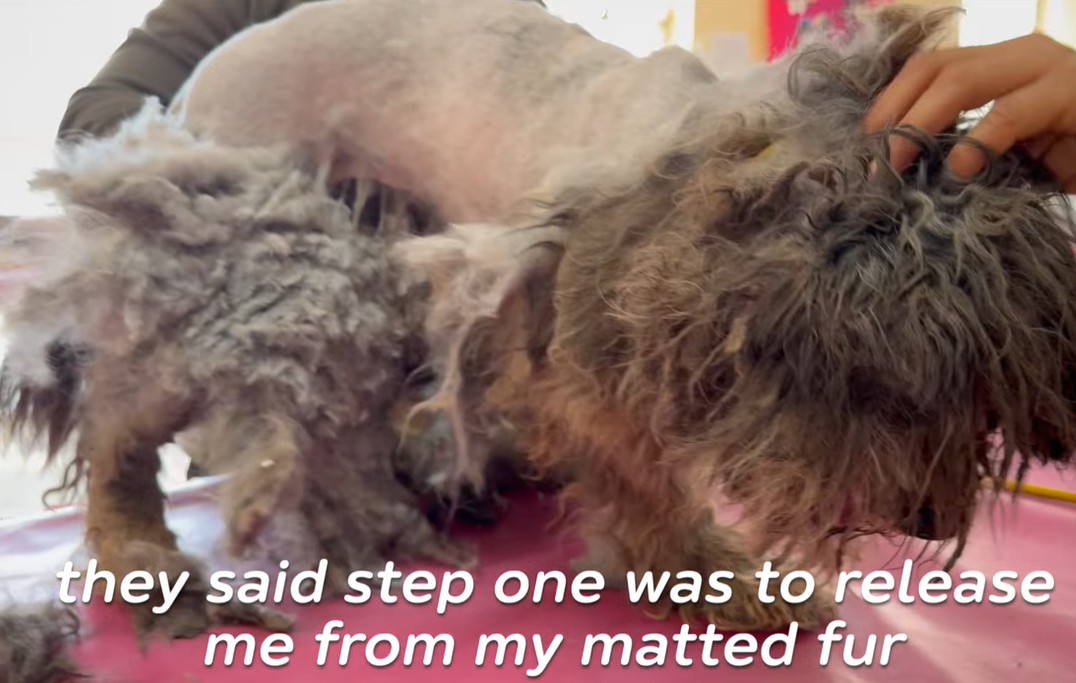
And that began with removing the coat that had been weighing her down.
Her Coat Had Become a Heavy Shell Around Her Body
Years of neglected grooming had transformed Bronty’s fur into something far different from a normal coat.
The mats had tightened close to her skin.
They restricted comfortable movement and concealed much of her actual size and shape.
Removing them could not be rushed.
Groomers worked carefully for hours, cutting through section after section while trying not to frighten a dog who was already uncomfortable with human contact.
As the tangled fur fell away, a much smaller dog slowly appeared underneath.
For the first time in a long while, her skin was no longer trapped beneath the heavy coat.
Movement became easier.
But grooming addressed only the problem everyone could see.
Bronty still had to learn what to make of the people now caring for her.
VIDEO: A Senior Dog Was Almost Hidden Beneath Matted Fur — Then Groomers Finally Revealed Her
Freedom From the Mats Did Not Immediately Remove Her Fear
After grooming, Bronty remained cautious.
She startled easily.
Unexpected noises could make her tense.
A hand reaching toward her sometimes caused hesitation rather than excitement.
No one needed to invent a detailed explanation for those reactions.
Her behavior simply showed that she was not yet comfortable.
So caregivers gave her space.
Food arrived regularly.
Her physical needs were addressed.
Human contact remained gentle and predictable.
Rather than insisting that Bronty become affectionate, the people around her allowed her to decide when she was ready to come closer.
That patience began working.
Not overnight.
But little by little.
The First Changes Appeared in the Way She Approached People
As Bronty became accustomed to the shelter routine, her behavior began to soften.
She watched familiar people instead of immediately retreating.
She allowed gentle contact for longer periods.
Then she began leaning toward it.
The dog who had once treated an approaching hand as something uncertain started discovering that touch could feel good.
Her body was becoming healthier too.
Regular meals helped restore strength.
Her newly groomed coat remained clean and manageable.
Movement no longer meant fighting against layers of hardened fur.
Soon, Bronty was not simply walking because she needed to get somewhere.
She began moving with energy.
Caregivers saw playful little steps.
Then more confidence.
The senior dog hidden beneath the mats was finally beginning to show herself.
A New Family Gave Her a New Name
Eventually, Bronty found a home.
Her new family renamed her Gertie.
Before long, she gained another affectionate nickname:
“Gertie the Goat.”
The name came from the quirky, playful personality that emerged once she became comfortable.
It was a remarkable contrast.
At the shelter, Gertie had been cautious and easily startled.
At home, with routines she understood and people she recognized, she became increasingly expressive.
She stayed close to her humans.
She sought affection.
And when it was time to go outside, the senior dog who had once moved so tentatively began showing far more enthusiasm.
Her world was expanding.
Then Gertie Became a Familiar Face at the Dog Park
The local dog park gave Gertie another place to reveal her personality.
She ran across the grass.
Interacted with other dogs.
And became familiar enough to regular visitors that her family began describing her as something of a little park celebrity.
Gertie also developed friendships of her own.
One of her closest companions was a dog named Molly.
Then there was Mable, a Schnauzer who seemed to capture Gertie’s attention in a particularly enthusiastic way.
No one needed to explain why.
Gertie simply liked her.
The senior dog who had once been too frightened to relax around unfamiliar movement was now actively seeking out dogs she recognized.
Watching her at the park made the contrast with her first days difficult to ignore.
She was no longer trying to make herself smaller.
She was participating.
Senior Age Did Not Stop Her From Discovering Play
Gertie’s story carried an important reminder about older rescue dogs.
Her age did not prevent change.
It did not prevent her from forming new relationships.
And it certainly did not prevent her from enjoying herself.
She learned new routines.
Adapted to a new home.
Built relationships with new people.
Made canine friends.
And found pleasure in running across grass after spending so much time hidden beneath an uncomfortable coat.
Being a senior dog meant Gertie had fewer years ahead than a young puppy might.
It did not make those years less valuable.
What mattered was that the time she had now looked completely different from the life she had been living before rescue.
The Dog Beneath the Fur Had Been There All Along
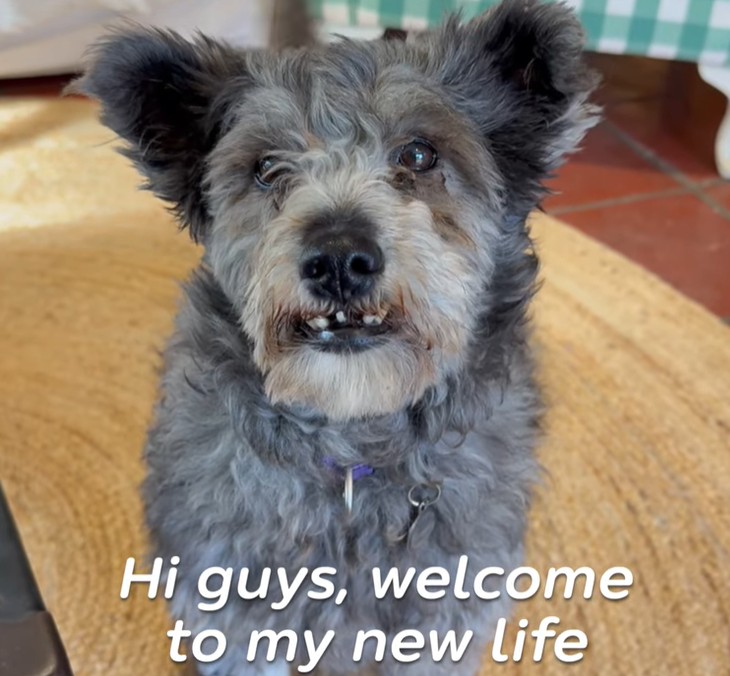
The most striking part of Gertie’s transformation was not simply how different she looked after grooming.
Removing the mats revealed her body.
Patience revealed everything else.
Her curiosity.
Her affection.
Her playful habits.
Her attachment to her people.
Her friendship with Molly.
And her amusing fascination with Mable.
None of those qualities were created by the haircut.
They had simply been difficult to see while Gertie was uncomfortable, frightened, and trying to adjust.
Once her physical burden was removed and her environment became predictable, she had room to show more of herself.
Gertie Was Not Too Old for a New Beginning
When she first arrived, Gertie was an older dog hidden beneath neglected fur and wary of the people around her.
Someone could have looked at her age, her condition, and the work ahead and decided there were easier dogs to help.
Instead, people stayed.
They removed the mats carefully.
Fed her.
Allowed trust to grow without forcing it.
Then a family welcomed her home.
Today, the dog once known as Bronty has a very different routine.
She goes to the park.
Runs across the grass.
Spends time with dogs she knows.
Leans into the people she trusts.
And answers to a name associated not with neglect, but with the funny little personality her family came to love.
Once, nearly everything about Gertie was hidden beneath a coat no dog should have been forced to carry.
Now there is nothing hiding her.
She is simply Gertie.
Older, loved, unmistakably herself—and finally free to enjoy the life that was still waiting for her.


