Some dogs survive because they are strong.
Others survive because they have something even stronger to hold on to.
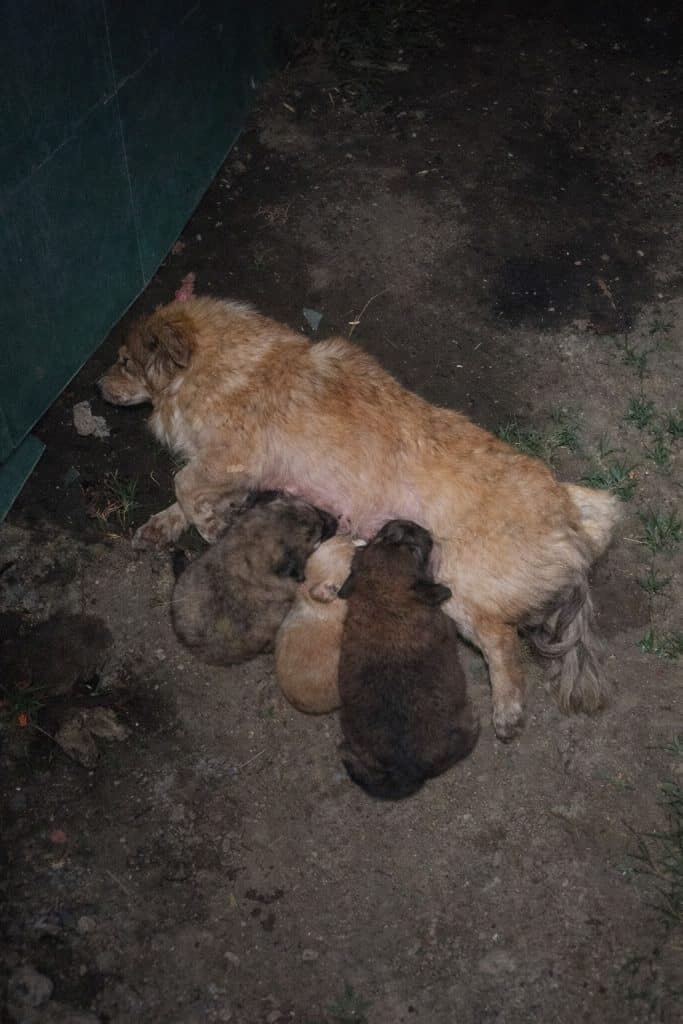
For Amal, that reason was lying right beside her: three tiny newborn puppies who still needed their mother, even after her body had stopped cooperating.
What happened to Amal changed everything in an instant. One moment, she was reacting on instinct to shield her babies. The next, she was on the ground, unable to use her back legs. But even then, she did not crawl away. She stayed exactly where she was, keeping herself close to the puppies who depended on her most.
A Mother’s Instinct Changed Her Life in a Second
Amal’s injury began with a sudden, chaotic moment.
A child came too close to her newborn puppies, and like many mothers would, Amal reacted immediately. She moved to place herself between her babies and the perceived danger.
It was an instinctive act.
Fast.
Protective.
Unhesitating.
But in the confusion that followed, Amal was struck and fell hard to the ground. The impact was severe. Almost immediately, her back legs stopped responding.
From that moment on, she could no longer stand.
For a mother caring for newborn puppies, there could hardly be a more devastating injury. She needed to move, to keep them warm, to stay alert, to protect them. Yet her body would no longer let her do what instinct still demanded of her.
And still, she did not leave them.
Video: Amal — The Mother Dog Who Lost the Use of Her Legs but Refused to Stop Fighting for Her Puppies
Found in the Grass, Still Guarding the Babies Beside Her
Hours passed before help arrived.
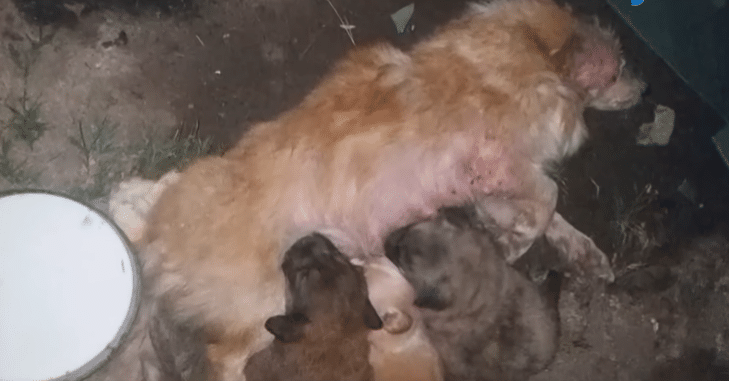
By then, Amal was still lying in the grass, unable to rise and unable to carry herself to safety. But what stands out most is that she remained beside her puppies the entire time.
They stayed pressed close to her.
She stayed close to them.
Even injured, even in pain, she held her position as best she could, using presence alone as a kind of protection. There was no dramatic struggle left in her body. There was only endurance.
When rescuers found the little family, the urgency of the situation was immediately clear. Amal needed emergency veterinary care, and the puppies needed to remain safe and warm.
There was no time to waste.
Amal and her three babies were taken in quickly, and from that moment forward, her fight shifted from pure survival to something more structured: treatment, monitoring, and the long uncertain road of recovery.
The Diagnosis Confirmed Why She Couldn’t Stand
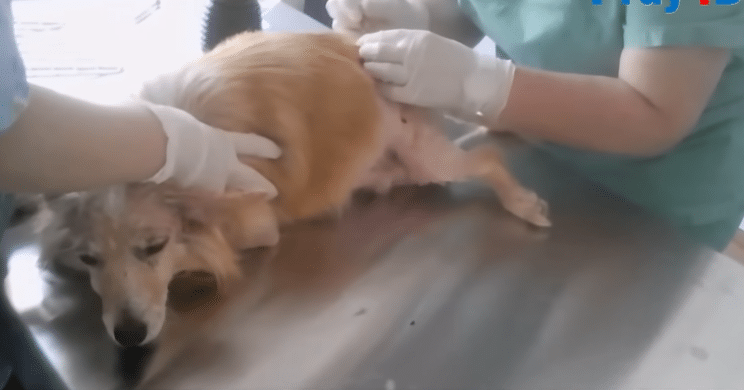
At the veterinary clinic, Amal was examined right away.
The diagnosis was serious.
She had suffered severe spinal trauma, which explained why her hind legs were no longer working. The injury had affected her mobility so significantly that standing, walking, and even changing position caused strain and discomfort.
For the veterinary team, the first goal was stabilization.
They needed to reduce inflammation, manage her pain, and determine whether her body would begin to respond to treatment without immediate surgery. A careful recovery plan was put in place, built around medication, close observation, and therapies designed to stimulate nerve response.
Nothing about the process would be fast.
There were no promises of an instant turnaround. Spinal injuries are complex, and progress can be painfully slow. But Amal had one important advantage: she was no longer alone, and she was finally under the care of people who were prepared to fight for her recovery.
That mattered.
Because a dog in Amal’s condition does not just need medical expertise. She needs consistency, patience, and a team willing to notice every small change.
The Separation No Mother Wants, but Healing Required It
One of the hardest parts of Amal’s recovery came not from the injury itself, but from what treatment made necessary.
Because of the medications she needed, Amal could no longer safely nurse her puppies. To protect them, the babies had to be placed on a separate feeding program.
It was a painful decision, but it was the right one.
The puppies needed nourishment that would keep them healthy.
Amal needed medication and time to recover.
For a mother who had already gone through so much, this separation could not have been easy. Yet even from a distance, Amal remained deeply attentive to her puppies. She watched them. She reacted to their sounds. Her focus often returned to them, even while her own body was struggling.
The people caring for the family worked to support them all.
The puppies were fed and monitored carefully.
Amal was kept comfortable, treated gently, and surrounded by reassurance.
Rescue is often described through the biggest moments: the discovery, the transport, the diagnosis. But in reality, much of healing happens in the quieter decisions that protect an animal’s future, even when those decisions are emotionally difficult in the present.
For Amal, this was one of those moments.
Progress Arrived in Small Signs Before It Became Visible to Everyone
Amal’s recovery did not begin with a dramatic breakthrough.
It began with tiny signs.
A little more response.
A little more strength.
A little more engagement.
Day by day, treatment continued. Medication helped reduce inflammation. Therapy was used to encourage her body to respond. Caregivers watched closely for changes others might easily miss.
With spinal trauma, small progress matters.
A shift in posture matters.
A stronger attempt to balance matters.
A brief moment of weight-bearing matters.
For a while, those little victories were all they had to hold on to. But they were enough to keep going.
Amal’s caregivers continued helping her through the slow, repetitive, often exhausting work of rehabilitation. And though there were no instant miracles, her body did begin to answer.
That response changed the mood around her recovery.
There was still caution, of course. But now there was also a growing sense that Amal might achieve more than mere survival.
She might regain movement.
The First Time She Stood Changed Everything
Then came the moment everyone had been waiting for.
Amal stood up.
Only for a few seconds.
Only with effort.
And not without trembling.
But she stood.
After days of uncertainty and painstaking care, that single moment meant everything. It showed that her body had not given up. It showed that the treatment was reaching her in a meaningful way. And perhaps most importantly, it opened the door to the next step.
Soon after, Amal managed a step.
Then another.
They were not easy steps. Her balance was still uncertain, and every movement demanded concentration and strength. But the progress was real.
From there, recovery began to build.
The dog who had once lain helpless beside her puppies was now relearning how to hold herself up. Each small effort carried both physical difficulty and visible determination. Amal did not suddenly become strong again overnight, but she kept moving forward.
That steady effort became the heart of her recovery story.
Not a miracle in one day.
But courage repeated, again and again, until it became visible.
Back on the Grass, Back Beside Her Puppies, Back in Life
As the weeks passed, Amal’s transformation became easier to see.
Her condition improved.
Her fur grew back fuller and healthier.
Her eyes looked brighter.
Her body no longer carried the same defeated stillness it had when rescuers first found her.
Most importantly, she regained enough mobility to be reunited more fully with her puppies again.
What had once felt almost impossible slowly became real.
Amal could stand on the grass.
She could watch her puppies play.
And eventually, she could move well enough to join them.
That image says more than almost anything else in her story. A mother who once could not rise from the ground was now back where she belonged: beside the babies she had tried so hard to protect from the very beginning.
Her injury did not disappear from her story.
It became part of the reason her recovery matters so much.
Amal is not remarkable simply because she was hurt.
She is remarkable because she kept going through the long middle part, when healing was slow and outcomes were uncertain.
Her story reminds us that animals feel vulnerability far more deeply than many people realize, and that timely intervention can change the entire course of a life. It also reminds us that motherhood, in any form, often looks like staying present even when the body is exhausted.
Amal could have been left there.
Unable to walk.
Still guarding her puppies.
Easy for the world to overlook.
Instead, someone stepped in.
Someone got her to treatment.
Someone stayed with the process long enough to see it through.
And because of that, Amal’s story did not end on the grass where she fell.
It continued into recovery.
Into reunion.
Into movement.
Into life.
Today, when she stands beside her puppies again, she carries more than strength in her legs. She carries the proof that even after devastating injury, healing can still return—one careful step at a time.


