Every day, the street moved around him.
Cars passed.
People hurried by.
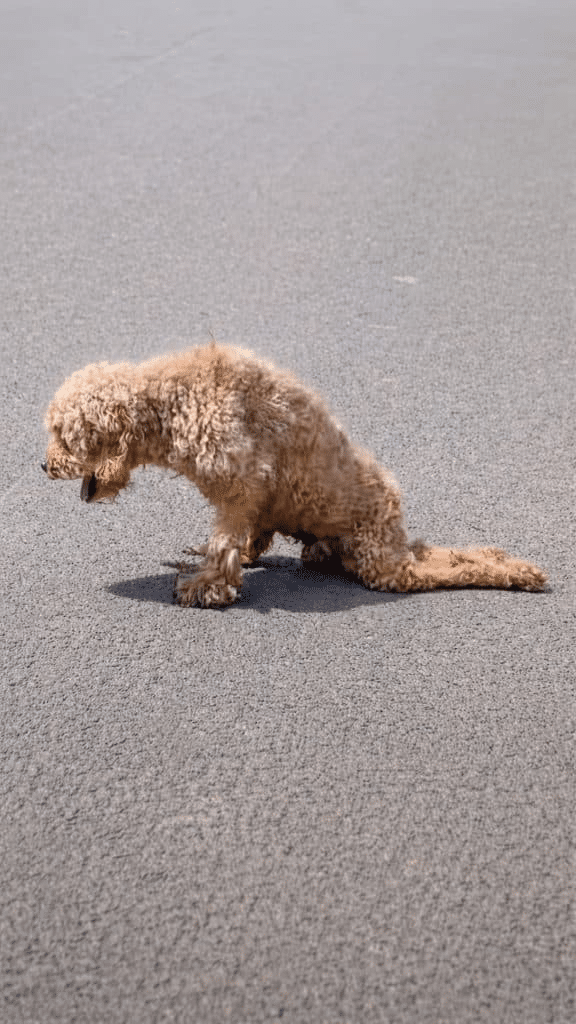
And somewhere near the edge of all that movement, a small dog pulled himself forward using only his front legs.
His hind legs dragged behind him, offering no support as his body scraped across the hard pavement.
He had learned to survive that way.
Slowly.
Painfully.
One exhausting stretch of road at a time.
Many people saw him.
Then one man did something different.
He came back.
Every Journey Began With His Front Paws
The little dog could not walk normally.
Whatever had happened to his hind legs had left them unable to support him, so every movement depended on the strength in the front half of his body.
He planted his front paws.
Pulled.
Rested.
Then pulled again.
The pavement beneath him was rough and exposed to the heat of the day. Moving across it meant dragging much of his body directly against the ground.
Yet he continued.
He still needed food.
He still needed water.
And surviving on the street meant finding both wherever he could.
A small scrap left behind might become a meal.
A little water might have to last until he found more.
Meanwhile, traffic and hurried pedestrians continued around him.
The dog was visible.
But being visible did not mean someone would stop.
For some time, no one did.
Video: He Dragged Himself Across the Street With Only His Front Legs — Until One Man Finally Stopped
The First Person Who Stopped Didn’t Try to Rush Him
Then one day, a man noticed the dog.
Not simply in passing.
He stopped long enough to understand how difficult every movement had become.
Rather than walking directly toward him and trying to grab him, the man approached carefully.
He brought water.
He offered food.
Then he waited.
For a vulnerable street dog, an unfamiliar person can be another uncertainty. The man gave him enough space to decide whether coming closer felt safe.
Eventually, hunger and thirst won over hesitation.
The dog accepted what was offered.
Then came a tiny response.
His tail moved.
It was only a small wag, but the man noticed.
He had helped him for that moment.
Still, the dog remained on the street when the man eventually left.
And that might have been the end of their encounter.
Except the man could not forget what he had seen.
He Went Home, but the Dog Stayed on His Mind
The image followed him.
A small dog pulling himself across the pavement.
Two hind legs dragging behind.
A life built around surviving one difficult day after another.
By the next day, the man had made a decision.
He returned.
The dog was still there.
Same street.
Same damaged legs.
Same exhausting method of getting from one place to another.
This time, the man was not planning to leave him behind again.
He knelt beside the dog, approached gently, and lifted him from the ground.
There was no complicated rescue operation.
No crowd gathered around them.
Just one person returning to a place he could easily have avoided.
And one small dog leaving the street in his arms.
From that moment forward, the dog would no longer have to drag himself through traffic simply to survive another day.
His First Safe Night Was About the Basics
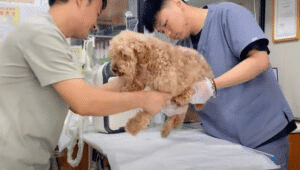
Once he was away from the street, the first priorities were simple.
The dirt covering his body was washed away.
Areas irritated by dragging against the ground could finally receive attention.
He was given food.
Water.
And somewhere protected to sleep.
For perhaps the first time in a long while, he did not need to keep moving because danger might be approaching.
He could simply rest.
But as his rescuer cared for him, one reality remained unchanged.
His hind legs still did not work.
Food could rebuild strength.
A clean environment could help his skin recover.
Safety could remove the daily dangers of the street.
None of those things, however, allowed him to walk.
His rescuer began thinking about what could.
Not how to change the dog’s body overnight.
But how to give him a way to move through the world without dragging it behind him.
That question led to an idea.
A small mobility cart.
The First Cart Didn’t Need to Be Perfect
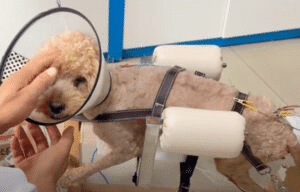
The man began working on a device that could support the dog’s hindquarters while allowing his front legs to remain free.
There were measurements to take.
Parts to fit.
Adjustments to make.
The cart had to be light enough for a small dog to move comfortably, yet stable enough to keep his back legs safely supported.
The first attempt was not necessarily going to work perfectly.
So the man tested.
Adjusted.
And tried again.
What mattered was creating something suited to this particular dog.
For so long, movement had meant pressing his front paws against the ground and pulling the rest of himself forward.
A cart could change that equation.
His front legs would still provide the power.
But now wheels could carry the part of his body that could not.
Eventually, the device was ready for its most important test.
The dog himself.
At First He Didn’t Know What the Wheels Were For
The dog was gently secured into the cart.
For a moment, he did very little.
The sensation was unfamiliar.
His back end was suddenly supported at a height he had not been able to maintain himself.
There were wheels beside him.
His body no longer touched the ground in the same way.
He needed to understand what all of it meant.
With encouragement nearby, he tried moving one front paw.
Then the other.
The wheels followed.
He tried again.
And suddenly, the motion began to make sense.
For the first time, forward movement did not require dragging his hindquarters across the ground.
He could push with his front legs and roll.
A few uncertain steps became more confident ones.
His tail began moving.
Soon, he was traveling across the yard with an ease that had once been impossible.
The cart had not restored the use of his hind legs.
It had done something different.
It had given him mobility despite them.
The Dog Who Once Crawled Could Finally Explore
Once he understood how the cart worked, a different side of the little dog began to appear.
There was room to explore now.
Moving no longer required the same exhausting effort.
The ground beneath him was no longer something his body had to scrape across with every attempt to go forward.
He could cross the yard.
Turn.
Follow movement around him.
And pick up speed.
To someone watching only the final moments, it might have looked like a happy dog enjoying a set of wheels.
But the significance becomes clearer when compared with where he started.
This was the same dog who had once pulled himself along a busy street in search of food and water.
The same front legs were still doing the work.
Only now, someone had made sure the rest of his body could come along safely.
His rescuer had not simply removed him from danger.
He had looked at the limitation the dog would continue living with and asked what could be done about it.
The answer was not perfect.
It did not need to be.
It simply needed to give the dog a better way forward.
One Act of Kindness Became a Decision to Return
The most important moment in this dog’s story may not have been when the cart finally rolled.
It may have happened the day before.
When a man stopped.
Offered food and water.
Then went home.
Because helping once would have been kind.
Coming back changed the dog’s life.
There is a difference between noticing suffering and taking responsibility for what happens next.
That man could not repair the dog’s legs.
He could not undo whatever had happened before they met.
But he could remove him from the street.
He could clean his wounds.
Feed him.
Give him somewhere safe to sleep.
And when he realized walking would remain difficult, he could build something that allowed the dog to move in a new way.
That is what made the rescue more than a single moment.
It became a series of choices.
Stop.
Return.
Lift him up.
Care for him.
Try a solution.
Adjust it.
Try again.
Once, this little dog moved forward by dragging himself across pavement while the world passed around him.
Now, his front paws still carry him forward.
But wheels support him from behind.
And someone is there beside him.
He did not need the whole world to stop.
He only needed one person to stop—and then decide to come back.


