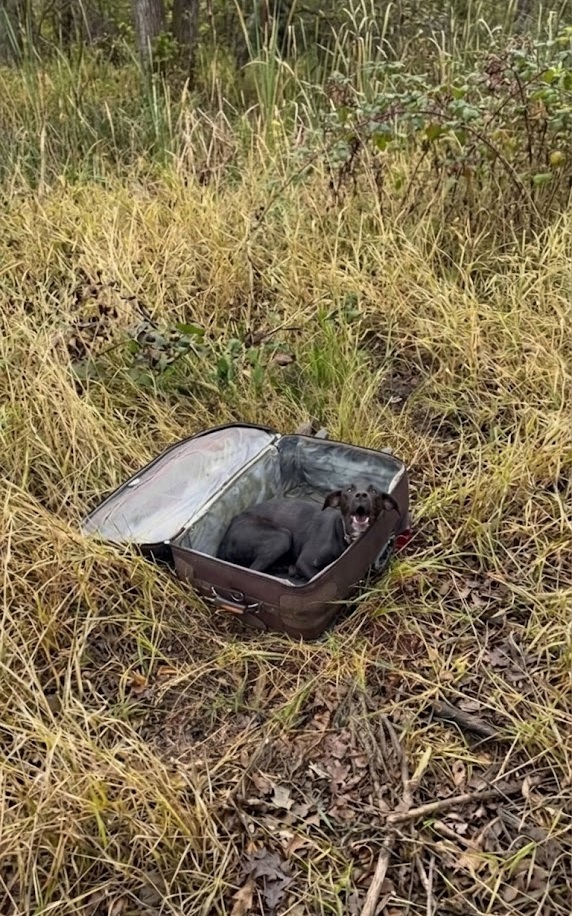
The suitcase looked like something someone no longer wanted.
It had been left alone in an open field, far from the comfort of a home or the steady movement of a busy road.
Rain had begun falling around it.
The ground was wet.
The fabric was damp.
And there was nothing about the scene to suggest that something alive might be inside.
Then the suitcase was opened.
Curled within the confined space was a small dog.
He did not jump toward the opening.
He did not bark.
He barely moved at all.
His body was weak enough that he could not stand, and his cloudy eyes appeared unable to focus on the people now gathered around him.
The rescuers did not yet know his history.
They did not know how long he had been there.
They did not know whether he would survive.
All they knew was that the little dog inside that suitcase needed help immediately.
They lifted him carefully into their arms.
Soon he would have a name.
Julius.
And the fight to give him a future had begun.
He Was Too Weak to Climb Out on His Own
Once Julius was removed from the suitcase, his condition became easier to see.
He was extremely frail.
His legs offered little support.
His eyes were cloudy, and his lack of visual response suggested that he was blind or severely visually impaired.
Even being handled seemed to require more energy than he had available.
There were many questions surrounding the circumstances in which he had been found, but there was no time to search for answers before addressing the problem directly in front of them.
Julius needed veterinary care.
Now.
Because he could not walk safely, rescuers supported his entire body while carrying him to the vehicle.
He offered little resistance.
The field disappeared behind them.
Then the suitcase.
Then the rain.
Julius could not see where he was being taken, but the world around him had already changed.
Instead of being enclosed alone, he was surrounded by voices.
Instead of wet ground, there were warm hands supporting him.
Instead of waiting for something to happen, people were finally doing something.
The rescuers rushed him to an emergency clinic.
There, they discovered just how serious his condition really was.
Video: Julius Is Found Sealed Inside a Suitcase — Blind, Weak, and Unable to Stand
The Diagnosis Made His Future Even More Uncertain
At the clinic, Julius underwent an examination.
According to the rescue account, veterinarians diagnosed him with advanced canine distemper.
His condition was severe.
He was dangerously dehydrated and experiencing repeated seizures, neurological symptoms that made an already fragile situation even more difficult.
The medical team began supportive treatment immediately.
Fluids helped address dehydration.
Medication was administered.
His temperature, seizures, and general condition were monitored closely.
There was no quick treatment that could simply make everything disappear.
At that point, the veterinary team was trying to give Julius enough support for his body to respond.
His prognosis was poor.
The possibility of euthanasia was reportedly discussed because of the severity of his illness and the concern that continued deterioration could mean prolonged suffering.
It was not a decision anyone took lightly.
For the rescuers who had carried Julius from the field, the most important question was whether treatment could still give him a reasonable chance.
As long as that possibility remained, they wanted to continue.
So Julius stayed at the clinic.
Fluids continued dripping.
Medication continued.
And everyone waited for some indication that the little dog was responding.
The First Two Days Brought More Waiting Than Answers
For nearly two days, there was little anyone could celebrate.
Julius remained weak.
The seizures continued.
His body needed constant support, and caregivers could not know whether the next several hours would bring improvement or another setback.
They watched him carefully.
Sometimes the smallest details became important.
A slight movement of his head.
A change in his breathing.
A reaction to touch.
Anything that suggested Julius was still engaging with the world around him.
Most of the time, however, recovery looked like waiting.
There were no dramatic leaps forward.
No sudden moment when a veterinarian announced that everything would be fine.
There was simply another dose of medication.
Another period of rest.
Another check of his condition.
Then another seizure.
This is the part of rescue stories that photographs often cannot show.
Between the shocking beginning and the hopeful ending can be long hours when nobody knows what the ending will be.
Julius had been removed from the suitcase.
But the medical fight was only beginning.
Then came the third morning.
Something was different.
On the Third Morning, the Seizures Finally Stopped
The caregivers noticed that Julius had gone longer without another seizure.
They continued monitoring him.
Minutes passed.
Then more time.
The seizures that had repeatedly exhausted his already weakened body did not return.
It was encouraging.
But Julius remained fragile.
Nobody assumed he was suddenly out of danger.
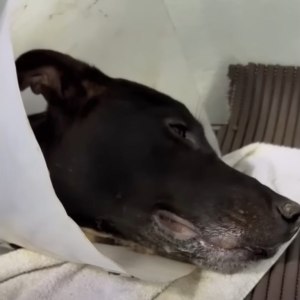
Then, after lying quietly, he began to move.
Julius lifted his head.
Slowly.
Carefully.
For another dog, raising the head from a bed would be an ordinary movement.
For Julius, it was one of the clearest signs of responsiveness the team had seen.
Then he surprised them again.
He barked.
It was not loud.
It was not the confident bark of a healthy dog demanding attention.
It was small.
Soft.
But everyone heard it.
The dog who had been virtually silent when the suitcase opened was announcing his presence.
Julius was still there.
Soon another encouraging change followed.
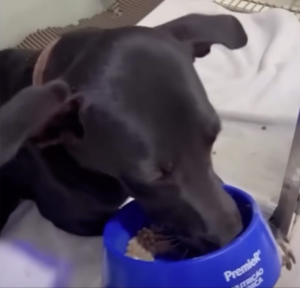
He began showing interest in food.
At first, he ate only a little.
But those first bites mattered.
His caregivers had spent days focusing on keeping his body stable.
Now Julius was beginning to do something for himself.
Eat.
Respond.
Participate.
The question surrounding his future had not disappeared.
But for the first time, there were visible reasons to imagine one.
Eating Became the Next Small Victory
Julius needed time to recover from everything his body had endured.
The seizures stopping did not mean he immediately became strong.
He was still thin.
Still visually impaired.
Still unable to move normally.
But food became part of his routine.
A little at first.
Then more.
Nourishment gave his body something it desperately needed to begin rebuilding strength.
With each passing day, caregivers noticed small improvements.
Julius remained awake for longer periods.
He responded more clearly when someone approached.
His head turned toward sounds.
Then his legs began becoming more active.
At first, there was no real walking.
He shifted himself.
Tried to reposition.
Attempted to push upward.
His muscles were weak, and coordination remained difficult.
The people caring for him did not force the process.
Julius had already survived the critical first days.
Now recovery could happen at the pace his body allowed.
One attempt.
Rest.
Another attempt later.
Eventually, he began supporting more of his own weight.
The dog who had needed to be lifted completely from the suitcase was beginning to discover what his legs could still do.
Julius Learned to Understand the World Without Seeing It
As his overall condition improved, his blindness became less of a medical crisis and more of something his new life needed to accommodate.
Julius could not depend on vision the way most dogs do.
So he relied on everything else.
Sound told him where people were.
Scent helped him identify familiar places.
Touch gave him information about what was immediately around him.
Routine made the world predictable.
His caregivers learned to speak before reaching toward him so that a sudden touch would not surprise him.
His food and water were kept in places he could learn.
The space around him remained consistent enough for Julius to begin building a mental map.
At first, he moved carefully.
A few steps.
Stop.
Listen.
Continue.
His nose worked constantly.
His ears turned toward voices.
When someone familiar entered the area, Julius did not need to see them to recognize that something known had arrived.
He began turning toward those voices.
Then moving toward them.
Blindness changed how Julius explored his environment.
It did not remove his curiosity about it.
And as his body became stronger, that curiosity grew.
Trust Was Built Through Things Julius Could Hear and Feel
Julius had experienced enormous physical stress before reaching safety.
Because no one could know exactly what he associated with people, his caregivers allowed trust to develop without forcing affection.
They approached consistently.
Spoke gently.
Provided food.
Administered treatment.
Then returned the next day and did the same thing again.
Those repetitions gave Julius information he could understand.
The familiar voice meant food was coming.
Those footsteps belonged to someone he knew.
That hand touched gently.
This place remained safe when he woke up.
Gradually, Julius began relaxing around the people caring for him.
He accepted touch more easily.
Then he started leaning toward it.
One day, his tail moved.
A small wag.
Later, the wag became easier to notice.
Eventually it became one of the ordinary ways Julius responded when someone familiar approached.
The change was remarkable precisely because no one had demanded it.
Julius was not required to trust.
He was given enough safe experiences to decide for himself that he could.
The dog who had once barely responded when humans opened the suitcase was now actively seeking interaction with them.
His First Steps Changed the Way Everyone Saw His Future
As Julius became stronger, his attempts to stand became more successful.
His legs held him for longer.
His balance improved.
Then he began walking.
At first, every step was careful.
Without sight, Julius had to combine physical recovery with learning how to navigate.
He followed familiar sounds.
Used his nose.
Remembered where objects were located.
And slowly expanded the area he felt comfortable exploring.
A handful of steps became a walk across the room.
A walk across the room became movement through larger spaces.
He began finding his own resting places.
He located his food.
He approached people.
For the rescuers, those movements carried a memory with them.
They remembered lifting Julius because he could not stand.
Now he was deciding where he wanted to go.
That difference represented weeks of medical care, nourishment, rest, and repeated attempts.
Julius had not regained his eyesight.
He did not need to in order for his life to become larger.
What he needed was an environment where blindness was understood rather than treated as the end of his possibilities.
Eventually, a family was willing to offer exactly that.
A Family Was Willing to Meet Julius Where He Was
Julius’s rescue story eventually reached people beyond those directly involved in his recovery.
Among them was a family interested in giving him a permanent home.
Adopting Julius meant understanding the dog in front of them.
He was blind.
He had survived serious illness.
Predictable routines would help him.
Changes in furniture or unfamiliar environments might require additional patience.
The family knew those things.
They still wanted to meet him.
Julius could not look across the room and study their faces.
He met people differently.
He listened to their voices.
He investigated their scent.
He allowed a hand near him.
Then he decided whether to come closer.
The introduction was allowed to happen at his pace.
No one needed a dramatic instant connection.
The goal was something more lasting.
A relationship Julius could learn through repetition.
Eventually, it was time for him to leave rescue care.
And on that day, Julius did something that would have seemed almost impossible when the suitcase first opened.
He walked.
On his own legs.
Toward his new life.
Home Became a Place Julius Could Learn by Heart
A blind dog may experience a home differently, but familiarity can make that world remarkably navigable.
Julius began learning his new environment.
Where his bed was.
Where meals appeared.
Which direction led to an open space.
Which sounds belonged to his family.
Which footsteps meant someone familiar was approaching.
Over time, the uncertainty of a new place gave way to routine.
Julius did not need to see a soft bed to know where he could rest.
He did not need to see the person beside him to recognize a familiar hand.
He did not need to see a bowl to know dinner had arrived.
The world that had once been reduced to the inside of a suitcase was expanding through scent, sound, memory, and trust.
His family saw more than his limitations.
They saw the dog that had emerged during recovery.
Affectionate.
Curious.
Responsive.
Eager to participate in life.
And Julius finally had the one thing emergency medicine alone could never provide.
Permanence.
The same people tomorrow.
The same safe place the day after that.
A home he could learn well enough to move through with confidence.
The Suitcase Was Where Julius Was Found — Not Who He Became
There is no escaping the disturbing image at the beginning of Julius’s story.
A suitcase sitting alone in a rainy field.
A zipper opening.
A blind dog inside who could not stand.
But if his story ends there, the most important part is lost.
Julius lived beyond that moment.
His life became a collection of small victories.
The seizures stopped.
He lifted his head.
He barked.
He ate.
His legs grew stronger.
His tail began to move.
He learned familiar voices.
Then he stood.
He walked.
And eventually, he entered a home.
Not every seriously ill animal will have the same outcome, and Julius’s early prognosis showed just how uncertain recovery can be.
But his story demonstrates what patient care can sometimes make possible when an animal is given the opportunity to respond.
Nobody could undo the circumstances in which Julius had been discovered.
They could only change what came next.
They did.
They carried him out of the field.
Veterinarians treated him.
Caregivers stayed beside him during the uncertain days.
They helped him understand a world without sight.
And eventually, a family offered him something he had never been guaranteed.
Tomorrow.
Then another tomorrow.
And another after that.
Today, Julius does not need eyes to recognize when the people he loves are near.
He hears them.
He smells them.
He knows the spaces beneath his paws.
He knows where he is safe.
The little dog who once could not climb out of an abandoned suitcase now moves through a world he has learned in his own way.
The suitcase remains part of his history.
But it was never allowed to become his ending.


