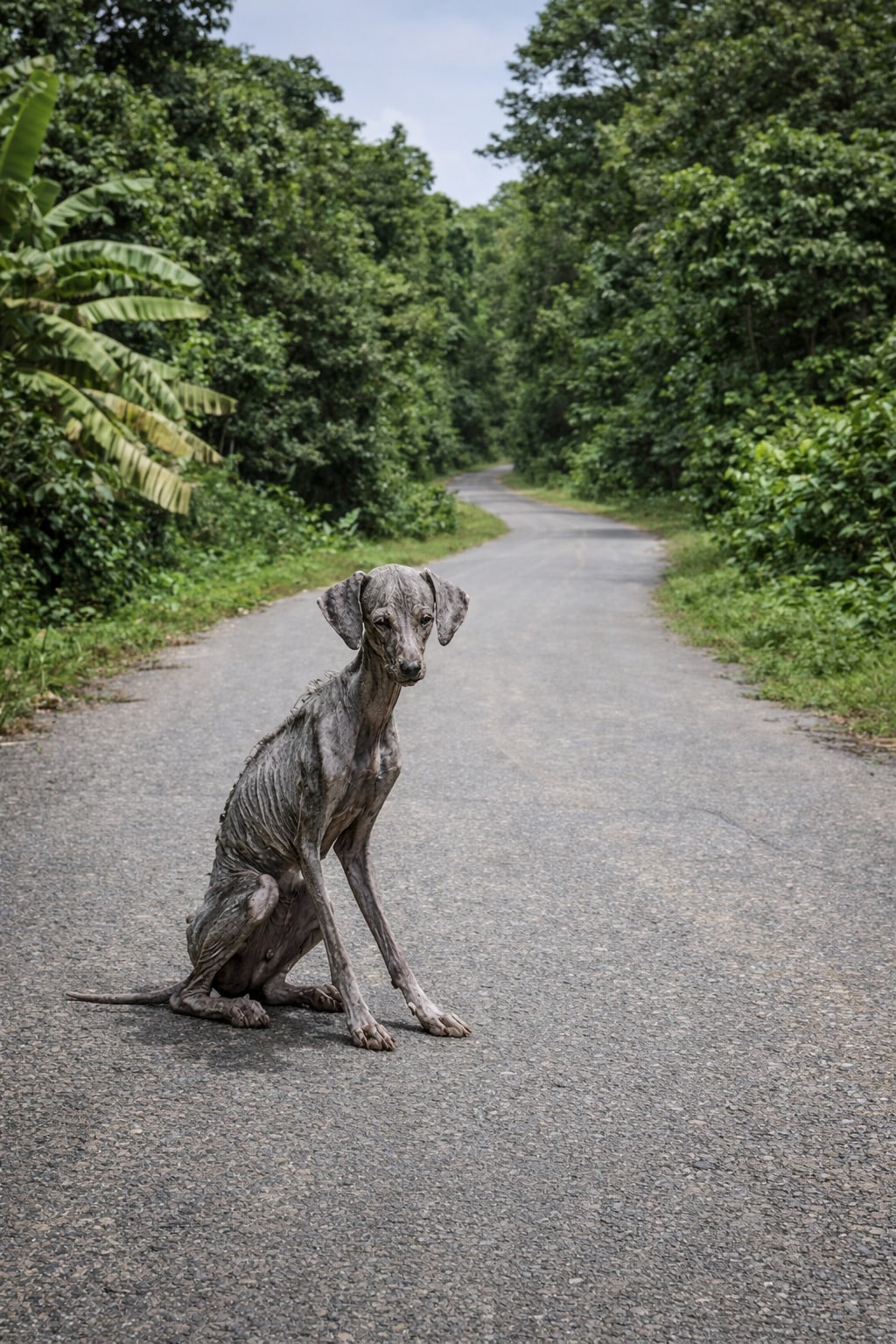
From a distance, it was difficult to tell what was lying beside the road.
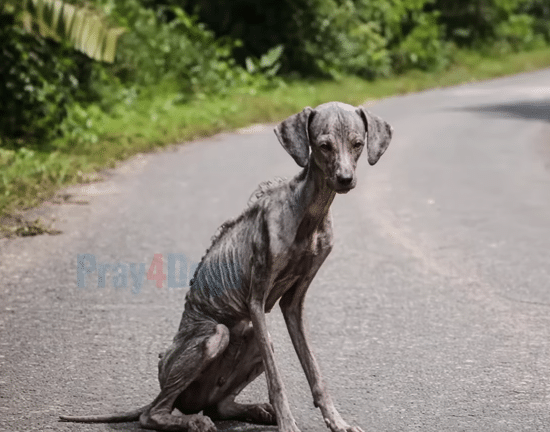
The dog’s body was almost completely hairless.
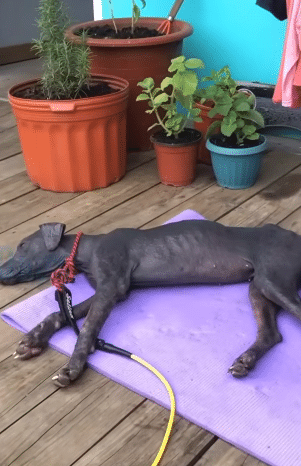
His skin was inflamed and exposed, stretched over a frame so thin that every movement seemed difficult. He remained close to the ground, barely reacting to what was happening around him.
This was in the Bocas del Toro islands, where someone eventually noticed him.
Later, he would be called Australia.
But in that first moment, there was no dramatic rescue scene.
No sudden burst of energy.
No wagging tail.
Just a severely weakened dog who appeared to have been struggling for a long time.
The person who found him could have continued walking.
Instead, they stopped.
That decision became the beginning of a recovery no one could yet see.
His Body Needed Help Before Anything Else Could Change
Up close, Australia’s condition was even more concerning.
His coat was gone across most of his body.
The exposed skin looked irritated and unhealthy, and his thin frame suggested that proper nutrition had been missing for some time.
He moved very little.
When someone came close, his body tensed.
Touch was not something he appeared comfortable with.
There was no way to know exactly what had happened before he was found or how long he had been living in that condition.
His body could show the effects.
It could not explain the entire history.
So instead of trying to fill in those missing pieces, the person helping Australia focused on what could be changed now.
Food.
Skin care.
Rest.
Treatment.
And a safe place where he would not have to keep searching for those things on his own.
Australia did not need anyone to promise that everything would suddenly become better.
He needed someone willing to return the next day.
And the day after that.
Video: Australia Is Found Without Fur and Barely Moving — Then His Long Recovery Begins
The First Days Were Almost Completely Uneventful
Australia’s recovery did not begin with a miracle.
It began with routine.
Small meals were offered instead of overwhelming his weakened body.
His skin was cleaned carefully.
Treatment was applied to the affected areas.
Then he was allowed to rest.
At first, there was little visible response.
He did not suddenly become affectionate.
He did not follow people around.
And he remained cautious whenever hands approached.
That caution was respected.
If Australia pulled away, the interaction slowed down.
If he seemed uncomfortable, he was given space.
The goal was not to convince him immediately that every person could be trusted.
It was much simpler.
Show him that this particular person would not hurt him.
Then repeat that lesson.
One meal.
One treatment.
One quiet visit at a time.
Some days looked almost identical to the previous one.
But the person caring for him continued.
That consistency eventually began producing changes so small they could easily have been missed.
He Stopped Moving Away From the Hands Helping Him
One of the first differences appeared during treatment.
Australia had initially recoiled when someone touched him.
His skin was sensitive, and unfamiliar contact made him visibly tense.
Over time, however, his reactions softened.
He stopped pulling away as quickly.
Then he remained still while his skin was treated.
Eventually, he allowed a person to stay beside him without keeping his entire body guarded.
These were not dramatic signs.
But they mattered.
For an animal recovering in close contact with people, being able to remain calm during care makes almost every other part of recovery easier.
Australia began recognizing the routine.
A person approached.
A familiar voice spoke.
His skin was treated.
Food arrived.
Then he was left to rest.
Nothing unpredictable followed.
The same pattern returned again later.
Gradually, Australia no longer seemed to prepare for the worst every time someone came close.
His world was beginning to contain familiar things.
And familiar things were easier to trust.
Then the Changes Became Visible
The first improvements in Australia’s appearance were subtle.
A thin layer of fur began appearing across areas that had previously been bare.
At first, it was easy to overlook.
Then more came in.
As his coat gradually returned, his body began changing too.
Regular meals helped him gain weight.
His frame started filling out.
His movements became less hesitant.
He no longer spent all of his time remaining close to the ground.
His eyes followed what was happening around him with increasing interest.
And then came one of those tiny milestones that meant far more to the people who had seen the beginning.
His tail moved.
Not wildly.
Just enough to notice.
A small wag from a dog who had once barely responded to anything around him.
It did not mean recovery was complete.
It meant Australia was beginning to participate.
He was watching people.
Responding to them.
Showing curiosity.
The physical healing was making room for more of his personality to appear.
The Dog Who Once Barely Moved Began Exploring
As Australia’s strength increased, his world became larger.
At first, movement was practical.
Stand.
Walk a little.
Rest.
Then the walking became easier.
He began moving around simply because something had caught his interest.
A smell.
A sound.
An open area.
That curiosity marked another important change.
When Australia was first found, almost all of his energy seemed directed toward basic survival.
Now he could spend some of it exploring.
Eventually, he began running.
For a healthy dog, running across open ground is ordinary.
For Australia, it created a powerful contrast with the animal who had once lain nearly motionless beside the road.
His legs were stronger.
His body carried more weight.
His coat continued filling in.
And he moved without appearing burdened by the same discomfort that had shaped his first days in care.
There was no single moment when everyone could say the old Australia had disappeared.
Recovery does not work that way.
Instead, there were enough good days that eventually the difference became impossible to ignore.
The dog standing in front of them simply looked and behaved like a different animal.
Months Later, His Transformation Was Difficult to Recognize
With continued care, Australia’s coat became fuller.
The inflamed appearance of his skin improved.
His body condition changed dramatically from the thin frame first discovered near the road.
But the transformation was not limited to photographs.
Australia now approached life differently.
He moved with greater confidence.
He explored unfamiliar spaces.
He responded to people.
He enjoyed activity.
Even when his surroundings changed, he appeared increasingly capable of adapting rather than immediately withdrawing.
That ability mattered because rescue care was never meant to be the final destination.
Australia eventually needed a life beyond recovery.
A place where feeding, shelter, and companionship were not part of a temporary treatment plan.
They were simply normal.
That next chapter eventually arrived.
Australia was given the opportunity to enter a new home and a new environment.
Once again, there were unfamiliar sounds and smells.
But this time, Australia was not the dog who had been lying helpless beside the road.
He carried with him months of different experiences.
Reliable meals.
Gentle handling.
Safe places to sleep.
People who had approached without causing pain.
Those experiences gave him something he had not possessed during the first rescue.
A foundation.
Safety Became Something Australia Could Expect
In his new surroundings, Australia continued adjusting.
He explored.
Learned the layout.
Became familiar with the people around him.
The change in his behavior reflected something more than improved health.
Australia now seemed to expect good things from everyday life.
Food would come.
Someone would be nearby.
There would be somewhere safe to rest.
An unfamiliar sound did not automatically mean something terrible was about to happen.
That kind of confidence is rarely created through one extraordinary act.
It is built through repetition.
The same meal arriving tomorrow.
The same gentle hand.
The same protected space.
The same person returning again.
Australia had received those things long enough for them to become part of his understanding of the world.
The dog whose body once tightened at touch could now accept closeness.
The dog who barely moved could run.
The dog whose skin had been almost completely bare now had a healthy-looking coat.
And the dog found with almost nothing was finally living somewhere that asked nothing of him except to be a dog.
His Story Was Changed by Someone Who Stayed
Australia’s transformation is easy to summarize with two images.
Before:
Thin.
Hairless.
Inflamed skin.
Motionless beside the road.
After:
A full coat.
A stronger body.
Movement.
Curiosity.
A safe home.
But those two images leave out the most important part.
Everything between them.
The first meal when nothing seemed different afterward.
The first treatment when he still pulled away.
The next treatment when he pulled away a little less.
The first new hairs appearing on damaged skin.
The first tail movement.
The first confident steps.
The first run.
Those moments mattered because someone was there long enough to see them.
Australia did not recover because one person performed one enormous act.
His life changed because care was repeated.
Again.
And again.
And again.
There was no way to erase whatever had happened before he was found in Bocas del Toro.
There was no way to give him back the time when his body had been struggling.
But the future was still unwritten.
The person who noticed Australia could not know what he would eventually become.
They only knew what was in front of them that day.
A dog in terrible condition.
A dog who needed help.
A dog still alive.
That was enough.
Months later, Australia no longer resembled the animal who had once seemed unable to do more than lie beside the road.
He had fur.
Strength.
Confidence.
A place to belong.
The transformation did not begin when his coat grew back.
It began much earlier.
It began when someone saw a dog who appeared to have almost nothing left—
and decided that was not a reason to leave him there.


