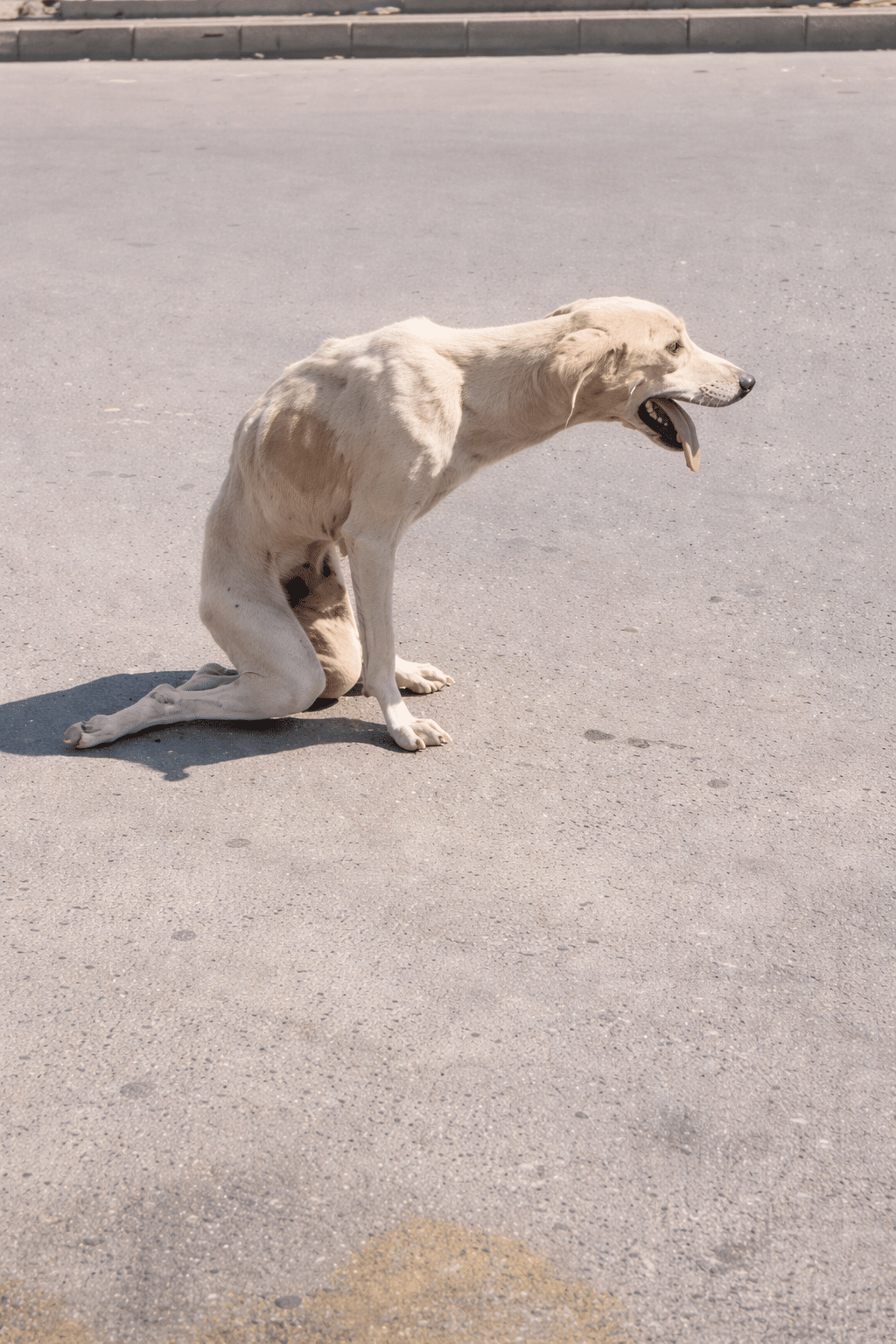
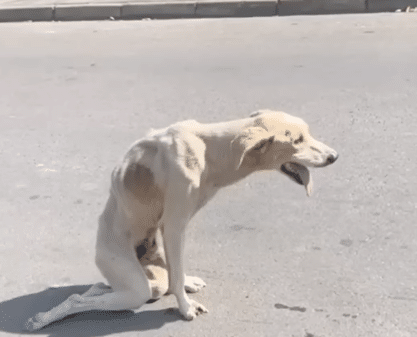
At first, the movement was easy to miss.
Something was shifting slowly across the road.
Not walking.
Dragging.
A dog was pulling himself forward with what little strength remained in the front of his body, while his back end followed helplessly across the asphalt.
The pavement had been heating under the sun.
There was no shade around him.
No soft ground.
No obvious place he was trying to reach.
Yet Greg kept moving.
A few inches.
Then another effort.
Then another.
He could not stand.
He appeared exhausted.
And every attempt to move placed his already fragile body against the rough surface beneath him.
There was no way to know how long he had been struggling there before someone finally noticed.
But when help arrived, Greg no longer had to drag himself forward alone.
For the first time, someone else would carry him.
Every Inch of the Road Required Another Effort
Up close, Greg’s condition was deeply concerning.
His body was thin.
His energy was limited.
And whatever had happened to his hind legs had left him unable to use them normally.
When he tried to move, his front legs did most of the work.
He pulled.
Stopped.
Rested.
Then tried again.
At times, soft cries accompanied the movement.
Even gentle handling appeared uncomfortable, suggesting that his body was dealing with significant pain or sensitivity.
The rescuers could not determine everything about his condition simply by looking at him.
They did not know exactly what had caused his mobility problems.
They did not know how long he had been unable to walk.
What they did know was that leaving him on the road was not an option.
The asphalt offered no relief.
His body was already depleted.
And continuing to drag himself across the surface would only demand more of the strength he barely had.
So the rescuers approached slowly.
Greg watched them.
He did not have the mobility to run.
That made patience even more important.
A dog who cannot escape should never be made to feel trapped by the people trying to help him.
They spoke quietly.
Moved carefully.
Then supported his body and lifted him from the road.
Video: Greg Is Found Dragging Himself Across the Hot Asphalt — Unable to Stand, but Still Trying to Move
For Once, Greg Did Not Have to Pull Himself Forward
Being carried changed something immediately.
Not his medical condition.
Not the weakness in his legs.
Something simpler.
Greg could rest.
He no longer had to use his front legs simply to move away from the heat.
His body was supported instead of scraping across the ground.
The rescuers placed him somewhere safe and began the trip toward veterinary care.
During the ride, Greg remained weak.
There was no sudden sign that everything would be fine.
He still needed an examination.
He still needed treatment.
And no one yet knew how much function might return to his legs.
But the most urgent part of the roadside struggle was over.
Greg was no longer exposed on the asphalt.
He had water available.
He had shade.
People were watching his condition.
Those things can sound ordinary.
For a dog found dragging himself along a road, they represented the beginning of an entirely different day.
At the clinic, attention turned toward helping his body stabilize.
Recovery Began With the Most Basic Things
The first stage of Greg’s care focused on what his weakened body needed immediately.
Fluids.
Nutrition.
Rest.
Pain management and other treatment as directed by the veterinary team.
There was no single procedure that could instantly return him to normal.
His body needed time.
And because the original rescue account provides limited medical detail, the exact cause and diagnosis behind Greg’s inability to walk are not clear.
What could be observed was his condition.
He had arrived exhausted and unable to stand normally.
So the people caring for him began from there.
A comfortable place to lie down.
Food in manageable portions.
Water.
Regular monitoring.
Then another day of the same.
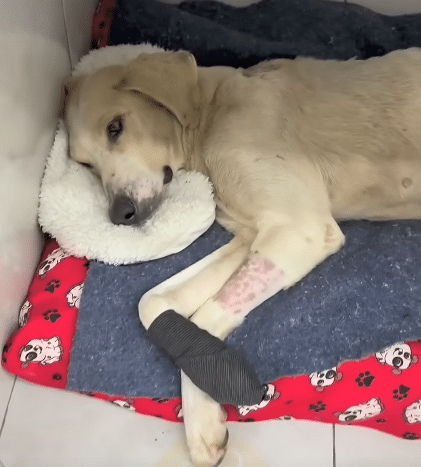
Greg slept for long periods.
His body seemed to need it.
When food was offered, he gradually began showing interest.
At first, even eating a little felt important.
Not because one meal could transform him.
Because it meant he was participating.
His caregivers were giving his body support.
Greg was beginning to respond.
The First Improvements Were Almost Too Small to Notice
Nothing dramatic happened during those early days.
That was expected.
Recovery from severe weakness often appears uneventful from the outside.
Greg ate.
Rested.
Received care.
Then rested again.
But slowly, there were differences.
He seemed more aware when someone approached.
His eyes followed movement around him.
He showed more interest in meals.
He changed his position more often instead of remaining completely still.
Those small actions mattered.
The dog on the road had used almost every available bit of energy simply to drag himself forward.
Now some of that energy could be directed toward recovery instead.
The caregivers continued assisting him without demanding more than his body could give.
When he needed to be repositioned, they helped.
When he became tired, they allowed him to stop.
There was no benefit in forcing movement simply to create a dramatic milestone.
Greg needed strength before he needed distance.
So they waited for his body to tell them when it was ready for more.
Learning That Hands Could Support Him Instead of Hurt
Handling remained an important part of Greg’s recovery.
At the beginning, he appeared sensitive to touch.
That made sense.
His body hurt.
He had been moving across a rough road.
And every attempt to reposition him involved areas that were already weak.
So the caregivers developed a routine around him.
They approached slowly.
Supported his body carefully.
Avoided unnecessary handling.
And allowed Greg to become familiar with what happened each time someone came close.
A person entered.
A voice spoke.
Food arrived.
Treatment followed.
Then he was allowed to rest again.
Over time, Greg became less tense during those interactions.
He no longer seemed surprised by every touch.
He began to recognize the people caring for him.
That did not require imagining that all of his fear had vanished.
It simply meant experience was teaching him something new.
These hands lifted instead of dragged.
These hands brought food.
These hands helped him change position when his own body could not do it comfortably.
The physical care continued.
And alongside it, familiarity grew.
Movement Began to Mean Something Different
For Greg, movement had once meant struggle.
On the road, moving required pulling his body across the pavement.
There was little choice involved.
He moved because staying there was dangerous.
During recovery, movement gradually became something else.
An opportunity to rebuild.
The caregivers encouraged activity only as his condition allowed.
At first, that could mean little more than helping him adjust his posture.
Later, Greg began making more deliberate attempts to use his body.
His front legs remained active.
He shifted.
Pushed.
Tried to lift himself differently.
The progress was not smooth.
Some attempts ended quickly.
His strength could disappear after only a short period of effort.
So they let him rest.
Then tried again another time.
The important change was that Greg now had people controlling the environment around his efforts.
There was no hot road beneath him.
No need to keep moving until he was completely exhausted.
He could try.
Stop.
Recover.
And try again later.
That difference gave his body something it had not possessed on the asphalt.
Time.
Greg Started Looking Beyond the Next Few Inches
As the days continued, another change became noticeable.
Greg became more interested in what was happening around him.
He looked toward voices.
Watched people moving nearby.
Responded when meals arrived.
For an animal in severe discomfort, the world can become extremely small.
Pain.
Hunger.
The surface beneath the body.
The next effort.
Greg’s world had looked like that when he was found.
Now there was room for curiosity.
That mattered even if his mobility remained limited.
Recovery is not measured only by whether a dog suddenly starts running.
Sometimes the earlier signs are behavioral.
An animal notices something beyond discomfort.
Chooses to engage.
Anticipates food.
Responds to a familiar person.
Those were the kinds of changes appearing in Greg.
He was no longer spending every moment focused on dragging himself somewhere else.
He had reached a place where he was allowed to stay.
And because of that, he could begin paying attention to life rather than merely enduring it.
His Future Was Still Uncertain — But It Was Finally a Future
Greg’s story did not resolve in a single dramatic moment.
There was no instant cure.
No morning when every problem had suddenly disappeared.
His recovery remained a process.
That is important.
The original rescue story leaves parts of Greg’s long-term medical outcome unclear, and there is no need to invent milestones that were not documented.
What we do know is that his circumstances changed completely.
He went from dragging himself across an exposed road to receiving regular care.
From being exhausted and alone to having people monitor his condition.
From moving because he had no choice to resting because someone had finally made a safe place for him.
Each day offered the possibility of another improvement.
More strength.
A better appetite.
More comfortable movement.
Another response to the people around him.
These were modest victories.
Together, they created something Greg had not seemed to have on that road.
Options.
He no longer had only one direction available.
Forward, inch by painful inch.
Now there were people helping decide what the next step should be.
The Most Important Moment Happened Before the Clinic
It is easy to think Greg’s rescue began with treatment.
In one sense, it did.
Veterinary care and ongoing support were essential.
But there was another moment that had to happen first.
Someone had to stop.
The dog on that road was not standing where he could easily approach a person.
He was not running beside traffic.
He was dragging himself.
Slowly.
Close to the ground.
From a distance, he could have been overlooked.
Someone noticed the movement anyway.
Then looked closer.
That second look changed the direction of Greg’s life.
The rescuers could not immediately repair his legs.
They could not know what his final outcome would be.
They did not need those answers before helping him.
They only needed to recognize that an animal in pain should not be left where he was.
So they lifted him.
Sometimes that is what rescue looks like.
Not knowing whether everything can be fixed.
Not knowing exactly what happened.
Simply understanding that leaving the animal there will not make anything better.
Then doing the next useful thing.
For Greg, that meant getting his body off the asphalt.
He No Longer Has to Crawl Just to Be Noticed
The image at the beginning of Greg’s story is difficult to forget.
A thin dog against a sun-heated road.
Front legs pulling.
Back legs unable to carry him normally.
Another effort.
Another few inches.
Then a pause.
It would be easy to describe that as determination.
But perhaps we do not need to decide what Greg was thinking.
His behavior is powerful enough on its own.
He kept moving because movement was still possible.
Then someone saw him.
From that point forward, survival no longer depended entirely on what his exhausted body could do by itself.
Someone provided food.
Someone provided water.
Someone made sure he could rest somewhere safer.
Someone handled him carefully when movement hurt.
Someone returned the next day.
And those ordinary acts changed the meaning of his story.
Greg did not need to prove that he deserved rescue by crawling farther.
He did not need to stand first.
He did not need to become healthy before people cared.
He was helped in the condition in which he was found.
That may be the most important part.
Sometimes a rescue begins when an animal reaches a person.
Greg could not do that.
So someone crossed the distance for him.
On the asphalt, every inch had belonged to Greg.
Every movement came from his own depleted strength.
After rescue, the burden changed hands.
For once, he did not have to drag himself toward something better.
Someone picked him up—
and carried him there.


