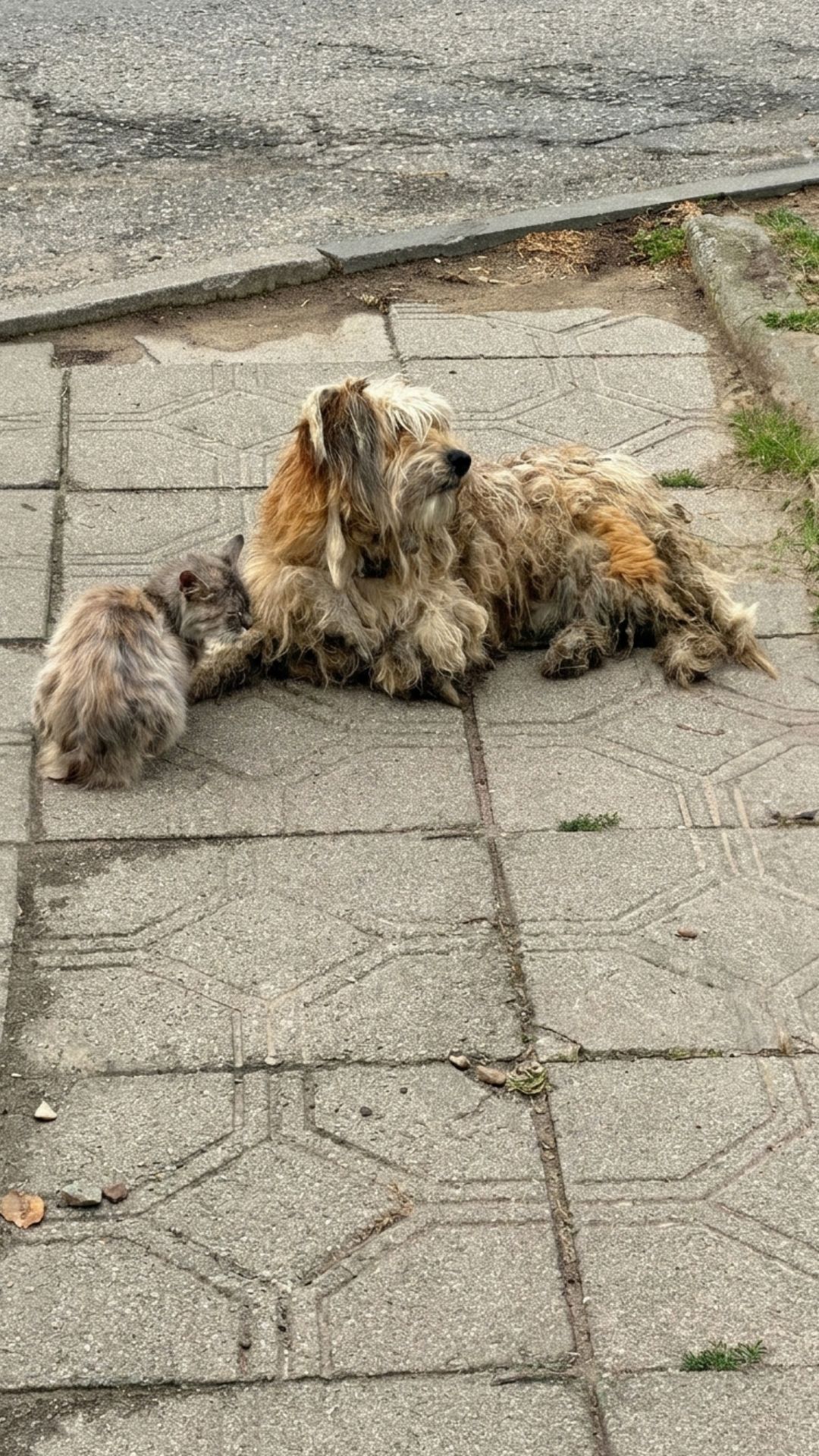
For years, Barbos and Masha knew the same home.
Barbos was a dog.
Masha was a cat.
That difference never seemed to matter much to them.
They ate near each other.
Rested in the same rooms.
And often curled up close enough that anyone watching could see how accustomed they had become to sharing their lives.
Their elderly owner cared for both of them.
The house was familiar.
Meals arrived.
Doors opened into rooms they knew.
At night, there was somewhere safe to sleep.
Then their owner died.
Everything that had made their world predictable disappeared almost at once.
According to the rescue account, the people who took over the property did not keep Barbos and Masha inside.
The two animals were put outdoors.
The door to the home they knew closed behind them.
And suddenly, the dog and cat had only one familiar thing left.
Each other.
They Stayed Near the House After Everyone Else Was Gone
At first, Barbos and Masha remained close to the property.
That made sense.
It was the place they knew.
The familiar smells were still there.
The walls were still there.
The surroundings had not changed as quickly as the people inside them had.
But the routine was gone.
No familiar owner appeared with food.
No door opened to let them back inside.
The rescue account describes the pair continuing to stay together as days became weeks and then months.
Survival outside was very different from life in a home.
Food was no longer guaranteed.
Weather became something they had to endure rather than simply hear through a window.
Every safe resting place had to be found.
And unfamiliar people were no longer automatically associated with care.
Barbos and Masha adapted in the only way they could.
They stayed close.
There is no way to know exactly what either animal understood about losing their owner.
We cannot know whether they were consciously “waiting” for her to return.
But their behavior was clear.
Even after the home was no longer available to them, the dog and cat continued choosing one another.
When Barbos moved, Masha often stayed nearby.
When Masha rested, Barbos remained close.
The relationship that had once been part of an ordinary household was becoming something more important.
It was now one of the few pieces of their old life that had not disappeared.
Video: Barbos and Masha Lose Their Home — But Refuse to Leave Each Other Behind
Months Outside Changed the Way They Responded to People
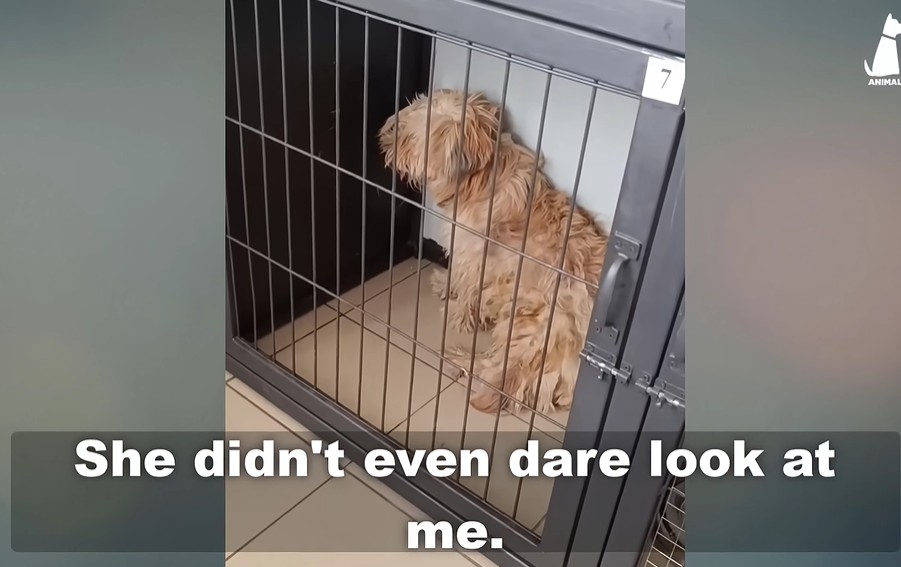
As time passed, the pair became more cautious.
Masha especially began keeping her distance from people.
If someone tried to approach too closely, she ran.
Barbos remained watchful too.
Neither animal behaved aggressively in the rescue account.
They simply did not make rescue easy.
That distinction mattered.
Fear should not be mistaken for hostility.
From the animals’ perspective, strangers were entering the space they had learned to survive in.
Masha had the mobility to escape.
Barbos appeared intent on remaining near her.
So when rescuers eventually became involved, they knew that simply walking forward and reaching down would not work.
The pair needed to be approached as a unit.
If Barbos was secured while Masha escaped, the cat could disappear.
If Masha was frightened into hiding, Barbos might become even more difficult to move.
Everything had to happen slowly.
The rescuers began by observing.
Where did the animals retreat?
How close would they allow a person to come?
What movements made them nervous?
Rather than demanding trust immediately, the team worked around the fear that was already there.
That patience eventually allowed both animals to be brought to safety.
For the first time since losing their home, Barbos and Masha were indoors again.
But their rescuers were about to discover that getting them off the street was only half the problem.
At the Clinic, Separating Them Made Everything Harder
Veterinary facilities naturally have routines.
Dogs are usually kept in areas designed for dogs.
Cats are placed in quieter spaces intended for cats.
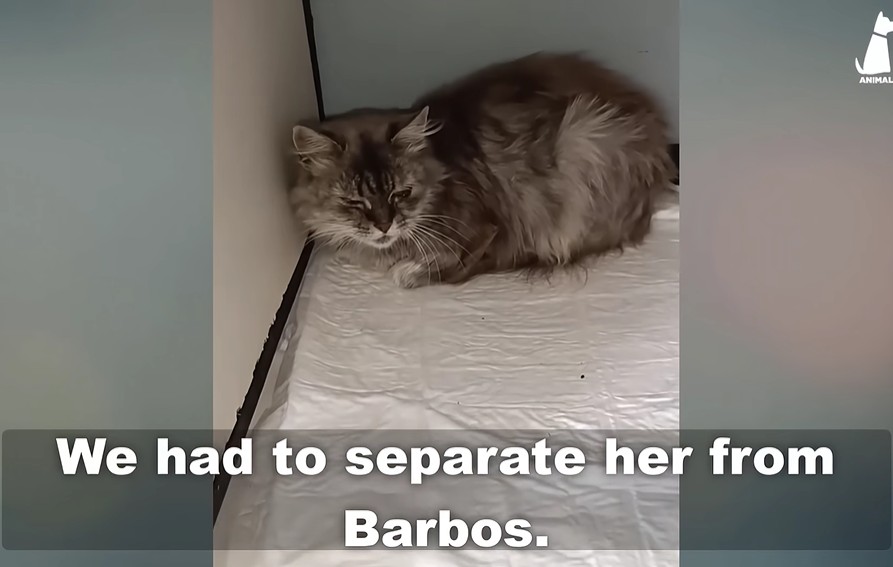
So after Barbos and Masha arrived, staff initially separated them.
It was a normal decision.
Almost immediately, however, something seemed wrong.
Neither animal settled comfortably.
The rescue account describes them becoming restless and anxious when they were apart.
Masha had already entered an unfamiliar environment filled with new smells and sounds.
Now Barbos was gone too.
Barbos faced the same problem from the opposite side.
For months, perhaps longer, the two had relied on each other’s presence as something familiar.
Suddenly, the clinic had removed that familiarity.
The staff noticed.
So they tried something simple.
They reunited them.
The difference was immediate enough to matter.
Barbos stayed close to Masha.
Masha relaxed more readily near him.
No complicated behavioral intervention was necessary to understand the message.
The dog and cat were more comfortable together.
From then on, their bond became part of the treatment plan rather than an inconvenience to work around.
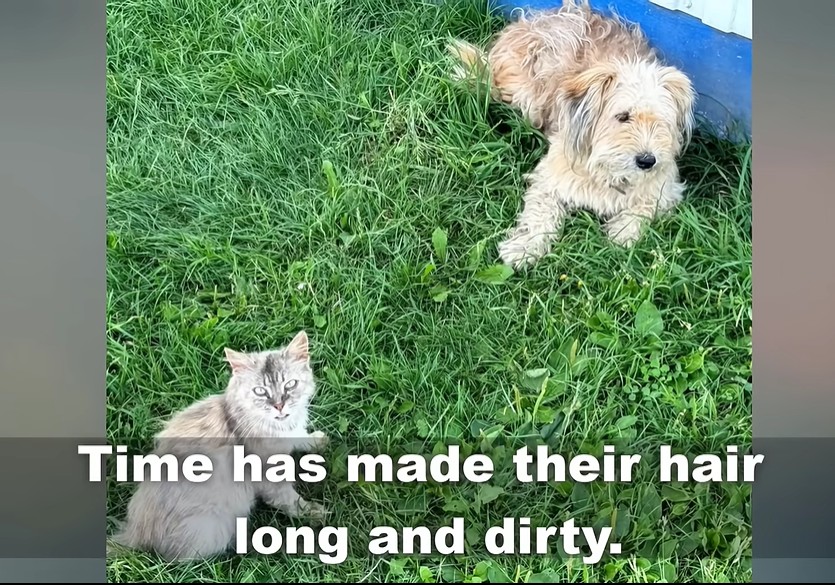
Their Medical Needs Were Different, but Recovery Happened Side by Side
Once the pair had settled enough to be examined, the veterinary team could focus on their individual needs.
Masha required closer medical attention and treatment.
Barbos was more stable, but his condition still reflected the strain of living outside.
The source does not provide enough clinical detail to accurately reconstruct every diagnosis, so there is no reason to invent one.
What is clear is that both animals needed more than a meal and a night indoors.
They needed stability.
Regular food.
Veterinary monitoring.
Rest.
And time to adjust to people again.
Their recovery did not look identical.
Masha needed treatment specific to her condition.
Barbos needed his own care and observation.
But whenever possible, the two remained near one another.
That allowed the staff to meet their medical needs without unnecessarily removing the thing that appeared to make them feel most secure.
Their routines slowly became predictable again.
Meals arrived.
People entered without chasing them.
Treatment happened.
Then the people left.
Nothing terrible followed.
The next day, the pattern repeated.
For animals that had become cautious around humans, consistency mattered.
Barbos and Masha did not need anyone to convince them with words that they were safe.
They needed repeated experiences that ended safely.
Barbos and Masha Began Learning That People Could Be Predictable Again
Masha’s fear did not disappear simply because she had a roof over her head.
She remained cautious.
New people still required time.
Barbos was also careful in unfamiliar situations.
So the caregivers did not force closeness.
Food could be placed nearby.
A person could sit without reaching toward them constantly.
Hands could approach slowly when treatment was necessary.
Then the animals were allowed to rest.
Over time, the distance began shrinking.
A person standing nearby no longer automatically caused retreat.
A familiar voice became recognizable.
The sound of food being prepared began to mean something positive.
Barbos became increasingly comfortable with the people caring for them.
Masha followed at her own pace.
And throughout that process, one familiar presence remained constant.
If she became uncertain, Barbos was nearby.
If Barbos rested, Masha could settle beside him.
The pair did not need to navigate recovery alone.
The same relationship that had helped them cope outdoors now helped them adjust to safety.
Finding Them a Home Created One Difficult Condition
Eventually, Barbos and Masha became healthy and stable enough for the rescue team to think about adoption.
That should have been the easy part.
It was not.
People showed interest.
But many potential adopters wanted only one animal.
Someone wanted the dog.
Someone else might have considered the cat.
From a practical perspective, separating them could have made placement easier.
Two different species can be harder to adopt together than two animals of the same kind.
The rescue team had already seen what separation did to them.
At the clinic, they had struggled when placed apart.
Together, they settled.
That history mattered.
So the rescuers made a decision.
Barbos and Masha would be adopted as a pair.
It narrowed the number of possible homes.
It meant waiting longer.
But the goal was not simply to find the fastest available placement.
It was to find a home that made sense for the animals they actually knew.
Barbos and Masha had already lost one home.
They had lived outside together.
They had been rescued together.
They had recovered together.
Separating them at the point when life was finally becoming stable again did not feel like the right ending.
So they waited.
This time, waiting did not mean cold streets or uncertain meals.
It meant staying somewhere safe until the right people arrived.
Then a Family Asked for Both
Eventually, someone did.
A family learned about Barbos and Masha.
They were told that the pair came together.
They understood that adopting one meant adopting the other.
Instead of seeing that as a problem, they accepted it.
They wanted both.
That changed everything.
There would be no difficult goodbye between the dog and cat.
No separate cars taking them toward different houses.
No attempt to teach either animal to adjust to life without the companion who had remained through every previous change.
When the day came, Barbos and Masha left rescue care the same way they had entered it.
Together.
A new home meant another unfamiliar environment.
New rooms.
New smells.
New people.
But this time, neither animal had to investigate alone.
Barbos had Masha.
Masha had Barbos.
And the family understood from the beginning that their connection was something to respect rather than break.
Their New Life Became Remarkably Ordinary
Today, the most meaningful difference in their lives is how little they need to think about survival.
Meals appear regularly.
There is somewhere warm to sleep.
They no longer have to remain close to an old property because it is the only familiar place available.
They have a new routine.
The same household.
The same family.
And each other.
Barbos still stays near Masha.
Masha still rests comfortably with Barbos nearby.
Some habits did not need to change.
Only their purpose did.
Outside, proximity may have helped them navigate uncertainty.
Now they can lie together simply because they prefer it.
They no longer need each other to compensate for everything else being unstable.
Their bond can return to what it may have been at the beginning.
Companionship.
That is perhaps the most satisfying part of their story.
Rescue did not erase the relationship that helped them through the difficult chapter.
It preserved it long enough for that relationship to exist somewhere safe again.
They Lost Almost Everything Except One Familiar Presence
Barbos and Masha’s story can easily become overly sentimental.
A dog protecting a cat.
Two animals refusing to separate.
Companions surviving because of love.
But the observable details are already powerful enough.
They once lived in the same home.
Their owner died.
According to the rescue account, they were put outside afterward.
They continued staying together.
Masha became frightened of people.
Rescuers eventually brought both animals to safety.
When separated at the clinic, neither settled well.
When reunited, they relaxed.
And when adoption time came, rescuers decided they should remain together.
Those facts tell a story without needing much embellishment.
Their relationship gave them continuity during a period when almost everything else changed.
The house disappeared.
The owner disappeared.
Daily routines disappeared.
Safety disappeared.
But when one animal looked nearby, the other was still there.
That mattered.
Then rescue added something new.
People who respected that bond instead of treating it as a logistical problem.
Their Second Chance Worked Because Nobody Asked Them to Leave Each Other Behind
There are many moments in this story when separating Barbos and Masha might have been easier.
It would have been easier for the people who first put them outside to make sure each animal went somewhere safe.
That did not happen.
Later, it would have been easier for rescuers to place the dog and cat permanently in different sections of the clinic.
They tried separation and saw the effect.
So they changed course.
Finally, it would have been easier to accept two different adopters rather than wait for one family willing to take both.
Again, they chose differently.
Those decisions shaped the ending.
Barbos and Masha did not need their relationship treated as something cute but optional.
Their behavior showed that being together helped them feel secure.
The people caring for them paid attention to that.
And eventually, the right family did too.
There is no longer an empty house for them to wait beside.
No uncertain search for food.
No need for Masha to disappear whenever a stranger approaches.
No need for Barbos to remain alert beside her on the street.
They still choose each other.
But the world around them has changed.
Now there is warmth on both sides of them.
Food waiting nearby.
People who expect them to be there tomorrow.
And a home where nobody asks whether they would be easier to manage apart.
Barbos and Masha lost the life they once knew.
For a while, all they had left was each other.
Then rescuers gave them something more without taking that one remaining piece away.
A second chance.
Together.
And after everything that had already separated them from the life they knew, that may have been exactly the kind of rescue they needed.


