It started with something completely ordinary.
A dog was chasing a cat down a quiet street, moving quickly and paying attention to little else around him.
Then, in a matter of seconds, the chase stopped.
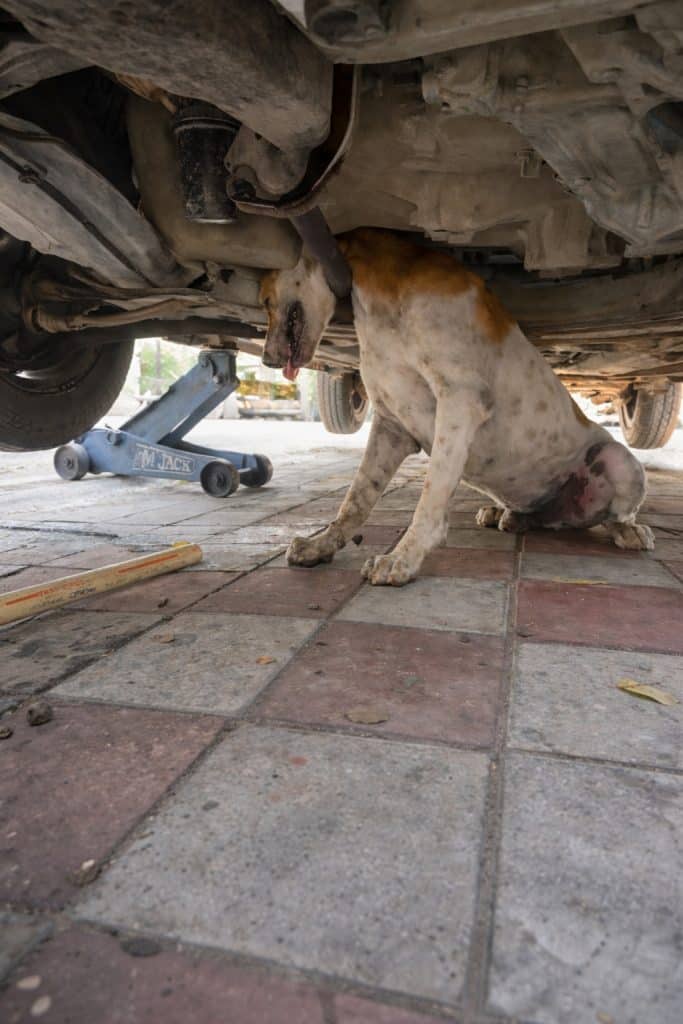
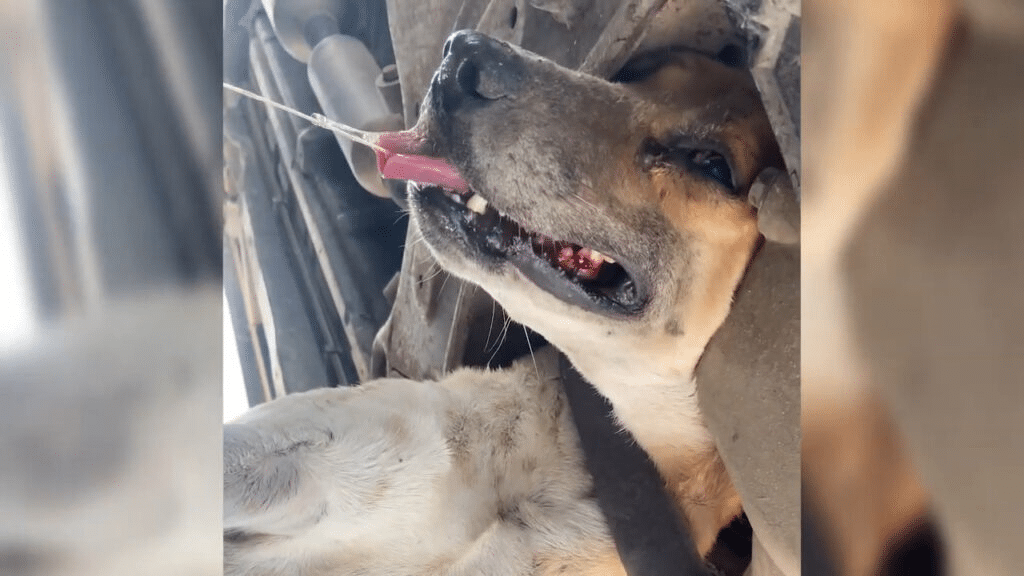
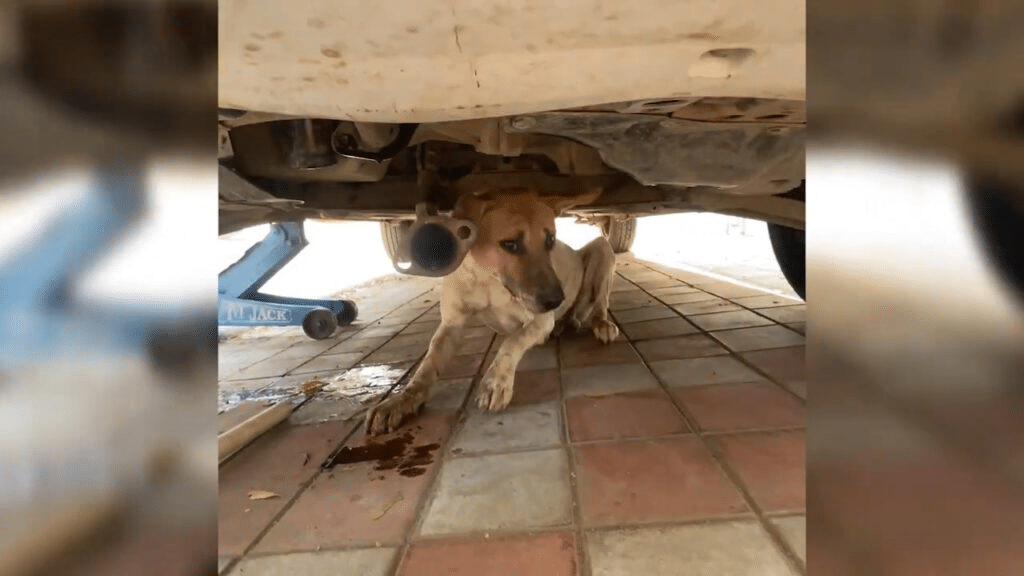
The dog had pushed his head into the exhaust pipe of a parked car.
And when he tried to pull back, he couldn’t.
His head was stuck.
What had looked like a harmless burst of instinct had suddenly become a rescue where one wrong move could make the situation much worse.
Pulling Him Free Could Have Hurt Him
The dog’s first reaction was exactly what anyone might expect.
He struggled.
Twisted his body.
Pulled backward.
But the metal pipe held firm.
People nearby quickly realized that simply grabbing the dog and pulling was too risky. His head was trapped inside a narrow piece of metal, and using force could cause additional injury.
So instead of continuing to struggle with the pipe themselves, they called for help.
Rescuers from the Nirbhay Foundation arrived and assessed the situation.
The dog was frightened but alert.
His body remained tense as he tried to understand why he could not move normally.
The team needed to free him without turning panic into injury.
That meant slowing everything down.
Video: A Dog’s Head Became Stuck Inside a Car Exhaust Pipe — Watch How Rescuers Freed Him Without Pulling
The Safest Solution Was to Remove the Pipe
Rather than trying to force the dog’s head back through the narrow opening, rescuers focused on the car itself.
With permission from the vehicle’s owner, they began working to remove the section of exhaust trapping him.
It was a much more controlled approach.
The dog could remain relatively still while the rescuers worked around the metal instead of pulling directly against his neck and head.
Tools were positioned carefully.
The pipe was loosened step by step.
There was no room for unnecessary force.
Every movement had to account for the frightened animal still attached to the other end.
Eventually, the exhaust section began to give.
Then, after one final adjustment, the dog was free.
The Moment He Was Released, He Took Off
For a brief moment after the pipe came away, the dog remained still.
Then his entire posture changed.
He shook himself.
Turned.
And ran.
There was no dramatic pause or long recovery scene.
He simply moved across the street with the energy of a dog who suddenly had control of his body again.
According to the rescue account, he appeared mobile and alert after being freed.
His tail was moving.
His steps were strong enough that he quickly disappeared from the immediate rescue scene.
For the team, it was a welcome ending to an unusual emergency.
But there was barely time to process it.
Another call came in.
And this time, the situation was very different.
The Next Dog Couldn’t Simply Run Away
The second emergency involved a dog that had reportedly been struck by a vehicle.
When rescuers reached the scene, the contrast with the first dog was immediate.
This animal was not trapped inside an object.
He was injured.
He lay tense and moved cautiously, with signs that one of his legs had taken the force of the impact.
Because road accidents can cause injuries that are not immediately visible, the rescuers knew that guessing would not be enough.
A veterinary examination was needed.
One concern stood above the others:
His spine.
If the spinal column had been seriously damaged, the recovery ahead could look very different.
So the dog was examined carefully before any assumptions were made about what he could or could not recover from.
The Spine Was Intact, but One Leg Needed Treatment
The assessment brought some reassuring news.
According to the rescue team, the dog’s spine was intact.
That did not mean he was uninjured.
One leg had been affected by the accident and required continued treatment.
Unlike the dog freed from the exhaust pipe, this rescue would not end within a few minutes.
The injured dog needed somewhere safe to recover.
He was transported to the rescue center, where treatment could continue away from traffic and the uncertainty of the street.
Pain management became part of the process.
So did rest.
Then, as his condition allowed, gentle rehabilitation began.
The goal was not to force rapid improvement.
It was to help him begin using the injured leg again without placing unnecessary stress on his body.
Recovery Showed Up One Step at a Time
There was no single moment when the injured dog suddenly returned to normal.
Instead, progress appeared gradually.
At first, he protected the affected leg.
His movements were guarded.
Then he began testing it.
A little pressure.
A cautious step.
More rest.
With continued treatment and rehabilitation, he started placing greater weight on the leg.
His movement became steadier.
The tension visible in his body began to ease.
And as physical discomfort improved, more of his usual energy returned.
Those small changes mattered because each one showed that recovery was moving in the right direction.
A dog who had arrived unable to move comfortably was beginning to trust the injured limb again.
Two Emergencies Required Two Completely Different Kinds of Help
The two rescues could hardly have been more different.
One dog had become trapped because his head was stuck inside a piece of metal.
The other had been injured after a collision.
The first emergency required rescuers to avoid pulling and instead dismantle part of a car.
The second required veterinary assessment, pain management, rest, and rehabilitation over time.
One dog ran away almost immediately after being freed.
The other needed continued care before his movement began improving.
Yet both situations depended on the same basic decision.
Someone saw an animal in trouble and chose to become involved.
And in both cases, reacting without thinking could have made things worse.
The trapped dog needed careful mechanical removal rather than force.
The injured dog needed medical assessment rather than assumptions about what had happened internally.
Sometimes Helping Means Knowing When Not to Rush
Animal rescue is often associated with speed.
And there are emergencies where acting quickly is essential.
But these two cases show another side of rescue.
Speed alone is not enough.
The right kind of help matters.
With the first dog, rescuers had to resist the instinct to simply pull harder.
With the second, they had to understand that improvement would not come in a few dramatic minutes.
One required calm problem-solving.
The other required patience over days of recovery.
Both dogs eventually moved forward because the people around them adjusted their response to what each situation actually required.
One ran from the scene the moment the exhaust pipe released him.
The other slowly began putting weight on an injured leg again.
Two very different endings.
But one lesson connecting them:
When an animal is frightened or injured, helping well can matter just as much as helping fast.


