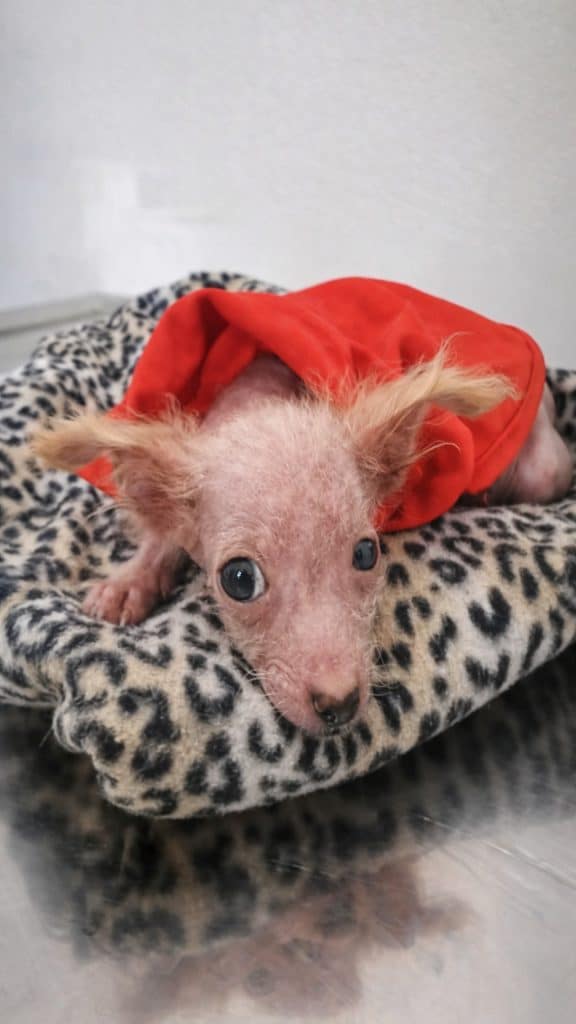
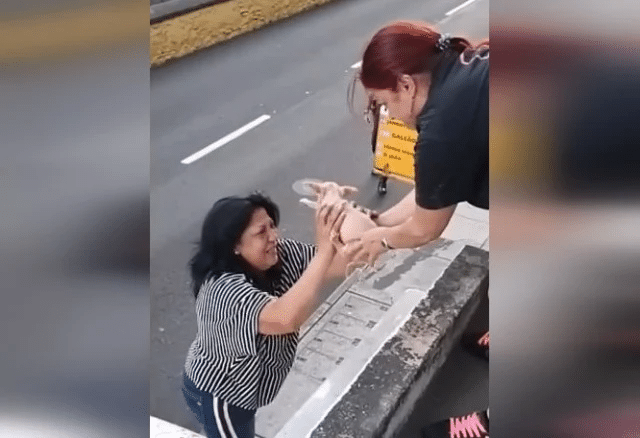
When Moka was carried out of the facility, the outside world seemed to overwhelm him.
His small body trembled.
Open space was unfamiliar.
Even ordinary movement around him appeared to make him tense.
But fear was only part of the problem.
Moka was dangerously weak.
His body had been deprived of proper care for so long that simply breathing had become difficult. He was severely underweight, his skin was inflamed, and there was little strength left in his fragile frame.
The rescuers had reached him.
But getting Moka out was only the beginning.
Before anyone could teach him that people could be gentle, doctors first had to keep him alive.
Moka Was One of the Weakest Dogs They Found
The conditions inside the facility had taken a serious toll on the animals living there.
Dogs had been confined without the level of care they needed, and several were already showing the physical effects.
Moka stood out immediately.
He was extremely thin.
His breathing was labored.
His body seemed to have almost nothing left in reserve.
Once he reached veterinary care, the situation became urgent.
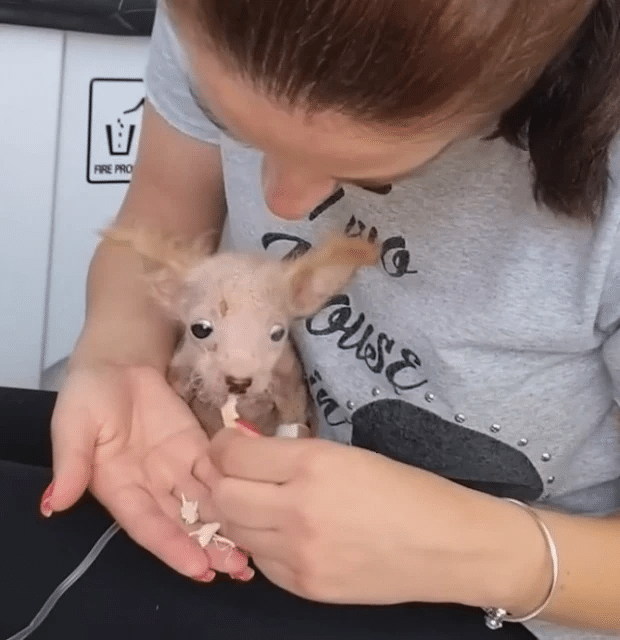
Moka needed supplemental oxygen to help him breathe.
Then came a blood transfusion.
For a puppy in such a weakened condition, the first hours were not about rehabilitation or socialization.
They were about stabilization.
Keep him breathing.
Support his body.
Give him enough strength to reach the next day.
Video: Moka Was So Weak He Needed Oxygen and a Blood Transfusion — Watch His Fight Begin
Surviving the First Crisis Revealed Another Challenge
Once Moka became more stable, caregivers could finally assess the rest of his condition.
He was severely underweight.
His skin was irritated and sensitive.
His immune system had been weakened.
Those problems could be addressed through veterinary treatment, nutrition, and time.
But another difficulty was visible in the way Moka reacted to people.
When someone reached toward him, he pulled away.
He did not seek affection.
He did not appear curious about unfamiliar hands.
Instead, he tried to create distance.
No one could know exactly what experiences had shaped those reactions.
What the rescuers could observe was simple:
Human contact frightened him.
So they decided that recovery would have to happen on Moka’s terms.
The Other Puppies Improved Faster — Moka Needed Something Different
Some of the other rescued dogs began eating eagerly and exploring their surroundings as their physical condition improved.
Moka moved more slowly.
He remained cautious.
New sounds made him hesitate.
Unexpected movement could cause him to withdraw.
The caregivers realized that pushing him to behave like the other puppies would accomplish very little.
So they adjusted the environment instead.
Voices stayed soft.
Movements around him became deliberate.
Nobody forced him into interaction simply because they wanted him to become comfortable faster.
If Moka wanted distance, he was given distance.
If he watched from across the room, that was enough.
If he remained still while someone sat nearby, that counted too.
For perhaps the first time, people were allowing him to decide how close he wanted to be.
One Morning, He Walked to the Bowl by Himself
Moka’s progress arrived in moments small enough that someone not watching carefully might have missed them.
Then one morning, he approached his food bowl.
Nobody carried him over.
Nobody held food directly in front of him.
He went there himself.
And he ate.
It was an ordinary action for most dogs.
For Moka, it was a meaningful step toward independence.
Eating consistently meant his body could begin rebuilding.
But choosing to approach the bowl also meant he was becoming more comfortable in the environment around him.
Soon, caregivers began introducing short periods outdoors.
At first, the unfamiliar space seemed like a lot to process.
Moka stayed outside only briefly.
Then he began tolerating a little more.
Fresh air.
Sunlight.
New smells.
A few additional minutes each day.
The world beyond confinement was slowly becoming less frightening.
Video: After Days of Fear, Moka Finally Walked to His Bowl Alone — Then His Tail Began to Move
His Body Began Showing the Results of Consistent Care
Moka’s recovery continued through routine rather than dramatic intervention.
Regular meals helped restore weight and energy.
Medicinal baths were used to soothe his irritated skin.
Veterinary care addressed the physical problems his body had been carrying.
Gradually, the changes became visible.
His skin improved.
His coat began growing back.
He stood more steadily.
He had more energy to observe what was happening around him.
But the caregivers were also watching another kind of progress.
Moka began hiding less.
Instead of immediately moving away when familiar people entered, he sometimes stayed where he was.
He watched them.
He listened.
And occasionally, his tail moved.
Only a little.
There was no sudden transformation into an outgoing puppy.
That was not the goal.
Moka was simply beginning to understand that not every person approaching him meant something frightening was about to happen.
Familiar Faces Slowly Became Part of His Safe World
Consistency became one of the most important parts of Moka’s recovery.
The same people returned.
Food arrived regularly.
Baths were handled gently.
No one punished him for being afraid.
No one demanded affection in exchange for care.
Day after day, the environment around him became more predictable.
That predictability gave Moka room to become curious.
Instead of spending every moment focused on avoiding something frightening, he could begin paying attention to other things.
A sound outside.
A bowl being prepared.
A familiar person sitting nearby.
The changes were subtle.
But by around the fifteenth day, the difference from his arrival was becoming clear.
Moka was eating consistently.
He appeared calmer around caregivers he recognized.
And he was beginning to engage with the world instead of simply trying to withdraw from it.
He Was Getting Better — But He Was Not Ready to Be Rushed
Moka’s improvement did not mean his recovery was finished.
He still needed time before adoption would be appropriate.
Physical wounds can often be measured.
Weight can be recorded.
Skin can be examined.
Bloodwork can be repeated.
Fear is different.
There is no single test that announces when a frightened dog suddenly feels completely safe.
For Moka, progress meant accumulating positive experiences.
Another meal without uncertainty.
Another bath handled carefully.
Another person respecting his boundaries.
Another quiet afternoon when nothing frightening happened.
Those moments did not erase whatever came before.
They gave him new experiences to learn from.
And gradually, Moka began behaving less like a puppy waiting for something bad to happen.
The Most Important Part of His Rescue Came After He Survived
Saving Moka’s life required urgent medical care.
Oxygen helped him through a moment when breathing had become difficult.
A blood transfusion gave his weakened body additional support.
Nutrition helped rebuild what prolonged deprivation had taken away.
But once the immediate crisis passed, the rescue became quieter.
People had to wait.
They had to resist turning recovery into a race.
Moka could not be convinced to trust through enthusiasm or affection alone.
He needed repeated proof that his new environment was different.
So the caregivers kept showing up.
They fed him.
Treated him.
Sat near him.
Gave him room.
And waited for Moka to make the next move.
Eventually, he did.
First toward his food.
Then into the sunlight.
Then by remaining near people he once would have avoided.
And finally, in the smallest movement of his tail.
Moka was not completely healed after fifteen days.
He did not need to be.
The important change was already happening.
The puppy who once needed oxygen simply to keep going was beginning to discover that survival did not have to be the only thing his life was about.
For the first time, Moka was being given something he could not receive through medicine alone:
Time to learn that a human hand could arrive without hurting him.


