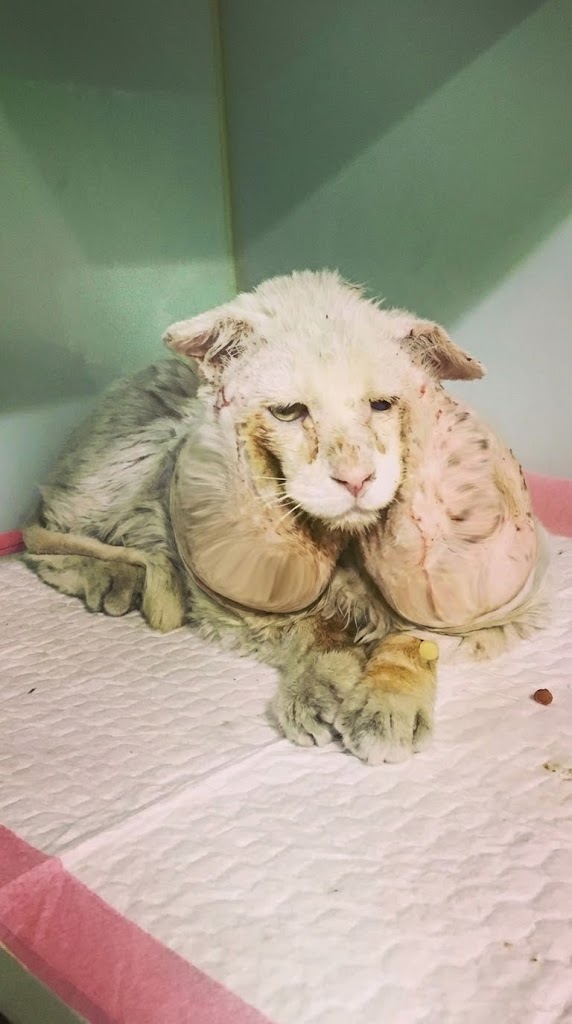
Simba was impossible to overlook.
In the middle of a quiet parking lot, the small cat moved slowly across the concrete, each step careful and uncertain.
His body was thin.
His coat was patchy.
But what immediately drew attention were the enormous swellings on both sides of his face.
They changed the shape of his cheeks so dramatically that, from a distance, Simba barely looked like an ordinary cat.
Yet he continued walking.
No one knew exactly how long he had been living this way.
What rescuers could see was enough.
Simba needed medical care.
And this time, someone was finally going to make sure he received it.
His Face Revealed Only Part of What He Had Been Enduring
When rescuers approached, Simba did not run.
He did not hiss or try to disappear beneath a parked car.
Instead, he allowed them to come closer.
That made it possible to see the rest of his condition.
His frame was underweight.
His fur was uneven.
There were old marks on his body along with areas that still needed attention.
Inside his mouth, the problems continued.
According to the rescue account, Simba was suffering from chronic stomatitis, a painful inflammatory condition affecting the mouth.
Several teeth were also damaged.
Eating had become difficult.
The large swellings on his face were therefore only the most visible part of a much bigger medical problem.
Rescuers knew this would not be solved with a quick visit to the clinic.
Simba needed sustained care.
Video: Simba Was Found With Two Huge Swellings on His Face — See the Moment His Rescue Finally Began
He Surprised Everyone With How Calmly He Accepted Help
Simba was taken directly to the veterinary hospital.
For an animal who had been surviving outdoors while dealing with pain and illness, a clinic could easily have become another frightening place.
New smells.
Unfamiliar people.
Hands examining areas that were already sensitive.
But Simba responded in a way the team did not expect.
He remained remarkably calm.
During examinations, he allowed the veterinary staff to handle him.
When people touched his face or checked his mouth, he did not lash out.
And when someone stroked his head, Simba often relaxed into the contact.
At times, he even purred.
It would be easy to describe that behavior as complete trust.
What could be observed more safely was something simpler:
Despite everything happening around him, Simba tolerated care extraordinarily well.
That allowed the team to begin treatment without adding unnecessary stress to an already fragile body.
The Clinic Became His Home for Nearly a Month
Veterinarians estimated that Simba would need an extended period of treatment.
The plan focused on addressing multiple problems at the same time.
His facial swellings required medical attention.
The inflammation inside his mouth needed to be controlled.
His damaged teeth had to be considered.
And his thin body needed consistent nutrition.
There was no single treatment capable of restoring all of that overnight.
So Simba stayed.
Day after day, the medical team monitored his progress.
Soft food made eating easier while his mouth remained sensitive.
Regular meals helped rebuild his strength.
And veterinary care focused on reducing the swelling and inflammation that had made ordinary life so uncomfortable.
Recovery came slowly.
But it came.
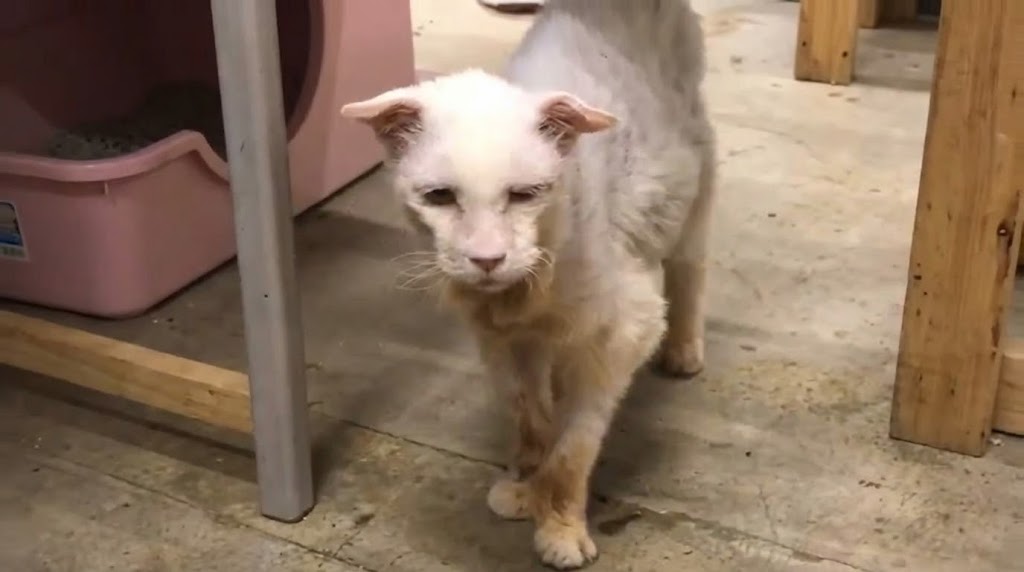
The First Changes Were Small Enough to Miss
At first, progress appeared in subtle ways.
Simba ate more consistently.
His body began gaining strength.
The swelling around his face gradually reduced.
Inflammation became less severe.
He rested for longer periods without appearing as uncomfortable.
Then his coat began looking healthier.
Those changes might not have seemed dramatic from one day to the next.
But over several weeks, the difference became easier to see.
His face was changing.
His posture was changing.
And his behavior was changing too.
The cat who had once moved carefully across the parking lot now had enough comfort and energy to pay attention to things beyond simply getting through the day.
Video: Weeks Into Treatment, Simba’s Face Began Changing — And His Playful Side Started to Appear
One Small Toy Revealed How Much Better He Felt
As Simba became more comfortable, the veterinary staff began seeing glimpses of a different cat.
A toy near his bed caught his attention.
He reached toward it.
Played with it.
Explored instead of simply resting.
For many healthy cats, playing with a toy would mean almost nothing.
For Simba, it represented a shift.
When he first arrived, his body was dealing with pain, weakness, and ongoing inflammation.
Now he had enough energy to become curious.
Even his sleep changed.
Instead of keeping his body tightly curled and guarded, he began resting more comfortably.
He could stretch out.
Relax.
Sleep without appearing constantly prepared for discomfort.
Those quiet moments mattered as much as any visible medical improvement.
They showed that Simba was not only looking better.
He was beginning to feel better.
After 25 Days, Simba Was Ready to Leave the Hospital
Nearly a month after arriving, Simba reached an important milestone.
After approximately 25 days of treatment and observation, he was discharged.
The cat leaving the clinic looked noticeably different from the one rescuers had carried inside.
His movements were steadier.
His eyes appeared brighter.
His body had more strength.
And the enormous facial swelling that had dominated his appearance had significantly improved.
But leaving the hospital did not mean returning to the parking lot.
Simba now had somewhere safe to continue recovering.
A home.
Soft surfaces replaced concrete.
Meals arrived regularly.
There were people nearby who knew his history and understood that his recovery still needed time.
For the first time in the story rescuers knew, Simba no longer had to manage illness while also trying to survive outdoors.
By Day 130, He Barely Resembled the Cat From the Parking Lot
The transformation became even more striking over the following months.
By around Day 130, Simba looked dramatically different.
His fur had grown thick and healthy.
His body appeared stronger.
His face no longer carried the same severe swelling that had made him almost unrecognizable.
And his behavior reflected the change.
Simba moved with greater confidence.
He approached people.
Rubbed against legs.
Responded to affection with the loud purrs his caregivers had first heard during treatment.
Looking at him then, it was difficult to connect the healthy, fluffy cat with the frail animal once walking alone through a parking lot.
Yet it was the same Simba.
The difference was what happened after someone finally stopped.
His Transformation Took Far More Than One Rescue Moment
It is tempting to reduce rescue stories to a single dramatic event.
The moment an animal is found.
The moment someone picks them up.
The moment they enter a clinic.
But Simba’s story was built over months.
Finding him only created the opportunity.
Then came examinations.
Treatment.
Soft food.
Daily monitoring.
Rest.
More treatment.
Twenty-five days in the hospital.
Then continued care at home.
By Day 130, the results were dramatic.
But none of those results came from one miraculous afternoon.
They came from consistency.
The kind of care that continues after the first emotional moment has passed.
Simba No Longer Has to Walk Through Pain Alone
The first image of Simba is difficult to forget.
A thin cat crossing a sun-faded parking lot.
Two enormous swellings hanging from his face.
A painful mouth.
A body that had clearly needed help long before anyone intervened.
But that image is no longer the whole story.
There is another Simba now.
A cat with a thick coat.
A stronger body.
A comfortable place to sleep.
A cat who plays.
Seeks affection.
And purrs when people come close.
His recovery does not erase what happened before he was found.
It shows what became possible afterward.
Someone noticed that Simba needed more than food left beside the road.
They took him for medical care.
The veterinary team stayed with the difficult treatment.
And months later, the cat once defined by the enormous burden on his face was finally able to be known for something else.
His personality.
His affection.
And the life that had been waiting underneath all that pain.


