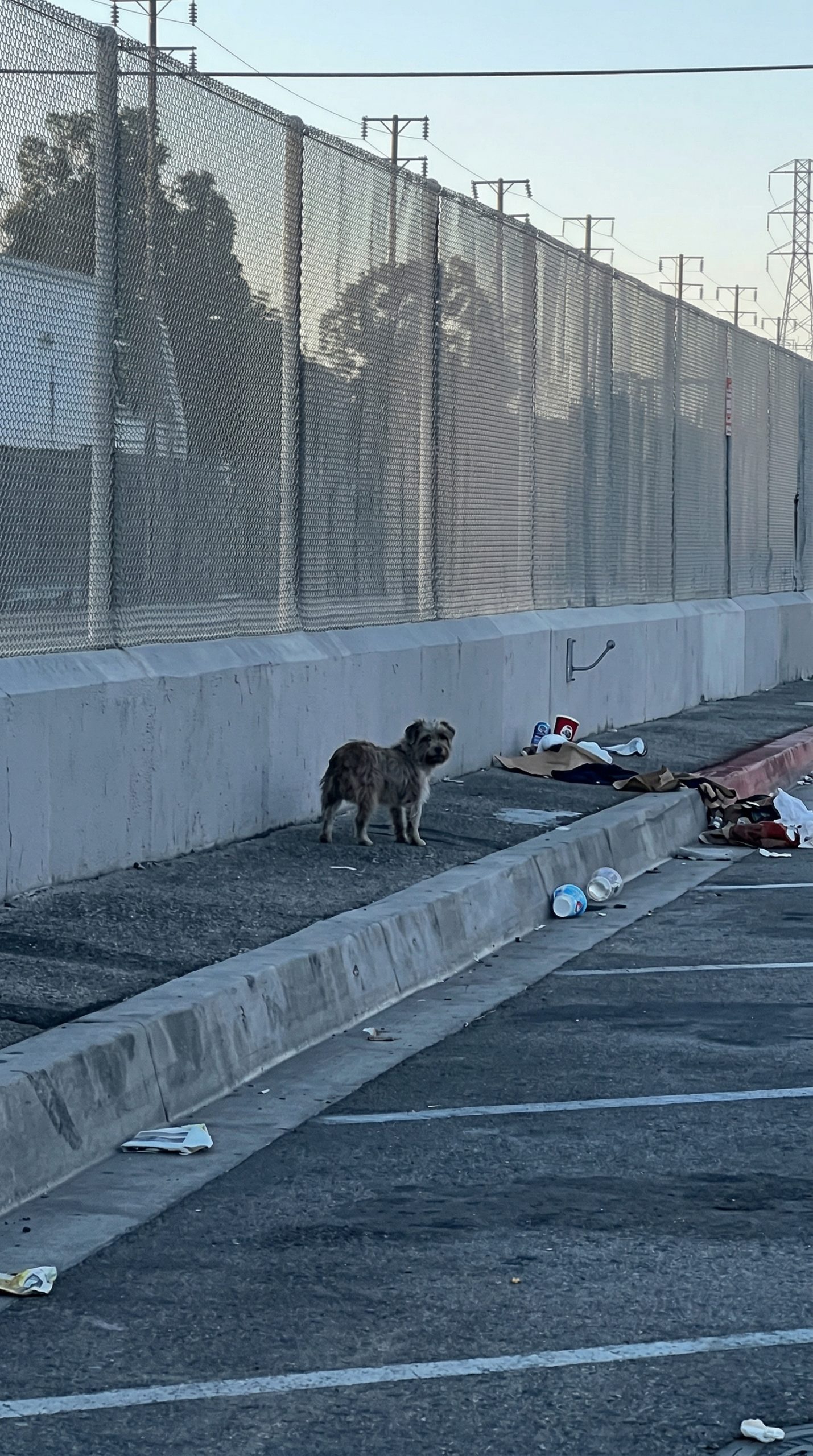
For weeks, people along a busy road in Los Angeles County kept seeing the same little dog.
She was thin.
Her light-colored coat had become tangled into heavy mats.
And every day, she returned to the same fence beside the road.
Then she would do something unusual.
She would rise onto her hind legs, stretch her small body upward, and peer through the gaps toward the passing traffic.
Car after car moved by.
People came and went.
Still, she kept returning to that fence.
No one could know exactly what she expected to find on the other side.
But after nearly a month of watching her repeat the same behavior, one thing became impossible to ignore.
She needed help.
And two rescuers were determined to reach her before another month passed.
Every Day, She Returned to the Fence and Looked Toward the Road
The little dog had become a familiar sight in the area.
People noticed her moving along the roadside and disappearing between nearby structures.
But what stayed with them most was the way she stopped at the fence.
She would stand upright on her back legs.
Then she would look through.
Her front paws rested against the barrier while traffic passed beyond it.
From the outside, the behavior looked almost like searching.
Perhaps she was watching movement.
Perhaps she had learned that people and cars appeared from that direction.
The rescue account suggests she may have been waiting for the family who had left her behind, although no one could know for certain what she understood or expected.
What was clear was that she remained in the same area for weeks.
And while she waited, her physical condition continued to decline.
Her coat became increasingly matted.
Her body remained thin.
The California heat only made carrying so much tangled fur more uncomfortable.
Eventually, local people contacted experienced rescuer Suzette Hall, founder of Logan’s Legacy 29.
Suzette joined forces with Rosario Ortiz.
They believed getting the dog off the street was urgent.
They quickly discovered that seeing her was much easier than catching her.
Video: For Weeks She Stood at the Fence Watching Every Car — Until Rescuers Finally Reached Her
For Nearly Two Weeks, She Would Not Let Anyone Close Enough to Help
The dog had survived by keeping her distance.
That instinct did not disappear simply because the people approaching her had good intentions.
Suzette and Rosario returned again and again.
They brought food.
They offered water.
They tried to remain patient and predictable.
But the little dog was deeply wary of people.
If someone moved too close, she ran.
Even something as simple as offering water by hand was enough to make her retreat.
That created a difficult problem.
The rescuers could see that she needed care.
But forcing a frightened dog into a corner outdoors could send her into traffic or cause her to disappear completely.
So they tried humane traps.
They watched the places she frequented.
They waited for opportunities.
Some days ended without progress.
They would leave not knowing exactly where she would sleep that night or whether she would return the next morning.
Then they came back anyway.
Nearly two weeks passed like this.
The dog continued appearing.
The rescuers continued trying.
Neither side was ready to give in.
Then She Disappeared Into an Abandoned Building
The breakthrough came almost accidentally.
One day, the rescuers saw the little dog slip inside an abandoned building nearby.
This time, they knew where she was.
And more importantly, they had a chance to prevent her from running back toward the road.
They moved quickly.
Using whatever was available—including trash bins and old baby gates—they began blocking possible exits.
The setup was far from elegant.
It did not need to be.
It only needed to keep the dog from slipping through another opening before they could safely secure her.
Once the exits were covered, Suzette and Rosario entered through a narrow, damaged section of the structure.
Inside, the light was limited.
The frightened dog tried to maintain distance.
But for the first time after days of searching and failed attempts, she could no longer vanish across an open street.
The rescuers did not charge toward her.
They moved slowly.
They spoke softly.
Little by little, they guided her toward a smaller area.
Then came the moment they had been working toward for nearly two weeks.
A lead slipped carefully over her.
The little dog was finally secure.
The chase was over.
The Dog They Had Been Trying to Catch Could Finally Stop Running
For days, nearly every encounter with people had ended the same way.
Someone approached.
The dog retreated.
Someone tried again.
She disappeared.
Now, for the first time, she no longer had to rely on running to protect herself.
The lead meant the rescuers could finally move her away from the roadside and toward professional care.
They took her directly to Camino Pet Hospital.
Only then could everyone properly examine just how much neglect her coat had hidden.
The mats were extraordinarily thick.
Dirt and tangled fur had accumulated in dense layers around her small body.
At first, according to the rescue account, the team was not even certain whether the dog was male or female.
Her coat concealed that much.
The clippers came out.
And the removal process began.
One section at a time, months of tangled fur started falling away.
Underneath was a much smaller dog than the heavy coat had suggested.
A little female.
Delicate.
Thin.
And finally free of the mats that had been weighing her down.
Layer by Layer, the Dog Beneath the Mats Finally Appeared
Severely matted fur is more than a cosmetic problem.
For this little dog, the coat had become something she carried everywhere.
The thick sections pulled against her skin.
They trapped dirt.
They added weight around a body that was already small and underconditioned.
Removing them had to be done carefully.
As the clippers worked through the tangled coat, the shape of the dog underneath became clearer.
Her legs looked smaller.
Her body looked lighter.
Her features could finally be seen without layers of neglected fur surrounding them.
The transformation was immediate.
Not because grooming erased everything she had experienced.
But because one physical burden had finally been removed.
The dog who had spent weeks navigating the streets with a coat she could not escape could now begin recovering without it.
Suzette gave her a name.
Reject.
The name reflected the circumstances surrounding her rescue and the sense that she had been left behind.
But the people caring for her were determined that rejection would not define what happened next.
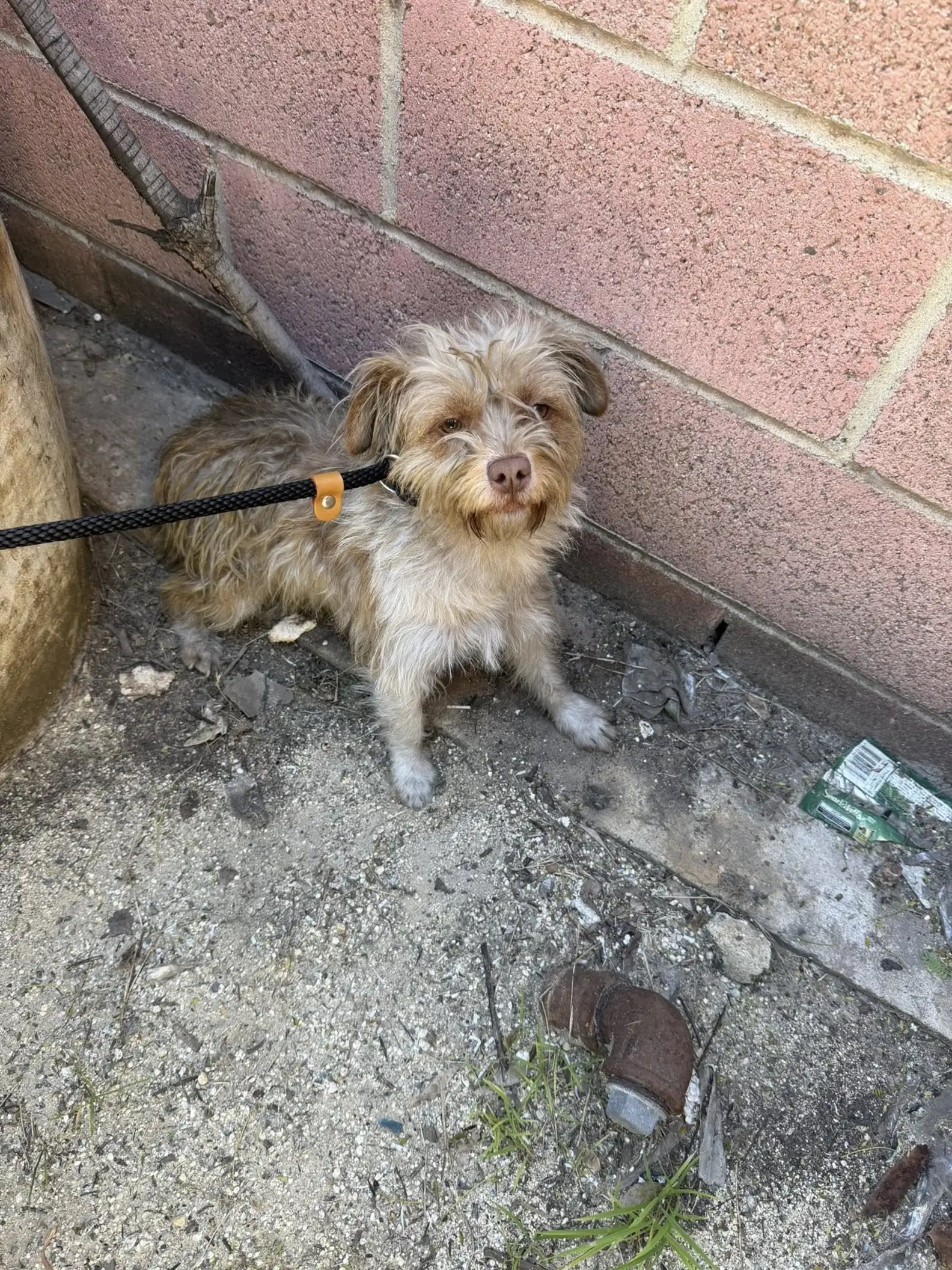
Once She Was Safe, Her Gentle Personality Had Room to Appear
A dog repeatedly running from rescuers can easily look untouchable from a distance.
Reject had spent almost two weeks proving how difficult she was to approach.
But fear outside did not necessarily describe who she was.
It described what she had learned she needed to do to survive.
Once she was safely contained, cleaned, and surrounded by people who were no longer chasing her through unfamiliar spaces, another side of her could begin emerging.
The little dog beneath all that fear was gentle.
She could accept care.
She could be handled.
She could begin adjusting to people who approached without disappearing afterward.
That shift is common in rescue stories for an important reason.
Street behavior is survival behavior.
A frightened dog may run because running has kept her safe.
She may avoid water offered by hand because getting close to unfamiliar people feels dangerous.
She may hide inside abandoned structures because enclosed spaces offer protection.
None of those behaviors mean she is incapable of trusting.
They mean trust has to be built somewhere safer.
Reject finally had that opportunity.
She No Longer Needed to Stand at the Fence Searching the Road
The image people remembered most was the small dog rising onto two legs beside the fence.
Day after day.
Looking through.
Watching the world move beyond her.
There is no way to know exactly what she believed each time a vehicle passed.
The rescuers could not ask her why she remained in that area.
But they could change what happened next.
Reject no longer had to return to the roadside.
She no longer had to disappear whenever someone tried to approach.
She no longer had to carry thick, dirty mats through the heat.
Her days could now contain something different.
Food provided regularly.
Clean water.
A safe place to rest.
People who knew where she was at night.
And human contact that did not end with her having to run.
Those changes might sound ordinary.
For a dog who had spent weeks surviving outdoors, they were enormous.
The People She Once Ran From Became the Reason She Was Safe
It took nearly two weeks of failed attempts to catch Reject.
That part of the story matters.
Not every rescue happens because an animal immediately recognizes help.
Sometimes the opposite happens.
A frightened dog runs from the very people trying to save her.
The rescuers may go home empty-handed.
The trap may remain untouched.
Food may disappear only after everyone leaves.
Progress can look like nothing is happening at all.
But Suzette and Rosario returned.
Again and again.
That consistency eventually put them in the right place when Reject entered the abandoned building.
Had they stopped returning after the first failed attempt, the opportunity might never have come.
Instead, they were there.
They blocked the exits.
They entered carefully.
They secured the lead.
And after almost a month of living near that road, Reject finally left it behind.
Her Story Changed Because Someone Kept Coming Back
Reject had spent weeks near the fence.
Whatever had kept drawing her there, she continued looking toward the world beyond it.
People saw her.
Eventually, people worried enough to call for help.
Then two rescuers arrived and discovered that helping her would require far more patience than simply opening a car door.
Reject ran.
They returned.
She hid.
They returned.
She avoided the traps.
They returned.
Until one day, the dog slipped into a building and the rescuers finally had their chance.
That persistence changed everything.
Today, the little dog no longer needs to balance upright simply to watch passing cars from behind a fence.
She has been seen.
She has been cleaned.
She has people around her who know her story and care what happens next.
Perhaps that is the most powerful contrast in her journey.
For weeks, Reject appeared to be the one waiting.
In the end, the people who saved her proved they knew how to wait too.


