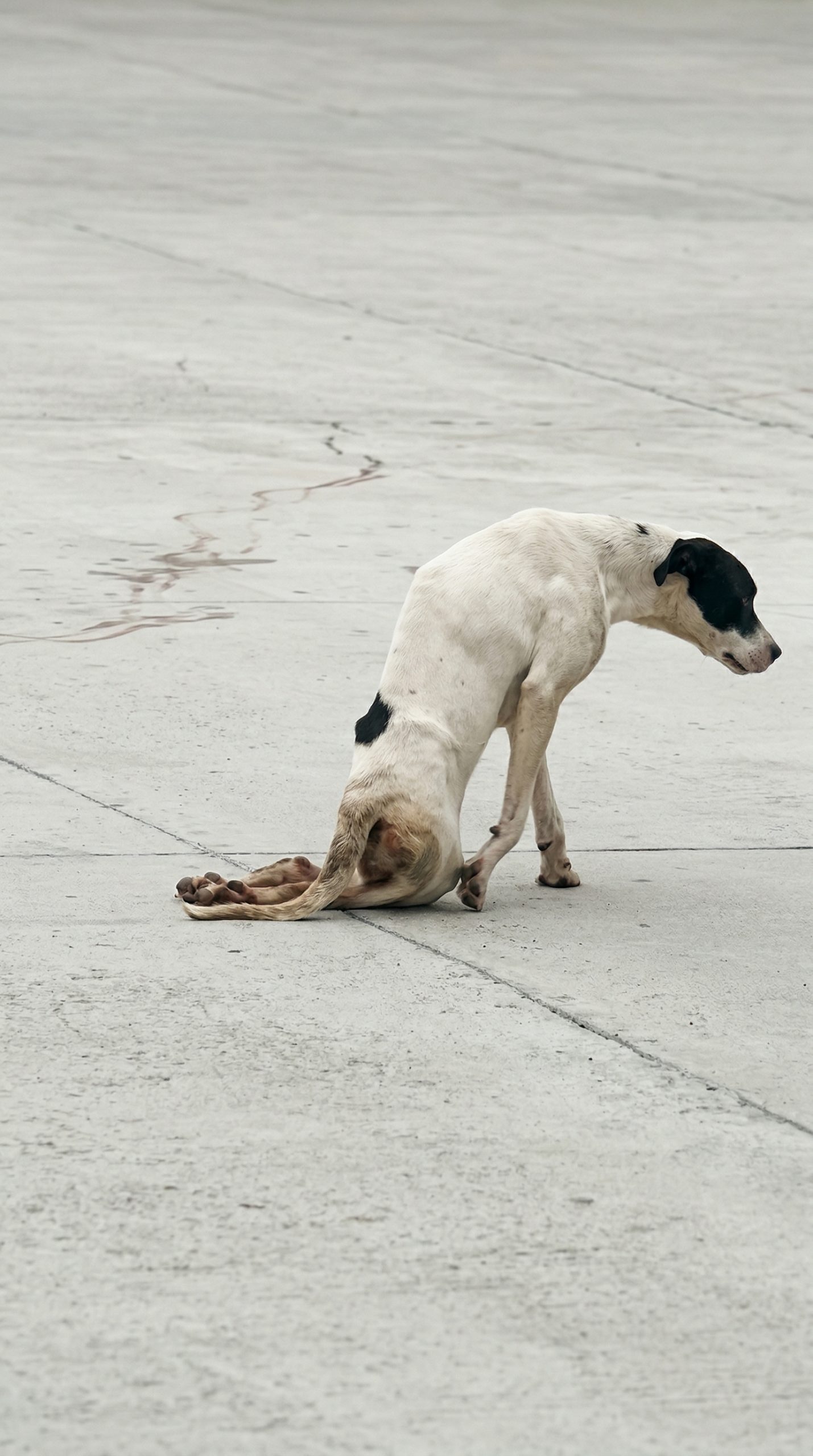
Beanie could not use her back legs.
So whenever she needed to move, she planted her front paws against the concrete and pulled the rest of her body behind her.
Inch by inch.
Across pavement that offered no protection from the constant friction.
By the time Bailey saw her in a Kansas City, Kansas, gas station parking lot, the black-and-white pittie’s paws and lower body already showed the consequences.
Her skin was raw.
Some areas were bleeding.
And according to people nearby, she had been living around the area for roughly a month.
Bailey had only planned to drive through.
Instead, she stopped the car.
And Beanie’s life began changing from that moment forward.
She Wasn’t Limping — She Was Pulling Her Entire Body Across the Concrete
At first, Bailey could hardly make sense of what she was seeing.
The dog ahead of her was moving, but not in the way a dog normally should.
Her hind legs remained behind her.
Only her front legs worked to pull her forward.
Every movement brought her body into contact with the rough surface beneath her.
Bailey stopped immediately and approached.
Up close, the situation was even more concerning.
Beanie’s paws and skin had been worn from repeatedly dragging herself across hard ground. The injuries looked too established to have happened that morning.
Bailey asked people in the area how long the dog had been there.
The answer stunned her.
They said she had been around for approximately a month.
Whatever Beanie’s exact history had been during those weeks, she clearly needed help now.
Bailey refused to leave her there for another day.
She lifted the frightened dog from the pavement and began looking for veterinary care.
Video: She Could Only Drag Herself Across the Concrete — Until Bailey Finally Stopped
The First Veterinary Visit Brought Another Obstacle
Bailey took the dog to an emergency veterinary clinic.
She hoped the next step would be simple.
Get her examined.
Find out what was wrong.
Begin treatment.
Instead, she encountered a financial barrier.
According to the account, the emergency clinic required a substantial payment before moving forward with treatment, and Bailey could not cover the amount at that moment.
She suddenly had an injured dog in her care and no immediate solution.
But returning Beanie to the gas station was never an option.
Bailey brought her home.
She gave her a name.
Beanie.
And for the entire weekend, she focused on the things she could do safely while searching for more help.
She cleaned the areas damaged by contact with the pavement.
She changed bandages.
She gave Beanie a soft place to rest.
Most importantly, she stayed nearby.
For a dog who had spent weeks adapting to life on hard ground, simply being able to lie somewhere without needing to drag herself to safety was already a major change.
At Kansas State, Bailey Finally Received Answers — But Not the Ones She Wanted
Bailey continued searching for a place that could properly evaluate Beanie.
Eventually, she brought her to the Kansas State Veterinary Teaching Hospital.
There, specialists examined the little pittie more thoroughly.
Bailey had hoped there might be a surgical solution.
Instead, the assessment was much more complicated.
According to the rescue account, veterinarians believed Beanie was too physically fragile for the operation being considered and that attempting it carried an unacceptable risk.
That did not mean there was nothing left to do.
It meant her future would have to look different from the one Bailey had originally imagined.
There would be no immediate surgery that suddenly restored everything.
Beanie would need support.
Physical rehabilitation.
Time.
And a person willing to accept progress in whatever form her body could manage.
Bailey chose to be that person.
Recovery Began With Movements Almost Too Small to Notice
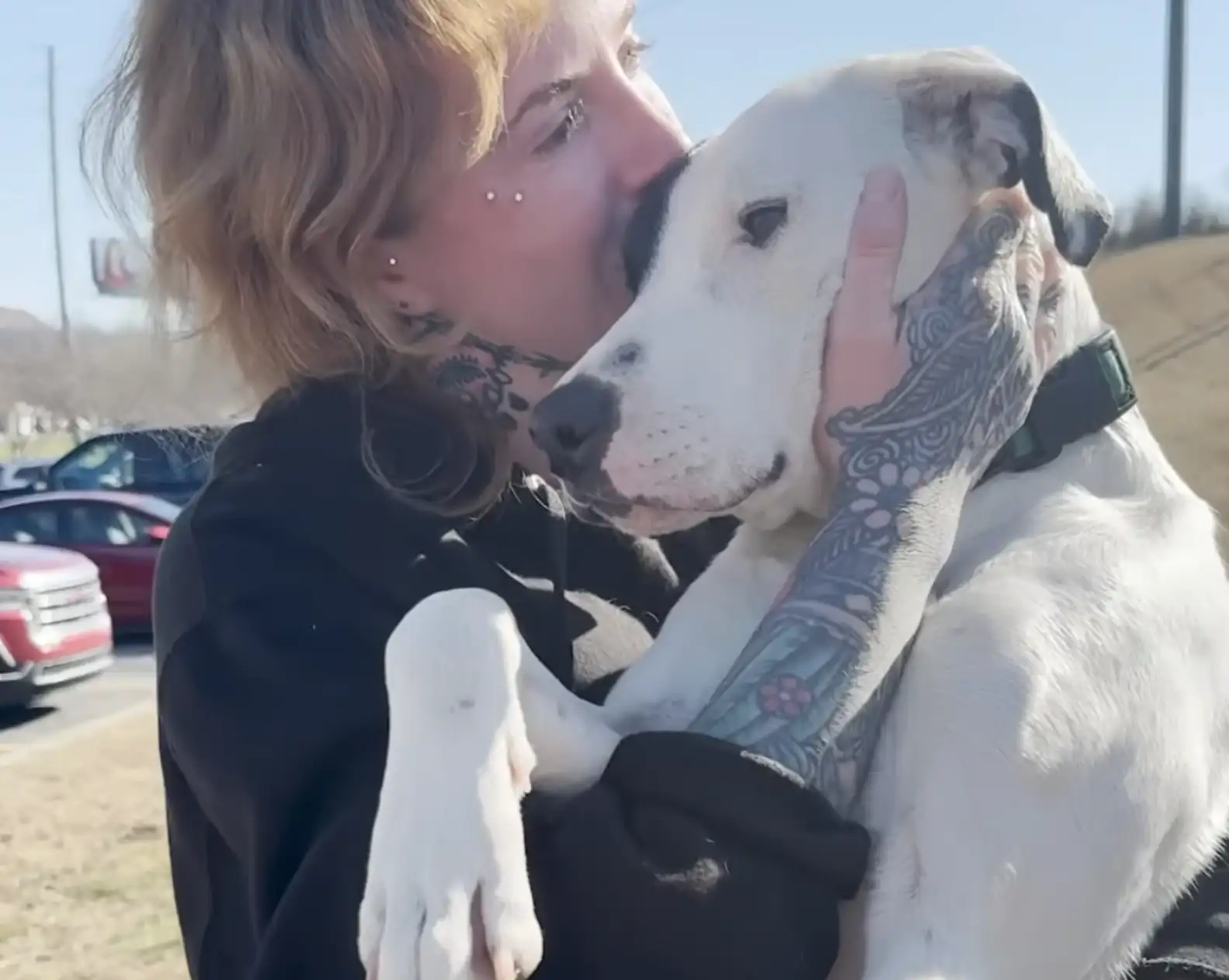
Back home, Bailey focused on helping Beanie become stronger.
There was no dramatic overnight transformation.
Progress came through repetition.
Gentle physical therapy.
Supported movement.
Rest.
Another attempt the following day.
Beanie’s front legs had spent weeks doing nearly all the work.
Now Bailey could help take some of that burden away while encouraging the rest of her body to become as strong and functional as possible.
Some days offered obvious improvement.
Others did not.
That is often the difficult part of rehabilitation.
The work happens long before the result becomes visible.
Bailey continued anyway.
She adjusted Beanie’s environment so the dog could move without scraping herself against rough surfaces.
She remained attentive to the injured areas on her body.
And gradually, Beanie began showing more of the personality that had been hidden beneath survival.
The dog who had once been noticed only because she was dragging herself across a parking lot became affectionate, engaged, and increasingly eager to move.
Beanie Arrived While Bailey Was Still Grieving Another Very Special Dog
There was another reason Beanie’s rescue felt deeply personal to Bailey.
In 2024, Bailey had lost her senior rescue dog, Lucy.
Lucy had lived with only two legs.
Caring for her had taught Bailey what life with a differently abled dog could look like.
Losing her had also left a profound absence.
Then Beanie appeared.
Another dog with unusual mobility needs.
Another animal whose future depended on someone willing to see possibility beyond what her body could not do.
Bailey came to feel that the timing carried meaning.
She believed Lucy had somehow guided Beanie toward her.
That belief was deeply personal, and no one could prove why their paths crossed when they did.
What could be seen was the result.
Bailey already understood that a dog did not need four fully functioning legs to experience affection, play, curiosity, or a meaningful life.
Beanie had found someone uniquely prepared to understand that.
Two Months Later, She Was Doing What Once Seemed Impossible
As the weeks passed, Beanie became stronger.
Her wounds healed.
Her body condition improved.
And the frightened dog from the gas station began moving with far more confidence.
Then came an important development.
Beanie received a custom wheelchair.
For the first time, her rear body could be supported while her front legs propelled her forward without dragging her skin across the ground.
The difference was immediate.
She could move faster.
Turn more freely.
Explore without paying for every few feet with another abrasion.
And once she understood what the wheelchair allowed her to do, Beanie did not simply move.
She ran.
The same front legs that had once pulled an injured body across a parking lot were now carrying an excited dog through the world with wheels supporting her behind.
She also became capable of standing on her own for periods of time, according to the account.
It was not the conventional recovery Bailey may once have hoped for.
It was something better suited to the dog Beanie actually was.
A way forward that worked for her.
The Wheelchair Did Not Give Beanie Her Life Back — It Gave Her More Ways to Enjoy It
It is easy to look at a mobility device and focus on what an animal has lost.
Beanie’s reaction told a different story.
The wheelchair was not a symbol of limitation.
It was freedom.
Without it, moving across rough ground had required her body to scrape against the surface.
With it, she could remain upright.
She could travel farther.
She could move at a speed that matched the excitement she seemed to feel.
The transformation was not about making Beanie look like every other dog.
It was about helping her experience the things dogs care about.
Going somewhere interesting.
Following someone she trusts.
Feeling the air while moving quickly.
Exploring without getting hurt.
Those ordinary joys had once been almost impossible.
Now they were part of her day.
Bailey Stopped for a Dog Others Had Learned to See as Part of the Parking Lot
Perhaps the hardest part of Beanie’s story is not her paralysis.
It is how long she reportedly remained in the area before Bailey intervened.
A month is a long time for an injured dog to survive outdoors.
People apparently knew she was there.
They had seen her condition.
Yet somehow, Beanie remained.
It is impossible to know every person’s circumstances or whether anyone else had attempted to find help.
What matters is what Bailey did when she encountered her.
She stopped.
Then she stayed involved after the dramatic moment of rescue was over.
When the first clinic visit became financially impossible, she did not return Beanie to the street.
When specialists told her surgery was too risky, she did not decide the dog’s life had no future.
She adapted.
Beanie adapted too.
Together, they found another path.
The Dog Who Once Dragged Herself Forward Can Now Run
The first image of Beanie tells only part of her story.
A black-and-white pittie on concrete.
Back legs trailing behind.
Front paws doing all the work.
Skin damaged by the ground beneath her.
It would have been easy to look at that image and see only what Beanie could not do.
Bailey saw what she still could.
Beanie could connect.
She could learn.
She could grow stronger.
She could enjoy affection.
And eventually, with the right support, she could run.
Today, when Beanie moves in her custom wheels, the concrete beneath her no longer controls how far she can go.
She does.
Her story was not changed by one impossible cure.
It was changed by something much more realistic.
A woman who stopped.
Care that continued when the easy options disappeared.
And a dog who was finally given a way to move forward without hurting herself just to get there.
Bailey may have lifted Beanie from the parking lot.
But everything afterward proved something equally important.
Saving a life does not always mean restoring what was lost.
Sometimes it means looking at what remains—and building an entirely new future around it.


