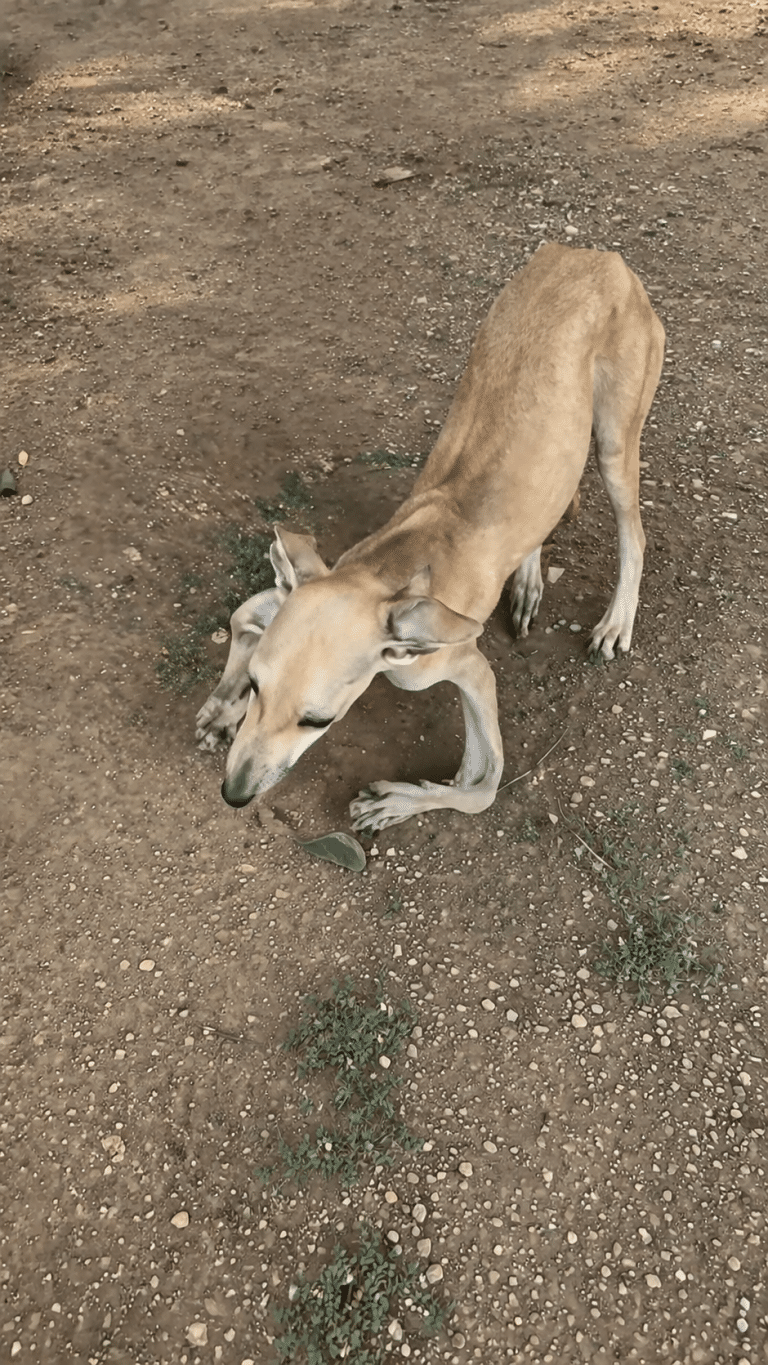
Dash never moved like the other dogs around him.
While they could run across the street without thinking, every step required effort from him.
His front legs curved inward, making balance difficult and turning ordinary movement into something he had to constantly adjust for.
Still, he kept going.
He did not have a safe home waiting nearby.
He did not have someone carrying him when his legs became tired.
He simply learned to move the only way his body allowed.
But life on the streets becomes even harder when walking itself is a challenge.
Reaching food took more effort.
Avoiding danger was more difficult.
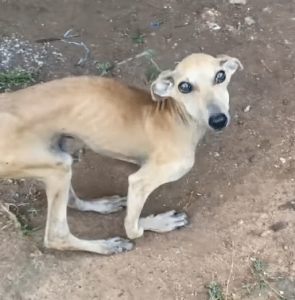
And over time, Dash became thinner and weaker.
Then someone finally noticed that the little dog struggling to move needed more than sympathy.
He needed a real chance.
Every Step on the Street Required Extra Effort
Dash’s leg condition affected even the simplest parts of daily life.
Standing required balance.
Walking required concentration.
Running the way other dogs could was almost impossible.
Yet he continued adapting.
He shifted his weight.
Found ways to move forward.
Stopped when he needed to rest.
Then tried again.
The problem was that the street offered no protection for a dog with limited mobility.
Food might be several blocks away.
Water was never guaranteed.
And if something frightened him, Dash could not simply sprint to safety.
By the time rescuers found him, his body showed how difficult that life had become.
He needed food and rest.
But his legs also required a closer medical evaluation.
Video: Dash Struggled to Stand on Curved Legs—Then Treatment Gave Him a New Way Forward
Rescuers Saw More Than the Way His Legs Looked
When Dash arrived in care, the goal was not to make him look like every other dog.
The important question was whether anything could make movement more comfortable and functional for him.
Veterinary evaluation showed that his front legs needed specialized treatment.
According to the rescue account, a corrective procedure was planned to improve their structure.
This would not be an instant solution.
Dash’s body had been moving in the same unusual pattern for a long time.
Even after treatment, he would need recovery and rehabilitation before anyone knew how much his mobility could improve.
The procedure was only the beginning.
Healing Meant Learning How to Use His Body Differently
After treatment, Dash could not simply get up and start running.
His legs needed time.
So did the muscles that had spent so long compensating for his condition.
Recovery was approached carefully.
Rest protected the healing areas.
Nutrition helped rebuild strength.
And movement was introduced gradually rather than forced.
One of the tools used during rehabilitation was water therapy.
In the water, Dash could practice moving while placing less pressure on his legs.
That allowed him to work on coordination and strength in a more controlled way.
At first, the movements were uncertain.
But Dash kept participating.
Water Therapy Turned Small Movements Into Progress
Dash’s early rehabilitation did not look dramatic.
A few controlled movements in the water.
A short attempt to stand more evenly.
Another session the next day.
Progress came in small pieces.
His balance improved.
His steps began looking steadier.
The work was repetitive, but repetition was exactly what his body needed.
Each session allowed him to practice movement without carrying his full weight in the same way.
Slowly, the pattern began changing.
Dash was not suddenly moving perfectly.
He was simply moving better than before.
And that was enough to keep building on.
His Confidence Grew Alongside His Strength
As Dash became physically stronger, his behavior began changing too.
He spent less time hesitating before moving.
He explored more.
He stayed closer to the people caring for him.
The tired, cautious expression from his early days became less noticeable.
There was more curiosity now.
More interest in what was happening around him.
For a dog who had spent so much energy simply getting from one place to another, having movement become easier opened up new possibilities.
He could investigate.
Follow.
Play.
Do things that had once required too much effort.
Then Came the Moment He Began to Run
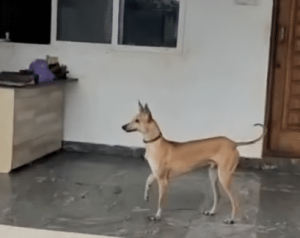
Eventually, Dash did something that would have been difficult to imagine when he was first found.
He ran.
Not necessarily with the exact movement of every other dog.
That was never the point.
What mattered was that he could move fast enough to feel freedom.
He crossed the grass.
He played.
He rolled around comfortably.
His legs were no longer only something he struggled against.
They were carrying him into experiences that had once been out of reach.
The transformation was especially meaningful because it had been built so slowly.
First standing.
Then steadier steps.
Then longer movement.
And finally, running in his own way.
Dash Did Not Need to Become “Perfect” to Have a Good Life
Dash’s story is not about turning a different body into a normal one.
It is about improving what was possible for him.
His legs may never look or function exactly like those of another dog.
That does not prevent him from enjoying life.
He can move.
Play.
Explore.
Rest comfortably.
And stay close to the people who helped him through recovery.
Those are the things that matter most.
The goal was never perfection.
It was comfort, mobility, and the chance to participate fully in his own life.
His Second Chance Was Built One Step at a Time
Dash survived the streets by adapting to a body that made every journey harder.
Then rescuers gave him something he had never had before.
Support.
Veterinary treatment.
Rehabilitation.
Time.
And people willing to celebrate progress even when it came slowly.
His life changed through small victories.
A steadier stance.
A better step.
A stronger session in the water.
A few more feet across the grass.
Until eventually, the dog who once struggled simply to stand was moving freely enough to play.
Dash never needed a dramatic miracle.
He needed someone willing to believe that improvement was possible—
and patient enough to help him reach it one careful step at a time.


